Scallops of Martian ice

Scallops of Martian ice
Click for full image.

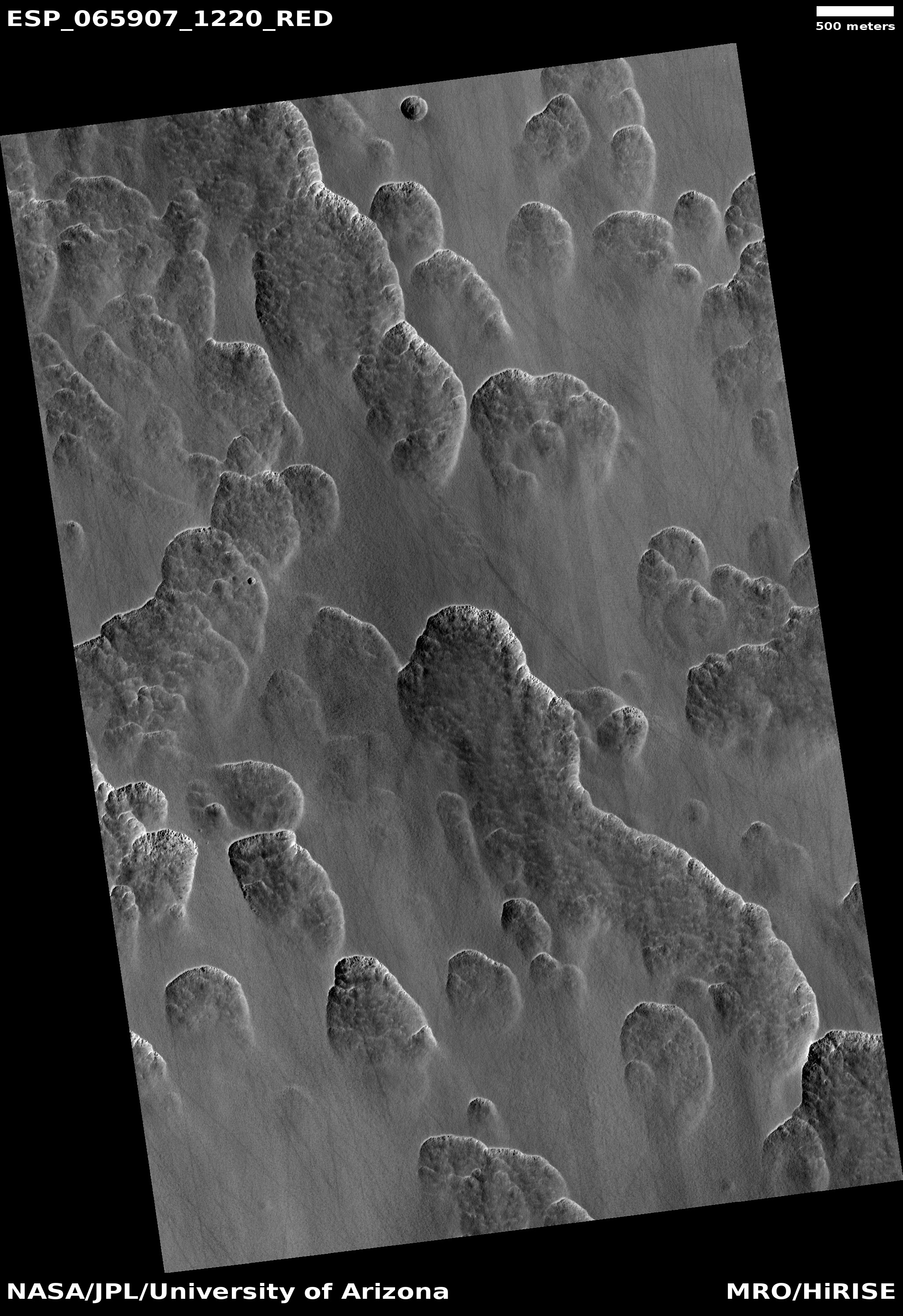
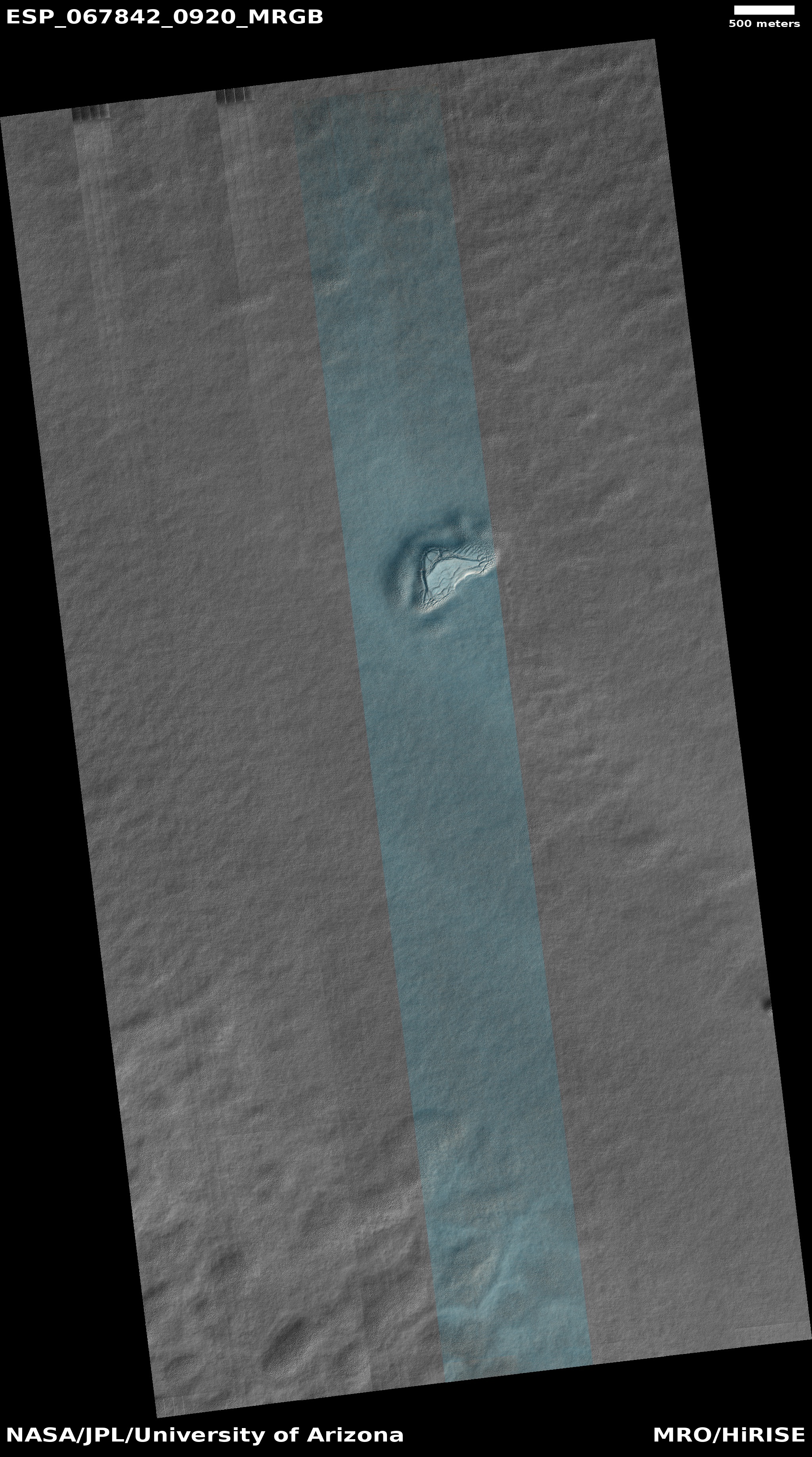
Cool image time! The photo to the right, cropped to post here, was yesterday’s captioned image from the MRO science team. From the caption, written by Shane Byrne of the Lunar and Planetary Lab University of Arizona,

About a third of Mars has water ice just below the dusty surface. Figuring out exactly where is vital for future human explorers. One of the ways scientists do this is to look for landforms that only occur when this buried ice is present. These scallops are one of those diagnostic landforms.

A layer of clean ice lies just below the surface in this image. As the ice ablates away in some spots the surface dust collapses into the hole that’s left. These holes grow into the scallops visible here as more and more ice is lost.

You can see those holes near the top of the scallop’s slopes.
» Read more

0 comments

New hypothesis: Mars didn’t lose water, it got trapped chemically in its crust

Using data from the many orbiters, landers, and rovers sent to Mars, scientists yesterday proposed a new model for the loss of water on Mars, suggesting that instead of escaping through its thin atmosphere it was instead chemically trapped in the planet’s crust.

New data challenges the long-held theory that all of Mars’s water escaped into space

Billions of years ago, the Red Planet was far more blue; according to evidence still found on the surface, abundant water flowed across Mars and forming pools, lakes, and deep oceans. The question, then, is where did all that water go?

The answer: nowhere. According to new research from Caltech and JPL, a significant portion of Mars’s water—between 30 and 99 percent—is trapped within minerals in the planet’s crust. The research challenges the current theory that the Red Planet’s water escaped into space.

First, this is only a model. It proves nothing, and carries many assumptions based on our limited knowledge. We mustn’t accept it at face value.

Second, the first sentence quoted above from this Caltech press release is an example of a trick the scientists have played that our ignorant press has fallen far. What the press release implies superficially is that Mars is now a barren dry place, with little water. Researchers (and readers of Behind the Black) know however that this description is not accurate, that the planet apparently has a lot of water still, only that it is confined as buried ice to latitudes above 30 degrees. Only the equatorial regions appear dry, but not the rest of the planet.

Regardless, this new hypothesis is important if true, as it will help provide an explanation for the Red Planet’s entire geological and climatic history. It might even help solve the mystery of the liquid water that appears to have once existed there, on a planet whose atmosphere is too thin and cold to allow for such a thing.

1 comment

A cracking Martian glacier?

A cracking Martian glacier?
Click for entire image.

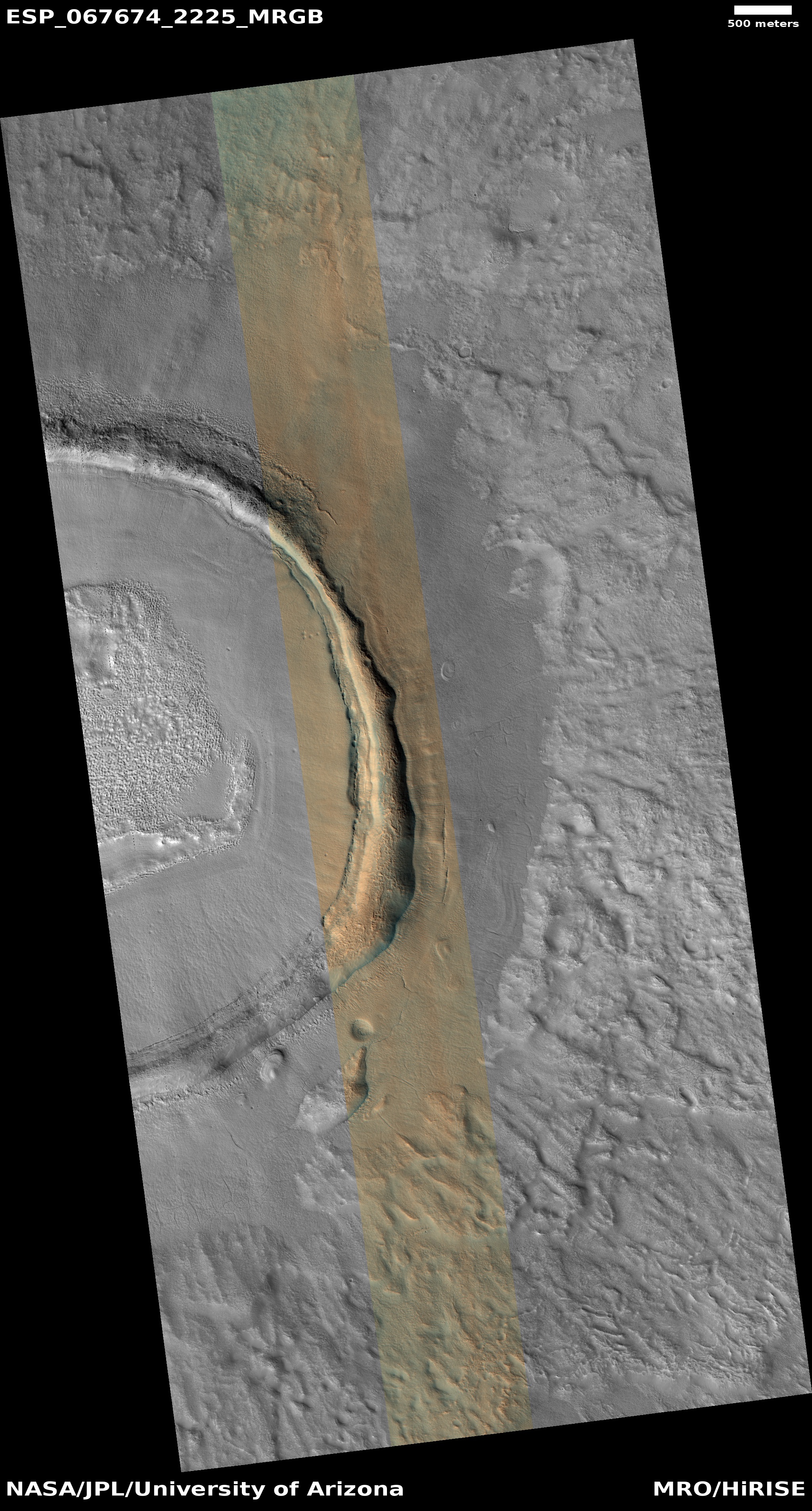
Cool image time! The photo to the right, cropped to post here, was taken on December 4, 2020 by the high resolution camera on Mars Reconnaissance Orbiter (MRO)

I have cropped it to show at full resolution the area that contains what the scientists apparently consider the most interesting feature in this image, which they have labeled as “pits forming lines.” These are the vertical cracks and strings of holes that can be seen in this glacier-like flow. In addition, you can see that the cracking is not just vertical, but also extends out in horizontal directions, though the widest cracks are all vertical.

The next image below, which is a lower resolution crop of the full photo, shows a wider view to provide a better picture of the glacier itself.
» Read more

2 comments

Hubble’s wide field camera returns to operation

Though the Hubble Space Telescope returned to science operations on March 12th after going into safe mode, its wide field camera did not.

Engineers however now report that they have successfully restored the camera to operations as well. The reason for the delayed restoration exemplifies Hubble’s aging status.

Analysis showed that voltage levels in WFC3 power supplies have slowly decreased over time as their electronics aged. The electronics experience colder temperatures when the hardware is turned off in safe mode. This factor coupled with the power the instrument components draw as they are turned back on contributed to the small voltage fluctuation that suspended WFC3 recovery operations. Further detailed analysis indicated that it would be safe to slightly reduce the low voltage limit to avoid a future suspend, and it would be safe to recover the instrument to its science state.

The instrument has now been safely recovered. Standard calibration of the instrument and other pre-observation activities will be conducted this week.

All the telescope’s equipment has been adjusted in recent years to deal with the varying ages of its instruments and its main structure. For example, this wide field camera was installed during the last shuttle serving mission in 2009, and is therefore one of Hubble’s newest components. It however is now more than a decade old, and thus needs careful handling to function properly.

Other components are far older, such as the primary motor to open and close the telescope’s “lens cap”. That failed during this safe mode, forcing engineers to switch to a back up motor to control the cap. Whether they can recover that primary motor is presently unclear, though unlikely.

Expect more such issues in the coming years.

7 comments

Today’s blacklisted Americans: 30,000 videos banned by YouTube for stating COVID conclusions that disagree with health authorities

BANNED!

They’re coming for you next: Google’s YouTube has now blacklisted more than 30,000 videos simply because they stated conclusions relating to COVID-19 vaccines that either contradicted or challenged opinions or conclusions held by the World Health Organization or other governmental health authorities.

The headline is only listing the videos removed by YouTube because they state conclusions relating to various coronavirus vaccines that YouTube disagrees with. It turns out this is only the tip of the iceberg.
» Read more

27 comments

How the blobby craters on Mars help map the planet’s existing accessible water

Distorted blobby crater rim in Utopia Planitia
Click for full image.

Today’s cool image on the right, rotated, cropped, and reduced to post here, is part of a series of cool images that have repeatedly shown the blobby and squishy look of crater impact sites in the Martian northern lowland plain dubbed Utopia Planitia. Taken on January 2, 2021 by the high resolution camera on Mars Reconnaissance Orbiter (MRO), it shows the southeast rim of a very distorted crater that appears filled with glacial material and is also surrounded by an apron of smooth material.

At 42 degrees north latitude, it is somewhat expected to find evidence of glacial-like features in such a crater. Moreover, throughout the 30 to 60 degree mid-latitude band in Utopia Planitia are found numerous such blobby craters (other examples found here, here, and here), all suggesting that the impact occurred on a flat plain with a layer of water ice close to the surface. The heat of the impact melted that ice layer. In such a circumstance, the crater rims were easily deformed because as liquid water (for a short time) it could flow into any number of shapes.

At least that’s my theory. According to Colin Dundas of the U.S. Geological Survey’s Astrogeology Science Center in Arizona,

The exact processes that create the patterns are still debated. The flattened/degraded rims are not necessarily related to this morphology, as such craters can have sharp rims, so they may relate to post-impact modification.

In other words, later erosion after the crater formed could have rounded the rim and maybe even distorted it from a circle.

Regardless, the processes that made this crater rim look as it does were clearly widespread, as shown in the wider view below, provided by the context camera on MRO.
» Read more

2 comments

Hubble about to resume science operations even with new issues

Engineers have fixed the computer software issue that caused the Hubble Space Telescope to go into safe mode this week, and are preparing it to return to full science operations.

It appears the problem was caused by a software upgrade that caused a conflict.

More serious however was this problem, which could have damaged the telescope beyond repair had it had been randomly pointed at the Sun during safe mode.

In entering safe mode on Sunday, however, the team discovered that the aperture door located at the top of the telescope failed to automatically close. This door is a safeguard designed to keep the Sun’s damaging light and heat out of the telescope’s interior, protecting its sensitive instruments and their surroundings. It serves as a safety net if Hubble accidently points in the direction of the Sun due to an error or hardware problem.

…The team has looked at spacecraft engineering data, run various tests, and verified that the door did indeed remain open despite the commands and power being sent to close it. Additional attempts to move the door by sending commands from the ground to its primary motor also failed to make the door move. However, the same commands sent from the ground to its backup motor did indicate movement, and that motor is now set as the primary motor. The team is looking at options to further reduce any associated risk.

It appears the primary motor that moves the door has failed. Fortunately there is a backup motor, but this is just one more item where the telescope has lost redundancy. We are very lucky that during safe mode the telescope didn’t end up pointing at the Sun, even for a very short time, for that would have ended Hubble’s operation for good. I suspect the safe mode software includes protections against that occurrence, but the possibility nonetheless existed.

3 comments

Curiosity faces the mountains

A cropped section from Perseverance's 1st panorama
A cropped section from Perserverance’s 1st panorama.
Click for full image.

Though the present excitement over the spectacular images and sounds coming down from Perseverance is certainly warranted, what must be understood is that this rover is presently only at the beginning of its journey, and is thus sitting on relatively boring terrain, from a merely visual perspective. The scientists might be excited, but to the general public, all we really are seeing is a flat dusty desert with some scattered rocks on the floor. In the far distance can be seen some hills and mountains (Jezero Crater’s rim), but they are very far away.

Curiosity, which the press and the public has largely forgotten about, is actually just beginning what will likely be the most breath-taking part of its journey. As I noted in my last rover update last week, Curiosity is now at the very base of Mount Sharp, and is about to enter the mountain’s canyons and initial slopes. For its past eight-plus years of roving it has been on the flat floor of Gale Crater, followed by some weaving among the smallest foothills of Mount Sharp. The views have been intriguing and exciting from a research perspective, but hardly breath-taking from a picture-taking point of view.

That is now changing. The picture below, taken by Curiosity just this week, gives us a taste of what is to come.
» Read more

11 comments

A proposal to rebuild Arecibo as a better radio telescope

Even as the National Science Foundation (NSF) proceeds with the disassembly of the destroyed Arecibo radio telescope in Puerto Rico, some astronomers are proposing that a new radio telescope be built in its place, with a new design that will not require the instrument platform floating above a single dish.

Here’s the idea as outlined in a white paper circulated by Roshi and his colleagues: The Next Generation Arecibo Telescope would pack hundreds, maybe even more than 1,000 smaller radio dishes into the same space now occupied by the single 305-meter dish. Those smaller antennas would combine forces to act like a single larger telescope (no suspended instrument platform required).

Ideally, those dishes would be on a single, tiltable platform to access more of the sky from the Arecibo site; it’s possible multiple platforms could do the same.

The revamped telescope would have twice the sky coverage of the legacy dish, 500 times the field of view in individual images, at least double the sensitivity, and five times the radar power.

The cost for this new radio telescope is presently estimated to be about half a billion. Considering that the NSF didn’t have the money to operate the old Arecibo telescope, which was why it wasn’t properly maintained and collapsed, I doubt it has the cash to build this replacement. Congress, which likes printing money it doesn’t have, might step in and fund it, but if so that will only add to the national debt that is certainly going to cause the bankruptcy of the nation at some point in the future, a point that is getting closer and closer with each new trillion that Congress nonchalantly spends, on almost a monthly schedule.

4 comments

Strange ridge ripples on the windswept plateau above Mars’ biggest canyon

Strange ridges on Mars
Click for full image.

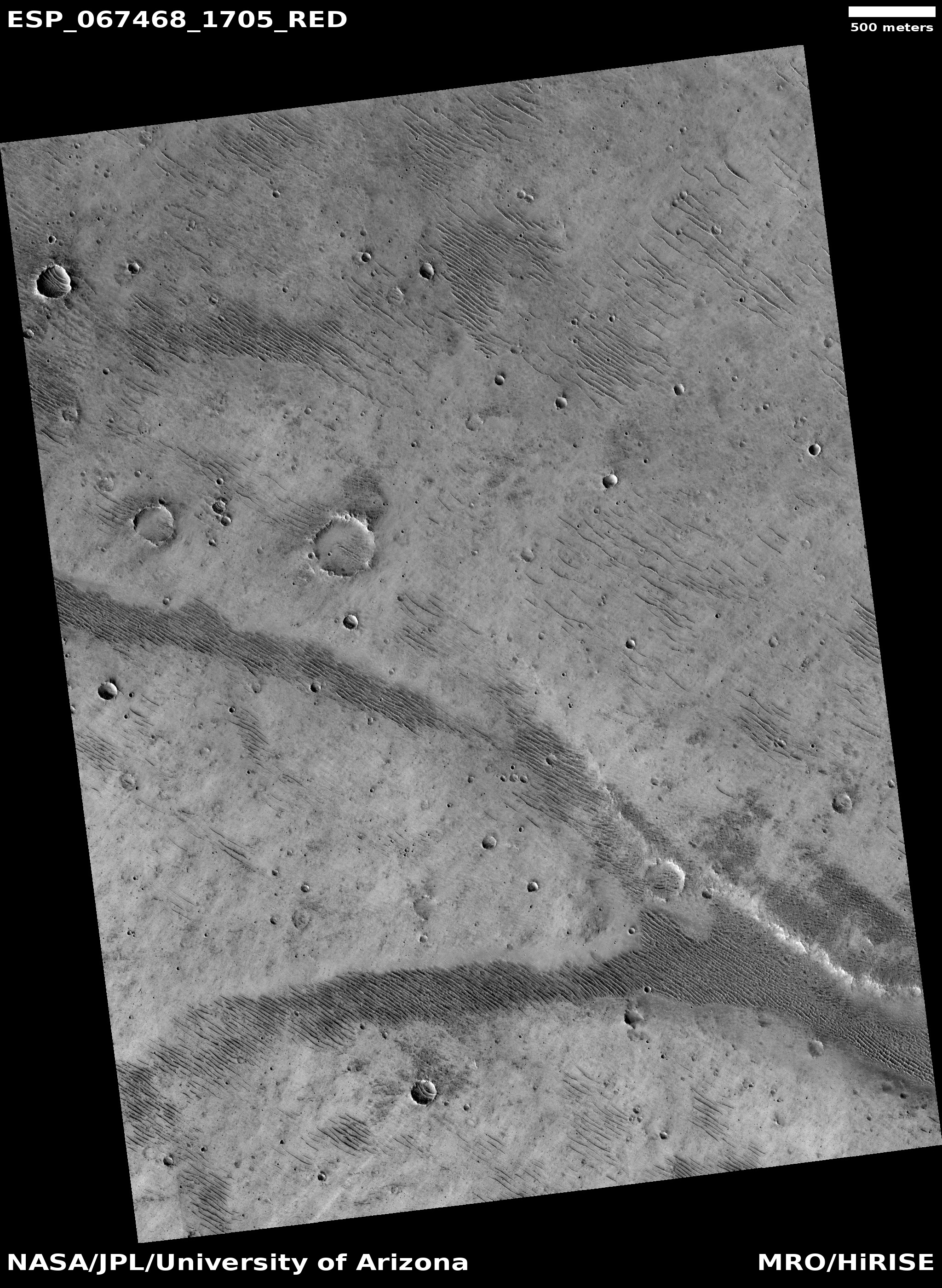
Today’s cool image is once again another of what I dub a “what the heck?” photo. The picture to the right, cropped to post here, was taken on December 17, 2020 by the high resolution camera on Mars Reconnaissance Orbiter (MRO) and captures some very strange ridges on the plateau above Mars’ biggest canyon, Valles Marineris.

The image, labeled merely as a “terrain sample,” was taken not as part of any specific research project but scheduled by MRO’s science team in order to maintain the camera’s temperature. When they do this they try to take pictures covering something interesting, but often it is a potshot that sometimes shows little of interest.

In this case the photo shows something very strange. The ridges in the sample are packed into one area only, but if you look at the full image you will see that they are also scattered about randomly and sometimes isolated on the flat plains surrounding this spot.

Interestingly, these ridges resemble the first “What the heck?” image I ever posted in 2019. That photo was located at about the same elevation as these ridges, but due west in the volcanic plains near Mars’s giant volcanoes and just off the western edge of the overview map below.
» Read more

2 comments

First results from UAE’s Al-Amal/Hope Mars orbiter

First data from Al-Amal
Click for full image.

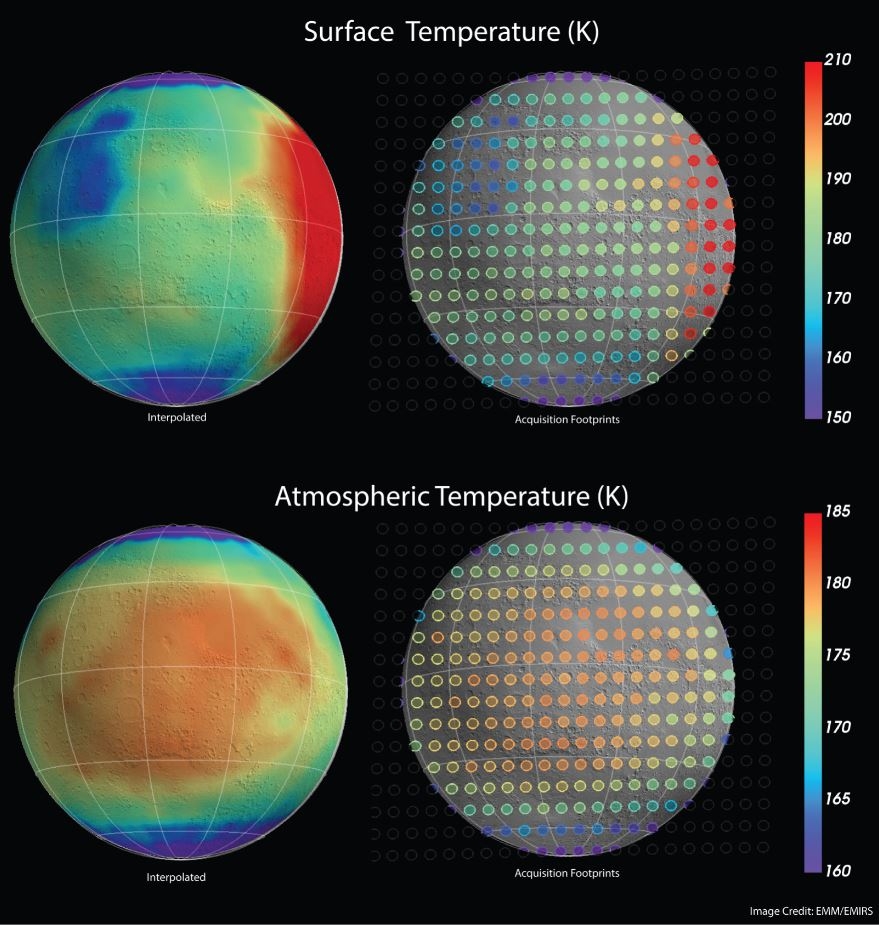
The first science results from the United Arab Emirates Al-Amal Mars orbiter (“Hope” in English) have been released by the American universities operating one instrument.

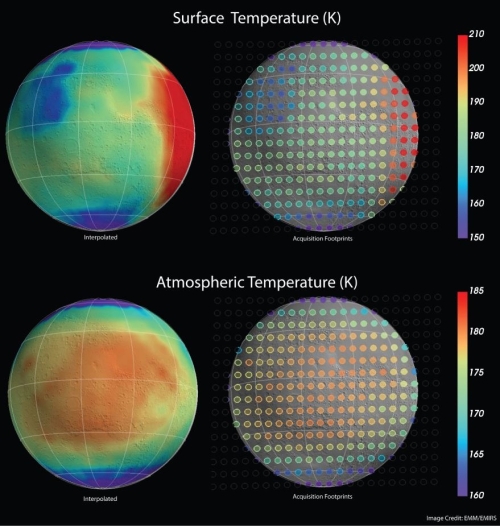
The image to the right shows that data. The right globes show the areas of actual temperature data for both the Martian surface and atmosphere, with the left globes extrapolating that data across the entire planet.

The purple-green-blue hues show that the measurements were taken of the Martian nightside, although dawn on the planet can be seen on the right-hand side of the surface temperature image, as depicted by the red hues. Features such as Arabia Terra, which has cold nighttime temperatures, can be observed in the upper left portion of the surface temperature data, depicted by the blue and purple hues.

“EMIRS [the infrared spectrometer] is going to acquire about 60 more images like this per week once we transition into the primary science phase of the Emirates Mars Mission,” said EMIRS Instrument Scientist Christopher Edwards, who is an assistant professor and planetary scientist at [Northern Arizona University]. “We’ll use these images and sophisticated computer programs to build up a complete global, daily understanding of the Martian atmospheric components, like dust, water ice, water vapor and atmospheric temperature.” [emphasis mine]

The highlighted words above illustrate the true nature of this U.S./UAE joint mission. Right now the spacecraft is being operated by Emirate engineers in the UAE, but the spacecraft and its instruments were really built by U.S. universities, paid for by the UAE. As such, those American universities remain in charge of running those instruments, though UAE students are also being used to do that work as part of their education.

None of this is to denigrate the effort by the UAE. It used its financial resources to buy the expertise of American universities and companies to build this Mars orbiter, but did so with the express requirement that those American universities and companies also educate and train its people in such work.

That deal however once again illustrates the value of private enterprise and freedom. The UAE wanted to teach its people how to fly a planetary space mission. American universities had the knowledge to do it. The former then bought the skills from the latter, while the latter then got a science mission for free.

A match made in heaven with both benefiting marvelously.

1 comment

A iceberg of water ice floating on a Martian dry ice sea

Ice mesa near Mars' south pole
Click for full image.

British biologist John Haldane once once wrote, “The universe is not only queerer than we suppose, but queerer than we can suppose.”

Today’s cool image to the right, cropped to post here, is a fine example of Haldane’s words. It was taken on January 15, 2021 by the high resolution camera on Mars Reconnaissance Orbiter of a single lone mesalike feature sticking up in a flat expanse of Mars’ south polar dry ice/water ice cap.

I emailed Shane Byrne of the Lunar and Planetary Lab University of Arizona, who had requested the photo, to ask him what he thinks we are looking at. His response:

This region has a thick layer of CO2 ice sandwiched between water ice that’s above and below. CO2 ice is denser than water ice so I think a fragment of water ice of the underlying layer has risen up through the denser CO2 ice that covers this area (what geologists call a diapir).

Byrne also admits this remains merely “just a wild theory,” not yet confirmed.

Assuming this theory to be right, in a sense then this mesa is not really a mesa at all but an iceberg of water, floating not in a saltwater liquid ocean as on Earth but on a frozen sea of dry ice. Talk about queer! The wider shot below, taken by MRO’s context camera, illustrates how isolated this water iceberg is on that dry ice sea.
» Read more

4 comments
1 238 239 240 241 242 729