
Engineers create the blackest material yet
Researchers have created the blackest least reflective material ever made, using as inspiration the scales on the all-white cyphochilus beetle.
Researchers have created the blackest least reflective material ever made, using as inspiration the scales on the all-white cyphochilus beetle.
Astronomers have assembled the largest single image of the entire Milky Way ever taken.
It is 46 billion pixels across.
The amazing view of the Milky Way was built out of 268 individual views of the galaxy that includes the sun and the Earth, captured night after night over the course of five years with telescopes in Chile’s Atacama Desert. Astronomers at Ruhr-Universität Bochum used the data to examine stars whose brightness changes over time — and the image portrays more than 50,000 new objects with variable brightness that have never been recorded before.
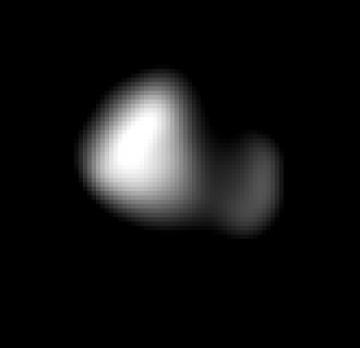
The uncertainty of science: The New Horizons science team has released their best image of Pluto’s moon Kerberos, finding it to be nothing like what they expected.
Before the New Horizons encounter with Pluto, researchers had used Hubble Space Telescope images to “weigh” Kerberos by measuring its gravitational influence on its neighboring moons. That influence was surprisingly strong, considering how faint Kerberos was. They theorized that Kerberos was relatively large and massive, appearing faint only because its surface was covered in dark material. But the small, bright-surfaced, Kerberos now revealed by these new images show that that idea was incorrect, for reasons that are not yet understood.
Instead, Kerberos is much smaller than expected, and its surface is bright, suggesting it is covered by relatively clean ice. It is also double lobed, kind of like Comet 67P/C-G.
The uncertainty of science: An analysis of data from the Hubble Space Telescope and Kepler suggests that the Earth might be one of the first planets in the universe to harbor life.
I label this result uncertain because it is based on what I consider to be a very poor sampling of exoplanets as seen by Kepler. Kepler might have found a lot of exoplanets, but the numbers are still small and skewed by the limited types of suns observed and the short time frame of its observations. Moreover, the data from Hubble is rich, but also quite small, leaving great uncertainties for all of these conclusions.
At the same time, this conclusion might help explain why, after almost a half century of looking, we have yet to detect any evidence of radio communications from any other civilizations. You would think we would have detected something by now. Maybe they don’t exist, and we are the first.
In a paper [pdf] presented this week at a lunar science conference, scientists announced the identification of more than 200 new impact craters on the Moon from Lunar Reconnaissance Orbiter (LRO).
As of 1 May 2015, we have scanned and classified changes in 14,182 NAC temporal pairs using our automated change detection tool leading to the discovery over 200 impact craters ranging in size from 1.5 to 43 m. In addition, we also identified thousands of other surface changes, including about 44,000 low reflectance splotches, 3,500 high reflectance splotches, 850 mixed reflectance splotches, [and] 1 Chinese lander/rover.
They think the splotches are created from impacts too small to see with LRO.
Hat tip James Fincannon.
A comparison of satellite data between 1997 and 2015 strongly suggests that an El Niño as strong as the one in 1998 is developing in the Pacific.
The animation is below the fold. Climate scientists have been predicting a strong El Niño for the last few years, with little success. It might finally be happening, however, and if so, it should at least help alleviate the drought in California.
Egyptian researchers have developed what they think could be a cheap and easy way to desalinate sea water.
In a paper published last month in the journal, Water Science & Technology, researchers Mona Naim, Mahmoud Elewa, Ahmed El-Shafei and Abeer Moneer announced that they have developed a new way to purify sea water using materials that can be manufactured easily and cheaply in most countries, and a method that does not rely on electricity.
The technology uses a method of separating liquids and solids called pervaporation. Pervaporation is a simple, two-step process – the first step involves filtering the liquid through a ceramic or polymeric membrane, while the second step requires vaporizing and collecting the condensed water. Pervaporation is faster, cleaner and more energy efficient than conventional methods, not least because the heat required for the vaporization stage does not necessarily have to be electrically generated.
The technology is not yet proven, but if it bears fruit, many of the world’s water problems will soon vanish.
The uncertainty of science: A new study has raised questions about the methods scientists have used to date the late heavy bombardment in the early solar system.
A study of zircons from a gigantic meteorite impact in South Africa, now online in the journal Geology, casts doubt on the methods used to date lunar impacts. The critical problem, says lead author Aaron Cavosie, a visiting professor of geoscience and member of the NASA Astrobiology Institute at the University of Wisconsin-Madison, is the fact that lunar zircons are “ex situ,” meaning removed from the rock in which they formed, which deprives geoscientists of corroborating evidence of impact. “While zircon is one of the best isotopic clocks for dating many geological processes,” Cavosie says, “our results show that it is very challenging to use ex situ zircon to date a large impact of known age.”
The problem is that the removal of the zircon from lunar rocks changes the data enough to make the dating unreliable. The method might work on Earth, but the dating done on Apollo samples can be questioned. This means that much of the supposed history of the solar system, centered on what planetary scientists call the late heavy bombardment, a period 4 billion years ago when the planets were being hit by innumerable impacts as they cleared the solar system of its dusty debris disk, might not have happened as dated from lunar samples. If so, our understanding of when that bombardment ended and life began to form on Earth might be considerably incorrect.
The solution? Get to the planets in person, where you can obtain many samples in situ and thus gather a much deeper understanding of the geology.
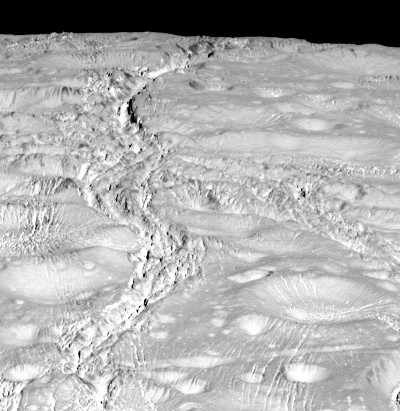
The Cassini science team has released the first image from Wednesday’s flyby of the Saturn moon Enceladus.
Scientists expected the north polar region of Enceladus to be heavily cratered, based on low-resolution images from the Voyager mission, but the new high-resolution Cassini images show a landscape of stark contrasts. “The northern regions are crisscrossed by a spidery network of gossamer-thin cracks that slice through the craters,” said Paul Helfenstein, a member of the Cassini imaging team at Cornell University, Ithaca, New York. “These thin cracks are ubiquitous on Enceladus, and now we see that they extend across the northern terrains as well.”
To see more you can browse the raw images here.
The next flyby later this month will be especially interesting as they will dip to within 30 miles of the surface.
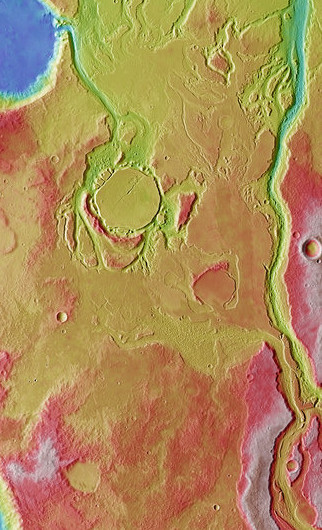
A newly released image from ESA’s Mars Express orbiter shows that catastrophic flooding — caused by ice melted from volcanic activity — created the Mangala Valles channels on Mars.
The perspective image on the right shows the topography of the region, with low points indicated in blue and high points by red. The channel along the right side of the image is Mangala Valles itself, though you can also see additional flood channels to the left of it passing around and through a large crater whose floor now stands above the surrounding terrain caused by the erosion of the rim plus the deposit of sediment inside the crater during the flooding.
I have a soft spot for Mangala Valles. When it was first photographed by the first orbiter missions to Mars in the early 1970s I was struck by its river-like appearance and striking topography. I therefore placed my Martian colony here in one of my efforts at science fiction writing. I figured it a good location for colonization, as there would likely be water and, by roofing over the deep canyon, a colony could be built relatively easily.
Better locations on Mars have since been found, but the location still intrigues me.
An evening pause: Rocco had suggested this short video about the joys of going out and digging clams. I prefer the video below, of a real clam doing its own digging, because it shows us something we normally don’t see and that is really amazing. Who would have thought that a clam could bury itself so quickly, with a single digging foot?
Observations using Kepler have uncovered a star whose light fluctuations can only be explained in two ways.
First,
If another star had passed through the unusual star’s system, it could have yanked a sea of comets inward. Provided there were enough of them, the comets could have made the dimming pattern. But that would be an extraordinary coincidence, if that happened so recently, only a few millennia before humans developed the tech to loft a telescope into space. That’s a narrow band of time, cosmically speaking.
Second? Maybe the star’s light is being blocked by a swarm of megastructures built by an alien civilization. They intend to look for radio emissions from the star in wavelengths associated with technology to see if this theory has any possibility.
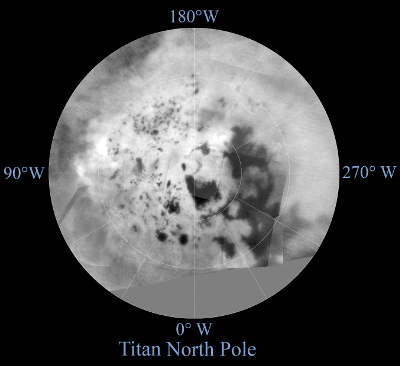
The Cassini science team has released new maps of Titan, including new maps of both poles, assembled from images taken during the 100 flybys that the spacecraft has made of the moon since it arrived in orbit around Saturn.
The scale is rough, just less than a mile at best, and there is no topographic information because the thick atmosphere allows for no strong sunlight or shadows. The images show differences in surface brightness, which does tell us where Titan’s dark methane lakes are.
This is likely the best we will get of Titan for decades, until another spacecraft is sent there.
As Cassini approaches the end of its decade-long mission at Saturn it will begin its last series of flybys of the moon Enceladus starting October 14.
Images will arrive a day or two afterward. The last two flybys will take place in late October and then in December, with the second October flyby getting closest, only 30 miles from the surface.
Beginning next year they will shift the spacecraft’s orbit so that it can get a better look at Saturn’s poles during its last two years. In that orbit flybys of the moons cannot be done.
Using the Hubble Space Telescope astronomers have compiled a new set of maps of Jupiter, showing changes in the gas giant’s bands and spots, including the Giant Red Spot.
The scientists behind the new images took pictures of Jupiter using Hubble’s Wide Field Camera 3 over a ten-hour period and have produced two maps of the entire planet from the observations. These maps make it possible to determine the speeds of Jupiter’s winds, to identify different phenomena in its atmosphere and to track changes in its most famous features.
The new images confirm that the huge storm, which has raged on Jupiter’s surface for at least three hundred years, continues to shrink, but that it may not go out without a fight. The storm, known as the Great Red Spot, is seen here swirling at the centre of the image of the planet. It has been decreasing in size at a noticeably faster rate from year to year for some time. But now, the rate of shrinkage seems to be slowing again, even though the spot is still about 240 kilometres smaller than it was in 2014.
My original post about NOAA’s October update to its monthly tracking of the Sun’s sunspot cycle contained an incorrect graph. For reasons I do not understand, the first graph they posted did not include the data for September, thus creating for me the illusion that little had changed in September. I am now posting the correct graph here, below the fold, with annotations to give it context.
In September numbers showed a slight jump in sunspot activity, though once again nothing so significant as to change the overall trends. Moreover, the correction doesn’t change what I wrote previously in any way: the rate of decline seems to have transitioned down from the 2009 prediction (red curve) to the 2007 weak prediction (lower green curve). This doesn’t real mean much, as the sunspot number can still vary up and down considerable before we reach solar minimum in two or three years.
A moment of terror: During the first week of successful operation, there was an initial moment of terror when the engineers checking out Astrosat, India’s first space telescope, thought the spacecraft was unable to point at its target accurately.
During the first orbit, there was a difficulty in detecting this Crab Nebula as the satellite happened to pass through the South Atlantic Anomaly (SAA) region when Crab was in the field of view. SAA avoidance zone was deliberately kept wide to protect the instruments, and detectors were switched OFF in this interval during the initial days of Astrosat operation. When all the data were systematically analysed and data were selected based on the availability of Crab in the detector field of view, one could see the Crab emerging from Earth’s shadow (Fig 3).
Using the Crab Nebula as Astrosat’s first target, the check-out has been proceeding well, with full research operations expected to begin in the next few weeks.
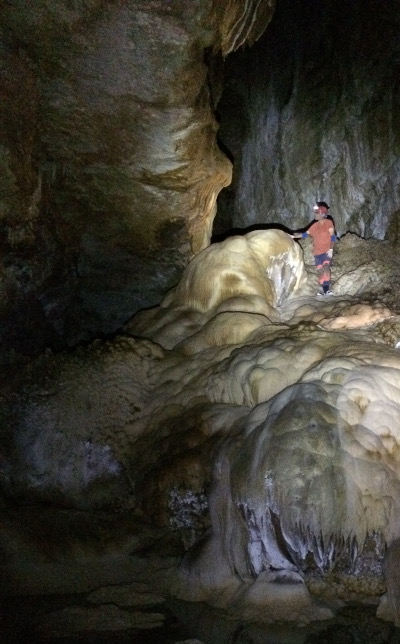
The picture on the right will explain why I have been silent posting since Friday. I have just returned with five friends from three days of caving in New Mexico, doing some wild caving plus my first visit to Carlsbad Caverns since 1992, guided by a local caver who has been helping me with my cave survey project in Arizona.
New Mexico probably has the largest concentration of truly large and spectacularly decorated caves in the entire world. I’ve caved there previously, but this was my first trip driving from Arizona. We went to two wild caves, one of which I had never visited before and a second that I had seen during my 1992 trip. The picture shows me in the latter, standing above a large clear pool near the back of the cave with some giant flowstone speleothems all around me.
The new cave contained a room dubbed Speleogasm, because every formation there, of which there are too many to count, is completely festooned with helectites and sodastraws in a mad protrusion that no geologist can as yet explain. Nor is there any way to describe it adequately or photograph it successfully. To witness it you need to go, requiring the specialized caving skills that include the techniques and equipment required to rappel and climb a 40 foot rope.
As always, the advantages of learning how to do this successfully is the reward of seeing things that few ever see. It is why engineers and scientists strive so hard to get planetary probes to distant planets. And why humans want to travel to the planets. For me, getting inside a remote and beautifully decorated cave will just have to do.
Do you own red-blue 3-D glasses? Get them out and go to this link. Rosetta scientists have created a 3-D image of Comet 67P/C-G, including the jets of material shooting out from its surface.
[C]reating a 3d anaglyph of dynamic events like this is notoriously difficult: often the jets are too faint or their duration is too short to find two high-quality images taken several minutes apart that are suitable to pair together to create this type of view. However, the OSIRIS team got lucky with this particular event, capturing two images separated by about two-and-a-half minutes.
The image shows a bright, collimated jet embedded in a broader emission structure. The three dimensional perspective also reveals the conical shape of the jet and that the collimated feature is emitted towards the observer.
Scientists studying the rounded rocks on the surface of the asteroid 25143 Itokawa, photographed by the Japanese probe Hayabusa, have concluded that sunlight combined with the asteroid’s tiny gravity caused them move and thus erode themselves.
As sunlight bounced off the orbiting boulders, photons provided a tiny push. As they radiated back outward as heat, they triggered a recoil effect that added a gentle spin. Over time, these slowly spinning boulders bumped into each other with enough force to wear their edges into smooth surfaces.
Warning! This is only a model, and thus could very well be wrong. It is reasonable however and worth considering as a factor in studying the early formation history of asteroids.