Coral islands defy sea level rise

The uncertainty of science: Despite having some of the highest rates of sea level rise in the past century, the 29 islands of Funafuti Atoll in the Pacific show no signs of sinking.

Despite the magnitude of this rise, no islands have been lost, the majority have enlarged, and there has been a 7.3% increase in net island area over the past century (A.D. 1897–2013). There is no evidence of heightened erosion over the past half-century as sea-level rise accelerated. Reef islands in Funafuti continually adjust their size, shape, and position in response to variations in boundary conditions, including storms, sediment supply, as well as sea level.

Be aware as well that the cause of the rise in sea level here is not clearly understood. It could be the global warming we have seen since the end of the Little Ice Age of the 1600s, or other more complex factors.

1 comment

Nature ignores the elephant in the room

In an article on the possibility that a section on the edge of the Antarctica icecap might be melting, the journal Nature illustrated some of the political agenda-driven science that corrupts climate science and the journalism that covers the field by never noting that the icecap is presently setting size records.

Read the article at the link. Though they never mention global warming, they hint at it repeatedly by noting the arrival of new warm ocean currents. More importantly, they fail to place the whole issue in context by never noting the record-setting growth of the icecap in recent years. For a section of the icecap fringe to suddenly accelerate its “surge to the sea five years ago” during a period when the icecap has been expanding in an unprecedented manner is hardly surprising, and is hardly an indication of global warming. Instead, it suggests the icecap is behaving exactly as one would expect, shedding excess ice as it expands.

By not mentioning the icecap’s recent growth the article allows an uneducated reader to come the incorrect conclusion: that only global warming could cause this melting. It also avoids revealing the complexity and uncertainties that surround this climate research.

6 comments

Balanced rock on Comet 67P/C-G

balanced rock on Comet 67P/C-G

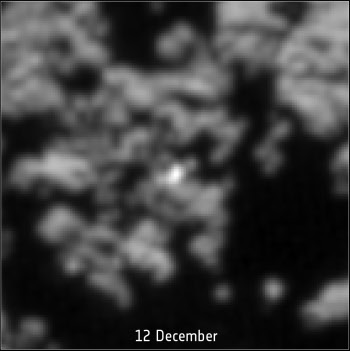
Cool image time! Rosetta’s high resolution camera has discovered a group of balancing rocks on the surface of Comet 67P/C-G.

The image on the right, cropped and brightened by me, shows the most dramatic of these rocks. The scientists are as yet uncertain on how these rocks got to where they are.

“How this apparent balancing rock on Comet 67P/C-G was formed is not clear at this point,” says OSIRIS Principal Investigator Holger Sierks from the Max Planck Institute for Solar System Research (MPS) in Germany. One possibility is that transport processes related to cometary activity played a role, causing such boulders to move from their original site and reach a new location.

It is also possible that the rocks were sitting on a base of ice that simply evaporated away over time.

0 comments

New Horizons spots all of Pluto’s 5 known moons

New Horizons has now been able to image all of Pluto’s known moons.

Pluto’s five known satellites are Charon, Hydra, Nix, Kerberos and Styx. At 648 miles (1,043 km) in diameter, Charon is nearly half as wide as Pluto itself, but the other four moons are minuscule. Kerberos and Styx, for example, are thought to be just 4 to 13 miles (7 to 21 km) and 6 to 20 miles (10 to 32 km) wide, respectively.

That the spacecraft has been able to spot them all this soon bodes well for what it will see when if flies past Pluto in July.

1 comment

Is the dark material along Europa’s long surface fissures sea salt?

The uncertainty of science: By creating what they call “Europa in a can” here on Earth, scientists have determined that the dark material that appears to have seeped out of Europa’s long linear fractures might be sea salt from the underground ocean, turned brown by the harsh radiation hitting the moon’s surface.

This result is quite intriguing, but the only thing certain about it is its uncertainty. The only way we will know what this brown material really is will be to go there again with much better equipment and study the material itself

1 comment

Prototype variable star has a previously unknown companion

The uncertainty of science: The star that gave its name to the class of variable stars called Cepheid variables — used by astronomers to measure distances to nearby galaxies — has after more than 200 years of study been suddenly found to be a binary system.

Delta Cephei, prototype of the cepheids, which has given its name to all similar variable stars, was discovered 230 years ago by the English astronomer John Goodricke. Since the early 20th century, scientists have been interested in measuring cosmic distances using a relationship between these stars’ periods of pulsation and their luminosities (intrinsic brightness), discovered by the American Henrietta Leavitt. Today, researchers from the Astronomical Observatory of UNIGE, Johns Hopkins University and the ESA show that Delta Cephei is, in fact, a double star, made up of a cepheid-type variable star and a companion that had thus far escaped detection, probably because of its low luminosity. Yet, pairs of stars, called binaries, complicate the calibration of the period-luminosity relationship, and can bias the measurement of distances. This is a surprising discovery, since Delta Cephei is one of the most studied stars, of which scientists thought they knew almost everything. [emphasis mine]

This discovery illustrates the shaky foundation of a great deal of astronomical research. The presence of a companion is an additional variable that could very significantly skew the relationship between the stars’ pulses and its luminosity, thus making the use of this data to determine distance much less reliable. This in turn could have a significant effect on the present estimate of the expansion rate of the universe, which in turn could have a significant effect on the theories of dark energy. Moreover, if the past distance estimates to many objects are wrong than what we know about those objects is far less certain.

1 comment

Sunset on Mars

sunset on Mars

Cool image time! The image above is not a sunset over the Blue Ridge Mountains of Tennessee. It is a beautiful blue sunset on Mars, taken by Curiosity from Gale Crater.

The image is the first sunset imaged by Curiosity in color, and is calibrated to match what the human eye would see.

Meanwhile, the rover’s journey continues, with a slight detour to check out an interesting hillside.

6 comments

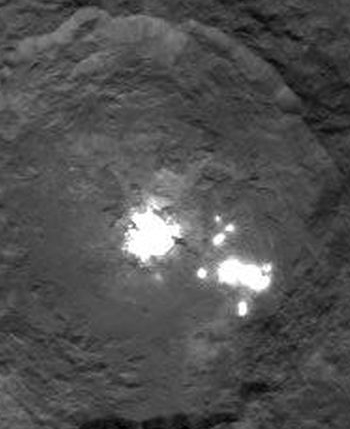
New images of Dawn’s double bright spot

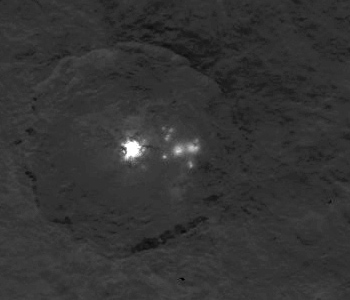
The double spot on Ceres

Cool image time! Dawn has released a new animation made from images taken in early May, showing more details of the dwarf planet’s double bright spot.

As they note at the link, the double spot is now “revealed to be composed of many smaller spots.” As they also add, “Their exact nature remains unknown.”

Dawn’s engineers are now beginning to ease the spacecraft down to its survey orbit, about 2,700 miles above the surface.

1 comment

Scientist abandons research due to protests and lack of support

The fascists win again: Tired of the constant abuse from animal rights activists as well as the unwillingness of his institution and colleagues to support him, a researcher has decided to abandon his neurology work.

The researcher was cleared of any wrong-doing in his treatment of his research monkeys. Nonetheless, he has written a letter to a number of scientists who did support him, explaining his decision.

“I am no longer willing or able to accept the never-ending stream of abuse from animal activists toward myself and my co-workers while seeing them encouraged to increase their aggressive activities by the tolerance and very slow reactions of scientific organizations. There is a clear lack of consequences for illegal actions such as infiltration, violation of privacy, theft of documents, and even intentionally caused distress to animals in order to film supposed animal torture or abnormal behavior,” the letter states.

Logothetis’s letter also faults his scientific colleagues in Tübingen for distancing themselves from the controversy. The neighboring Max Planck Institute for Developmental Biology posted a disclaimer on its website emphasizing that there are no monkeys at the institute, he notes, and colleagues at the nearby Hertie Institute for Clinical Brain Research refused to issue a declaration of support.

The letter was not intended to be made public, Logothetis told ScienceInsider, and he regrets that it has been circulated beyond the people to whom he addressed it. He stresses that the problem of inaction is not specific to the Max Planck Society. “In my view organizations worldwide must change strategy immediately. Filing charges against infiltrators should be a ‘must’ whether or not radical activists manage to escape consequences in the first trials. In our case, there was more than enough evidence to support a number of accusations,” he says.

This kind of reminds me of a lot of situations these days, where obvious law-breakers — from minority rioters to feminist rape accusers to Islamic terrorists — are allowed to get away with abuse and illegal behavior simply because their “cause” is considered righteous in some way by our modern leftwing state religion.

0 comments

A review of what little we know of Pluto prior to New Horizons’ arrival

The principle investigator of the New Horizons mission to Pluto gives us an overview of what is known, and what we might find, when the spacecraft does its fly-by on July 14.

Pluto has very distinct surface markings, including apparent polar caps, and it has an atmosphere (mostly nitrogen). We know that Pluto’s interior is primarily made of rock — about 70% by mass. Also, Pluto-Charon constitute a true binary planet, with a barycenter (center of mass) situated in the open space between them. We know Charon is a “rising star” among the solar system’s icy bodies, with evidence for recently created surface ices, possible internal activity (hinted at by the spectroscopic discovery of ammonium hydrates a few years ago), and some likelihood of an atmosphere itself — perhaps gas that was siphoned off Pluto! As for the small satellites — Styx, Nix, Kerberos, and Hydra — we know very little about them beyond their orbits and crude colors. Soon all six of those points of light, planet and moons, will be real worlds thanks to NASA’s New Horizons.

He also admits that trying to guess what we might find is quite hazardous, and likely will end up wrong.

0 comments

Mysterious X-rays at the center of the galaxy

The uncertainty of science: The x-ray space telescope NuSTAR has detected high energy x-rays at the center of the Milky Way coming from no obvious source.

In and of themselves, X-rays from the galactic center aren’t unusual. But the X-rays NuSTAR detects don’t seem to be associated with structures already known to exist. For example, a supernova remnant named Sgr A East emits low-energy X-rays but not high-energy X-rays. The high-energy blotch doesn’t correlate with structures seen in radio images either, such as the dust and gas clouds of Sgr A West that are falling toward the supermassive black hole.

Instead, Perez and her colleagues propose that thousands of stellar corpses could be responsible for the high-energy X-rays: massive (and still-growing) white dwarfs, spun-up pulsars, or black holes or neutrons stars feeding on low-mass companion stars.

All of their proposed solutions, however, have serious problems explaining all of the data.

0 comments

The Sun drifts downward

NOAA today posted its monthly update of the solar cycle, showing the Sun’s sunspot activity in April. As always, I am posting it here, with annotations to give it context, as I have done since 2010.

April 2015 Solar Cycle graph

The graph above has been modified to show the predictions of the solar science community. The green curves show the community’s two original predictions from April 2007, with half the scientists predicting a very strong maximum and half predicting a weak one. The red curve is their revised May 2009 prediction.

Though sunspot activity increased in April, it remained well below the predicted numbers from the 2009 prediction, as has sunspot activity generally done for this entire solar cycle.

Note that if you extrapolate the red curve of the 2009 prediction down to its end you find that the solar minimum was predicted to occur sometime after 2020. Based on the rate of activity we have seen for the past year, it is very possible that the minimum will occur sooner, and will likely last longer.

But then again, the sun does what the sun wants to do. We don’t exactly understand the root causes of the solar cycle, and can only watch it unfold time after time as we try to peel back its mysteries.

1 comment

An exoplanet that shouldn’t exist

Worlds without end: Astronomers have discovered an exoplanet that is too big for its tiny host star.

Present theory says that a Jupiter-sized planet should not have formed around this M-class dwarf star. But it has. In addition, the planet has the mass of Saturn but has been puffed up to the size of Jupiter. Yet, the star doesn’t provide it enough heat to cause it to puff up in this manner.

1 comment

Latest images from New Horizons see Pluto’s polar cap

Images taken between April 12 and April 18 by New Horizons of Pluto not only show one complete rotation of the planet as well as its moon Charon, the images also show a bright spot at Pluto’s pole that could be a polar cap.

The article calls it an “ice cap” but that is premature. At Pluto that cap could be made of a number of materials, not just water. We will not know until New Horizons gets closer.

1 comment

Is it dark matter, or a previously unrecognized failure of Newton?

Dark matter?

The uncertainty of science: Using new data gathered by the 10-meter Keck telescope in Hawaii, astronomers have found that the outer stars of elliptical galaxies exhibit the same behavior as the outer stars of spirals, suggesting once again the existence of dark matter.

One of the most important scientific discoveries of the 20th century was that the spectacular spiral galaxies, such as our own Milky Way, rotate much faster than expected, powered by [the] extra gravitational force of invisible “dark matter” as it is now called. Since this discovery 40 years ago, we have learned that this mysterious substance, which is probably an exotic elementary particle, makes up about 85 percent of the mass in the Universe, leaving only 15 percent to be the ordinary stuff encountered in our everyday lives. Dark matter is central to our understanding of how galaxies form and evolve – and is ultimately one of the reasons for the existence of life on Earth – yet we know almost nothing about it.

“The surprising finding of our study was that elliptical galaxies maintain a remarkably constant circular speed out to large distances from their centers, in the same way that spiral galaxies are already known to do,” said Cappellari. “This means that in these very different types of galaxies, stars and dark matter conspire to redistribute themselves to produce this effect, with stars dominating in the inner regions of the galaxies, and a gradual shift in the outer regions to dark matter dominance.”

What is most fascinating about this press release, however, is that it also noted that dark matter is only one explanation for the data, and that the failure of Newtonian physics at large distances, instead of dark matter, might also provide an explanation.

However, the [solution] does not come out naturally from models of dark matter, and some disturbing fine-tuning is required to explain the observations. For this reason, the [problem] even led some authors to suggest that, rather than being due to dark matter, it may be due to Newton’s law of gravity becoming progressively less accurate at large distances. Remarkably, decades after it was proposed, this alternative theory (without dark matter) still cannot be conclusively ruled out.

Physicists call this other theory MOND, for modified Newtonian dynamics. It is not a very popular theory, however, and is almost always ignored, even though it appears to work as well as dark matter to explain the motion of stars in galaxies. Instead, most scientists favor dark matter.

For this press release to mention it as suggests the new data favors it over dark matter, which would make this a significant discovery.

9 comments
1 281 282 283 284 285 438