
Hubble captues triple moon transit across Jupiter
Cool image time! The Hubble Space Telescope has captured a rare simultaneous transit of three of Jupiter’s moons across the face of the gas giant.
Cool image time! The Hubble Space Telescope has captured a rare simultaneous transit of three of Jupiter’s moons across the face of the gas giant.
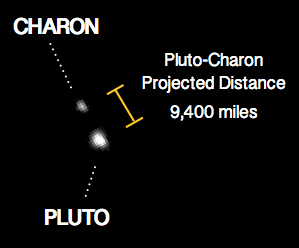
The New Horizons science team has finally released the navigation image of Pluto and Charon that the spacecraft took on January 25.
A cropped version is on the right. The image shows Pluto and its biggest moon Charon, with both appearing somewhat elongated in shape. Why this is so is not explained by the press release, but I suspect it is because the goal of the image was not sharpness but to locate the planet for navigation purposes.
Science has the answer!
Scientists have discovered a micro-organism that has not evolved in more than 2 billion years.
Schopf and his colleagues used a variety of spectroscopic imaging techniques to study sulfur bacteria fossils embedded in deep sea rocks of varying ages. Analysis of the microorganisms from 1.8 billion-year-old rocks from Western Australia and 2.3 billion-year-old rocks collect off the coast of Chile showed that ancient sulfur bacteria looks the exact same now as it has for more than two billion years.
Climate scientist Fred Singer asks two very good questions about climate change.
If you do anything, click on the link to see the two graphs. They illustrate quite clearly the difference between what real scientists pay attention to versus the fantasies of fake scientists like Michael Mann.
At a press conference at the January meeting of the American Astronomical Society scientists and engineers of the Space Telescope Science Institute that operates the Hubble Space Telescope reported that it is functioning far better than expected and is likely to continue to function until 2020 or beyond.
This is good news, since there is nothing being planned to replace Hubble. The article implies that the James Webb Space Telescope has that job, but Webb is an infrared telescope, not optical, and thus observes the universe in wavelengths not visible to the human eye.
The uncertainty of science: The big discovery earlier this year of gravitational waves confirming the cosmological theory of inflation has now been found to be completely bogus. Instead of being caused by gravitational waves, the detection was caused by dust in the Milky Way.
Even while the mainstream press was going nuts touting the original announcement, I never even posted anything about it. To me, there were too many assumptions underlying the discovery, as well as too many data points with far too large margins of error, to trust the result. It was interesting, but hardly a certain discovery. Now we have found that the only thing certain about it was that it wasn’t the discovery the scientists thought.
Nor is this unusual for the field of cosmology. Because much of this sub-field of astronomy is dependent on large uncertainties and assumptions, its “facts” are often disproven or untrustworthy. And while the Big Bang theory itself unquestionably fits the known facts better than any other theory at this time, there remain too many uncertainties to believe in it without strong skepticism.
Launched in December for a 2018 rendezvous with an asteroid, Hayabusa-2 has successfully completed its initial check-out according to Japanese officials.
Checkups on early-phase functionality are being carried out over a three-month period. Although the first Hayabusa had suffered malfunctions of its ion engines, it is confirmed that the four ion engines of Hayabusa-2 are functioning properly, JAXA said. Kuninaka said: “With the engines functioning, the explorer can set out on its voyage with a lot of leeway. I feel like, ‘Way to go!’”
The competition heats up: A private company, dubbed Spire, has announced its intention to launch a 20-satellite constellation of weather satellites, all cubesats, by the end of 2015.
Spire raised $25 million in Series A funding during the summer of 2014, bringing its total amount to $29 million. The company already has customers in a variety of verticals, but Platzer said weather was planned to be a focus from the company’s inception.
…With the U.S. National Oceanographic and Atmospheric Administration (NOAA) facing an impending weather data gap, an increasing amount of focus has been placed on leveraging commercial options as well. Last year NOAA issued a Request for Information (RFI) on RO that piqued interest from the commercial sector. Congress has also urged the agency to leverage private sector capabilities.
For years I argued that there is no justification for the federal government to provide free weather satellite data to private companies like the Weather Channel. There is more than enough profit to be made tracking and predicting the weather for these companies to launch their own orbiting networks, just as the television and communications industries do. Thus, it is good to see a new start-up take advantage of this need and to push to make a business out of it.
The Rosetta team has provided a detailed update describing their so far unsuccessful search for Philae on the surface of Comet 67P/C-G.
In addition, the update also looks into the possibility that Philae might wake up in the late spring when the comet’s orbit and rotation changes enough so its solar panels are more exposed to the Sun.
Bottom line: Don’t expect them to find the lander from images. Right now it is a mere three pixels in size. And whether it will come back to life as well also remains unknown.
Link here.
What I like is how all of these weird jobs have been filled, or created, by people who want them. ‘Tis a nice illustration of freedom at work.
Link here.
The first surprising result emerging from VIRTIS’s study of Comet 67P/Churyumov-Gerasimenko is the measurement of its albedo, or how much sunlight is reflected by the surface of the nucleus. With an albedo of only 6%, about half as much as the Moon’s, 67P/C-G is one of the darkest objects in the Solar System. Such a low reflecting power indicates that the surface of the comet contains minerals such as, for example, iron sulfides, but also carbon-based compounds. The low albedo also indicates that there is little or no water ice on the outermost layers of the surface of the nucleus.
“This clearly doesn’t mean that the comet is not rich in water, but only that there is no water ice in the outermost shell, just over one millimetre thick,” explains Fabrizio Capaccioni, VIRTIS Principal Investigator from INAF-IAPS in Rome, Italy. “The reason for this is rooted in the recent history of the comet’s evolution, since repeated passes in the vicinity of the Sun cause surface ice to sublimate.”
This result, combined with other Rosetta data, also suggests that during each pass the dust that did not escape along the comet’s tail settled back down to coat the surface and hide the lower layers of water ice.
Using 20 radar images of asteroid 2004 BL86 as it flew past Earth on January 26, scientists at JPL have created a movie showing the orbital motion of the asteroid’s moon.
The images also show one of the most spherical asteroids I have ever seen. Like Ceres, the larger size has helped shape the asteroid into a more typical-looking planetary sphere.
A Harvard scientist used a random text generator to create a fake science paper entitled “Cuckoo for Cocoa Puffs?” and was able to get it accepted at 17 journals. [Note: the link includes an auto-download of the pdf of the scientist’s fake paper.]
Shrime decided to see how easy it would be to publish an article. So he made one up. Like, he literally made one up. He did it using www.randomtextgenerator.com. The article is entitled “Cuckoo for Cocoa Puffs?” and its authors are the venerable Pinkerton A. LeBrain and Orson Welles. The subtitle reads: “The surgical and neoplastic role of cacao extract in breakfast cereals.” Shrime submitted it to 37 journals over two weeks and, so far, 17 of them have accepted it. (They have not “published” it, but say they will as soon as Shrime pays the $500. This is often referred to as a “processing fee.” Shrime has no plans to pay them.) Several have already typeset it and given him reviews, as you can see at the end of this article. One publication says his methods are “novel and innovative”!. But when Shrime looked up the physical locations of these publications, he discovered that many had very suspicious addresses; one was actually inside a strip club.
Essentially, these fake journals are scams to get $500 from scientists, generally from third world countries who can’t get their papers published in the bigger first world journals. (What does that tell us about those bigger first world journals?)
The best line of the article however was this: “Many of these publications sound legitimate. To someone who is not well-versed in a particular subfield of medicine—a journalist, for instance—it would be easy to mistake them for valid sources.” [emphasis mine] It seems to me that if you are a journalist writing about a particular field, you should be reasonably educated on that field and be able to spot a fake journal. I certainly can. That it is assumed that mainstream journalists who report on medicine cannot speaks volumes about the quality of the field.
On Sunday Dawn took the best images ever of Ceres, the largest asteroid in the solar system.
The images are still somewhat fuzzy, as the spacecraft is still more than 140,000 miles away.
On Sunday New Horizon took its first approach images of Pluto, still six months from the actual fly-by.
The images are still being processed and have not yet been released. Note also that these are being taken from quite a distance. They will only be a tease, not the real thing. For that we will have to wait a few more months.
Worlds without end: Using archived Kepler data astronomers have identified a solar system of five Earth-sized exoplanets, orbiting a red dwarf star about 117 light years from Earth.
The paper describes Kepler-444, a star that’s 25 percent smaller than our sun and is 117 light years from Earth. The star’s five known planets have sizes that fall between Mercury and Venus. Those planets are so close to their star that they complete their orbits in fewer than 10 days. At that distance, they’re all much hotter than Mercury and aren’t habitable.
The important detail from this discovery is that the star is very ancient, more than 11 billion years old, which means these planets are that old as well. In other words, planets began forming the same time as the first stars. Which also means that there has been plenty of time in the universe for other intelligent life to form, besides our own.
Radar images of the large asteroid 2004 BL86 as it flew past the Earth today have revealed that it has its own small moon.
The new images also show a second object positioned close to 2004 BL86. Benner told Space.com that the second object is a moon, with a diameter between 164 and 328 feet (50 and 100 m). Previous studies of the light around 2004 BL86 had already identified a moon orbiting the asteroid, and the new images confirm that discovery, he added. About 17 percent of asteroids in 2004 BL86’s size range have smaller objects trailing along with them.
Boulders and other small-scale features on the surface of the asteroid are coming into focus in the new images, as is the overall shape of the asteroid, according to Benner. He compared the object to another asteroid that made a close flyby of Earth six years ago, called 2008 EV5. It appears that 2004 BL86, like 2008 EV5, has an equatorial ridge around its middle, which makes it look “kind of like a muffin, or perhaps a top,” said Benner, who’s based at NASA’s Jet Propulsion Laboratory (JPL) in Pasadena, California.
This data is from radar data collected early in the fly-by, so we should expect even more details to come out in the next day or so.
Data from a U.S. instrument on Rosetta has shown that the water venting off of Comet 67P has increased significantly since the spacecraft arrived.
“In observations over a period of three months [June through August, 2014], the amount of water in vapor form that the comet was dumping into space grew about tenfold,” said Sam Gulkis, principal investigator of the MIRO instrument at NASA’s Jet Propulsion Laboratory in Pasadena, California, and lead author of a paper appearing in the special issue [of Science].
The amount of water at the maximum level averages about 40 ounces every second.
In related Rosetta news today, data from the comet is showing that the dust leaving its surface is dust that had settled back down after the comet’s last close pass to the Sun.
Some data produced by Dawn while it was in orbit around the asteroid Vesta have suggested to some scientists that liquid water might have helped create a handful of the surface features on the asteroid.
The theory is interesting and might be true. I also wouldn’t bet a lot of money on it, because this interpretation of the data is somewhat tentative and based on a lot of assumptions.