The underground Moon

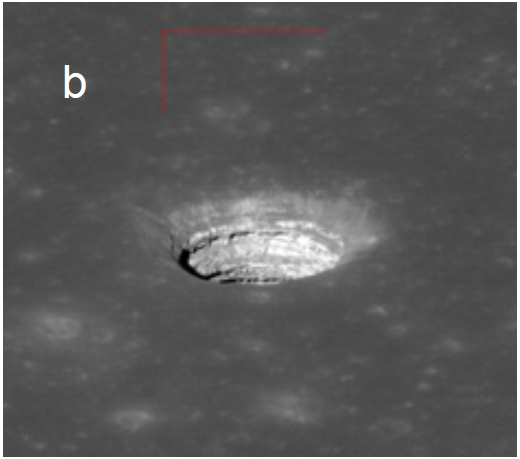
More images of lunar cave pits have been posted by the scientists of Lunar Reconnaissance Orbiter (LRO). They have also published their first paper [pdf] about these cave pits for the 2011 Lunar and Planetary Science Conference taking place in March. The paper summarizes, with images, what is know about the three pits on the Moon that have each been imaged a number of times at different angles and lighting situations.

Mare Tranquilitatus
» Read more

2 comments

The bigotry among social psychologists

The bigotry among social psychologists. Key quote:

Dr. Haidt (pronounced height) told the audience [at the Society for Personality and Social Psychology’s conference] that he had been corresponding with a couple of non-liberal graduate students in social psychology whose experiences reminded him of closeted gay students in the 1980s. He quoted β€” anonymously β€” from their e-mails describing how they hid their feelings when colleagues made political small talk and jokes predicated on the assumption that everyone was a liberal.

β€œI consider myself very middle-of-the-road politically: a social liberal but fiscal conservative. Nonetheless, I avoid the topic of politics around work,” one student wrote. β€œGiven what I’ve read of the literature, I am certain any research I conducted in political psychology would provide contrary findings and, therefore, go unpublished. Although I think I could make a substantial contribution to the knowledge base, and would be excited to do so, I will not.”

2 comments

Scientists discover treasure trove of fossils in limestone layer in China

Scientists have discovered a treasure trove of 250-million-year-old fossils in limestone layer in China. Key quote:

The 50-foot-thick (16 meters) layer of limestone that held these fossils dates back to when south China was a large island just north of the equator with a tropical climate. A smattering of fossil land plants suggest this marine community lived near a conifer forest. The fossils are exceptionally well-preserved, with more than half of them completely intact, including soft tissues. Apparently they were protected across the ages by mats of microbes that rapidly sealed their bodies off from decay after death.

0 comments

Kepler finds 68 Earthsized planets

Exoplanets galore! The Kepler team announced today the discovery of 68 Earth-sized planets, five in the habitable zone. Key quote:

The discoveries are part of several hundred new planet candidates identified in new Kepler mission science data, released on Tuesday, Feb. 1. The findings increase the number of planet candidates identified by Kepler to-date to 1,235. Of these, 68 are approximately Earth-size; 288 are super-Earth-size; 662 are Neptune-size; 165 are the size of Jupiter and 19 are larger than Jupiter. Of the 54 new planet candidates found in the habitable zone, five are near Earth-sized. The remaining 49 habitable zone candidates range from super-Earth size — up to twice the size of Earth — to larger than Jupiter.

0 comments

finding out what’s politically correct

Want to know what the academic elite think is or is not politically correct? Make two different Freedom of Information Act requests at the same university for two scientists who just happen to be on opposite sides of the global warming debate and see how the university responds.

Not surprisingly, the university was glad to do whatever it could to hurt the global warming skeptic, while stonewalling any requests for information about the global warming advocate.

0 comments
1 415 416 417 418 419 441