Opportunity at Santa Maria Crater, as seen from space

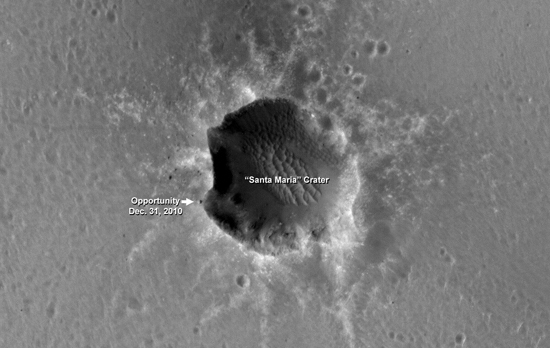
The image below was taken by Mars Reconnaissance Orbiter on New Year’s Eve. It shows the rover Opportunity on the rim of stadium-sized Santa Maria Crater, where scientists plan to spend the next two months exploring the crater.

Opportunity has truly been an astonishing success for NASA’s planetary science program. The rover has operated on the Martian surface since 2004, almost seven years beyond its original mission length. It is presently about halfway on its long journey to the much larger Endeavour Crater (14 miles in diameter), still several miles away.

Opportunity at Santa Maria

0 comments

A plunge in solar activity in December

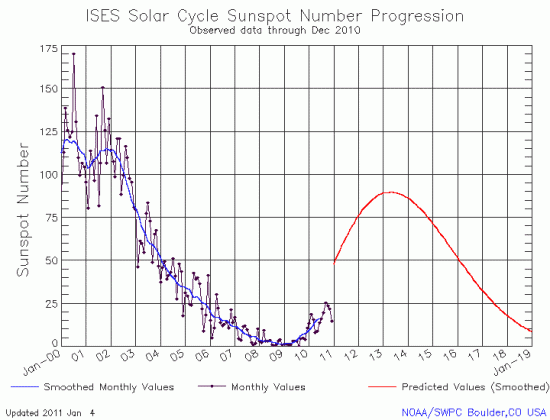
The monthly update of the Sun’s developing sunspot cycle was published tonight by NOAA’s Space Weather Prediction Center. You can see the newest graph below, which shows the slow rise in sunspots (blue/black lines) in comparison with the consensis prediction made by the solar science community in May 2009 (red line).

Not only does the Sun’s generally quiet trend continue, its activity took an additional plunge in December, dropping significantly from the previous month. This drop is probably due to the seven days of no sunspots that took place in mid-December.

All in all, we continue to head for the weakest maximum in two hundred years (see the graph on this page), which in the past meant very cold weather. Though scientists do not yet understand why the Sun does this or how these changes in solar activity influence the climate as much as they do, that this in now happening at a time when we have the technology to truly study it is an opportunity that must not be missed.

The December sunspot graph

0 comments

Why Most Published Research Findings are False

Why most published research findings are false. And written by a published but skeptical climate scientist. Key quote:

In global warming research, there is a popular misconception that oil industry-funded climate research actually exists, and has skewed the science. I canโ€™t think of a single scientific study that has been funded by an oil or coal company.

But what DOES exist is a large organization that has a virtual monopoly on global warming research in the U.S., and that has a vested interest in [anthropogenic global warming] theory being true: the U.S. Government. The idea that government-funded climate research is unbiased is laughable. The push for ever increasing levels of government regulation and legislation, the desire of government managers to grow their programs, the dependence of congressional funding of a problem on the existence of a โ€œproblemโ€ to begin with, and the U.N.โ€™s desire to find reasons to move toward global governance, all lead to inherent bias in climate research.

1 comment

The 97% “Consensus” is only 75 Self-Selected Climatologists

The 97% “Consensus” is only 75 Self-Selected Climatologists. Key quote:

Close examination of the source of the claimed 97% consensus reveals that it comes from a non-peer reviewed article describing an online poll in which a total of only 79 climate scientists chose to participate. Of the 79 self-selected climate scientists, 75 agreed with the notion of AGW [anthropogenic global warming]. Thus, we find climate scientists once again using dubious statistical techniques to deceive the public that there is a 97% scientific consensus on man-made global warming; fortunately they clearly aren’t buying it.

0 comments

Heading towards a Maunder Minimum

Though I have been saying that the Sun’s lack of sunspots the last two years suggests the possibility of that we might be facing an extended period without solar activity, I am not a solar scientist. Today, in a paper published today on the Los Alamos astro-ph website, a solar scientist says just that. Key quote:

One method that has yielded predictions consistently in the right range during the past few solar cycles is that of K. Schatten et al., whose approach is mainly based on the polar field precursor. The incipient cycle 24 [on-going right now] will probably mark the end of the Modern Maximum, with the Sun switching to a state of less strong activity.

0 comments

The Sun is no longer blank

After six blank days, the Sun is once again showing spots. As I have mentioned several times in 2010, this might be the last time the Sun is blank for years to come as it ramps up to solar maximum. However, don’t bet on it, as the Sun’s activity has been way below all predictions. The upcoming solar maximum might very well be the first in centuries with blank days interspersed throughout.

0 comments

Opportunity takes a rest stop at a crater

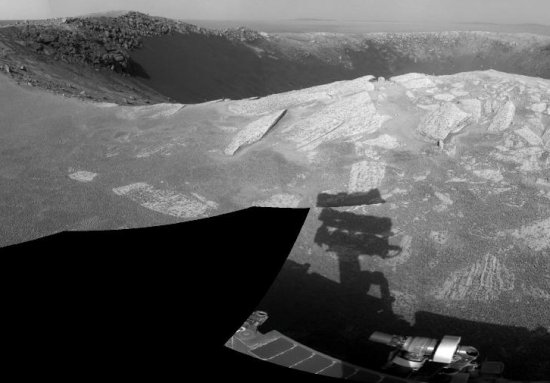
In its 14 mile multi-year trek to Endeavour Crater — now about half completed — the Mars rover Opportunity has stopped to take a short rest stop at a small crater.

The crater, dubbed “Santa Maria Crater” by the scientists who operater Opportunity, is about the size of a football field. What makes it especially interesting are the sharp rocks piled up on its rim, as they are probably debris ejected from the crater at impact. Since this material probably came from deep below the Martian surface, it is also likely to hold information about the Martian geological past, thereby making it a prime research site.

Santa Maria crater

0 comments
1 419 420 421 422 423 441