
An asteroid discovered more than 100 years ago is actually an extinct comet coming back to life
An asteroid discovered more than 100 years ago is actually an extinct comet. And it is coming back to life!
An asteroid discovered more than 100 years ago is actually an extinct comet. And it is coming back to life!
Recent monitoring of the Sun’s brightness as it went from maximum to minimum in its solar cycle has found that, surprisingly, the changes in brightness across different wavelengths do not necessarily vary in lockstep. Key quote:
SIM suggests that ultraviolet irradiance fell far more than expected between 2004 and 2007 — by ten times as much as the total irradiance did — while irradiance in certain visible and infrared wavelengths surprisingly increased, even as solar activity wound down overall. The steep decrease in the ultraviolet, coupled with the increase in the visible and infrared, does even out to about the same total irradiance change as measured by the TIM during that period, according to the SIM measurements.
The stratosphere absorbs most of the shorter wavelengths of ultraviolet light, but some of the longest ultraviolet rays (UV-A), as well as much of the visible and infrared portions of the spectrum, directly heat Earth’s lower atmosphere and can have a significant impact on the climate. [emphasis mine]
The uncertainty of science: Did the Martian methane signal come from Earth?
The hubbub about this week’s lunar solstice eclipse was, from my perspective, mostly manufactured press blather. For those who had never seen a lunar eclipse, it was a spectacular experience, but there really was nothing scientifically or technically unique about the fact that it happened to occur on the solstice.
However, below is an eclipse that is definitely unique both technically and scientifically. Scientists using the Mars rover Opportunity have filmed an eclipse on Mars, showing the Martian moon Phobos crossing in front of the Sun. Consider the engineering accomplishment: not only did they need to be able to calculate exactly when this would happen at a very particular spot on the Martian surface, they had to have a camera there able to take the movie. And they had to operate it from Earth!
Scientists have completed the IceCube neutrino observatory in Antarctica, a cubic kilometer in size and situated a mile deep in the ice.
Another scheme to stop a dangerous asteroid: Use a flotilla of solar sails to divert Apophis.
How close to the Sun could we get?
According to a statistical analysis, scientists predict the discovery of Earth’s twin in 2011.
Note that I reported this story three months ago, on September 13!
Alan Stern, project scientist of NASA’s mission to Pluto, New Horizons, gives his perspective ten years after the start of the project.
There’s a mini ice age coming, says a man whose predictions the last few winters have been better than the British weather service.
Good intentions strikes again! Automakers are suing the EPA over its decision to allow a higher ethanol mixture in gasoline. Key quote:
Automakers say they are worried the EPA decision would eventually lead to motorists unknowingly filling up their older cars and trucks with E15 and hurting their engines. The problem could be exacerbated if E15 fuels are cheaper than more conventional blends, prompting owners of older vehicles to use the fuel despite the potential engine problems.
Bat researchers have concluded that the fungus seen on the dying bats in the northeast United States these past four years is far more deadly than any fungus previously studied, and is increasingly believed to be the primary cause of the bat deaths. Key quote:
“This fungus is amazingly destructive — it digests, erodes, and invades the skin — particularly the wings — of hibernating bats,” said Meteyer. “The ability of this fungus to invade bats’ wing skin is unlike that of any known skin fungal pathogen in land mammals.”
Apropos my post yesterday on the sunspot cycle: A Dalton Minimum repeat is shaping up.
This research has a bearing on NASA’s plans to subsidize the new space companies: Research has found that subsidies to the Spanish film industry had no effect on its productivity, while giving awards did, increasing “internal and external distribution demand.”
A 10-man team of explorers and scientists today completed the first there-and-back crossing of the continent of Antarctica using wheeled vehicles. From the expedition blog:
We quickly took ourselves to the mess tent for some hot coffee and something which we had been craving for a while – Coca Cola. The feeling among the team was satisfaction and elation at what we had achieved and relief that the belt drive had held out! The first Expedition ever to travel coast to coast and back again, with the privilege of visiting the South Pole twice. We joked in the mess tent before deciding that we were not going to sleep and headed over to the Mechanic Area and back to the vehicles.
Radar data from the European satellite, Cryosat-2, has been used to map the ocean circulation across the Arctic basin.
For the first time since October 10, and only the third time since August, the Earth-facing side of the Sun is blank, showing no sunspots. All told, 2010 has only been blank 13% of the time, for a total of 46 blank days, with only 12 days left in the year. These numbers contrast sharply with 2009, when the Sun was blank 71% of the time, or 260 out of 365 days.
It is very clear that the solar minimum is now over, and that the Sun ramping up to its next maximum. Blank days should soon cease (today might very well be the last for years), and the number of sunspots should continue to increase through approximately 2013, when astronomers now expect the maximum to peak.
It will be a weak maximum, however, likely accompanied with cold weather. At least, this has been the pattern for the last ten centuries, based on the best data that scientists have. When the Sun produces sunspots, the Sun gets hotter, and though that increase in radiation appears slight, it seems enough to warm the Earth’s climate. This is what appears to have happened around the year 1000, during what climate scientists call the Medieval Warm Period.
And when the Sun goes blank, or produces fewer sunspots, the Sun dims, and the Earth’s climate cools. This is what happened in the 1600s and 1700s, when the Little Ice Age gripped much of the Earth. It also happened in the first two decades of the 1800s, the last time the Sun produced as few sunspots as it is now, and when at least one year was called “the year without a summer”. Interestingly, that cold period at the beginning of the 1800s was also a period of intense volcanic activity, which threw a lot of dust and material into the atmosphere and thus helped contribute to the cooling of the Earth.
The last half of the 20th century, however, has not seen that much volcanic activity, which has made the atmosphere today clearer than any time in the past five decades. It has also been a time of increased solar activity, with most of the solar maximums peaking at generally higher numbers. No wonder scientists have detected evidence of a slight warming in the climate.
However, that warming appears to be ending, and it is doing so at the same time the Sun is going spotless. Though we don’t yet fully understand the mechanics of how these two events are linked, it behooves us to pay close attention. No climate prediction or computer model will mean anything if it does not.
Meanwhile, solar scientists remain unclear about the causes behind the solar cycle’s ebbs and flows. They have a reasonable idea that the cycle is caused by the Sun’s magnetic dynamo as it flips from one polarity to another. But why this happens is still subject to debate.
More importantly, it remains a complete unknown how long the next sunspot minimum will be. The Sun could spring back to life, as it did in the 1850s, producing lots of sunspots. Or sunspots might fade out for a few additional decades, as they did in the 1600s.
Sadly, based on the state of our science today, this is a question that probably no one will be able to answer — until we actually see it happen.
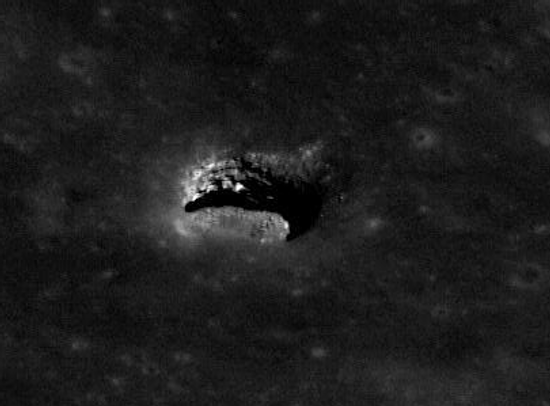
NASA engineer James Fincannon emailed me the image below, cropped from this Lunar Reconnaissance Orbiter scan. It shows a side view of the same lunar pit previously discussed by me in July (here and here).
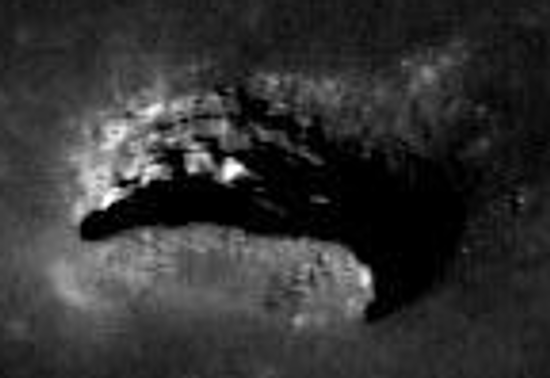
This image below was almost certainly ordered up by LRO scientists after seeing the images above so that they could get a look at the pit’s walls. I have further cropped it and blown it up so we can get a really good look too! See the second image below.
In this side view, we are looking across the top of the pit at the far wall and floor. On that far wall you can see what look like three coarse horizontal layers, below which is a deeply shadowed floor layer that is probably either cave passage or a significant overhang. Further processing will probably be bring out some further details and hopefully answer this question.
In a previous post, I had noted that this wall is probably about 200 feet deep. This new image thus gives any experienced rock-climber or caver a very nice sense of what a rappel down the side of that pit would be like. To me, it reminds me of some of the open-air cave pits I’ve rappelled into in New Mexico.
Update: I should note that that overhang/cave entrance at the bottom of the pit is probably at least 30 feet high. An impressive entrance, indeed.
Also, lunar scientist Paul Spudis emailed me with these comments:
[The pit] is very similar to some tube systems that I have studied in Hawaii. The wall units are exposed lava flows. They are probably all from the event which made this flow — a single flow can be made up of multiple flow units, hence, the apparent “layering.”
Of course, getting into an open pit and then moving through open void lava tubes that radiate from it are two different things. In terrestrial tube systems, many tubes are open and accessible but sometimes they are not. They can be blocked up by frozen lava or rubble from adjacent tube collapse.
Unfortunately, I don’t think we’re going to know what the situation on the Moon is until we get there. However, I must say, this particular area looks very promising.
Engineers now think that a cracked nozzle caused the Japanese probe Akatsuki to miss Venus.