Antarctic increase in sea ice since 1970 cannot be explained by ozone hole

In another paper published today in the Geophysical Research Letters of the American Geophysical Union, researchers have found, according to their computer model, that the increase in sea ice since 1970 in Antarctica cannot be explained by the ozone hole. (Note that the sea ice has been shrinking in the northern hemisphere while it has been growing in the south.) Key quote from paper:

It is presently unclear why the observed Southern Hemisphere sea ice extent trends are so different from those in the Northern Hemisphere. Previous studies have suggested that the cause might be related to atmospheric circulation changes induced by the stratospheric ozone hole. The results in this study are not consistent with this view and highlight the need for continued investigations of Antarctic sea ice extent trends.

0 comments

Modern climate models can’t predict sudden climate change

A paper published today in Geophysical Research Letters of the American Geophysical Union says that the general circulation climate models used by scientists today to predict things like global warming cannot predict past examples of similar sudden climate change. Key quote from abstract:

These [sudden] shifts are thus noise induced with very limited predictability, and early detection of them in the future might be wishful thinking.

0 comments

Listen to the sound of Babylonia

A researcher at the University of Cambridge is posting audio recordings on the web of Babylonian poetry, myths, and other texts, so that everyone can hear what the ancient languages sounded like. Key quote:

“In many cases [the works] are the equivalent of Old English tales like Beowulf,” Dr. Worthington added. “Through them, we meet gods, giants, monsters and all sorts of other weird and wonderful creatures. As stories they are amazing fun.”

0 comments

The state of the Sun, September 30, 2010

Time to update the state of the Sun, as seen by satellite data (the last update was in July). The graph below, posted today by Physikalisch- Meteorologisches Observatorium Davos (PMOD), shows the variation in the Sun’s Total Solar Irradiance since 1978. I have added a blue horizontal line to show that even now, two years after the Sun reached the lowest point in its most recent solar minimum, it has still not brightened enough to equal the lowest point in the two previous minimums. (Note that if we included the minimum from 1976, the Sun would still be below that as well.)

solar cycle as of Sept 30, 2010

Once again, the evidence is building that the Sun might be heading towards the weakest maximum seen to two centuries. And when that happened, things got very cold on Earth.

the sunspot cycle

0 comments

First planet discovered that might harbor life!

Big news! Scientists have discovered the first rocky terrestrial planet orbiting its sun at a distance where life as we know it could form. The planet itself has a mass three to four times Earth, so no matter what, conditions on its surface would be very different than here. Nonetheless, this is a major discovery, and is only the first of many. Key quote:

The discovery suggests habitable planets must be common, with 10 to 20 per cent of red dwarfs and sun-like stars boasting them, the team says. That’s because Gliese 581 is one of just nine stars out to its distance that have been searched with high enough precision to reveal a planet in the habitable zone.

2 comments

Results from Hayabusa delayed till next year

We won’t know if the Japanese probe Hayabusa actually brought asteroid materials back to Earth until spring 2011. Key quote from the project scientist:

Kawaguchi said his science team found “tens of particles” in Chamber A of the canister. The tiny particles are being removed one-by-one in an extraction process that is stretching longer than anticipated.

Note that they still have not opened Chamber B, which is thought to have had a better chance of capturing asteroid material because it was the chamber in contact with the asteroid Itokawa.

0 comments

One third of so-called extinct species have turned up alive

Back from the dead! A new study has found that scientists are significantly over-estimating the number of animal extinctions, with approximately one third of the so-called “extinct” species turning up alive. This quote makes one wonder if politics have been a factor:

The mistakes cannot be blamed on primitive technology or old fashioned scientific methods. “Mammals missing in the 20th century were nearly three times as likely to be rediscovered as those that disappeared in the 19th century.”

0 comments

Dangerous asteroid discovered by new telescope

A new survey telescope, designed to scan the entire available sky approximately three times every month, has discovered its first potentially hazardous asteroid (PHO) , 150 feet in diameter and set to speed past the Earth at a distance of 4 million miles in mid-October. Key quote:

Most of the largest PHOs have already been catalogued, but scientists suspect that there are many more under a mile across that have not yet been discovered. These could cause devastation on a regional scale if they ever hit our planet. Such impacts are estimated to occur once every few thousand years.

0 comments

The crumbling cliffs of Mars

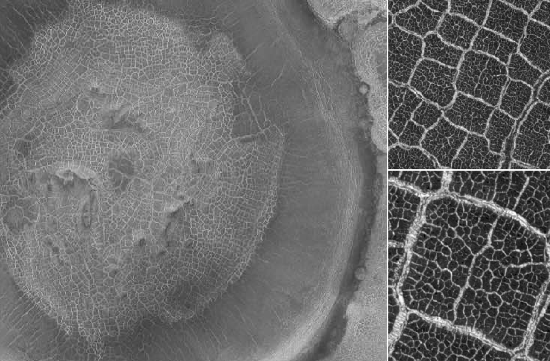
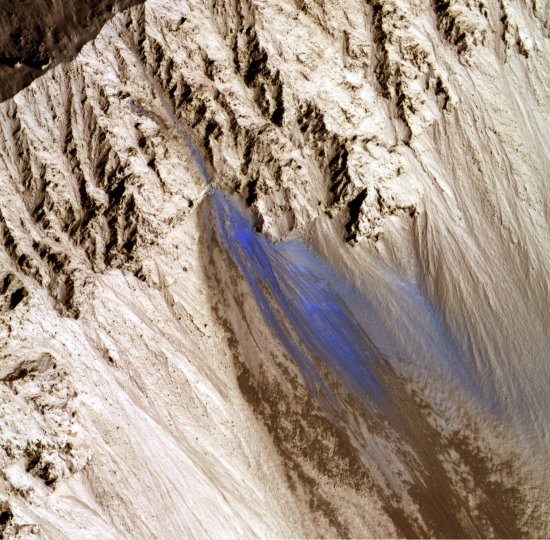
Among the new images posted last week by the HiRise camera on Mars Reconnaissance Orbiter is a picture showing the layered and looping ridgelines within Galle Crater. A close-up of these ridgelines revealed the precarious nature of those crumbling cliff tops.

Below is a low resolution version of the image, with a high resolution cropped inset below that, showing a close-up of the most interesting looking area. In the inset you can see that the top of the cliff has separated away. It almost looks as if several large pieces are about to break off. You can also see that the top of the cliff to the north is made up of hanging rocks that appear to almost float in the air. They too look as if they are about to break off.

What makes this even more intriguing is that there are no boulder piles at the bottom of any cliff. All we can see on the valley floor is a pattern of polygonal fractures, possibly “due to ground ice, or regional tectonic stresses.” If large pieces of these ridge lines are breaking off periodically, as they surely appear to be doing, where has the debris gone?

Martian cliffs

crumbling cliffs

0 comments

A scientist’s ten commandments

Published today on the astro-ph website, this preprint by Ignacio FerrΓ­n of the Center for Fundamental Physics at the University of the Andes, Merida, Venezuala, is probably the shortest paper I have ever seen. I think that Dr. Ferrin will forgive me if I reprint it here in its entirety:

1. Go to your laboratory or your instrument without any pre-conceived ideas. Just register what you saw faithfully.

2. Report promptly and scientifically. Check your numbers twice before submitting.

3. Forget about predictions. They are maybe wrong.

4. Do not try to conform or find agreement with others. You may be the first to be observing a new phenomenon and you may risk missing credit for the discovery.

5. Criticism must be scientific, respectful, constructive, positive, and unbiased. Otherwise it must be done privately.

6. If you want to be respected, respect others first. Do not use insulting or humiliating words when referring to others. It is not in accord with scientific ethics.

7. Do not cheat. Cheating in science is silly. When others repeat your experiment or observation, they will find that you were wrong.

8. If you do not know or have made a mistake, admit it immediately. You may say, “I do not know but I will find out.” or “I will correct it immediately.” No scientist knows the answer to everything. By admitting it you are being honest about your knowledge and your abilities.

9. Do not appropriate or ignore other people’s work or results. Always give credit to others, however small their contribution may have been. Do not do unto others what you would not like to be done unto you.

10. Do not stray from scientific ethics.

It seems that some scientists in the climate field (Phil Jones of East Anglia University and Michael Mann of Pennsylvania State University are two that come to mind immediately) would benefit by reading and following these rules.

1 comment
1 427 428 429 430 431 438