China launches 2nd Moon mission
China has launched its second unmanned lunar probe, designed to photograph the Moon from an orbit altitude of 9 miles.
China has launched its second unmanned lunar probe, designed to photograph the Moon from an orbit altitude of 9 miles.
Time to update the state of the Sun, as seen by satellite data (the last update was in July). The graph below, posted today by Physikalisch- Meteorologisches Observatorium Davos (PMOD), shows the variation in the Sun’s Total Solar Irradiance since 1978. I have added a blue horizontal line to show that even now, two years after the Sun reached the lowest point in its most recent solar minimum, it has still not brightened enough to equal the lowest point in the two previous minimums. (Note that if we included the minimum from 1976, the Sun would still be below that as well.)
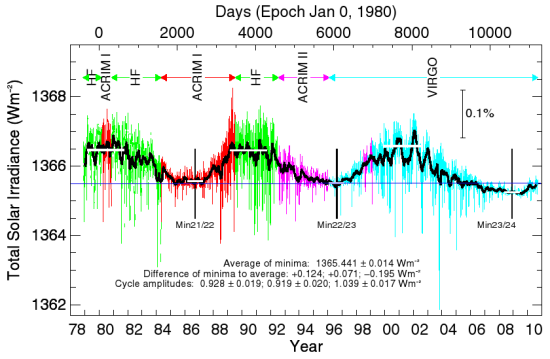
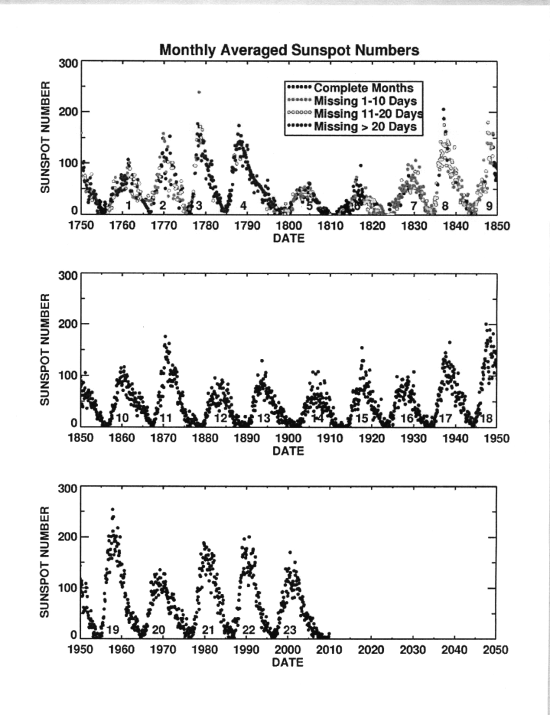
Once again, the evidence is building that the Sun might be heading towards the weakest maximum seen to two centuries. And when that happened, things got very cold on Earth.
Big news! Scientists have discovered the first rocky terrestrial planet orbiting its sun at a distance where life as we know it could form. The planet itself has a mass three to four times Earth, so no matter what, conditions on its surface would be very different than here. Nonetheless, this is a major discovery, and is only the first of many. Key quote:
The discovery suggests habitable planets must be common, with 10 to 20 per cent of red dwarfs and sun-like stars boasting them, the team says. That’s because Gliese 581 is one of just nine stars out to its distance that have been searched with high enough precision to reveal a planet in the habitable zone.
We won’t know if the Japanese probe Hayabusa actually brought asteroid materials back to Earth until spring 2011. Key quote from the project scientist:
Kawaguchi said his science team found “tens of particles” in Chamber A of the canister. The tiny particles are being removed one-by-one in an extraction process that is stretching longer than anticipated.
Note that they still have not opened Chamber B, which is thought to have had a better chance of capturing asteroid material because it was the chamber in contact with the asteroid Itokawa.
Back from the dead! A new study has found that scientists are significantly over-estimating the number of animal extinctions, with approximately one third of the so-called “extinct” species turning up alive. This quote makes one wonder if politics have been a factor:
The mistakes cannot be blamed on primitive technology or old fashioned scientific methods. “Mammals missing in the 20th century were nearly three times as likely to be rediscovered as those that disappeared in the 19th century.”
NASA climate scientist James Hansen was arrested yesterday in a Washington, D.C. protest against mountaintop mining.
The launch of China’s next lunar probe, Chang’e 2, could occur as soon as this Friday.
Volcanic activity in northwest Saudia Arabia.
A new survey telescope, designed to scan the entire available sky approximately three times every month, has discovered its first potentially hazardous asteroid (PHO) , 150 feet in diameter and set to speed past the Earth at a distance of 4 million miles in mid-October. Key quote:
Most of the largest PHOs have already been catalogued, but scientists suspect that there are many more under a mile across that have not yet been discovered. These could cause devastation on a regional scale if they ever hit our planet. Such impacts are estimated to occur once every few thousand years.
How most popular press science articles are written.
A new study suggests that the glacier ice loss in Antarctica and Greenland is less than originally thought.
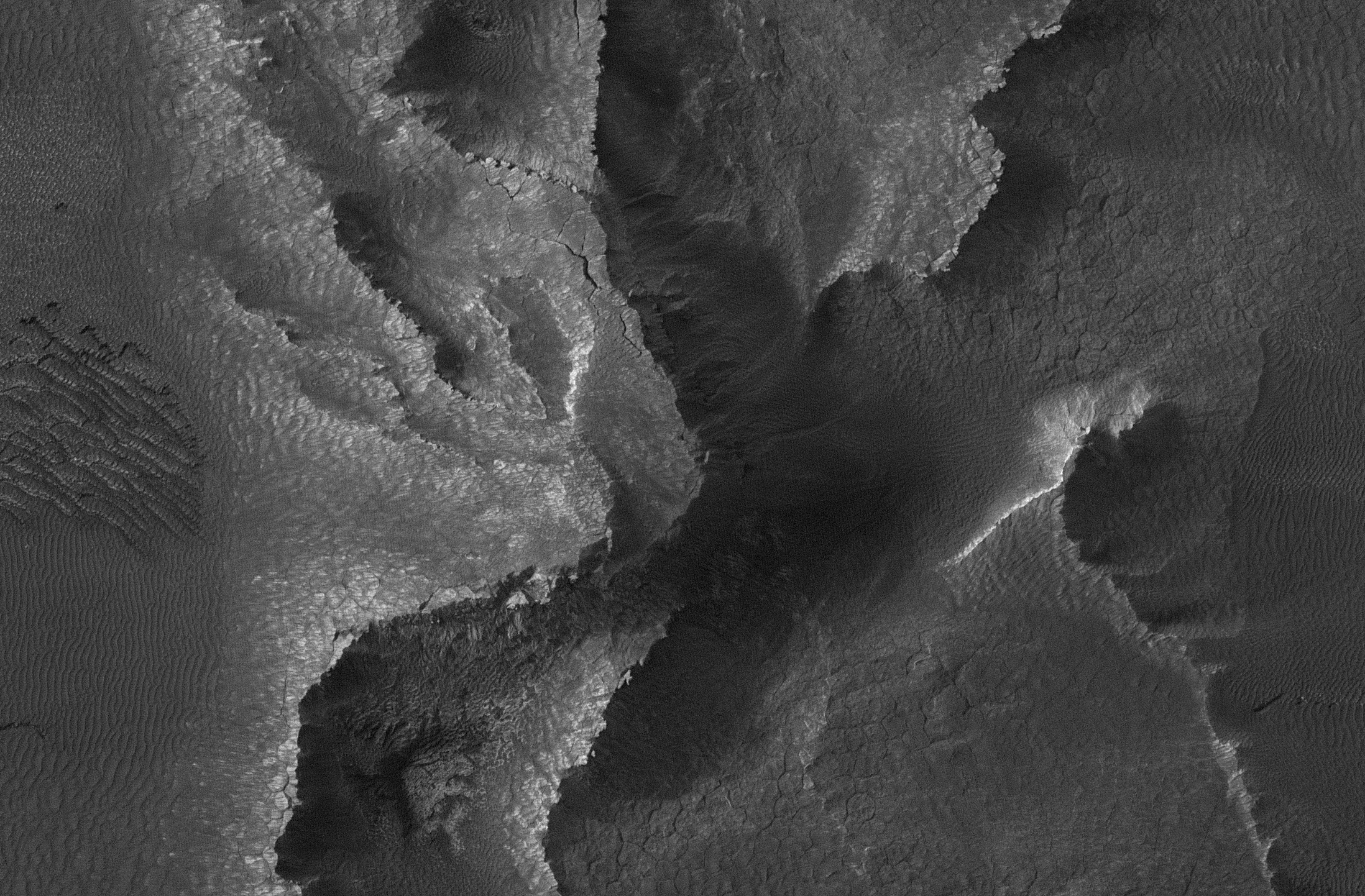
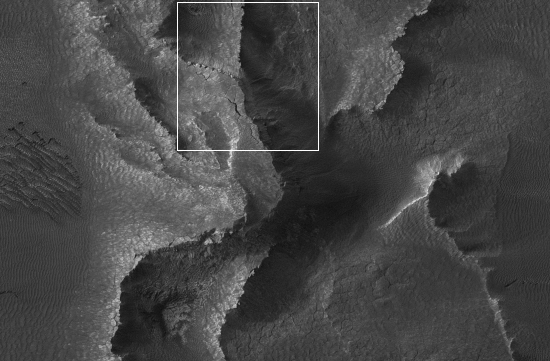
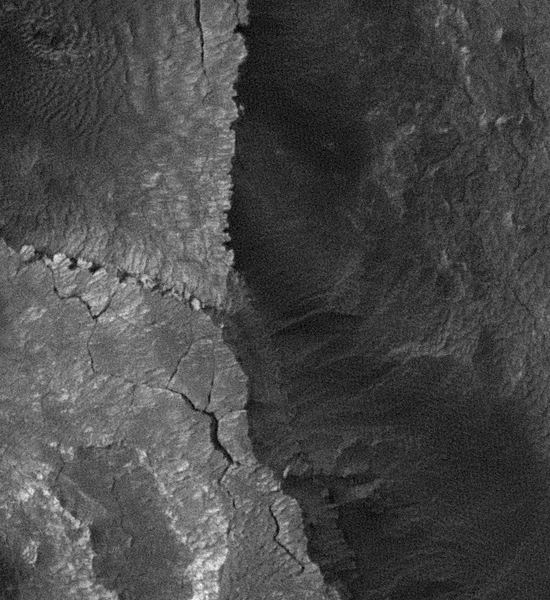
Among the new images posted last week by the HiRise camera on Mars Reconnaissance Orbiter is a picture showing the layered and looping ridgelines within Galle Crater. A close-up of these ridgelines revealed the precarious nature of those crumbling cliff tops.
Below is a low resolution version of the image, with a high resolution cropped inset below that, showing a close-up of the most interesting looking area. In the inset you can see that the top of the cliff has separated away. It almost looks as if several large pieces are about to break off. You can also see that the top of the cliff to the north is made up of hanging rocks that appear to almost float in the air. They too look as if they are about to break off.
What makes this even more intriguing is that there are no boulder piles at the bottom of any cliff. All we can see on the valley floor is a pattern of polygonal fractures, possibly “due to ground ice, or regional tectonic stresses.” If large pieces of these ridge lines are breaking off periodically, as they surely appear to be doing, where has the debris gone?
Published today on the astro-ph website, this preprint by Ignacio Ferrín of the Center for Fundamental Physics at the University of the Andes, Merida, Venezuala, is probably the shortest paper I have ever seen. I think that Dr. Ferrin will forgive me if I reprint it here in its entirety:
1. Go to your laboratory or your instrument without any pre-conceived ideas. Just register what you saw faithfully.
2. Report promptly and scientifically. Check your numbers twice before submitting.
3. Forget about predictions. They are maybe wrong.
4. Do not try to conform or find agreement with others. You may be the first to be observing a new phenomenon and you may risk missing credit for the discovery.
5. Criticism must be scientific, respectful, constructive, positive, and unbiased. Otherwise it must be done privately.
6. If you want to be respected, respect others first. Do not use insulting or humiliating words when referring to others. It is not in accord with scientific ethics.
7. Do not cheat. Cheating in science is silly. When others repeat your experiment or observation, they will find that you were wrong.
8. If you do not know or have made a mistake, admit it immediately. You may say, “I do not know but I will find out.” or “I will correct it immediately.” No scientist knows the answer to everything. By admitting it you are being honest about your knowledge and your abilities.
9. Do not appropriate or ignore other people’s work or results. Always give credit to others, however small their contribution may have been. Do not do unto others what you would not like to be done unto you.
10. Do not stray from scientific ethics.
It seems that some scientists in the climate field (Phil Jones of East Anglia University and Michael Mann of Pennsylvania State University are two that come to mind immediately) would benefit by reading and following these rules.
An archeology dig on the grounds of Cambridge’s Newnham College has unexpectedly unearthed evidence of a large Roman settlement.
In a preprint [pdf] posted today on the astro-ph website, astronomers outline the discovery of a star more like a twin of the Sun than any previously discovered. The star is located in the galactic star cluster M67, 3000 light years away. The similarity is so close that the scientists even speculate that the Sun itself might have formed in this same cluster, 4.5 billion years ago. Key quote from paper:
The similarity of the age and overall composition of the Sun with the corresponding data of M67, and in particular the agreement of the detailed chemical composition of the Sun with that of M67-1194, could suggest that the Sun has formed in this very cluster. According to the numerical simulations by Hurley et al. (2005) the cluster has lost more than 80% of its stars by tidal interaction with the Galaxy, in particular when passing the Galactic plane, and the Sun might be one of those. We note that the orbit of the cluster encloses, within its apocentre and pericentre, the solar orbit. However, the cluster has an orbit extending to much higher Galactic latitudes, presently it is close to its vertical apex at z = 0.41 kpc (Davenport & Sandquist 2010), while the Sun does not reach beyond z = 80 pc (Innanen, Patrick & Duley 1978). Thus, in order for this hypothesis of an M67 origin of the Sun to be valid, it must have been dispersed from the cluster into an orbit precisely in the plane of the Galactic disk, which seems improbable.
The last sentences above refer to the different orbital inclinations of the galactic orbits of both the Sun and M67. M67’s orbital inclination is far steeper. While M67 is presently about 1350 light years (410 parsecs) above the galactic plane, the Sun’s orbit never takes it more than 261 light years above the plane.
One more point of interest: M67 is a well known object to amateur astronomers, located in the constellation Cancer.
Using data accumulated over the past four years by Venus Express, scientists have shown that the giant double vortex storm at Venus’s south pole was only a temporary phenomenon. You can download the actual paper here [pdf]. Key quote from the paper:
The polar region of Venus shows a dynamics regime quite different than the rest of the planet, with a separation region delimited by the cold collar zone. Average wind speeds presents an almost solid body rotation, while instantaneous view highlights the complex dynamic structure with air flowing almost toward all directions. The so called dipole shape is not a stable feature and the morphology of the vortex is significantly variable on both short and long timescales.
The “cold collar” is an atmospheric ring of colder temperatures that encircles the planet’s poles.
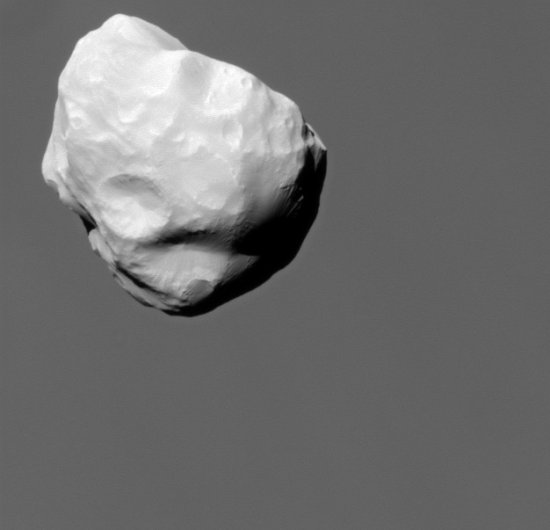
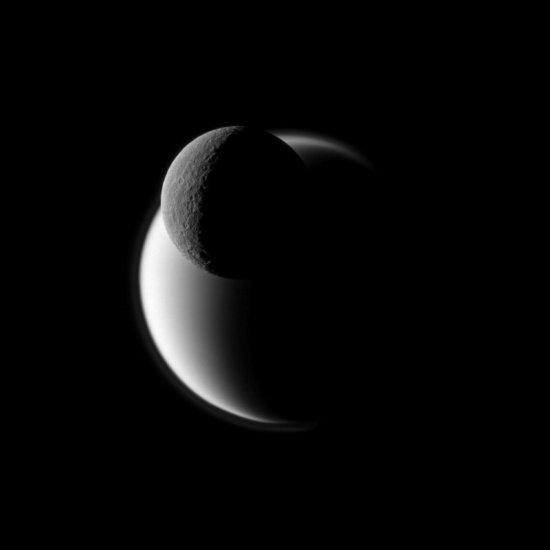
The Cassini spacecraft orbiting Saturn continues to send back a wealth of data, and some gob-smacking wonderful images. Below are two of the more recent examples. The first is not a computer-generated graphic: it shows the small moon Helene (21 miles across) during a fly-by on March 3, 2010, with Saturn’s atmosphere providing the background. The second captures Saturn’s two largest moons, with the smaller Rhea crossing in front of the larger Titan.
Pressure seems to be mounting for Rajendra Pachauri to resign as head of the IPCC. Key quote:
“It’s vital that this body is led by someone whose academic and intellectual credentials are unquestioned and I’m afraid that can no longer be said of him.”
The Japanese effort to rent out their Kibo module on ISS for research has stalled, mainly because private businesses apparently consider the prices too high.
Spring on Titan brings sunshine and patchy clouds.