Pluto’s ice: 97% nitrogen, 3% methane

More results from the press conference going on right now at the 42nd meeting of the AAS Division for Planetary Sciences:

Pluto’s surface ice is made up of 97% nitrogen, 3% methane, while the surface of the Kuiper Belt object Eris (which is larger than Pluto) is even more rich in methane, with a make up of 90% nitrogen and 10% methane. Both measurements go down to a depth of about 10 inches. To see the abstract for this result, go here.

1 comment

The atmosphere of Venus is 60% less dense at its poles

By diving into the upper atmosphere of Venus above its north pole, Venus Express has found that the atmosphere there is 60% less dense than predicted. This from a press conference going on right now at the 42nd meeting of the AAS Division for Planetary Sciences. They plan an additional dive campaign during the next month. And they plan more dives, going deeper each time, as they judge the consequences to the spacecraft each time.

To read the abstracts of the Venus Express papers, go here.

Updated: The full press release, with images, can be seen here.

0 comments

The October 2010 sunspot graph

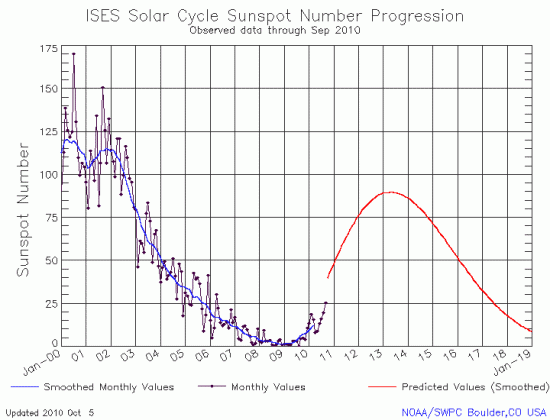
Yesterday NOAA’s Space Weather Prediction Center published its October monthly graph, showing the sun’s developing sunspot cycle in comparison with the consensis prediction made by the solar science community in May 2009.

October Sunspot graph

Sunspot activity in September clearly jumped, though it still remains far below predictions. Prepare for the weakest solar maximum since the 1810s!

Note also that today the Sun is blank, with no sunspots, the first time this has happened since August. At that time I speculated that this might “be the last time the Sun will be blank for years as it continues to ramp up to its next solar maximum.” Obviously not. The question now is whether today will be the finale in blankness for this minimum.

0 comments

Murder for the sake of climate idealogy

Bumped. Scroll down to see the update.

This video has been making the rounds on the web. Though I warn you that is somewhat graphic, it is essential that you watch it.

When I first saw this about a week ago, I didn’t quite know what to make of it. It was so vile and offensive I could not believe that it was legitimate. It obviously wants to pay some homage to Monty Python, but even Monty Python never went this far. How could anyone possibly think that killing small children in the name of environmentalism was in any way funny? And how could anyone ever believe that this video would persuade anyone to go along with the 1010 environmental campaign? If anything, the video does an excellent job of discrediting this organization and everyone involved with it.

Thus, despite what some bloggers were saying, I held back commenting, just to make sure the video was real and not a terrible prank meant to sabotage.

There is now no reason to hold back. Late last week, the 1010 organization itself issued an apology, admitting that this video was their handiwork. Before I continue, I think it is worthwhile for you to also read their apology, in all its venal glory. In many ways, it condemns them and their allies far more than the video did:
» Read more

7 comments

WISE telescope moves into final phase of mission

Having run out hydrogen coolant for its infrared cameras and with only a few more months of usable life, the Wide-Field Infrared Survey Explorer (WISE) has shifted its work from deep space astronomy to completing its last sweep of the solar system in a search for asteroids and comets.

Update: At a press conference going on right now at the 42nd meeting of the AAS Division for Planetary Sciences, WISE scientists note that the mission extension will continue for one month. If that month is successful, the mission will continue until the end of January 2011 in order to complete its solar system sweep. After this the spacecraft will be put in hibernation, available for future work.

Summary of solar system results so far:

  • 33,576 asteroids discovered of which 120 were Near Earth Asteroids.
  • 19 new comets.
0 comments

Liquid on Titan

The Cassini image below, released today at the 42nd meeting of the AAS Division for Planetary Sciences, shows light reflecting off a lake on Titan’s northern hemisphere. According to the scientists who took the image, this is the first definitive confirmation of the presence of liquid in those lakes.

Liquid reflection on Titan

0 comments

The wind-blown dunes of Mars

The HiRise Camera on Mars Reconnaissance Orbiter has released some wonderful new pictures, showing what are called barchan dunes on Mars.

Barchans are crescent-shaped, with the horns of the crescents pointing downwind. One barchan is visible in the upper part of the image, with the Southeast (lower right) horns longer than the other. This trend, along with the position of the steep face of the dune on the South side, indicates that the predominant winds which formed the dunes came from the North.

There are a lot more great images on the websites above.

Wind-blown dunes

0 comments

Antarctic increase in sea ice since 1970 cannot be explained by ozone hole

In another paper published today in the Geophysical Research Letters of the American Geophysical Union, researchers have found, according to their computer model, that the increase in sea ice since 1970 in Antarctica cannot be explained by the ozone hole. (Note that the sea ice has been shrinking in the northern hemisphere while it has been growing in the south.) Key quote from paper:

It is presently unclear why the observed Southern Hemisphere sea ice extent trends are so different from those in the Northern Hemisphere. Previous studies have suggested that the cause might be related to atmospheric circulation changes induced by the stratospheric ozone hole. The results in this study are not consistent with this view and highlight the need for continued investigations of Antarctic sea ice extent trends.

0 comments

Modern climate models can’t predict sudden climate change

A paper published today in Geophysical Research Letters of the American Geophysical Union says that the general circulation climate models used by scientists today to predict things like global warming cannot predict past examples of similar sudden climate change. Key quote from abstract:

These [sudden] shifts are thus noise induced with very limited predictability, and early detection of them in the future might be wishful thinking.

0 comments

Listen to the sound of Babylonia

A researcher at the University of Cambridge is posting audio recordings on the web of Babylonian poetry, myths, and other texts, so that everyone can hear what the ancient languages sounded like. Key quote:

“In many cases [the works] are the equivalent of Old English tales like Beowulf,” Dr. Worthington added. “Through them, we meet gods, giants, monsters and all sorts of other weird and wonderful creatures. As stories they are amazing fun.”

0 comments
1 428 429 430 431 432 440