An iron rain fell on Earth early in its formation

New research attempting to explain why the Earth but not the Moon has so much iron splattered through its mantle has found that iron can be more easily vaporized during impacts than previously thought, and thus rained down on the planet during the early asteroid bombardment.

Principal investigator Kraus said, “Because planetary scientists always thought it was difficult to vaporize iron, they never thought of vaporization as an important process during the formation of the Earth and its core. But with our experiments, we showed that it’s very easy to impact-vaporize iron.” He continued, “This changes the way we think of planet formation, in that instead of core formation occurring by iron sinking down to the growing Earth’s core in large blobs (technically called diapirs), that iron was vaporized, spread out in a plume over the surface of the Earth and rained out as small droplets. The small iron droplets mixed easily with the mantle, which changes our interpretation of the geochemical data we use to date the timing of Earth’s core formation.”

The Moon’s gravity in turn wasn’t sufficient to pull its own iron vapor down. Thus, it does not have much iron in its mantle.

3 comments

New evidence of child-smuggling in ancient Mayan human sacrifices

Isotope testing of the teeth of the skeletons of children found in a cave in Belize has found that none had come from that region, suggesting that the children were kidnapped from other neighboring communities before they were sacrificed to the Mayan gods.

Though the data is still being crunched (the full report will be published when Lorenz presents her thesis later this year), initial analysis indicates that the children whose bones littered the Midnight Terror Cave did not come from the surrounding Upper Roaring River Valley, where the cave is located, or even from Belize. In fact, the young victims appear to have been brought to this spot from as far as 200 miles away (an enormous distance in the 9th century), before being taken deep into the earth to have their beating hearts cut from their chests to appease any number of angry gods.

The article is fascinating not only for the profound archeological discoveries it documents but also for its detailed description of the science process itself. It also is brutally honest. Even though these results cast a poor light on ancient Indian culture, something that is very political incorrect in today’s world, the author minces no words, even if he does wring his hands a bit about these conclusions.

2 comments

Water ice volcanoes on Ceres

Data collected by Dawn since it entered orbit around Ceres on March 6 now strongly suggests that the bright spots on the surface are produced by venting water,

Andreas Nathues, principal investigator for Dawn’s framing camera, says the feature has spectral characteristics that are consistent with ice. Intriguingly, the brightness can be seen even when the spacecraft is looking on edge at the crater rim, suggesting that the feature may be outgassing water vapor above the rim and into space. “Ceres seems to be indeed active,” he says. The feature brightens through the course of the day, and then shuts down at night. Nathues says the behavior is similar to that of comets.

More here. By mid-April Dawn should finally settle this with high resolution images.

0 comments

New results from Messenger at Mercury

Hollows on Mercury

As Messenger nears the end of its lifespan orbiting Mercury, the project scientists have put together a slate of talks on what they have learned, presented today at the 46th annual Lunar and Planetary Science Conference in Houston.

The images that go with these presentations can be found here.

The image on the right is a close-up of the mysterious and unexpected hollows that Messenger found scattered everywhere on Mercury’s surface. According to today’s presentation, scientists now believe they are very recent features, formed when material with a lower boiling point evaporated away because of Mercury’s harsh and very hot environment. Imagine for example a vein of dry ice in a rock crack. The temperature rises above freezing and the dry ice evaporates. And like the convection bubbles in tomato sauce as it simmers, some of that evaporation pushes its way up by popping out a bubble and leaving behind a hollow.

In the case of Mercury the material is likely not dry ice, though scientists as yet are unsure what it is.

They are also presenting talks on magnesium on Mercury, the planet’s many scarps, and detailed observations of the permanently shadowed polar craters that might have water-ice in them.

0 comments

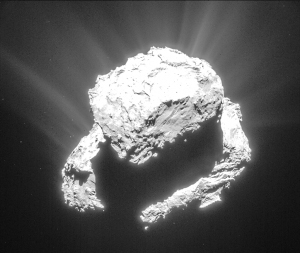
New areas of Comet 67P/C-G come out of the shadows

Comet 67P/C-G's smaller lobe

Rosetta has snapped a new image of Comet 67P/C-G’s smaller lobe that not only shows the increased activity around the nucleus but captures areas of the comet that had formally been in darkness. The image also includes the region where engineers think Philae landed, which I think is the area just below the brightest flat area in the center of the lobe. That this area is now in daylight is why engineers are hopeful that Philae might soon wake up.

0 comments

Sloppy biosafety procedures found at federal disease center

Does this make you feel safer? An investigation of a federal center for studying dangerous diseases in primates has found serious biosafety procedure violations.

Concerns arose at the center in Covington, Louisiana, after two rhesus macaques became ill in late November with melioidosis, a disease caused by the tropical bacterium Burkholderia pseudomallei. In January, the U.S. Centers for Disease Control and Prevention (CDC) and Department of Agriculture investigators traced the strain infecting the primates to a vaccine research lab working with mice. Last month, as the investigation continued, CDC suspended the primate center’s 10 or so research projects involving B. pseudomallei and other select agents (a list of dangerous bacteria, viruses, and toxins that are tightly regulated). Meanwhile, a report in USA Today suggested the bacterium might have contaminated the center’s soil or water.

…In addition, workers “frequently entered the select agent lab without appropriate protective clothing,” the release says. No center staff has shown signs of illness. On 12 March, however, Tulane announced that blood tests have found that one worker has low levels of antibodies to the bacterium, suggesting possible exposure at the center, according to ABC News.

Is there any area of government expertise that isn’t screwing up royally these days? As far as I can tell, the answer is no. The sooner we as a people can cut back on the government’s resources so that they won’t have the ability to do us harm, the better off we will be.

1 comment

Curiosity moves on

After six months and a short pause in work while engineers analyzed a short circuit, Curiosity has finally left the Pahrump Hills are on the slopes of Mount Sharp.

The rover has begun driving away from the Pahrump Hills outcrop where it had spent the last six months. On Thursday, March 12, it drove about 33 feet (about 10 meters) southwestward. The rover team plans on taking Curiosity through a valley called “Artist’s Drive” to reach higher geological layers of Mount Sharp. Curiosity is currently heading towards a rock outcrop known as “Garden City.”

The link has a nice image showing Curiosity’s recent travels as well as its future route.

1 comment

Magnetic field science satellites launched

An Atlas 5 rocket successfully launched four NASA research satellites Thursday night designed to study the behavior of the Earth and Sun’s magnetic fields at high resolution.

The quartet of observatories is being placed into an oblong orbit stretching tens of thousands of miles into the magnetosphere — nearly halfway to the moon at one point. They will fly in pyramid formation, between 6 miles and 250 miles apart, to provide 3-D views of magnetic reconnection on the smallest of scales.

Magnetic reconnection is what happens when magnetic fields like those around Earth and the sun come together, break apart, then come together again, releasing vast energy. This repeated process drives the aurora, as well as solar storms that can disrupt communications and power on Earth. Data from this two-year mission should help scientists better understand so-called space weather.

0 comments

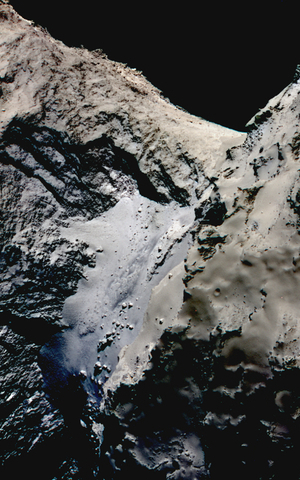
The neck of Comet 67P/C-G in color

The neck of Comet 67P/C-G

Rosetta’s high resolution camera has taken a color image of Comet 67P/C-G’s narrow neck, the area where the most plume activity has taken place.

When seen with the human eye, comet 67P/Churyumov-Gerasimenko is grey – all over. With its color filters Rosetta’s scientific imaging system OSIRIS, however, can discern tiny differences in reflectivity. To this effect, scientists from the OSIRIS team image the same region on the comet’s surface using different color filters. If, for example, the region appears especially bright in one of these images, it reflects light of this wavelength especially well.

“Even though the color variations on 67P’s surface are minute, they can give us important clues”, says OSIRIS Principal Investigator Holger Sierks from the Max Planck Institute for Solar System Research (MPS) in Germany. In a recent analysis performed by the OSIRIS team, the Hapi region clearly stands out from the rest of the comet: while most parts of 67P display a slightly reddish reflectivity spectrum as is common for cometary nuclei and other primitive bodies, the reflection of red light is somewhat lower in this region.

They as yet do not know exactly why the smooth area at the neck has a very slight blueish tinge, though they suspect it is because of the presence of a higher percentage of frozen water.

0 comments

Yutu reveals a complex lunar geology

The uncertainty of science: The Chinese lunar rover Yutu has uncovered a much more complicated geology history than previously predicted at its landing site on the moon.

Those data paint a detailed portrait of the Chang’e 3 landing site, which sits just 165 feet (50 m) away from a 1,475-foot-wide (450 m) crater known as C1. C1 was gouged out by a cosmic impact that occurred sometime between 80 million and 27 million years ago, the study authors said.

Yutu studied the ground it rolled over, characterized the craters it cruised past and investigated an oddly coarse-textured rock dubbed Loong, which measures about 13 feet long by 5 feet high (4 by 1.5 m). Overall, the rover’s observations suggest that the composition of its landing site is quite different from that of the places visited by NASA’s Apollo missions and the Soviet Union’s Luna program.

The rover found 9 distinct layers, suggesting numerous and different past events that layered the surface.

0 comments
1 475 476 477 478 479 729