
Twenty-three Indian Ocean nations test their own tsumani warning system
Twenty-three Indian Ocean nations successful tested their own tsumani warning system on Wednesday.
Twenty-three Indian Ocean nations successful tested their own tsumani warning system on Wednesday.
An archeology discovery in Africa suggests that Stone Age humans had an understanding of some basic but complicated chemistry.
Archaeologists have found evidence that, as long ago as 100,000 years, people used a specific recipe to create a mixture based on the iron-rich ochre pigment. The findings, published in the journal Science, “push back by 20,000 or 30,000 years” the evidence for when Homo sapiens evolved complex cognition, says Christopher Henshilwood of the universities of Bergen in Norway and Witwatersrand in Johannesburg, South Africa, who led the work. “This isn’t just a chance mixture, it is early chemistry. It suggests conceptual and probably cognitive abilities which are the equivalent of modern humans,” he says.
Amateur astronomers discover near Earth asteroid.
The uncertainty of science: Hesperia Planum, a giant basin on Mars, assumed for decades to have been formed by volcanic activity, now appears to have instead been formed by water.
Just another indication of how politically weak Obama is: The Democratic Senate has rejected Obama’s jobs plan.
Want to ask climategate scientist Michael Mann some questions? He will be presenting a paper today during a session on extreme weather and how it links to climate change at a geology conference in Minnesota.
The Dawn scientists have released another spectacular image of the south polar mountain on Vesta whose relative size is three times that of Mount Everest. More information about the image can be found here. From the caption:
The peak of Vesta’s south pole mountain, seen in the center of the image, rises about 13 miles (22 kilometers) above the average height of the surrounding terrain. Another impressive structure is a large scarp, a cliff with a steep slope, on the right side of this image. The scarp bounds part of the south polar depression, and the Dawn team’s scientists believe features around its base are probably the result of landslides.
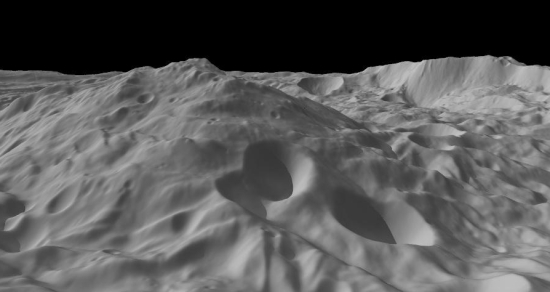
It appears the light gravity on Vesta allows for the formation of extreme topology.
From an email sent out by Ukrainian caver Alexander Klimchouk, received today:
Pavel Rud’ko of Krasnoyarsk (Rissia, Siberia) has reported the success of the recent expedition of Krasnoyarsk cavers to the Sarma Cave, Arabika Massif, Western Caucasus. The cave, previously explored by cavers from Krasnoyarsk and Irkutsk to -1570 m, has now been made almost 200 m deeper, to reach depth of -1760m and become the second deepest cave in the world.
The expedition led by Pavel Rud’ko has been carried out between September 1st – October 7th, 2011. The main branch has been pushed to -1760 m after breaking through a narrow meander at the old bottom. Many side and ascending passages in other parts of the cave have been also explored. The expedition performed systematic temperature measurements, and speleobiological and microbiological sampling.
With its new depth figure, Sarma surpassed the Illjuzia-Mezhonnogo-Snezhnaya system (-1753 m), located in the nearby Bzybsky Massif, and became the second deepest cave in the world, following Krubera Cave (-2191 m) located in the same massif. Thus, the western Caucasus now hosts three deepest caves in the worlds, two of them in Arabika Massif and one in Bzybsky Massif.
Some details of geology, hydrogeology and cave locations of Arabika can be found here. [pdf]
The uncertainty of science: Great Britain faces a “mini-ice age.”
Steven Hayward at Powerline has noted a new hockey stick graph, produced by scientists and described in detail by the journal Nature. This one is not specifically about climate, but about the reliability of science and the peer-review process itself. To quote the Nature article:
[Retraction] notices [of science papers] are increasing rapidly. In the early 2000s, only about 30 retraction notices appeared annually. This year, the Web of Science is on track to index more than 400 (see ‘Rise of the retractions’) — even though the total number of papers published has risen by only 44% over the past decade.
Below is the graph from the Nature paper. As Hayward says, “Lo and behold, it looks like a hockey stick! (Heh.)”
» Read more
An evening pause: “A grid of over 300 wooden matches is lit from one corner.” No sound, but you’ll watch anyway. There is something about a fire that compels us to watch.