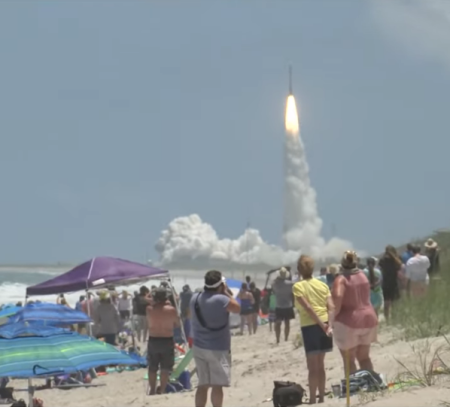
ULA successfully launches military reconnaissance satellite

screen capture from ULA's live stream
Screen capture from ULA’s live stream.

Capitalism in space: ULA successfully launched a Space Force military reconnaissance satellite using its Atlas 5 rocket. It also deployed two cubesats.

This was the first Atlas 5 launch in 2021. The satellite has now been deployed into its transfer orbit taking it to its final geosynchronous orbit.

The leaders in the 2021 launch race:

15 SpaceX
12 China
7 Russia
2 Rocket Lab
2 ULA

The U.S. now leads China 21 to 12 in the national rankings. Note also that though we are still six weeks short of the year’s halfway point, the U.S. is already more than halfway to its total from all of 2020, 40 launches. If this pace continues the U.S. has a good chance of reaching launch totals that were only routine during the mid-1960s, at the height of the beginnings of the space race.

0 comments

Today’s blacklisted American: Space Force officer fired for criticizing Marxism and condemning bigotry

Twitter's idea of debate
Show trials: What America’s Space Force apparently wants.

Blacklists are back and the military’s got ’em: Lt. Col. Matthew Lohmeier, a fourteen year veteran of the Air Force who became one of the first officers in the Space Force, has been fired by his superiors because he wrote a book criticizing Marxism and compounded that sin by repeating the criticisms, along with criticisms of the undeniable bigotry of critical race theory, on a public podcast.

From a military pr officer:

“This decision was based on public comments made by Lt. Col. Lohmeier in a recent podcast,” a Space Force spokesperson said in an email. “Lt. Gen. Whiting has initiated a Command Directed Investigation on whether these comments constituted prohibited partisan political activity.

Lohmeier’s temporary assignment in the wake of his removal was not immediately clear. [emphasis mine]

In addition, Amazon has decided to shadow ban Lohmeier’s book, Irresistible Revolution.

Irresistible Revolution has debuted in a strong position and as of this writing, it is #2 and #3 in military policy on Amazon, despite the fact that within hours of Lohmeier being relieved of his command, the book was no longer searchable on the publishing giant’s website. Only a direct link to the book’s page works at this time. It is available at Barnes & Nobles and other online booksellers such as Hudson and AbeBooks.

Lohmeier notes that he wrote the book entirely on his own time. He also informed the military of its existence and offered to have them review it before publication. The Pentagon said such a review was not required.

So what exactly did Lohmeier say that made his superior, Lt. Gen. Steven Whiting, believe he was participating in “partisan political activity”? From the Military.com come article:
» Read more

11 comments

X-37B testing beamed solar power from space

The U.S. Space Force’s X-37B mini-shuttle, presently in orbit for more than 300 days, is testing technology for capturing solar energy and beaming it back to Earth for use in the electricity grid.

Most of the robotic space drone’s duties on this mission, known as Orbital Test Vehicle-6 (OTV-6), are a tightly held secret. However, one known bit of research that the craft carries is the Photovoltaic Radio-frequency Antenna Module Flight Experiment, or PRAM-FX.

PRAM-FX is a Naval Research Laboratory (NRL) experiment that’s investigating transforming solar power into radio frequency (RF) microwave energy. PRAM-FX is a 12-inch (30.5 centimeters) square tile that collects solar energy and converts it to RF power.

Paul Jaffe, the innovation power beaming and space solar portfolio lead at NRL, said that PRAM-FX is not beaming microwave energy anywhere. Rather, the experiment is gauging the performance of sunlight-to-microwave conversion. To be measured is how the PRAM is performing from an efficiency standpoint and also from a thermal performance stance, he said.

The first results from PRAM were released in January, and showed an “8% total module efficiency,” which I think means it was able to beam down 8% of the solar energy that it gathered. This might seem poor, but if solar panels can provide that much of their energy for Earth use the pay-off could be quite large.

A much larger demonstration project will fly three different spacecraft in ’23 and ’24, each testing different components of the system.

9 comments

Space Force awards launch contracts (two each) to ULA and SpaceX

Capitalism in space: On March 9th the Space Force announced that it has awarded four new launch contracts, two each to ULA and SpaceX, for a total cost of just under $400 million, all to launch in ’23.

Under the task orders issued March 9, ULA and SpaceX will each launch two missions. ULA was awarded $225 million to launch and integrate the USSF-112 and USSF-87 missions on its Vulcan Centaur rockets while SpaceX was awarded $160 million to launch and integrate USSF-36 and launch NROL-69 on its Falcon 9 rockets.

Based on these numbers it appears ULA is charging about $113 million per launch for its new Vulcan Centaur rocket, while SpaceX is charging about $80 million using its Falcon 9.

For ULA, that is less that what it would charge using its Atlas 5 rocket, but not by much. For SpaceX this price is high, probably because the military might be demanding the company use new boosters for its launches.

These high prices for both are to me a sign of how little our federal government cares about saving any money for the taxpayer. While the competition brought on by SpaceX’s arrival is saving the military money, the way these contract awards are structured, with both ULA and SpaceX guaranteed to win them, neither company has an incentive to reduce its prices. Instead, they can overcharge and the military can do nothing about it.

In a more sane world the military would use the competition in the launch market to get an ever better deal. Instead, our federal government sees its budget as a blank check, and they are using it.

10 comments

Space Force ends development contracts with Blue Origin and Northrop Grumman

The Space Force, having chosen SpaceX and ULA as its sole launch providers, officially ended on December 31, 2020, its rocket development contracts with Blue Origin and Northrop Grumman.

The Air Force awarded Launch Service Agreements to Blue Origin, Northrop Grumman and United Launch Alliance. These were six-year public-private partnerships where both the government and the contractors agreed to invest in rocket development and infrastructure required to compete in the National Security Space Launch program.

The plan from day one was to discontinue the LSAs with companies that did not win a National Security Space Launch procurement contract. Blue Origin and Northrop Grumman lost to ULA and SpaceX, which were selected in August 2020. The Space and Missile Systems Center confirmed in a statement to SpaceNews that the LSAs with Blue Origin and Northrop Grumman ended in Dec. 31, 2020.

From October 2018 through December 2020, Blue Origin was paid $255.5 million. The original six-year agreement was worth $500 million. Northrop Grumman got $531.7 million over that same period, nearly two-thirds of the total value of the LSA which was $792 million.

This whole deal stinks to high heaven. First, it never made any sense for the military to restrict bidding on future launches to just two companies. Such a restrictions smells of a cartel deal designed to play favorites, something the government should not do. It also ends up costing the government more, as it limits competition.

Second, the money handed out sure looks like nice pay-offs to all these big companies, designed to pay company salaries rather than real design work. SpaceX chose not to take it, because it did not want to be beholden to the military’s bureaucracy in how it developed Starship/Super Heavy. That choice has proven wise, as the deal slowed development of both Blue Origin’s New Glenn and ULA’s Vulcan rockets by at least a year, while SpaceX Starship development has moved forward far quicker.

Moreover, its seems very inappropriate for ULA to still be getting this government cash while SpaceX does not. In truth, neither should get a dime unless they actually sign a contract to launch something for the Space Force. Otherwise it is just a form of kickback and a misuse of the taxpayer’s money.

Not that my complaining here will change anything. The big aerospace industry has been addicted to these kind of government payoffs for decades, and apparently will continue to be so addicted for the foreseeable future.

2 comments

Air Force terminates development contracts to ULA, Blue Origin, Northrop Grumman

In awarding ULA and SpaceX exclusive launch rights for all launches through 2026, the Air Force also decided to end prematurely the development contracts to ULA, Blue Origin, and Northrop Grumman aimed at helping these companies develop new rockets.

An issue at hand is the termination of the Launch Service Agreement contracts that the Air Force awarded in October 2018 to Blue Origin and Northrop Grumman, as well as to ULA. The purpose of the agreements was to help Phase 2 competitors pay for launch vehicle development and infrastructure. Blue Origin received $500 million; Northrop Grumman $792 million and ULA $967 million. The funds were to be spread out through 2024, and the Air Force from the beginning said the LSAs would be terminated with those companies that did not win a Phase 2 procurement contract.

Despite political pressure to not end the LSAs, the agreements will be terminated, Assistant Secretary of the Air Force for Acquisition Will Roper said Aug. 7 during a video conference with reporters. “We will work with those two companies to determine the right point to tie off their work under the LSA agreements,” Roper said. The intent of the LSAs “was to create a more competitive environment leading into Phase 2,” he said. “The point is not to carry them indefinitely.”

LSA funds supported the development of Blue Origin’s New Glenn rocket and Northrop Grumman’s OmegA launch vehicle. ULA will continue to receive funds for its Vulcan Centaur vehicle.

Almost immediately after the award of these contracts was announced in 2018, ULA and Blue Origin announced one year delays in the development of Vulcan and New Glenn. Apparently, meeting the additional requirements of military’s bureaucracy in exchange for getting the cash slowed development.

Now they won’t be getting a large part of that cash, making the decision to take it a deal with the devil. The delay in development has definitely hurt both companies in their competition with SpaceX. First, it likely has raised the cost and complexity of their new rockets, making it harder to compete in price. Second, the delay has given SpaceX more time to grab more customers while improving its own rockets.

SpaceX initially protested not getting a share of this development money, but has subsequently chosen to no longer pursue such government money for Starship because it doesn’t want itself hampered by obtuse government officials and their mindless requirements.

Meanwhile, Northrop Grumman’s Omega rocket is almost certainly dead. That company took the old big space company approach, structuring development around government cash. Without it there is no R&D money at Northrop Grumman to continue work. Furthermore, Omega was designed to serve only once customer, the military. Without any launch contracts there are no customers for Omega, especially because it likely has too high a launch price.

13 comments

California & Space Force to encourage private launches at Vandenberg

Capitalism in space: The state government of California has signed an agreement with the U.S. Space Force to expand private launches facilities at Vandenberg Space Force Base

It appears that the Space Force is aggressively trying to encourage new private launch operations to take flight out of Vandenberg. The article however is very unclear about exactly what this new agreement accomplishes. I could not find its actual text, and from the story all we get is typical government blather:

[Chris Dombrowski, acting director of the Governor’s Office of Business and Economic Development] said the organizations under the [agreement] will develop a “master plan that identifies the required infrastructure, human capital development, governance and financing necessary to support the United States Space Force mission and position California as a leader in the future of the commercial space industry.”

“This MOU serves as a critical investment in California’s innovative economy as we work to safely recover from the COVID-19 induced recession,” he said.

If anything, it appears that California’s Democratic and very power-hungry government is using this agreement to take control of any new private operations, so that it can dictate how they operate, according to its whims. If so, don’t expect much private enterprise to prosper at Vandenberg.

5 comments

Defense Department cancels small rocket contract awards

The Department of Defense yesterday withdrew the small contracts it had given to six small rocket companies on June 16 using funds allocated to help companies impacted by the Wuhan flu panic lock downs.

According to multiple industry sources, the selection of the six companies drew widespread criticism because it was unclear how these suppliers were selected over others. When contracts are awarded without an open competition, DoD by law has to file a “Justification & Approval” document explaining why an award was sole-sourced. No J&A documents were filed in this case.

This certainly appears fishy, as there are far more than six startups trying to capture market share in the smallsat launch market. Defense could now allow companies to competitively bid on this money, estimated to be about $115 million total, but it is unclear whether it will.

0 comments

Space Force restructures/reduces former Air Force command structure

The new Space Force has restructured and reduced the former Air Force command structure as it begins to take over military space operations from the latter agency.

The USSF field organization will consist of three echelons of command, where the Air Force currently is organized into five echelons. USSF’s organizational structure will initially consolidate and align all organize, train and equip mission execution from former Air Force space-related units.

…In order of hierarchy, the USSF field echelons are named field commands, deltas and squadrons. There will be three field commands aligned with specific mission focuses: Space Operations Command, Space Systems Command, and Space Training and Readiness Command. SpOC and SSC will be led by three-star general officers, and STARCOM will be led by a two-star general.

Deltas will be O-6 led and will be organized around a specific function – operations, installation support, training, etc. Within the deltas will be squadrons focused on specific tactics. When the field command structure is fully implemented, it will eliminate one general officer echelon and one O-6 echelon of command. Functions formerly performed at the eliminated echelons will be realigned where appropriate within the USSF.

This sounds good, but we shall see. New government agencies proposed by our federal government to streamline bureaucracies somehow always end up bloating those bureaucracies instead. The Space Force was created with this laudable goal. This press release at least suggests they are trying to achieve it.

3 comments

Atlas 5 launches X-37B spacecraft

Capitalism in space: ULA’s Atlas 5 rocket this morning successfully launched one of the military’s two X-37B reusable mini-shuttles into orbit.

I have embedded the video of the launch below the fold, with the launch occurring at 23:50.

As has been standard procedure during all previous X-37B missions, only a few details about the payloads have been released, though the military has said it wishes to be a bit more open this time.

“This sixth mission is a big step for the X-37B program,” said Randy Walden, director and program executive officer for the Air Force Rapid Capabilities Office. “This will be the first X-37B mission to use a service module to host experiments. The incorporation of a service module on this mission enables us to continue to expand the capabilities of the spacecraft and host more experiments than any of the previous missions.” The service module is attached to the aft end of the X-37B spaceplane, providing additional capacity for experiments and payloads. The X-37B itself, measuring more than 29 feet (8.9 meters) long, also has a cargo bay inside its fuselage.

Secretary of the Air Force Barbara Barrett said Wednesday that the Air Force’s Rapid Capabilities Office is partnering with the U.S. Space force and the Air Force Research Laboratory on the next X-37B mission. … “This important mission will host more experiments than any prior X-37B flight, including two NASA experiments,” Barrett said Wednesday. “One is a sample plate evaluating the reaction of select significant materials to the conditions in space. The second studies the effect of ambient space radiation on seeds.”

The X-37B also carries a space-based solar power experiment. “A third experiment designed by the Naval Research Laboratory transforms solar power into radio frequency microwave energy, then studies transmitting that energy to Earth,” Barrett said.

Once in orbit, the X-37B will also release a small satellite named FalconSat 8. Developed by Air Force Academy cadets in partnership with the Air Force Research Laboratory, the small satellite carries five experimental payloads. It will be operated by by the Air Force Academy’s Cadet Space Operations Squadron

They have not said how long this X-37B will remain in orbit.

The leaders in the 2020 launch race:

8 China
6 SpaceX
6 Russia
6 Europe (Arianespace)
3 ULA

The U.S. now leads China 11 to 8 in the national rankings, and will likely increase that lead very early tomorrow in the next day or so when SpaceX completes its next scheduled Falcon 9 Starlink launch. (Because of weather they have pushed back one day.
» Read more

17 comments

Air Force study rubber-stamps Air Force desire to limit launch companies

Garbage in, garbage out: An Air Force commissioned RAND study released yesterday has confirmed the Air Force’s desire to restrict the award of launch contracts for the next decade to only two companies.

“We asked RAND to independently double check the assumptions we used to build our acquisition strategy,” said Col. Robert Bongiovi of the Air Force’s Space and Missile Systems Center in California. “What we found was that our acquisition strategy encompasses RAND’s recommendations as we are already making prudent preparations for a market that will only sustain two providers with our phase two contract structure.”

…Part of the RAND report also recommended that the military closely watch companies over the coming years to see which are the most stable. “The U.S. Space Force should make prudent preparations for a future with only two U.S. providers of NSS-certified heavy lift launch, at least one of which may have little support from the commercial marketplace,” RAND Corporation said of its first main recommendation.

Though the report does suggest that the military continue its development program to help three companies through 2023, it reiterates the military’s belief that there simply isn’t enough business to support more than two companies.

For this reason, the Air Force space division, now the Space Force, had wanted to restrict bidding in the 2020s on its future satellite launches to only two companies out of the four (ULA, SpaceX, Northrop Grumman, Blue Origin) that hope to compete for this business. This report is their attempt to justify that decision.

However, the decision has been repeatedly delayed, partly because of a protest of the plan by Blue Origin and partly because a lot of political pressure in the background from those four companies, none of which want to be excluded from future bidding. It was originally going to be made last year, and is now delayed to later this year.

With the release of the report, the military also suggested that if Congress gives it more money, it might be able to open up bidding to more companies. How typical. Instead of trying to trim costs by allowing competition, the Space Force is now maneuvering elected officials to pump up its budget so that these companies all get more cash while picking the pockets of the taxpayer.

This is the same thinking that caused Boeing and Lockheed Martin to merge their launch operations into ULA and for the Air Force to give that new company a monopoly on launches in 2005. The Air Force assumed then that there wasn’t enough launch business for both companies. Rather than compete to lower costs so that both the Air Force and the private sector could afford more launches, the two companies agreed with this Air Force conclusion and teamed up with the Air Force to form a cartel to control the bulk of the U.S. launch market, while charging the Air Force $200-$500 million per launch.

Then SpaceX comes along and proves them completely wrong. It not only gets more than enough business to make a lot of money (in the billions), it charges only $60 million per launch. When the Air Force tried to deny it the right to bid against ULA for military launches, SpaceX sued, and won.

Now the Space Force wants to do the same thing in the 2020s, limiting to two the number of companies that can bid on contracts. All this will do is raise launch costs, and limit competition.

In the end, I doubt seriously if the Space Force effort here will work. All four companies are developing rockets, and all four should have the right to bid on all future launches. If the military tries to exclude any, they will sue, as SpaceX did, and win. Moreover, the military’s assumption that all four companies cannot survive because it doesn’t have enough business for all four is patently false. SpaceX proved them wrong. All these companies have to do is what SpaceX did, keep their launch costs low enough so that other private customers can buy their services.

There will then be more than enough business to go around, for all.

9 comments

Rocket Lab completes new launchpad at Wallops

Capitalism in space: Rocket Lab has signaled the completion of new launchpad at Wallops Island in the U.S. by the first roll out of an Electron rocket.

The actual launch of a Space Force test satellite is set for sometime in the summer.

Meanwhile, the company is ready to resume launches in New Zealand, but is stymied by the Wuhan panic.

Beck tells the Herald that his company’s Mission Control centre in Auckland is now fully operational with NZ’s move to level 3.

However, its “Don’t Stop Me Now” mission from Launch Complex 1 on the Mahia Peninsula – originally planned for March 24 – is still on hold, with no estimated launch date. “We’re now ready to launch, but currently border restrictions are preventing specialists from entering the country, which is having a negative impact. Our team is on standby to launch as soon as those restrictions are eased,” Beck says.

I hope the company has the resources to weather these government-imposed delays.

0 comments
1 9 10 11 12 13 14