Sierra Nevada introduces its cargo version of Dream Chaser

The competition heats up: Sierra Nevada has unveiled a revised cargo version of Dream Chaser, competing for NASA next round of freighter contracts to ISS.

They have made a number of changes, but the most significant is the new folding wings, allowing the spacecraft to fit inside the fairings of most rocket systems. This also eliminates one of the concerns I have read about the previous design on whether its wings could have withstood exposure to the maximum atmospheric stresses experienced during launch.

2 comments

Lockheed Martin enters the competition to supply cargo for ISS

The competition heats up: Lockheed Martin has joined Sierra Nevada, Orbital ATK, Boeing, and SpaceX in bidding for NASA’s next contract to ferry cargo to ISS.

Lockheed’s proposal is different in that it proposes a two spacecraft operation. The cargo would be hauled up in a very simple storage bin, where a long-term orbital tug would grab it and take it to ISS. The idea is that they would only have to build and launch the complicated thrusters, robot arms, computers, and avionics of their cargo freighter once, thereby saving money.

Two companies will be chosen. Since the first competition back in the mid-2000s, when NASA picked SpaceX and Kistler for the first cargo round, the quality of the bids has improved remarkably. Back then, NASA had to choose from a bunch of new companies, none of which had ever done this before. The big companies (Boeing, Lockheed Martin) then poo-pooed the competition, saying that it couldn’t be done as cheap as the new companies claimed. After Kistler went under and was replaced by Orbital, they and SpaceX proved the big companies were wrong.

Now the competition includes all the big players, except that those big players are no longer offering expensive systems but cut-rate efficient designs that are as cost effective as SpaceX and Orbital’s first designs.

2 comments

Water ice volcanoes on Ceres

Data collected by Dawn since it entered orbit around Ceres on March 6 now strongly suggests that the bright spots on the surface are produced by venting water,

Andreas Nathues, principal investigator for Dawn’s framing camera, says the feature has spectral characteristics that are consistent with ice. Intriguingly, the brightness can be seen even when the spacecraft is looking on edge at the crater rim, suggesting that the feature may be outgassing water vapor above the rim and into space. “Ceres seems to be indeed active,” he says. The feature brightens through the course of the day, and then shuts down at night. Nathues says the behavior is similar to that of comets.

More here. By mid-April Dawn should finally settle this with high resolution images.

0 comments

Virgin Galactic says LauncherOne will make its first flight in 2016

The competition heats up: The CEO of Virgin Galactic, George Whitesides, revealed at a satellite conference that they are on schedule for LauncherOne to make its first flight before the end of 2016.

The company recently started hot-fire tests of an engine called Newton 3 developed by Virgin Galactic for the first stage of LauncherOne, Whitesides said. That engine, capable of generating 265,000 to 335,000 newtons of thrust, uses liquid oxygen and kerosene propellants. “We’re now to the point where we’re very confident that we can build a very affordable rocket,” Whitesides said. After his speech, he said the company was on schedule to begin flights by the end of 2016, with even initial test flights likely carrying some satellites.

That it is Whitesides and not Richard Branson saying this makes me more confident that it is true, though I remain very skeptical of any promise made by anyone these days at Virgin Galactic. However, the impression from this article confirms an earlier impression I have had, that the company is beginning to shift its resources away from suborbital tourism with SpaceShipTwo and towards orbital launch services with LauncherOne. Branson had announced LauncherOne as a concept in 2012, but only recently have we begin to hear of any actual work on it.

1 comment

A Mars One finalist accuses the company of fraud

One of the finalists in the one-way-to-Mars competition by the company Mars One has now accused the company of fraud.

Most egregiously, many media outlets continue to report that Mars One received applications from 200,000 people who would be happy to die on another planet — when the number it actually received was 2,761.

As [finalist Joseph] Roche observed the process from an insider’s perspective, his concerns increased. Chief among them: that some leading contenders for the mission had bought their way into that position, and are being encouraged to “donate” any appearance fees back to Mars One — which seemed to him very strange for an outfit that needs billions of dollars to complete its objective. “When you join the ‘Mars One Community,’ which happens automatically if you applied as a candidate, they start giving you points,” Roche explained to me in an email. “You get points for getting through each round of the selection process (but just an arbitrary number of points, not anything to do with ranking), and then the only way to get more points is to buy merchandise from Mars One or to donate money to them.”

There’s more at the link. Essentially, the whole operation has apparently devolved into a petty scam to milk money from the finalists themselves.

None of this surprises me. From the beginning I considered the whole proposal unrealistic, which thus almost forced the people in charge to commit fraud.

1 comment

New results from Messenger at Mercury

Hollows on Mercury

As Messenger nears the end of its lifespan orbiting Mercury, the project scientists have put together a slate of talks on what they have learned, presented today at the 46th annual Lunar and Planetary Science Conference in Houston.

The images that go with these presentations can be found here.

The image on the right is a close-up of the mysterious and unexpected hollows that Messenger found scattered everywhere on Mercury’s surface. According to today’s presentation, scientists now believe they are very recent features, formed when material with a lower boiling point evaporated away because of Mercury’s harsh and very hot environment. Imagine for example a vein of dry ice in a rock crack. The temperature rises above freezing and the dry ice evaporates. And like the convection bubbles in tomato sauce as it simmers, some of that evaporation pushes its way up by popping out a bubble and leaving behind a hollow.

In the case of Mercury the material is likely not dry ice, though scientists as yet are unsure what it is.

They are also presenting talks on magnesium on Mercury, the planet’s many scarps, and detailed observations of the permanently shadowed polar craters that might have water-ice in them.

0 comments

New areas of Comet 67P/C-G come out of the shadows

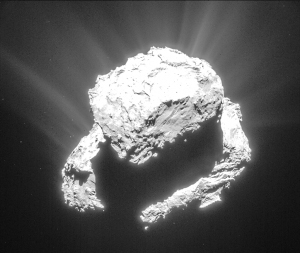
Comet 67P/C-G's smaller lobe

Rosetta has snapped a new image of Comet 67P/C-G’s smaller lobe that not only shows the increased activity around the nucleus but captures areas of the comet that had formally been in darkness. The image also includes the region where engineers think Philae landed, which I think is the area just below the brightest flat area in the center of the lobe. That this area is now in daylight is why engineers are hopeful that Philae might soon wake up.

0 comments

Curiosity moves on

After six months and a short pause in work while engineers analyzed a short circuit, Curiosity has finally left the Pahrump Hills are on the slopes of Mount Sharp.

The rover has begun driving away from the Pahrump Hills outcrop where it had spent the last six months. On Thursday, March 12, it drove about 33 feet (about 10 meters) southwestward. The rover team plans on taking Curiosity through a valley called “Artist’s Drive” to reach higher geological layers of Mount Sharp. Curiosity is currently heading towards a rock outcrop known as “Garden City.”

The link has a nice image showing Curiosity’s recent travels as well as its future route.

1 comment

Russia abandons super-rocket designed to compete with SLS

The competition heats up: Russia has decided to abandon an expensive attempt to build an SLS-like super-rocket and will instead focus on incremental development of its smaller but less costly Angara rocket.

Facing significant budgetary pressures, the Russian space agency, Roscosmos, has indefinitely postponed its ambitious effort to develop a super-heavy rocket to rival NASA’s next-generation Space Launch System, SLS. Instead, Russia will focus on radical upgrades of its brand-new but smaller Angara-5 rocket which had its inaugural flight in Dec. 2014, the agency’s Scientific and Technical Council, NTS, decided on Thursday, Mar. 12.

For Russia’s space industry, it appears that these budgetary pressures have been a blessing in disguise. Rather than waste billions on an inefficient rocket for which there is no commercial demand — as NASA is doing with SLS (under orders from a wasteful Congress) — they will instead work on further upgrades of Angara, much like SpaceX has done with its Falcon family of rockets. This will cost far less, is very efficient, and provides them a better chance to compete for commercial launches that can help pay for it all. And best of all, it offers them the least costly path to future interplanetary missions, which means they might actually be able to make those missions happen. To quote the article again:

By switching upper stages of the existing Angara from kerosene to the more potent hydrogen fuel, engineers might be able to boost the rocket’s payload from current 25 tons to 35 tons for missions to the low Earth orbit. According to Roscosmos, Angara-A5V could be used for piloted missions to the vicinity of the Moon and to its surface.

In a sense, the race is now on between Angara-A5V and Falcon Heavy. It shall be quite exciting to watch this competition unfold between big government and private enterprise over the next few decades.

0 comments

Magnetic field science satellites launched

An Atlas 5 rocket successfully launched four NASA research satellites Thursday night designed to study the behavior of the Earth and Sun’s magnetic fields at high resolution.

The quartet of observatories is being placed into an oblong orbit stretching tens of thousands of miles into the magnetosphere — nearly halfway to the moon at one point. They will fly in pyramid formation, between 6 miles and 250 miles apart, to provide 3-D views of magnetic reconnection on the smallest of scales.

Magnetic reconnection is what happens when magnetic fields like those around Earth and the sun come together, break apart, then come together again, releasing vast energy. This repeated process drives the aurora, as well as solar storms that can disrupt communications and power on Earth. Data from this two-year mission should help scientists better understand so-called space weather.

0 comments
1 1,072 1,073 1,074 1,075 1,076 1,329