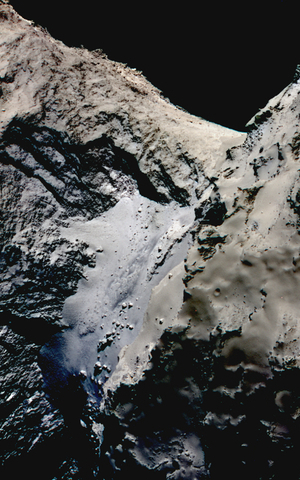
The neck of Comet 67P/C-G in color

The neck of Comet 67P/C-G

Rosetta’s high resolution camera has taken a color image of Comet 67P/C-G’s narrow neck, the area where the most plume activity has taken place.

When seen with the human eye, comet 67P/Churyumov-Gerasimenko is grey – all over. With its color filters Rosetta’s scientific imaging system OSIRIS, however, can discern tiny differences in reflectivity. To this effect, scientists from the OSIRIS team image the same region on the comet’s surface using different color filters. If, for example, the region appears especially bright in one of these images, it reflects light of this wavelength especially well.

“Even though the color variations on 67P’s surface are minute, they can give us important clues”, says OSIRIS Principal Investigator Holger Sierks from the Max Planck Institute for Solar System Research (MPS) in Germany. In a recent analysis performed by the OSIRIS team, the Hapi region clearly stands out from the rest of the comet: while most parts of 67P display a slightly reddish reflectivity spectrum as is common for cometary nuclei and other primitive bodies, the reflection of red light is somewhat lower in this region.

They as yet do not know exactly why the smooth area at the neck has a very slight blueish tinge, though they suspect it is because of the presence of a higher percentage of frozen water.

0 comments

Yutu reveals a complex lunar geology

The uncertainty of science: The Chinese lunar rover Yutu has uncovered a much more complicated geology history than previously predicted at its landing site on the moon.

Those data paint a detailed portrait of the Chang’e 3 landing site, which sits just 165 feet (50 m) away from a 1,475-foot-wide (450 m) crater known as C1. C1 was gouged out by a cosmic impact that occurred sometime between 80 million and 27 million years ago, the study authors said.

Yutu studied the ground it rolled over, characterized the craters it cruised past and investigated an oddly coarse-textured rock dubbed Loong, which measures about 13 feet long by 5 feet high (4 by 1.5 m). Overall, the rover’s observations suggest that the composition of its landing site is quite different from that of the places visited by NASA’s Apollo missions and the Soviet Union’s Luna program.

The rover found 9 distinct layers, suggesting numerous and different past events that layered the surface.

0 comments

Virgin Galactic test flights to resume in 2015?

I’ll believe it when I see it: The executive director of the New Mexico Spaceport Authority, which runs Spaceport America, said Tuesday that she hopes Virgin Galactic will resume test flights of a SpaceShipTwo suborbital ship sometime in 2015, with commercial flights beginning in 2016.

She claimed that work on the new ship is about 80% completed, with construction of another ship also underway.

Forgive me if I have my doubts. Virgin Galactic has spent more than a decade making these promises, with no results.

0 comments

A new song for space

At a press conference Sarah Brightman yesterday revealed that she is working with Andrew Lloyd Webber to create a new song to sing when she visits the International Space Station later this year.

She also said that she will sing it from the station near the end of her visit. While the reason she gave for this schedule was because she needed time to adjust to weightlessness, I also see this as good marketing, allowing time for a pr build-up to get the largest audience possible.

0 comments

Two astronauts gear up for one year in space

The final preparations are under way for sending two astronauts, one American and one Russian, to ISS for a full year.

Their launch is scheduled for March 27 in a Soyuz capsule.

One other cool aspect of this long mission: The American astronaut, Scott Kelly, has a twin brother, Mark Kelly, who is also an astronaut, though retired. Mark will be duplicating some of Scott’s in-space activities during the mission. Doctors will also compare how Scott’s body changes in weightlessness over time, in comparison to his brother here on Earth.

0 comments

Aerojet Rocketdyne to cut costs and streamline operations

The competition heats up: In renaming itself from GenCorp to Aerojet Rocketdyne, the company also announced today a four year program to cut costs and reduce its workforce by 10%.

It appears that most of the cuts will come from upper management, which suggests the company has identified fat it needs to get rid of in order to compete effectively in the re-energized aerospace industry.

0 comments

India’s space budget remains stable

India this year has budgeted $1.2 billion for ISRO, the government agency that runs its space program.

The most astonishing thing I learned from this article however was this tidbit:

The total, presented to the parliament Feb. 28, is roughly level with the 2014-15 budget presented last year. However, ISRO typically spends significantly less money than is allocated in any given budget year — for 2014-15 it spent just 58 billion rupees of the 72 billion rupee allocation — so it seems likely that spending in the coming year will fall short of 73.9 billion rupees. ISRO spokesman Deviprasad Karnik acknowledged the possibility that ISRO’s budget will be reduced before the end of the year. [emphasis mine]

Who ever heard of any government agency in the United States routinely spending less than its budget. The idea is unheard of!

1 comment
1 1,073 1,074 1,075 1,076 1,077 1,329