Uranus’s moon Oberon, of which we know little

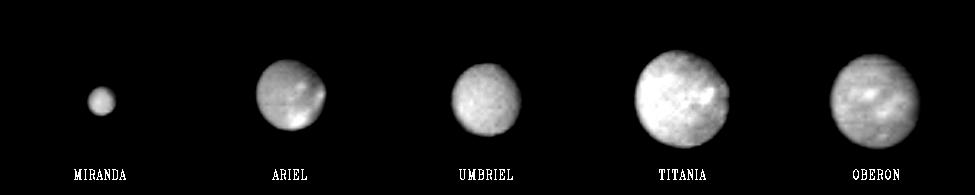
Uranus' five biggest moonsThe historically known moons of Uranus. Click for original NASA press release.

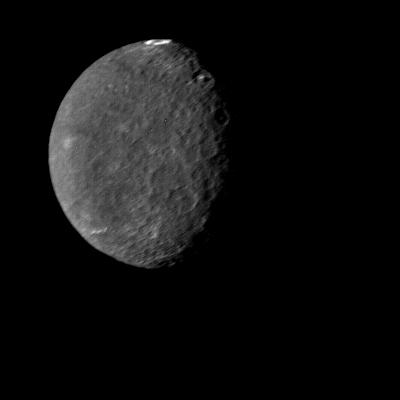
Oberon, as seen by Voyager-2
Click for original image.

Today we finish our week-long tour of the five largest moons of Uranus, all discovered by astronomers before the start of the space age, and imaged successfully if not very completely by Voyager-2 when it did its fly-by of the planet on January 24, 1986. The gallery of these moons above was taken by the spacecraft when it was on approach, still about three million miles from Uranus, and shows them in order from the innermost on the left to the outermost on the right. They are also scaled to show their relative sizes. To see Voyager-2’s close-up images of the four inner moons, posted earlier this week, go here, here, here, and here.

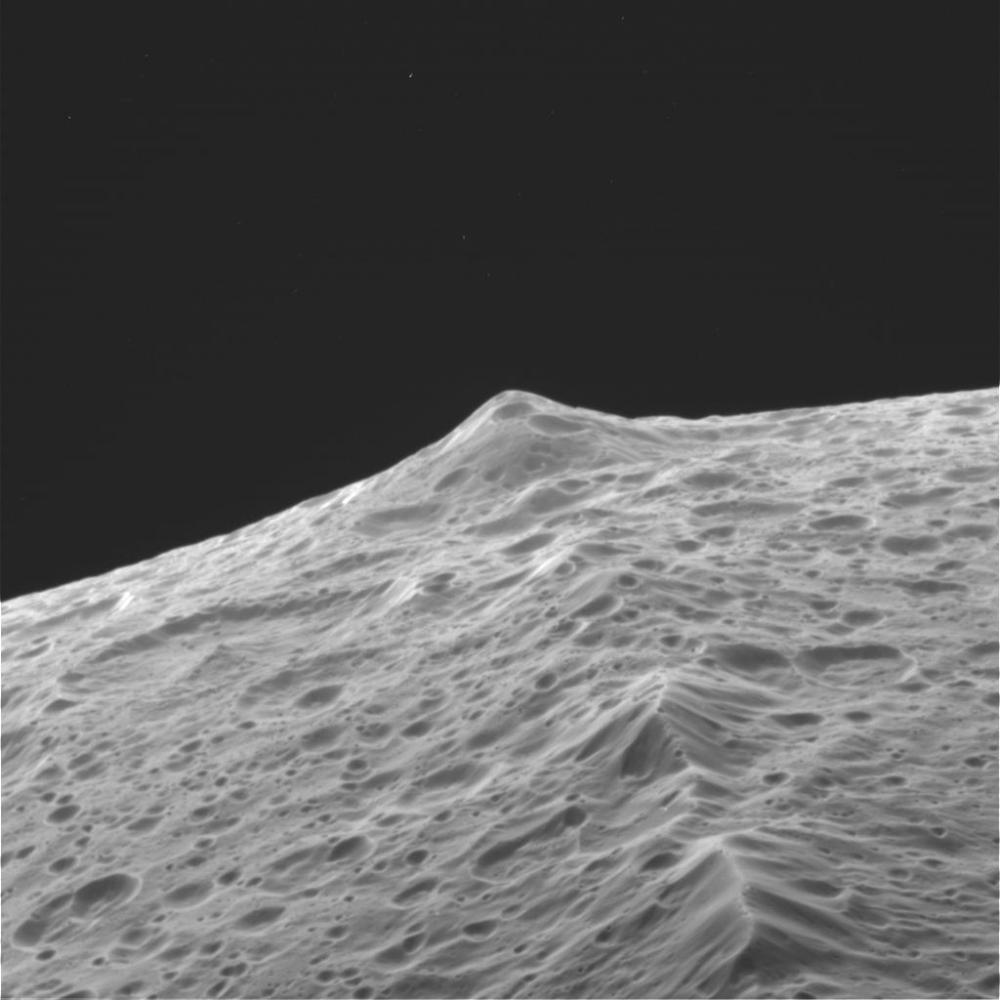
The picture to the right, cropped slightly to post here, is Voyager-2’s only high resolution image of Oberon, the outermost moon of this group. From NASA’s press release:

This Voyager 2 picture of Oberon is the best the spacecraft acquired of Uranus’ outermost moon. The picture was taken shortly after 3:30 a.m. PST on Jan. 24, 1986, from a distance of 410,000 miles. The color was reconstructed from images taken through the narrow-angle camera’s violet, clear and green filters.

The picture shows features as small as 7 miles on the moon’s surface. Clearly visible are several large impact craters in Oberon’s icy surface surrounded by bright rays similar to those seen on Jupiter’s moon Callisto. Quite prominent near the center of Oberon’s disk is a large crater with a bright central peak and a floor partially covered with very dark material. This may be icy, carbon-rich material erupted onto the crater floor sometime after the crater formed. Another striking topographic feature is a large mountain, about 6 km (4 mi) high, peeking out on the lower left limb.

Oberon is about 946 miles in diameter, making it the tenth-largest moon in the solar system. Because of the quickness of Voyager-2’s fly-by, it could get no closer images, and none of the planet’s nightside. Thus, only 40% of the surface has been photographed, and at not very high resolution.

Later spectroscopy from Hubble and other telescopes suggests there is water ice on the surface. Other data suggests Oberon may have a liquid underground ocean, but that conclusion is highly uncertain. Other than these vague facts and the image to the right, we essentially know almost nothing about this moon. Like Titiania, Uranus’s largest moon, Voyager-2’s data merely gave us a tantalizing glimpse, and that glimpse is now forty years old. No other mission has been there since, and none is planned in the near future.

Tomorrow, to summarize this tour, I will outline further what little we know of Uranus and its moons

0 comments

German rocket startup signs deal to launch from SaxaVord spaceport in Scotland

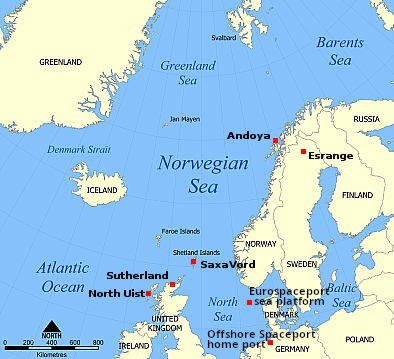
Proposed or active spaceports in North Europe

The German rocket startup HyImpulse yesterday signed a contract with the SaxaVord spaceport on the Shetland Islands in Scotland to do a suborbital test launch at SaxaVord later this year.

HyImpulse has agreed a launch deal with the Unst spaceport, with the aim of a suborbital launch in quarter three of 2026. It will be the second launch of the company’s SR75 suborbital launch vehicle following a successful lift-off in Australia in 2024, which used a hybrid propulsion system involving paraffin “candle wax” and liquid oxygen. HyImpulse said that initial launch, from Koonibba, showed the vehicle could demonstrate “stable flight validating system performance under operational conditions”.

Under the agreement, SaxaVord will provide launch infrastructure and operational support for the launch of the SR75.

HyImpulse is the second German rocket startup to sign a deal to launch from SaxaVord. Rocket Factory Augsburg plans its second attempt to do an orbital launch from there later this year. In 2024 it was gearing up to do that launch but an explosion during a full static fire test of the rocket’s first stage killed that plan.

Considering the red tape the United Kingdom has imposed on rocket companies, bankrupting two and delaying all launches for years from both SaxaVord and the other proposed spaceport in Sutherland, Scotland, I am surprised these two rocket companies have signed these deals. Maybe the UK’s Civil Aviation Authority (CAA) has been reformed and eased that red tape.

Or maybe HyImpulse will find its plans blocked by the CAA as that agency once again ponders at glacial pace the issuing of a new launch license. Stay tuned.

2 comments

OHB wins $285 million contract to build weather satellite constellation for ESA

ESA logo

Capitalism in space The Swedish subsidiary of the European aerospace company OHB yesterday announced it has won a $285 million contract from the European Space Agency (ESA) to build and maintain a six satellite weather satellite constellation.

The company had already successfully launched and tested a single demo satellite, proving a small satellite could do the job.

The foundation for this is the Arctic Weather Satellite (AWS), which OHB Sweden successfully placed in orbit as a demonstrator more than a year ago. The OHB SE subsidiary developed the small satellite on behalf of the European Space Agency ESA in record time, using a deliberately chosen New Space approach. Only three years passed between contract award and launch.

This new constellation is dubbed EUMETSAT Polar System – Sterna (EPS-Sterna), and will supplement and eventually replace the expensive government-built Eumetsat weather constellation presently in orbit.

OHB Sweden is the prime contractor for the delivery of the satellites for the EPS Sterna constellation. The consortium also includes Omnisys in Sweden as the supplier of the microwave instruments, which constitute the primary meteorological payload. A total of 20 satellites will be delivered under the contract. The industrial team includes approximately 30 companies. Germany is also strongly represented by SMEs that will contribute key hardware for the instrument and the satellite platform. The satellites will be procured by EUMETSAT through ESA. EUMETSAT itself will develop the ground segment, procure and provide the launch services, operate the satellites, manage the constellation and distribute the data through its data distribution mechanisms, which has a planned operational lifetime of 13 years.

This contract is another example of Europe’s fast shift in the past three years from the government model to the capitalism model. It took ESA almost a decade to finally decide to make that shift, but once it did it seems to be moving far faster than NASA did to implement it.

0 comments

Update on SpaceX’s preparations for the 12th orbital test flight of Starship/Superheavy

Link here. The testing has apparently verified the fueling system of Superheavy at the new launchpad.

Starship Flight 12 took another step toward launch, with Booster 19 completing an initial test campaign on the newly commissioned Pad 2 at Starbase, Texas. Culminating in a short Static Fire test, the series of tests was a first for Pad 2, the Block 3/V3 Super Heavy Booster, and for the upgraded Raptor 3 outside of single engine testing.

As the inaugural vehicle to undergo operations on this pad, B19’s campaign served as both a booster qualification test and a commissioning milestone for the expanded launch infrastructure, paving the way for a long-awaited static fire test of its Raptor 3 engines.

Lots of details worth reading. Ground testing will now shift to Starship. All in all, it does appear that an early April launch is likely.

4 comments

Scientists: Shadowcam images suggest there is little water in permanently shadowed lunar craters

Shadowcam-LRO mosaic
The floor of Shackleton Crater showing no obvious ice deposits,
as seen by Shadowcam, imposed on a Lunar Reconnaissance Orbiter
image. The black cross marks the south pole. Click for original image.

In a new paper published yesterday, the science team for the low-light Shadowcam instrument on South Korea’s lunar orbiter Danuri confirmed their earlier conclusion from 2024, that there appears to be far less water ice than expected in the permanently shadowed lunar craters near the Moon’s south pole. From their abstract:

We used the high-reflectance and forward-scattering optical properties to search for water ice in lunar PSRs [permanently shaded regions]. We found no evidence of widespread water ice in PSRs at abundances above the detection limit of 20 to 30 wt % but could not rule out widespread low-content water ice. A few small locations with both high reflectance and forward-scattering behavior were observed, which could be consistent with >10 wt % ice.

And from their conclusion:

Our manual examination of ShadowCam radiance images that cover all lunar PSRs suggests either that most of the lunar PSRs lack surface ice exposures or that their ice concentration is below the detection limit, approximately 20 to 30 wt % on the basis of the visible reflectance enhancement, which aligns well with previous ShadowCam findings. Only a few candidate high-reflectance anomalies were seen, which, if they are water ice, is consistent with previous sparse detections of lunar surface water ice.

There is still a chance there is water ice in these permanently shadowed craters, but it appears once again that if it exists, it will likely require processing to extract it from the soil, and there won’t be that much available regardless.

These results are not conclusive, but they do suggest that the south pole of the Moon will not be as ideal a location for a lunar base as previously imagined.

6 comments

Scientists detect the five chemicals that make up DNA/RNA inside Ryugu samples

Ryugu's northern hemisphere
Ryugu as seen by Hayabusa-2 shortly before it grabbed
samples from the surface. Arrow indicates planned touchdown
site.

Scientists studying the samples brought back from the asteroid Ryugu by Japan’s probe Hayabusa-2 have found therein a full set of the five fundamental chemicals that make up either DNA or RNA: adenine, guanine, cytosine, thymine and uracil. From the paper’s [pdf] abstract:

Organic molecules delivered from extraterrestrial materials may have played a key role in supplying building blocks for life on Earth. Here we report all five canonical nucleobases—purines (adenine and guanine) and pyrimidines (cytosine, thymine and uracil)—in samples returned from the C-type asteroid (162173) Ryugu by JAXA’s Hayabusa2 mission and compare the results with data from similar extraterrestrial material.

Ryugu samples contain nearly equal amounts of purines and pyrimidines, whereas Murchison is enriched in purines and Bennu and Orgueil in pyrimidines. Samples from Ryugu, Bennu and Orgueil, which have a similar mineralogy and elemental composition, show purine-to-pyrimidine ratios negatively correlating with ammonia.

These observations indicate that the nucleobases in these samples may have formed via a shared pathway depending on the physicochemical environment of the respective parent bodies. The detection of diverse nucleobases in asteroid and meteorite materials demonstrates their widespread presence throughout the Solar System and reinforces the hypothesis that carbonaceous asteroids contributed to the prebiotic chemical inventory of early Earth.

In other words, the data from these samples suggests that the formation of life on Earth was greatly aided by the deposition of these carbon molecules from asteroids onto the Earth.

At the same time, some caution must be exercised. At present we only have samples from three asteroids, one of which (Orgueil) was obtained shortly after it crashed on Earth. It will take a much larger census of many in-space asteroids to confirm this hypothesis.

5 comments

Why are commercial space startups shifting their focus to the military? $185 billion is the answer

War Department logo

In the past two years a number of space startups as well as established companies have shifted their work focus from getting NASA or commercial contracts to pursuing projects from the War Department.

The best example of this has been Sierra Space, which until three years ago was entirely focused on building a Dream Chaser reusable mini-shuttle to bring cargo to and from ISS, as well as partnering with Blue Origin to build their proposed Orbital Reef space station.

Then, in late 2023 the company underwent a major management and staffing shake-up aimed at winning military and national security contracts. At the same time work on its LIFE inflatable module — intended for Orbital Reef — practically ceased, while the effort to get Dream Chaser finished seemed to slow to a crawl, eventually causing NASA to drop it as an ISS cargo vehicle.

Sierra Space however is only one example. During this time Rocket Lab shifted its focus somewhat to the military in developing HASTE, its suborbital test version of its Electron rocket, in order to win substantial hypersonic test contracts from the Pentagon. And then there’s Tory Bruno, who quit his job as CEO of the rocket company ULA to take a job at Blue Origin heading a national security team aimed at winning that company military contracts.

So what has caused this shift? Has investment in the civil space industry dried up?

Hardly. The number of rocket startups continues to grow, fueled by the many new and established satellite companies planning constellations of tens of thousands to millions of satellites as well as the orbiting manufacturing possibilities presented by the five space stations under development. There is a lot of investment capital pouring into these efforts

The reason for this shift — which really isn’t so much a shift but a new focus that many companies are adding to their portfolio — is provided by an article today in Air & Space Forces Magazine, describing the War Department’s recent decision to add $10 billion to the budget of its Golden Dome project, raising it to $185 billion, while noting this:
» Read more
7 comments

Voyager-2’s only close-up image of Uranus’s moon Umbriel

Uranus' five biggest moonsThe historically known moons of Uranus. Click for original NASA press release.

Umbriel as seen by Voyager-2
Click for source.

Today’s cool image continues our tour of the five largest moons of Uranus, as seen by Voyager-2 in 1986 during its close-up visit. The family portrait above, taken from more than three million miles away during Voyager-2’s approach, shows the relative sizes of those five moons as well as their location relative to Uranus, with Miranda in the closest orbit and Oberon the farthest. I have already posted close-ups from Miranda and Ariel. Today’s image moves us outward to Umbriel.

The image to the right is Voyager-2’s best picture. In fact, it is really Voyager-2’s only close-up image, and as you can see, it is not that close or sharp. I have not reduced it at all. This is how NASA released it. From the NASA press release:

The southern hemisphere of Umbriel displays heavy cratering in this Voyager 2 image, taken Jan. 24, 1986, from a distance of 346,000 miles. This frame, taken through the clear-filter of Voyager’s narrow-angle camera, is the most detailed image of Umbriel, with a resolution of about 6 miles.

Umbriel is the darkest of Uranus’ larger moons and the one that appears to have experienced the lowest level of geological activity. It has a diameter of about 750 miles and reflects only 16 percent of the light striking its surface; in the latter respect, Umbriel is similar to lunar highland areas. Umbriel is heavily cratered but lacks the numerous bright-ray craters seen on the other large Uranian satellites; this results in a relatively uniform surface albedo (reflectivity). The prominent crater on the terminator (upper right) is about 70 miles across and has a bright central peak.

The strangest feature in this image (at top) is a curious bright ring, the most reflective area seen on Umbriel. The ring is about 90 miles in diameter and lies near the satellite’s equator. The nature of the ring is not known, although it might be a frost deposit, perhaps associated with an impact crater. Spots against the black background are due to ‘noise’ in the data.

This lone picture of Umbriel by Voyager-2 illustrates even more starkly the very sparse data we have of Uranus and its moons. Voyager-2 is the only spacecraft to ever visit this planet, and it only did a quick fly-by, just long enough to give us this one dim snapshot view. It is forty years later, and no other missions have flown there, nor is any planned in the near future. There are proposals, but none are yet approved.

2 comments

The first Artemis lunar landings might not go to the Moon’s south pole

It appears from remarks recently by one NASA official, that while the south pole remains the agency’s main lunar base target, it is now looking into other landing options in order to make those first manned landing less risky and easier and quicker to achieve.

Amit Kshatriya, NASA Associate Administrator was very vague in his statement, but nonetheless this was what it appears he was saying:

We have opened up the, I would say, the performance specification for the early landing missions in as many ways as we can, in terms of different lunar orbits we want to take, or different other constraints … to make it as agile as possible, to recognize performance limitations in some of the machines we have and let our providers tell us, hey, if you took these constraints out of the way, how could we go faster? So we’re going to do that.

The agency’s administrator, Jared Isaacman, is also pushing to quickly begin sending a lot of unmanned landers to the south pole by next year. Thus, under this plan, we might actually find out first whether there really is water in those permanently shadowed craters, before committing our manned lunar base to this location.

This new approach makes a great deal of sense, especially since the data that has looked into those craters has been very inconclusive, some positive and some negative.

33 comments

Canada leases Nova Scotia spaceport for $200 million

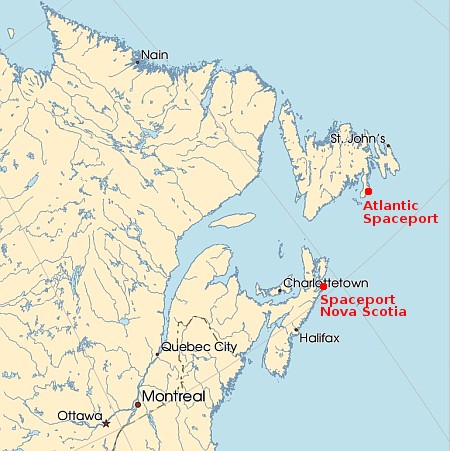
Proposed Canadian spaceports

The Canadian government yesterday announced it is committing significant funding to several space-related companies, including issuing a ten year $200 million lease to the Nova Scotia spaceport that has been unable to attract any launch customers for the past ten years.

The investment is a 10‑year, $200‑million agreement to lease a dedicated space‑launch pad that will serve as the central foundation for a multi-user spaceport near Canso, Nova Scotia. Operated by Maritime Launch Services, this spaceport will support the operational needs of the Department of National Defence (DND), the Canadian Armed Forces (CAF), and the wider Government of Canada, while also offering ad hoc access to allies and partners.

The history of Maritime and its Spaceport Nova Scotia is far from encouraging. It was first proposed in 2016, offering satellite companies both a launch site and a Ukrainian-built rocket. That plan fell through when Russia invaded the Ukraine and the rocket became unavailable. Since then Maritime has struggled to convince rocket companies to use the spaceport, all to no avail. It signed some deals, but none has gone anywhere. This Canadian government lease appears an attempt to save it, since it is very unlikely that this government will be capable of building its own rocket during those ten years.

In order to avoid accusations of favoritism, the government at the same time also announced further $8.3 million grants to three Canadian companies to help them develop their own rockets, one of which is Nordspace, which has its own proposed spaceport, the Atlantic Spaceport in Newfoundland. According to the government, these grants are part of a $105 million program to encourage a sovereign Canadian rocket industry. The other two companies are Reaction Dynamics, which wants to launch its suborbital rocket from Nova Scotia, and a new startup dubbed the Canada Rocket Company, of which little is known.

Apparently, the leftist Canadian government is following in the footsteps of the leftist government of the United Kingdom. In both cases their private spaceports have floundered for decades, unable to attract customers for a variety of reasons. To save them, both governments are now pouring cash into their pockets to prop them up.

In the case of the UK, the obstacles have almost entirely been the red tape of the government. In the case of Canada and Maritime’s Nova Scotia spaceport, it has been a series of bad management decisions that reflect poorly on the company. Private capital has thus not been interested in investing in it. Nor have any rocket companies been interested in launching from it.

So of course, the leftist Canadian government is going to use other people’s money to fund it. How typical.

Canadian may get its own launch capability from this program, but don’t bet on it. Government programs like this have routinely failed, wasting billions and decades with little to show for the effort. The program’s one saving grace however is that the government isn’t designing, building, and owning the rockets. It is instead hiring these three companies to do the work. Under that framework, there is a chance something might actually happen.

9 comments

SpaceX completes two launches since yesterday

Since last night SpaceX successfully completed two Starlink launches.

First, in the evening it placed 25 more Starlink satellites into orbit, its Falcon 9 rocket lifting off from Vandenberg Space Force Base in California. The first stage completed its 14th flight, landing on a drone ship in the Pacific.

Then, in the early morning hours it launched another 29 Starlink satellites, its Falcon 9 rocket lifting off from Cape Canaveral Space Force Station in Florida. The first stage completed its 11th flight, landing on a drone ship in the Atlantic.

Increasingly it appears SpaceX is improving the turn-around reuse time for its first stages. The two first stages on these flights had turn-arounds of 32 and 27 days respectively, which appears to be the average in recent launches. With a fleet of about two dozen stages, this pace allows the company to easily do multiple launches per week.

The leaders in the 2026 launch race:

34 SpaceX
12 China
3 Rocket Lab
2 Russia

SpaceX continues to lead the entire world combined in total launches, as it did in both ’24 and ’25.

2 comments

South Korean rocket startup Innospace pinpoints the cause of its first launch failure

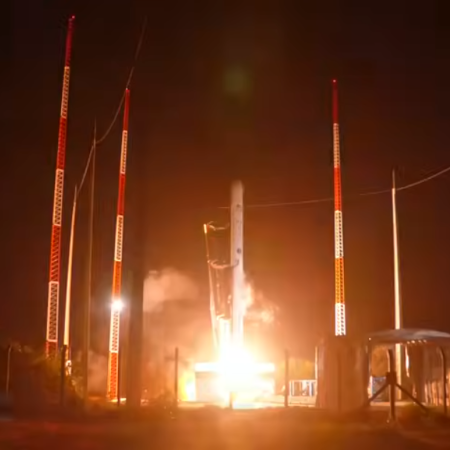
Less than five seconds after launch
Hanbit-Nano less than five seconds after launch,
prior to its failure in December 2025.

The South Korean rocket startup Innospace today released the results of its investigation into the launch failure of its Hanbit-Nano rocket on its maiden flight on December 22, 2025, pinpointing the failure 33 seconds after liftoff to a rupture in the first stage combustion chamber assembly

The launch vehicle was confirmed to have flown nominally during the initial phase of flight, with flight data transmitted normally following liftoff. Thirty-three seconds into flight, combustion gas leakage occurred at the forward section of the first-stage hybrid rocket combustion chamber assembly, resulting in a rupture of the combustion chamber and the subsequent separation of the launch vehicle into multiple parts.

The investigation further determined that the leakage was caused by insufficient compression and uneven sealing performance resulting from plastic deformation of sealing components during the reassembly process following the replacement of the forward chamber plug during launch preparation activities in Brazil.

Based on these findings, INNOSPACE plans to strengthen assembly processes and quality management procedures. The company will also implement certain design improvements and upgrades to related components and conduct additional functional verification procedures.

The company hopes to attempt a second launch in the third quarter of 2026, once again lifting off from Brazil’s Alcantera spaceport.

4 comments
1 21 22 23 24 25 1,327