Curiosity images the Martian version of a cave formation

An helictite on Mars?
Click for full image.

Cool image time! The photo to the right, cropped and reduced to post here, was taken today by Curiosity’s Mars Hand Lens Imager (MAHLI), a camera designed to get close high resolution images of very small features on the surface.

The Curiosity image site does not provide a scale, but MAHLI, located at the end of the rover’s robot arm, is capable of resolutions as small as 14 microns per pixel. Since a micron is one thousandth of a millimeter, and the original image was 1584 by 1184 pixels in size, that means the entire image is likely only slightly larger than 18 to 25 millimeters across, or slightly less than an inch.

This feature, which closely resembles a cave helictite, is thus about a quarter inch in size. Helictites, which in caves often resemble wildly growing roots, are nonetheless made of calcite, not organic material. They grow wildly because the water is being pushed out from their center is under pressure, so that as it drips away from the formation it leaves its calcite deposits randomly, causing the formation to grow randomly.

MAHLI also took what looks to be an infrared or heat image of the formation, which appears to show that the tips of the branches are at a different temperature, I think cooler, than the rest of the formation.

While seeping water causes helictites on Earth, what formed this thing on Mars is beyond my guess. It sure looks cool however.

4 comments

Space spat between Biden and Rogozin over Russian invasion of Ukraine

Yesterday saw harsh words expressed by both President Biden and the head of Roscosmos, Dmitry Rogozin, concerning the partnership of the two countries at ISS, with Biden imposing sanctions and noting these will specifically harm Russia’s space industry, and Rogozin responding by threatening to dump ISS on either a U.S. or European city.

In Biden’s statement, he said, “We estimate that we will cut off more than half of Russia’s high-tech imports, and it will strike a blow to their ability to continue to modernize their military. It will degrade their aerospace industry, including their space program,”

Rogozin’s response came in a series of tweets on Twitter, with his most bellicose statements as follows:

Do you want to destroy our cooperation on the ISS?

This is how you already do it by limiting exchanges between our cosmonaut and astronaut training centers. Or do you want to manage the ISS yourself? Maybe President Biden is off topic, so explain to him that the correction of the station’s orbit, its avoidance of dangerous rendezvous with space garbage, with which your talented businessmen have polluted the near-Earth orbit, is produced exclusively by the engines of the Russian Progress MS cargo ships. If you block cooperation with us, who will save the ISS from an uncontrolled deorbit and fall into the United States or Europe? There is also the option of dropping a 500-ton structure to India and China. Do you want to threaten them with such a prospect? The ISS does not fly over Russia, so all the risks are yours. Are you ready for them?

Meanwhile, it isn’t Russia’s space industry that will suffer the most from this invasion, but Ukraine’s. For example, the American company Launcher, which has had a software team in the Ukraine, has moved most of that team to Bulgaria for their safety.

As a precaution given the escalating political situation, during the last few weeks, we successfully relocated our Ukraine staff to Sofia, Bulgaria, where we opened a new Launcher Europe office. We also invited their immediate family to join them in this move and funded their relocation expenses. We continue to encourage and support five of the support staff and one engineer who decided to remain in Ukraine.

The company’s press release makes it clear that it is no longer dependent in any way with facilities in the Ukraine.

Launcher’s actions will not be the last. Expect all Western commercial efforts linked to the Ukraine to break off ties in order to protect their investments. Moreover, if Russia should recapture the Ukraine entirely, it will likely not give much support to its space industry, as Roscosmos has developed its own Russian resources in the past two decades and will likely want to support those instead.

Thus, the expected destruction of that country’s aerospace industry by Russia’s invasion proceeds.

16 comments

Stratolaunch’s Roc successfully completes 4th test flight

Capitalism in space: Stratolaunch’s Roc airplane, the largest ever flown, successfully completed its 4th flight yesterday, testing for the first time the retraction and extension of its landing gear.

The flight lasted one hour and forty-three minutes.

The company is now aiming to begin full operations in the second half of ’23, when it hopes it will also be dropping versions of its Talon-A test vehicle from the bottom of Roc to perform hypersonic tests for the military as well as commercial companies.

2 comments

SLS launch delayed again

As expected, NASA announced yesterday that it will be unable to launch its SLS rocket on its first unmanned test flight in April, as the agency had hoped, and is now evaluating a May launch date instead.

“April is not a possibility. We’re still evaluating the tail end of May,” said Tom Whitmeyer, NASA’s deputy associate administrator for exploration systems development. “But I want to be really careful once again, being straightforward with you. You know, we really need to get through this next few weeks here, see how we’re doing.”

The next possible windows for launch are from May 7-21, June 6-16 and June 29-July 12.

March 16th is still being targeted for the rocket’s full launch countdown dress rehearsal. Since the agency has said it will need about a month to assess the results of that dress rehearsal, the May launch window is exceedingly unlikely. Based on the slow pace NASA has set throughout this entire project, I predict that the launch will not occur before June, with the excellent chance it will be delayed to the summer. And this is assuming the dress rehearsal goes perfectly.

6 comments

The deadly impact of Russia’s Ukraine invasion on commercial space, on ISS, and beyond

The International Space Station
The Russian invasion might be signaling the end of the ISS partnership.

Though the international ramifications of the invasion of the Ukraine by Russia in the past week will be far reaching and hard to predict, we can get a hint by reviewing the impact on Russia’s long-standing partnership on ISS as well as the effect the invasion will have on a number of commercial enterprises dependent on both Russian and Ukrainian space rocketry.

The International Space Station

All signs so far from the western partners on ISS indicate that they are guardedly hopeful that the cooperation with Russia will continue unimpeded. According to two stories (here and here) describing a panel discussion today at George Washington University Space Policy Institute, state department officials expressed complete confidence that the partnership at ISS will continue without interruption, as it did in 2014 when Russia invaded the Crimea, taking it from the Ukraine. From the first link:
» Read more

100 comments

Ingenuity update: Dust storm caused issues; 20th flight upcoming

Overview map
Click for interactive map.

According to the Ingenuity engineering team in an update today, the Mars helicopter is getting ready for its 20th flight, scheduled for no earlier than today, even as the team successfully dealt with dust that settled on the helicopter’s various parts prior to flight 19.

The dust storm did, however, leave the Ingenuity team with two additional challenges to deal with: a dirty navigation camera window and dust in the swashplate assemblies.

Comparing navigation camera images taken before and after the dust storm revealed that the storm deposited debris on the ground-facing navigation camera window, specifically around the periphery of the camera’s field of view. Debris on the navigation camera window is problematic because Ingenuity’s visual navigation software may confuse the debris with the actual ground features that it tries to track during flight, which can cause navigation errors. Fortunately, Ingenuity’s software provides a tool for dealing with this issue: The team can provide an updated image mask file that tells the visual navigation software to ignore certain regions of the image. The operations team made use of this feature and performed an image mask update late last month.

The dust storm also deposited dust and sand in Ingenuity’s swashplate assemblies. On Mars as well as on Earth, a helicopter’s swashplates are very important because they control the pitch (angle from horizontal) of the rotor blades, which is essential for stable and controlled flight. Ingenuity’s swashplate issue was first detected when the rotorcraft reported a failure during its first automated swashplate actuator self-test since the dust storm on Jan. 28, 2022 (Sol 335 of the Perseverance mission). Data revealed that all six swashplate servo actuators were experiencing unusual levels of unusual levels of resistance while moving the swashplates over their range of motion.

The engineers subsequently tested a procedure, planned before launch, for cleaning the swashplates, and found that it worked.

The data from that activity showed a significant improvement – a reduction in servo loading, so the team followed it up with seven back-to-back servo wiggles on Sol 341. Remarkably, by the end of that activity, Ingenuity’s servo loads appeared nearly identical to nominal loads seen prior to the dust storm.

After dealing with both dust issues, flight 19 proceeded successfully, as planned.

The overview map above shows the present location of Perseverance as the red dot, the present location of Ingenuity by the green dot, and the approximate landing site for the helicopter’s 20th flight by the black dot. The tan dotted line shows Perseverance’s planned route.

Perseverance itself has been traveling fast since Ingenuity’s last flight on February 9th, almost completely retracing its steps to return almost to its landing site.

4 comments

Dry barren ground in Martian northern lowlands?

Dry barren ground in the Martian northern lowlands?
Click for full image.

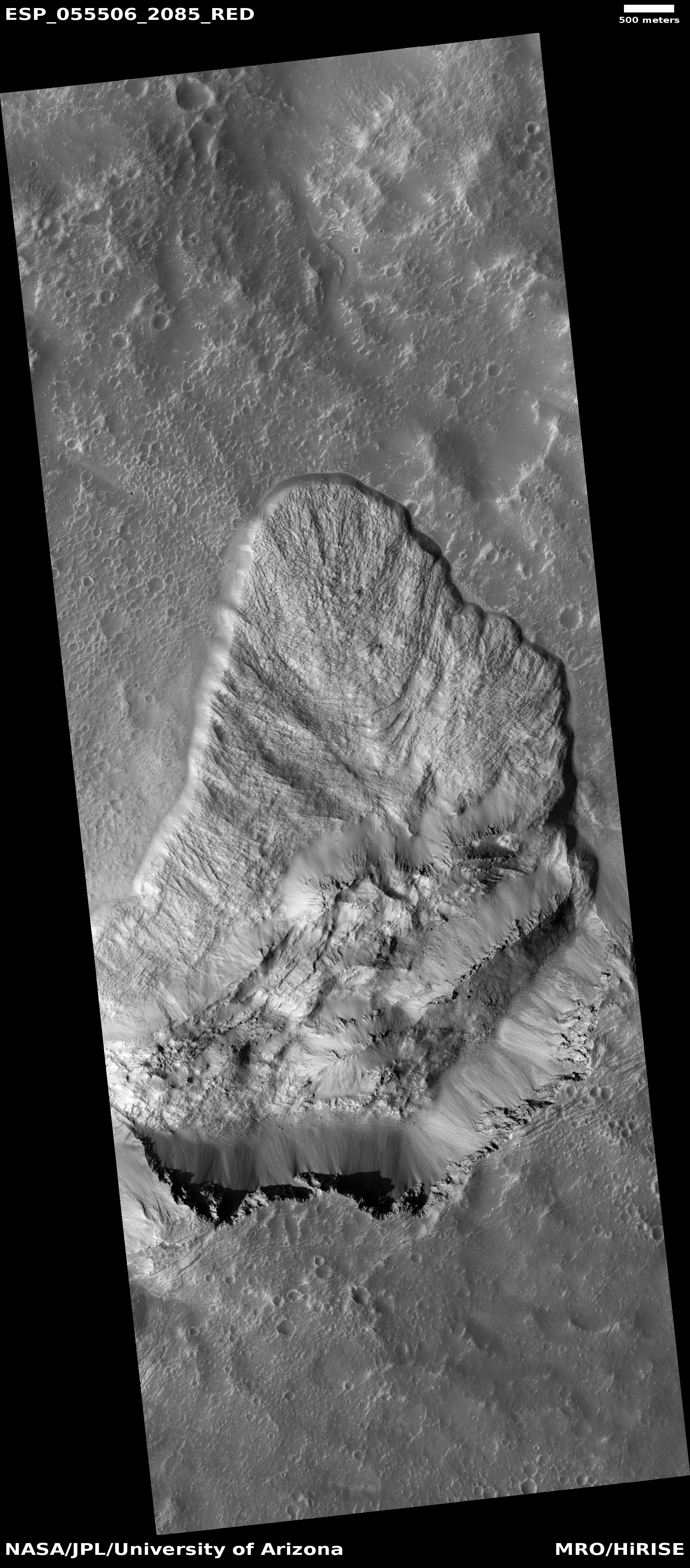
Today’s cool image is intriguing because of what appears to not be there, rather than what is there. The photo to the right, cropped and reduced to post here, was taken on November 3, 2021 by the high resolution camera on Mars Reconnaissance Orbiter (MRO).

At first glance it appears to show a very dry, barren surface. At its base are many parallel grooves running from the southwest to the northeast. On top of these grooves are several more recent crater impacts, as well as several patches of higher bedrock that appears to have been hard enough to resist whatever erosion process caused the groves.

Yet, based on the overview map below, the location of this photo should not be dry and barren, but instead home to a near-surface ice sheet covering everything.
» Read more

0 comments

Astra releases update on February 10th launch failure

Capitalism in space: Astra yesterday released an update on its investigation into its February 10th launch failure at Cape Canaveral.

The update doesn’t provide any conclusions, but merely notes that the company has completed its review of all “video and telemetry” from the event, and has reconstructed a full timeline from that data.

It is now reviewing that timeline to create what engineers call “fault trees”, each a specific scenario path pointing at a possible cause of the failure. Once that cause has been identified, engineers can then propose a solution.

According to the press release, the company is already “implementing corrective actions”, though the release provides no information as to what the cause was or what they are doing to correct. It states instead that once the investigation and corrections have been completely, the company will then release a full report.

Meanwhile, it appears that at least six law firms are considering suing the company, which became a publicly traded company in July 2021. These law firms “…are seeking clients who lost significant amount of money after purchasing the stock.” The launch failure caused the stock value to drop significantly, and these law firms apparently think that the company has made false claims about its plans — such as its claim that it will eventually be launch 300 times per year — and wish to put together a class action lawsuit based on this accusation plus the drop in stock price.

Whether Astra can meet its goal of 300 launches per year is certainly at this time questionable. However, it is too soon to call the company a failure. Once it recovers from the launch failure and resumes launches — a process that for any new rocket company generally takes a few years — that stock price will certainly recover, and will rise with each successful launch.

Only should Astra fail to resume launches, or continue to fail with each launch, will the stock truly crash, and thus provide these law firms with a possible case.

At the same time, in a free society we are supposed to recognize the concept of “buyer beware.” If you buy a product or a stock, it is at your own risk. If you fail to do due diligence beforehand, your loss is your responsibility, not the company who made the product or whose stock crashed.

It appears, based on everything Astra has so far done, an investment in its stocks while quite risky has not been an unreasonable gamble, making the present case for these lawsuits somewhat weak. Time will tell however whether that changes in the future.

2 comments

Curiosity’s coming travels across the rocky Greenheugh Pediment

Curiosity's view west on February 21, 2022 (Sol 3393)
Click for full resolution panorama. Original images can be found here, here, and here.

Overview map
Click for interactive map.

Curiosity, having successfully climbed up and out of Gordon Notch, was able to aim its navigation cameras forward yesterday and get its first views from this position across the very rocky Greenheugh Pediment to its next major goal, Gediz Vallis Ridge. The panorama above, taken by the rover’s right navigation camera, shows this view. The ridge is about 1,500 feet away, at its closest point. The rim of Gale Crater, barely visible in the haze, is about 20-30 miles away.

The overview map to the right indicates the area covered in this panorama by the yellow lines. The red dotted line indicates Curiosity’s planned future route.

Curiosity’s first view of the pediment was made in March 2020, from a point on its northern border, just beyond the top edge of the map. The panorama taken then showed what appeared to be a very treacherous and rough surface, possibly too rough for Curiosity to traverse.

According to the science team’s most recent update from before the holiday weekend, the plan had been to spend February 19-20 studying the ground, then drive a short distance yesterday to get a better view ahead.

This will give us a good vantage point to look into the valley ahead and try to scope out our future route. … We chose to drive about 10m total, in order to get the rover oriented at a good heading and parked in a good spot. We expect a similarly beautiful view from our post-drive imaging.

That view is the panorama above. Though still very rough, the ground ahead appears far more traversable than the surface seen in 2020.

1 comment

Have astronomers found an exoplanet with raining metal and gems?

The uncertainty of science: Using data from the Hubble Space Telescope, astronomers think they have detected on a hot Jupiter exoplanet 880 light years away the formation of clouds and rain made up metals and gems.

The exoplanet is tidally locked so that one side always faces its star, which also means the temperature difference between the two hemispheres is gigantic, 5,400 degrees Fahrenheit on the dayside and about 2,600 degrees on the nightside.

Previous Hubble data showed signs of metals including iron, magnesium, chromium and vanadium existing as gasses on the planet’s dayside. But in this study, the researchers have found that on the planet’s nightside, it gets cold enough for these metals to condense into clouds.

And, just as the strong winds pull water vapor and atoms around the planet to break apart and recombine, metal clouds will blow to the planet’s dayside and evaporate, condense back on the nightside and so on.

But metal clouds aren’t the only strange phenomenon these researchers spotted on this hot Jupiter. They also found evidence of possible rain in the form of liquid gems.

While tantalizing and alien, these results have many uncertainties. What the data suggests might not be the reality. To find out more, the astronomers hope to use the James Webb Space Telescope to do more infrared observations, once it becomes operational.

1 comment

China denies the rocket stage about to hit the Moon comes from its rocket

A Chinese official yesterday claimed that the abandoned rocket stage that will hit the Moon on or about March 4th does not come from its 2014 Long March 3C rocket that tested technology for the later launched Chang’e-5 lunar sample return mission, as suggested by amateur astronomers and an engineer at JPL.

“According to China’s monitoring, the upper stage of the rocket related to the Chang’e-5 mission entered into Earth’s atmosphere and completely burned up,” Foreign Ministry spokesperson Wang Wenbin said Feb. 21.

Space tracking data from the Space Force’s 18th Space Control Squadron suggests that 2014-065B—the international designator for the rocket stage in question—reentered the atmosphere in October 2015, a year after launch, apparently backing China’s claim.

We are thus left with a mystery. If that abandoned upper stage did not come from either a SpaceX or Chinese launch, what launch did it come from? Or is it a rocket stage at all? Could it be a previously unidentified asteroid?

There is also the possibility that it is a piece from that Chinese launch, considering how the orbital data matches so well. The stage could have split or broken apart, with one part falling in the ocean as monitored by the Space Force, and the other section now heading for the Moon. If so, China is likely denying this fact for propaganda reasons.

6 comments

Northrop Grumman to launch new satellite serving mission in ’24 on Falcon 9

Capitalism in space: Northrop Grumman yesterday announced that it has awarded the contract for the first launch of its Mission Robotic Vehicle (MRV) — designed as a robot capable of installing multiple mission extension pods (MEP) on satellites — to SpaceX for a launch scheduled in 2024.

Once in orbit each MEP [Mission Extension Pod] is captured by the MRV and stowed for transport to the client satellite. The MRV rendezvous and docks with the client to install the MEP, which operates like an auxiliary propulsion device and uses its own thrusters to maneuver the client vehicle. Then the MRV detaches itself and moves on to grab another MEP for the next customer. The MRV is designed to stay in orbit for 10 years.

Anderson said the company expects to install as many as 30 propulsion pods over the life of the MRV.

“Our manifest for the MRV is full through mid 2026,” he said. Besides Optus, five other customers have signed term sheets to purchase mission extension pods.

Essentially, Northrop Grumman upgraded its Mission Extension Vehicle design to separate the repair section from the robot that installs it so that it is cheaper to launch everything. It can now launch multiple lighter and smaller repair pods as needed, with the robot already in orbit ready to go.

0 comments
1 505 506 507 508 509 1,327