Martian crater overwhelmed by glacier?

Martian crater overwhelmed by glacier?
Click for full image.

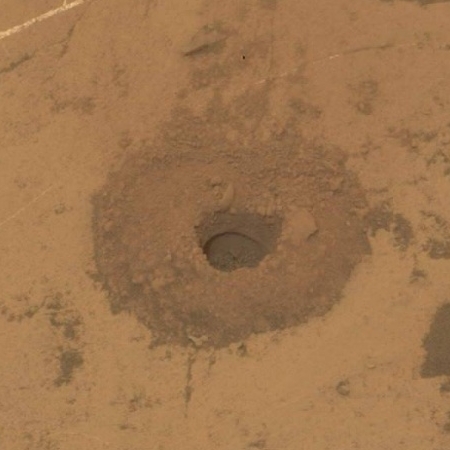
Cool image time! The photo to the right, rotated, cropped, and reduced to post here, was taken on January 28, 2022 by the high resolution camera on Mars Reconnaissance Orbiter. It shows what the science team labels a “modified crater.”

What I see is an old crater almost completely covered by glacial material. That material however is also very old, as there are numerous small craters on its surface, enough that it must have been here for a long time. Its cracked surface also suggests this glacier is very old.

Thus, while we might have ice here, buried by a thin layer of dust and debris to prevent it from sublimating away, it must be very old ice. The many climate cycles caused by the extreme swings in Mars’ rotational tilt, from 11 to 60 degrees, have apparently not caused this ice to ebb and flow very much.

Might it therefore not be ice, but hardened lava?

The location, as shown by the overview map below, provides some context, but only makes this mystery more puzzling.
» Read more

2 comments

Sunspot update: The Sun rages on

Time for my monthly sunspot cycle update, where I take NOAA’s monthly graph showing the long term trends in the Sun’s sunspot activity, and annotate it with additional data to provide some context.

The trend of sunspot activity exceeding the predictions continued in February. While the increase in activity from January still left it less than the activity in December, the total number of sunspots is still far above the number predicted by NOAA’s panel of solar scientists in 2020, with the rise towards a solar maximum also much steeper and far faster than predicted.
» Read more

2 comments

Romania signs Artemis Accords

Romania on March 1st became the sixteenth nation to sign the Artemis Accords, designed to get around the Outer Space Treaty’s restrictions on private enterprise and property rights in space.

Romania is now the third former Soviet block nation to sign the accords, joining Poland and the Ukraine. The full list of signatories now includes Australia, Brazil, Canada, Israel, Italy, Japan, Luxembourg, Mexico, New Zealand, Poland, Romania, South Korea, the United Kingdom, the United Arab Emirates, the Ukraine, and the United States.

Up to now Germany and France — two of the west’s most important major space powers — have resisted signing, probably because both countries have had strong partnership ties with Russia, and Russia opposes the accords. The Russian invasion of the Ukraine however has caused Germany to break off all such Russian cooperation, which suggests it now may be more amendable to signing. I also suspect France may become more willing, though predicting France in these matters is always difficult.

0 comments

Germany turns off its instrument on the Spektr-RG orbiting X-ray telescope

As part of Germany’s decision to break off all scientific cooperation with Russia in response to Russia’s Ukraine invasion, the Max Plank Institute has turned off its instrument on the Spektr-RG orbiting X-ray telescope.

Meanwhile, Roscosmos’ head, Dmitry Rogozin revealed he will demand compensation from Europe for its sanctions, including this shut down on Spektr-RG.

Europe’s sanctions cause real losses to Russia’s space corporation Roscosmos. The corporation will estimate them and demand a compensation from partners in Europe, Roscosmos’s press-service told TASS on Tuesday. “They have caused harm to the Spektr-RG laboratory’s research program by turning off one of the two telescopes. Their sanctions cause real losses to us. The damage will be estimated and a bill presented to the European side,” Roscosmos said.

It now appears that all the European cooperation with Russia in space is likely dead, at least until Russia gets out of the Ukraine.

8 comments

Rogozin halts launch of OneWeb satelllites planned for March 5

The head of Roscosmos, Dmitry Rogozin, today announced that he has halted all launch preparations for the March 5th launch of 36 OneWeb satellites on a Soyuz-2 rocket from Baikonur in Kazakhstan unless he received reassurances by March 4th that they would not be used for military purposes against Russia.

Roskosmos head Dmitry Rogozin announced that the mission would not proceed unless he received assurances by 21:30 Moscow Time on March 4 of non-military use of the satellites. Rogozin also demanded that the British government give up its stake in OneWeb.

I suspect Rogozin’s action here is a response to SpaceX’s delivery of Starlink terminals and the activation of its use for the Ukraine to fight the Russian invasion.

It is now certain that all the planned Soyuz-2 OneWeb launches this year will likely not occur, unless the situation in the Ukraine becomes settled quickly. This means OneWeb will have to scramble to find a new launch provider and pay for the launches a second time, since they have already paid Russia for, according to sources I spoke to last night, the next four Russian launches. It won’t get a refund from Russia, for sure.

0 comments

NASA IG: SLS/Orion cost per launch equals $4.1 billion and is “unsustainable”

The real cost of SLS and Orion

At a House hearing today the NASA Inspector General Paul Martin stated unequivocally that the cost of NASA’s SLS rocket, Orion capsule, and the associated ground systems is about $4.1 billion per launch, which made the entire program, in his words, “unsustainable.”

Appearing before a House Science Committee hearing on NASA’s Artemis program, Martin revealed the operational costs of the big rocket and spacecraft for the first time. Moreover, he took aim at NASA and particularly its large aerospace contractors for their “very poor” performance in developing these vehicles.

Martin said that the operational costs alone for a single Artemis launch—for just the rocket, Orion spacecraft, and ground systems—will total $4.1 billion. This is, he said, “a price tag that strikes us as unsustainable.” With this comment, Martin essentially threw down his gauntlet and said NASA cannot have a meaningful exploration program based around SLS and Orion at this cost.

Martin’s testimony confirms what was contained in his November 2021 report, from which I took the graphic above. The article at the link details at length Martin’s testimony today, which was amazingly harsh. He also said that

NASA is obscuring costs that it is spending on the Artemis program and that, in aggregate, his office believes NASA will spend $93 billion from 2012 to 2025 on the Artemis program. “Without NASA fully accounting for and accurately reporting the overall costs of current and future Artemis missions, it will be much more difficult for Congress and the administration to make informed decisions about NASA’s long-term funding needs—a key to making Artemis a sustainable venture,” Martin said.

Martin has merely confirmed what I have been writing now for more than a decade, and documented at great length in my 2017 policy paper, Capitalism in Space. In fact, let me quote from one of my earliest essays on this subject on Behind the Black, from 2011:
» Read more

18 comments

NASA buys three more manned Dragon flights from SpaceX

Capitalism in space: NASA today officially announced that it has extended its contract with SpaceX for manned Dragon flights by three, paying the company an additional $900 million.

Prior to the modification, SpaceX was contracted to fly three more missions to the ISS: Crew-4 and Crew-5 in 2022 and Crew-6 in 2023. With the extension, which is “fixed-price, indefinite-delivery/indefinite-quantity,” per NASA’s statement. SpaceX’s period of performance now runs through March 31, 2028 — a nice regular paycheck for the growing launch and space operations company.

This contract extension raises what NASA is paying SpaceX for manned launch services from $2.6 billion to $3.49 billion.

While it is likely NASA would have brought more Dragon flights, it is also likely that some of these flights would have instead been bought from Boeing, if its much delayed Starliner manned capsule had been available. It is not, so SpaceX gets the business.

Boeing’s next attempt to complete Starliner’s first unmanned demo mission to ISS is now scheduled for May.

6 comments

Shetland spaceport construction to begin in March

Capitalism in space: Construction of the United Kingdom’s first spaceport in more than a half century is now set to begin this month in the Shetland Islands, with the first launch expected before the end of the year.

The Lamba Ness peninsular in Unst will be home to the £43 million spaceport, with builders set to start work in late March, after Shetland Islands Council gave the project planning permission.

Three launchpads will be built at the SaxaVord spaceport, allowing for the launch of small satellites into either polar or sun-synchronous low-Earth orbits.

The company is aiming to launch 30 rockets a year, and has set the target of seeing its first orbital launch from UK soil after the third quarter of this year.

It appears now that the United Kingdom is going to have two different competing spaceports, one on the Shetland Islands and the second in Sutherland, Scotland. It appears the UK rocket startup Skyrora as well as a partnership between Lockhead Martin and the smallsat rocket startup ABL will launch from Shetland, while the UK company Orbex will use Sutherland.

0 comments

Rocket Lab to build new Neutron rocket at Wallops Island in Virginia

Capitalism in space: Rocket Lab announced yesterday that it will build the manufacturing factory for its new Neutron rocket at the Wallops Island in Virginia, close to the company’s launchpad there.

The complex will be home to a rocket production, assembly, and integration facility, as well as a dedicated launch pad for the Neutron rocket located on the southern end of Wallops Island. The estimated 250,000 square foot state-of-the-art complex will be constructed on a 28-acre site adjacent to the Wallops Island Flight Facility and will include a Launch Control Center, Rocket Lab’s fifth global operations center for launch activities and on-orbit operations. To support rapid production of the Neutron rocket, current plans for the complex include automated fiber placement robotic production systems capable of laying up meters of Neutron’s new, specially formulated carbon composite structures in minutes. As a reusable rocket, Neutron is designed to land back on the launch pad after a mission and from there it would be returned to the production complex for refurbishment and re-flight.

The Wallops Island spaceport hopes the state of Virginia will commit $45 million of its own money to this project, but that money still needs to be approved by the state’s legislature.

“Assuming that is done and blessed by the legislature, and we have no reason to believe it will not be, $15 million will go into construction for the facility, and the 30 million will be geared toward the construction of the new launch pad,” Mercer said, noting that the pad would be multi-purpose, not a Neutron exclusive.

3 comments

Scientists: Yutu-2 spots tiny glass globules similar to those found by Apollo astronauts

According to a paper just published Chinese scientists running the Yutu-2 rover on the far side of the Moon have spotted several tiny glass globules similar to those found by Apollo astronauts.

Xiao and his team believe the small spheres, which are between 0.59 and 0.79 inches (1.5 to 2.5 centimeters) across, were probably formed by relatively recent meteor impacts. Specifically, the researchers believe that the globules formed from anorthosite, a volcanically-formed rock rich in the mineral feldspar, after a high-energy impact melted the rock and reformed into spheres.

In appearance these Yutu-2 globules appear translucent, unlike the Apollo globules which were either dark or opaque. Since the rover did not do spectroscopy on these objects before moving on, however, their actual make-up is unknown, with the speculations by the researchers above merely that, speculations, though reasonable.

0 comments
1 503 504 505 506 507 1,327