Review of all Soyuz upper stages ordered by Russian manufacturer

According to anonymous sources, the Russian manufacturer of the Freget upper stage that failed yesterday during a Soyuz commercial launch has ordered a review of all Fregets.

The Lavochkin research and production association will check all manufactured Fregat boosters, a source in the space industry told TASS on Wednesday after a recent failed launch. “The Lavochkin Research and Production Association will check all Fregat boosters produced earlier. If defects are found, they [the boosters] will be sent for further development,” the source said.

The Lavochkin Research and Production Association did not comment on this information for TASS.

The problem is that Russia already spent almost a full year beginning in early 2016 checking all its rocket engines for substandard construction done by a corrupt manufacturer. Even though the Fregat is built by another manufacturer, did they not check the Fregat upper stages then also?

4 comments

NASA confirms next Dragon launch will be on used first stage

Capitalism in space: NASA today confirmed that it has finally approved the use of a Falcon 9 used first stage for the next Dragon launch on December 8.

NASA had said back on November 12 that they were considering this idea. It seems to me that SpaceX has probably been proceeding under the assumption they would say yes, which essentially at this point, only a few weeks from launch, put pressure on the timid NASA bureaucracy to finally get on the bandwagon.

1 comment

India’s next launch might slip to 2018

India’s next PSLV commercial launch might slip to 2018, despite months of effort to resume launches in 2017 following the August 31 PSLV launch failure when the rockets fairing did not release.

“We are working towards it. It will be in the end of December or first week of January. In that time frame,” ISRO Chairman A S Kiran Kumar said.

Kumar also said ISRO will try to launch on an average of once a month in 2018. The article also mentions the new and very oppressive Indian space law that has been proposed.

Asked whether the Space Activities Bill, 2017 would come up during the Budget session of Parliament, Kiran Kumar said “We have now put it in public comments. It would have to go through a set of discussions. The process has started.”

The draft of the proposed Bill to promote and regulate space activities of India, along with encouraging the participation of the private sector, has been uploaded on the ISRO website for comments from stakeholders and the public. [emphasis mine]

The highlighted text is typical of all news reports coming from India. The law does no such thing, and in fact will strongly discourage any work by the private sector. It appears that in India reporters either do not read the text of laws they are reporting on, or they really do not have freedom of the press there.

0 comments

Worms on Mars!

Scientists growing plants on Earth using a simulated Martian soil have found that earthworms like it.

These slimy invertebrates play a key role in making Earth soil healthy by digesting dead organic matter and excreting a potent fertilizer that helps release nutrients like nitrogen and phosphorus. Their constant burrowing also helps lighten up the soil, allowing air and water to seep through better.

That’s an important improvement for the simulated Mars soil, which water struggled to soak through in previous tests. Altogether, the tests showed that the combination of worms and pig slurry helped the plants grow in Martin soil, and the worms not only thrived but reproduced. “Clearly the manure stimulated growth, especially in the Mars soil simulant, and we saw that the worms were active,” says Wamelink. “However, the best surprise came at the end of the experiment when we found two young worms in the Mars soil simulant.”

Obviously, we do not know yet how the worms would respond to the lower Martian gravity, but it sure would be a significant experiment to see them reproduce there.

15 comments

SpaceX raises another $100 million in investment capital

Capitalism in space: In its current round of stock sales SpaceX had raised another $100 million in investment capital.

In August, the space exploration company sold $349.9 million worth of shares, a Securities and Exchange Commission (SEC) filing showed. That amount has now risen to $449.9 million, a new filing showed on Monday, adding an extra $100 million onto the current fundraising effort.

The latest injection of cash values SpaceX at $21.5 billion, according to Equidate, a platform that facilitates the trading of shares in private technology firms. SpaceX was not immediately available for comment on the valuation when contacted by CNBC.

If I was a big money investor I too would be interested in buying some SpaceX stock. Meanwhile, Aviation Week is reporting that the first Falcon Heavy launch has slipped to 2018. I am not surprised, but I have also not seen any other news reports on this, so I am withholding judgement.

1 comment

Second Soyuz launch from Vostochny a failure

The second Soyuz rocket launch from Russia’s new spaceport in Vostochny ended in failure this morning due to a problem with the rocket’s upper stage

It is presently unclear what happened. One Russian news report suggests “human error,” though I do not understand exactly what they mean by that. Either way, all 19 satellites, including a new Russian weather satellite and 18 smallsats, were lost.

For Russia, this failure comes at a bad time. Roscosmos had been striving to recover from last year’s recall of all rocket engines due to corruption at one of their factories. A new launch failure, especially if it is due to another engine issue, will not encourage sales from the international market. Worse, the lose of the 18 smallsats on this launch will certainly make future smallsat companies more reluctant to fly on a Russian rocket.

0 comments

Europe finally begins to realize that reusability cuts costs

Capitalism in space: Faced with stiff and increasing competition from SpaceX, European governments are finally beginning to realize that their decades of poo-pooing the concept of rocket reusability might have been a big mistake.

In what was likely an unexpected question during a Nov. 19 interview with Europe 1 radio, French Economy and Finance Minister Bruno Le Maire was asked if SpaceX meant the death of Ariane.

“Death? I’m not sure I’d say that. But I am certain of the threat,” Le Maire said. “I am worried.” Le Maire cited figures that are far from proven — including a possible 80% reduction in the already low SpaceX Falcon 9 launch price once the benefits of reusability are realized. “We need to relfect on a reusable launcher in Europe, and we need to invest massively in innovation,” Le Maire said.

Then there was a report out of Germany that has concluded that SpaceX commitment to reusability is about to pay off.

The article also cites those in Europe and with the U.S. company ULA that remain convinced that they can compete with expendable rockets. In reading their analysis, however, I was struck by how much it appeared they were putting their heads in the sand to avoid facing the realities, one of which has been the obvious fact that SpaceX has been competitively running rings around them all. This is a company that did not even exist a decade ago. This year it very well could launch more satellites than Europe and ULA combined.

8 comments

Russia astronauts have found bacteria living on the outside of ISS

Russia astronauts have found bacteria that was not intentionally brought into space living on the outside of ISS.

They are being studied on Earth but most likely they don’t pose any sort of danger, Russian cosmonaut Anton Shkaplerov told TASS on Monday. According to him, during spacewalks from the International Space Station under the Russian program, the cosmonauts took samples with cotton swabs from the station’s external surface. In particular, they took probes from places where the accumulation of fuel wastes were discharged during the engines’ operation or at places where the station’s surface is more obscure. After that, the samples were sent back to Earth.

“And now it turns out that somehow these swabs reveal bacteria that were absent during the launch of the ISS module. That is, they have come from outer space and settled along the external surface.”

I suspect it is a bit of hyperbole to say the bacteria came from outer space. It more likely came from either the station itself, or later spacecraft docking with the station. At the same time, the article is vague about what has been discovered. For example, it says nothing about the bacteria itself.

6 comments

A mission to interstellar object Oumuamua?

A private company and a volunteer group dedicated to promoting interstellar travel have written a paper [pdf] exploring the possibility of launching a mission to fly past the interstellar object Oumuamua, now speeding out of our solar system.

As they note in the paper’s abstract,

Can such objects be intercepted? The challenge of reaching the object within a reasonable timeframe is formidable due to its high heliocentric hyperbolic excess velocity of about 26 km/s; much faster than any vehicle yet launched. This paper presents a high-level analysis of potential near-term options for such a mission. Launching a spacecraft in a reasonable timeframe of 5-10 years requires a hyperbolic solar system excess velocity between 33 to 76 km/s for mission durations between 30 to 5 years. Different mission durations and their velocity requirements are explored with respect to the launch date, assuming direct impulsive transfer to the intercept trajectory. Several technology options are outlined, ranging from a close solar Oberth Maneuver using chemical propulsion, and the more advanced options of solar and laser sails. To maximize science return decelerating the spacecraft at ’Oumuamua is highly desirable, due to the minimal science return from a hyper-velocity encounter. It is concluded that although reaching the object is challenging, there seem to be viable options based on current and near-term technology.

The paper even considers the use of SLS or SpaceX’s Big Falcon Rocket.

8 comments

Beer on Mars

Capitalism in space: Budweiser’s goal to eventually brew beer on Mars will take its next step with the launch to ISS of a beer experiment in December.

To get the ball rolling, the famous beer brand is partnering with the Center for the Advancement of Science in Space, which manages the ISS U.S. National Laboratories, and Space Tango, a payload development company that operates two commercial research facilities within the National Laboratory.

Working with Budweiser’s innovation team, the group will send two barley-based experiments to the ISS as part of the next SpaceX cargo supply mission, scheduled for December 4. Budweiser’s barley seeds will stay in orbit for around a month before returning to Earth for analysis.

Seems right to me.

8 comments

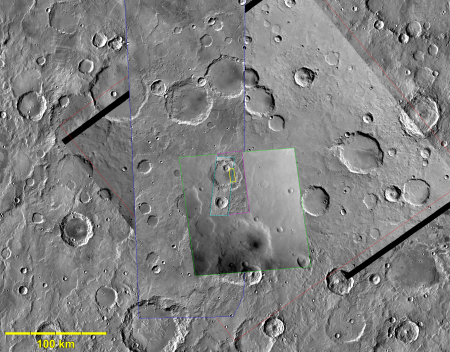
A spot on Mars, as seen by different orbiters over the past half century

Mars as seen over the past half century

The science team of Mars Reconnaissance Orbiter (MRO) have assembled a collection of images of the same location on Mars that were taken by different Martian orbiters, beginning with the first fly-by by Mariner 4 in 1965 and ending with MRO’s HiRise camera. The image on the right, reduced in resolution to post here, shows these images superimposed on that location, with resolutions ranging from 1.25 kilometers per pixel (Mariner 4) down to 50 meters per pixel (MRO).

This mosaic essentially captures the technological history of the first half century of space exploration in a single image. Mariner 4 was only able to take 22 fuzzy pictures during its fly-by. Today’s orbiters take thousands and thousands, with resolutions so sharp they can often identify small rocks and boulders.

The mosaic also illustrates well the uncertainty of science. When Mariner 4 took the first pictures some scientists thought that there might be artificially built canals on Mars. Instead, the probe showed a dead cratered world much like the Moon. Later images proved that conclusion to be wrong as well, with today’s images showing Mars to be a very complex and active world, with a geological history both baffling and dynamic. Even now, after a half century of improved observations, we still are unsure whether life there once existed, or even if exists today.

1 comment

XCOR bankruptcy leaves behind $27.5 million in debt

Capitalism in space: XCOR’s bankruptcy has revealed that the company owed $27.5 million to creditors, the largest of which are government agencies that gave the company money in the hope its operations would bring business to their regions.

Space Florida is the largest secured credit at $3.6 million. The state-run agency’s has a “blanket security interest in personal property.” XCOR had made a deal to manufacture and operate its Lynx suborbital space plane from Florida.

XCOR estimates it spent $25 to $30 million developing the unfinished Lynx. An additional $15 to $20 million would be required to complete the vehicle, according to the documents.

Midland Development Corporation (MDC) has $10 million in unsecured claims. The funding was provided to XCOR to move from its base in Mojave, Calif., to the West Texas city, a process the company did not complete before it filed for bankruptcy earlier this month.

In addition, a private spacesuit company, Orbital Outfitters, appears to have gone of business in connection with this bankruptcy.

0 comments

New technology for future missions to Venus

Link here. The article begins by focusing on new hardened computer chips that can survive the harsh conditions of the Venusian surface, then moves to discussing our state of knowledge of the Earth’s sister planet, and the possibilities of future missions.

The article is definitely worth reading, but it tends I think to exaggerate how close the technology might be for building landers and rovers that can survive for long periods on Venus. This paragraph, describing the hardened chip that survived a simulated Venus environment for 60 days, highlights this:

A modern silicon chip can contain 7 billion transistors; each of the chips running in the Venus chamber has 175. Neudeck also uses an old-school transistor design, long since abandoned in conventional microelectronics. It’s basically a hyperexpensive, obtuse pocket calculator. But a pocket calculator running on Venus could be valuable indeed. “This is already the complexity of many of the early scientific missions flown back in the ’60s and ’70s,” Neudeck says, and more powerful than the chips on Apollo flight computers. “You really can do science.”

Exploring Venus is essential and necessary for us to truly understand how planets form and evolve. Developing technology that can survive that harsh environment is equally necessary, as it will make all future space exploration easier and more capable. This engineering work appears to be taking the first steps in this direction.

0 comments
1 532 533 534 535 536 799