NanoRacks successfully deploys its largest commercial smallsat from ISS

Capitalism in space: NanoRacks today successfully deployed its largest commercial smallsat yet from ISS.

NanoRacks Kaber Deployment Program allows for a larger EXPRESS class of satellites to be deployed from the International Space Station, up to 100 kilograms. NanoRacks deploys these Kaber-class satellites currently through the Japanese Experiment Module Airlock, and will shift deployments to the NanoRacks Airlock Module when the Company’s commercial Airlock becomes operational (planned for 2019).

The key here is that NanoRacks is making money providing launch services to smallsats in partnership with ISS and others. They act as the go-between between the smallsat companies and the NASA bureaucracy, thus earning money by simplifying NASA’s generally Byzantine approval and launch process for private satellite companies.

2 comments

Vector’s third suborbital test flight set for January 2018

Capitalism in space: The third suborbital test flight of Vector’s Vector-R rocket has been scheduled for January 2018 in Mohave.

Vector has, to date, performed two test flights of the Vector, both only to very low altitudes. The first took place in May in California’s Mojave Desert and the second in August at the future site of Spaceport Camden on Georgia’s Atlantic coast. A third test, [company head Jim] Cantrell said, is planned for January, back in the Mojave Desert.

He raised a note of caution about that test. “We have a high chance of planting that one in the desert, because it’s using thrust vector control. We’re taking the training wheels off,” he said.

The article is mostly about Vector’s deal to launch from Wallops Island, which I noted last week. Much of that however is public relations that is far from reality. The important thing now is for Vector to finish its test program and prove its rocket can reach orbit.

0 comments

Engineers develop new technique to resume drill use on Curiosity

Engineers have successfully tested a new drill procedure on a duplicate rover on Earth that bypasses the problem in Curiosity’s drill.

The problem with the drill has been its feed mechanism, which pushes the drill bit downward as it drills its hole. The tests with the duplicate rover on Earth have instead had the drill bit fully extended and used the robot arm itself to push downward. It worked, but the problem on Mars is holding the drill bit perfectly straight and not slipping sideways. They are now doing a test with Curiosity to address this.

Curiosity touched its drill to the ground Oct. 17 for the first time in 10 months. It pressed the drill bit downward, and then applied smaller sideways forces while taking measurements with a force sensor. “This is the first time we’ve ever placed the drill bit directly on a Martian rock without stabilizers,” said JPL’s Douglas Klein, chief engineer for the mission’s return-to-drilling development. “The test is to gain better understanding of how the force/torque sensor on the arm provides information about side forces.”

This sensor gives the arm a sense of touch about how hard it is pressing down or sideways. Avoiding too much side force in drilling into a rock and extracting the bit from the rock is crucial to avoid having the bit get stuck in the rock.

Stay tuned for a Mars rover update, coming shortly!

0 comments

The glory of Cassini’s Saturn

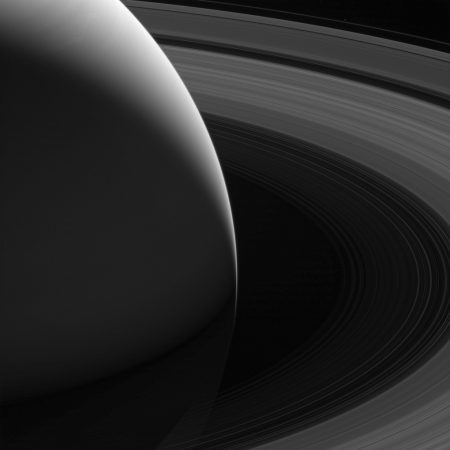
The glory of Saturn

Cool image time! The image on the right, reduced in resolution to post here, was taken by Cassini on August 17, 2017, one month before the spacecraft dived into Saturn to end its mission.

This view looks toward the sunlit side of the rings from about 19 degrees above the ringplane. The image was taken in green light with the Cassini spacecraft wide-angle camera on Aug. 12, 2017. Pandora was brightened by a factor of 2 to increase its visibility.

The view was obtained at a distance to Saturn of approximately 581,000 miles (935,000 kilometers) from Saturn. Image scale is 35 miles (56 kilometers) per pixel. The distance to Pandora was 691,000 miles (1.1 million kilometers) for a scale of 41 miles (66 kilometers) per pixel.

The moon Pandora can be seen in the full resolution image just beyond the outermost ring near the top of the screen.

0 comments

SpaceX barge damaged from fire after 1st stage landing

The drone barge used by SpaceX to successfully land a 1st stage during its October 11 launch was subsequently damaged by a fire on board during the return to port.

The exact series of events is unclear, but it is understood the booster leaked some of its residue RP-1 fuel, which flowed along the deck of the ASDS and pooled near the containers at the aft of the drone ship.

The booster then continued post-landing operations, designed to safe the booster ahead of crews boarding the ship to complete the safing process ahead of the trip back to port. At some point shortly after landing there was an ignition of the pooled RP-1, likely via the purging of the Triethylaluminum-Triethylborane (TEA-TEB) that is used as the first stage ignitor. This has to be purged as part of the safing procedures for allowing crew near the rocket. Fire hoses – staged on the deck of the ship – quickly doused the fire. However, the garage containing the robot – nicknamed “Roomba” or “OctaGrabber” (among other names) – was caught in the fire and damaged.

This was confirmed by the lack of the robot in view under the rocket during the ASDS’ return to Port.

It appears they are repairing the damages and that future barge landings will not be affected.

0 comments

NASA still hasn’t established a baseline cost for SLS’s future missions

Despite being told to do so in an 2014 GAO report, NASA has still not developed a budget to determine what it would cost to use SLS for any future beyond-Earth-orbit missions.

Worse, NASA says it doesn’t have to do this.

The government report notes that it previously recommended to NASA and Congress that costs of the first (and subsequent) human missions be calculated and disclosed three years ago in 2014. Since then, the report says, a senior official at NASA’s Exploration Systems Development program, which manages the rocket and spacecraft programs, replied that NASA does not intend to establish a baseline cost for Exploration Mission 2 because it does not have to.

This response must have struck investigators with the General Accountability Office—Congress’ auditing service—as a bit in-your-face. Later in the report, the director of acquisition and sourcing management for the accountability office, Cristina Chaplain, notes that, “While later stages of the Mars mission are well in the future, getting to that point in time will require a funding commitment from the Congress and other stakeholders. Much of their willingness to make that commitment is likely to be based on the ability to assess the extent to which NASA has met prior goals within predicted cost and schedule targets.” [emphasis mine]

In other words, NASA expects Congress to give NASA and SLS a blank check, forever. Sadly, based on the behavior of Congress now and in the past two decades, NASA might very well have reasonable expectations here.

2 comments

Vector signs deal to launch from Wallops

Capitalism in space: Vector has signed an agreement with the Mid-Atlantic Regional Spaceport on Wallops Island, Virginia to do commercial launches of its smallsat rocket there.

Vector Space Systems officials and Virginia Secretary of Transportation Aubrey Layne announced during a demonstration of the Vector-R launch vehicle at Launch Pad 0-B on Wallops Island that Vector has contracted to conduct three commercial orbital missions in the next two years from the Wallops spaceport, with an option for five additional launches.

Vector still needs to complete its test program, as its Vector-R rocket has not yet reached orbit.

1 comment

Wearing Mars and Moon spacesuit prototypes

An evening pause: This video to me was interesting because it illustrated (though the reporter either does not realize it or is being kind by not mentioning it) how poorly designed both these suits are. They require a crew to put on something that would be impractical on either the Moon or Mars, and appears heavy and clumsy. For Mars especially a much lighter and more natural suit is going to be essential. This is not it, though I am sure it is a worthwhile first attempt.

Hat tip Edward Thelen.

9 comments

NASA instrument for European space telescope flawed and must be rebuilt

The NASA instrument for Europe’s Euclid optical/near-infrared space telescope has been found defective and must be rebuilt, thus delaying the launch of the telescope by at least one year.

What interested me about this telescope is its goals and specifications:

Euclid is a two-ton space telescope selected by ESA in 2011 as a medium-class mission in its Cosmic Vision program of space science missions. The spacecraft features a 1.2-meter telescope with visible and near-infrared instruments to study dark energy and dark matter, which combined account for about 95 percent of the universe. Euclid will operate at the Earth-sun L-2 Lagrange point, 1.5 million kilometers from Earth, that is used by other infrared astronomy missions.

With a mirror about half the size of Hubble’s, this telescope will act as a partial replacement and back up for it. In fact, it will likely make numerous ground-breaking discoveries, as every optical telescope placed above the atmosphere has so far done.

Meanwhile, the article provided no information on the flaws, who built the flawed instrument, and who will pay for the delays its failure will cause.

1 comment

Blue Origin successfully completes first test of BE-4 rocket engine

Capitalism in space: Blue Origin has successfully conducted the first static fire test of its BE-4 rocket engine.

The test was six seconds long. The company has not released any further details, other than to say it was a success. This not only puts them closer to building their New Glenn rocket, it increases the chances that ULA will choose this engine for its Vulcan rocket.

1 comment

NASA extends Dawn’s mission orbiting Ceres

NASA has decided to extend the Dawn mission again, but have that extension remain in orbit around Ceres.

A priority of the second Ceres mission extension is collecting data with Dawn’s gamma ray and neutron spectrometer, which measures the number and energy of gamma rays and neutrons. This information is important for understanding the composition of Ceres’ uppermost layer and how much ice it contains.

The spacecraft also will take visible-light images of Ceres’ surface geology with its camera, as well as measurements of Ceres’ mineralogy with its visible and infrared mapping spectrometer.

The extended mission at Ceres additionally allows Dawn to be in orbit while the dwarf planet goes through perihelion, its closest approach to the Sun, which will occur in April 2018. At closer proximity to the Sun, more ice on Ceres’ surface may turn to water vapor, which may in turn contribute to the weak transient atmosphere detected by the European Space Agency’s Herschel Space Observatory before Dawn’s arrival. Building on Dawn’s findings, the team has hypothesized that water vapor may be produced in part from energetic particles from the Sun interacting with ice in Ceres’ shallow surface.Scientists will combine data from ground-based observatories with Dawn’s observations to further study these phenomena as Ceres approaches perihelion.

They aim to get as close as 120 miles of the surface during this extension, half as close as the previous closest approach.

0 comments

Iridium switches two upcoming launches to reused Falcon 9 first stages

Capitalism in space: Iridium has revised its launch agreements for two upcoming launches using the Falcon 9 rocket to have both use previously flown first stages.

While the article provides a lot of good background on SpaceX’s increasing sales of reused first stages, including the fact that 20% of SpaceX’s launches this year might end up using re-used first stages, an amazing number consider this is also the first year they are doing so, this quote from the article however is even more astonishing:

Importantly for Iridium, and for the launch market as a whole, Iridium revealed in its announcement that the cost of insuring the Iridium NEXT-4 and -5 missions did not change with the switch to flight-proven boosters. “Iridium confirmed with its insurers that there is no increase in premium for the launch program as a result of the use of flight-proven Falcon 9 rockets, further supporting Iridium’s conclusion that the risk profile is unchanged,” noted the release.

Overall, this is an excellent sign that the all-important insurance market element of spaceflight continues to see no increased risk with launching atop flight-proven boosters.

One of my sources close to SpaceX says that the company will likely not fly these reused first stages intact more than twice, but will still salvage the engines for additional reuses. Considering the engines are the most expensive component, this makes great sense. Even if SpaceX doesn’t fly a first stage intact, it has developed an efficient and effective method for recovering the engines for reuse.

1 comment

Producing oxygen and fuel from Martian CO2

New research suggests that the conditions on Mars are ideal for using its carbon dioxide to produce both oxygen and fuel for future manned missions.

Mars has excellent conditions for In-Situ Resource Utilisation (ISRU) by plasma. As well as its CO2 atmosphere, the cold surrounding atmosphere (on average about 210 Kelvin) may induce a stronger vibrational effect than that achievable on Earth. The low atmospheric temperature also works to slow the reaction, giving additional time for the separation of molecules.

Dr Guerra said: “The low temperature plasma decomposition method offers a twofold solution for a manned mission to Mars. Not only would it provide a stable, reliable supply of oxygen, but as source of fuel as well, as carbon monoxide has been proposed as to be used as a propellant mixture in rocket vehicles.

While achieving this kind of in-situ resource use is not trivial, it is essential if humans are going to settle colonies on Mars. This research seems to be a good start.

24 comments

Higher insurance rates for Proton threaten its market viability

Capitalism in space: Because the insurance industry is presently charging significantly more to insure a Proton launch than it charges for Falcon 9 or Ariane 5, the Russian share of the launch market is threatened.

Insurance premiums for launches of International Launch Services’ Russian Proton rocket, which satellite operators and insurers say is a necessary third leg for the commercial market — the SpaceX Falcon 9 and the ArianeGroup Ariane 5 being the other two — total about 12% of the insured value. That compares with 3-4% for Ariane 5 and 4-5% for the Falcon 9.

In dollar terms, that means that ILS customers seeking a $200 million policy covering the the value of the satellite, the launch and the satellite’s first year in orbit, would pay a $24 million premium. The same customer launching the same satellite on Falcon 9 or the Ariane 5 would pay no more than $10 million, and possibly less.

The industry cites the quality control problems experienced by the entire Russian space industry, and Proton in particular, in the past decade for this differential. They say they expect these rates to fall if Proton continues its string of successful launches, now totaling 12 in a row.

The article also includes an interesting interview with Kirk Pysher, the head of International Launch Services (ILS), which handles the commercial launches of Proton for Russia. He mentions the possibility that Russia will self-insure so private customers will no longer have bear the cost of these higher rates, thus making ILS more competitive with SpaceX and ArianeGroup.

I think there is another unstated reason why the insurance company is charging more. In the past five years Russia consolidated its entire aerospace industry into a single corporation, Roscosmos, run by the government. I suspect that insurers do not trust this set-up for being the best vehicle for achieving efficiency and good quality control, and that is why they are still taking a wait-and-see attitude on whether Russia has gotten a handle on the quality control issues that caused so many failures in recent years.

8 comments

NASA and Australia sign extension of space-tracking agreement

NASA and Australia have signed an extension of the treaty that allowed for the construction and operation of antennas in Australia used by NASA’s Deep Space Network.

Australia’s ambassador to the US, Joe Hockey, signed the Space Tracking Treaty on behalf of Australia, with the acting administrator of NASA, Robert Lightfoot, signing on behalf of the US, at a ceremony at the Australian Embassy in Washington DC.

The treaty covers civil space facilities owned by NASA and located within Australia, including the Canberra Deep Space Communication Complex at Tidbinbilla, as well as facilities in Western Australia and the Northern Territory.

That the treaty signing was turned into a photo-op, something that previous signings did not require, suggests to me that Australia’s politicians are planning bigger things for their future space program.

2 comments

Thirty mile cave on the Moon?

A new analysis of data from Japan’s Kaguya lunar orbiter suggests that one of the cave pits it found could be an entrance to a lava tube 30 miles long.

In 2009, the Kaguya probe found a large shaft with an opening about 50 meters in diameter in the Marius Hills area. The shaft descends about 50 meters beneath the surface.

The JAXA team analyzed data obtained from a lunar radar sounder on the probe that indicated an underground structure extended west from the shaft. The study confirmed that the cavern, likely created by volcanic activity, has not collapsed, and there is the possibility of ice or water existing in rocks within the cave, the team said.

Do a search on Behind the Black using the search terms “cave” and “moon” and you will see many images of this pit, taken by Lunar Reconnaissance Orbiter as a follow-up to the Kaguya mission.

6 comments

Turkey will establish space agency this year

The new colonial movement: According to one Turkish official, Turkey is aiming to establish its own space agency within a year in order to better coordinate its aerospace effort.

Arslan also said that once established, the Turkish space agency shall oversee all Turkish satellite manufacturing and needs, the development of Turkey’s own indigenous space launch capability and launch centre, all other aerospace requirements, and even a human spaceflight programme.

Like many of these third world space efforts, it is the country itself that is running the space program, not private companies. While the competition between these different countries (and the private American companies) will fuel the growth of the industry and the establishment of space colonies, in the long run this is not the best way to do things. It would be far better to establish policies that encourage private, competing, and independent companies within each of these third world countries. In that way, they will eventually have a larger economy and can better compete on the open market.

7 comments

During its landing in April a manned Soyuz capsule became partially depressurized

During its landing in April a Soyuz capsule carrying three astronauts returning from ISS became partially depressurized at about five miles altitude.

The partial loss of pressure did not put the crew in jeopardy, Stafford said. A valve normally opens once the capsule descends to an altitude of five kilometers to allow outside air into the capsule. The crewmembers were also wearing pressure suits, as is standard procedure on Soyuz landings.

The incident occurred when a buckle from the parachute system hit a welding seam in the capsule as the parachute deployed.

There is a reason the Russians require astronauts to wear pressure suits while in a Soyuz capsule. During the return to Earth in 1971 of three cosmonauts from the first Russian space station, Salyut 1, the capsule depressurized and the three men died of suffocation.

2 comments
1 536 537 538 539 540 799