Two new NASA science spacecraft achieve “first light”

First lights from Carruthers and IMAP

According to two different NASA announcements today, two new science spacecraft designed to study the Sun’s environment have successfully demonstrated that their cameras and instruments are working as planned, having taken their “first light” data after their recent launches.

That data is to the right. On top is the first light data from the Carruthers Geocorona Observatory. From the caption:

The images were taken on Nov. 17, 2025, from a location near the Sun-Earth Lagrange point 1 by the spacecraft’s Wide Field Imager (left column) and Narrow Field Imager (right column) in far ultraviolet light (top row) and the specific wavelength of light emitted by atomic hydrogen known as Lyman-alpha (bottom row). Earth is the larger, bright circle near the middle of each image; the Moon is the smaller circle below and to the left of it. The fuzzy “halo” around Earth in the images in the bottom row is the geocorona: the ultraviolet light emitted by Earth’s exosphere, or outermost atmospheric layer. The lunar surface still shines in Lyman-alpha because its rocky surface reflects all wavelengths of sunlight — one reason it is important to compare Lyman-alpha images with the broad ultraviolet filter. The far ultraviolet light imagery from the Narrow Field Imagery also captured two background stars, whose surface temperatures must be approximately twice as hot as the our Sun’s to be so bright in this wavelength of light.

This data will help map the corona or Sun’s atmosphere, near the Sun.

On bottom is the first light data from IMAP (Interstellar Mapping and Acceleration Probe), which will work to map the very fringes of the solar system, the heliosphere that separates the Sun’s environment from interstellar space.

To map the heliosphere’s boundaries, IMAP is equipped with three instruments that measure energetic neutral atoms: IMAP-Lo, IMAP-Hi, and IMAP-Ultra. These uncharged particles, called ENAs for short, are cosmic messengers formed at the heliosphere’s edge that allow scientists to study the boundary region and its variability from afar.

…As IMAP travelled away from Earth, the IMAP-Ultra instrument looked back at the planet and picked up ENAs created by Earth’s magnetic environment. These terrestrially made ENAs, which overwhelm ENAs coming from the heliosphere in sheer numbers, is a reason why IMAP will be stationed at L1. There the spacecraft will have an unobstructed view of ENAs coming from the heliosphere’s boundaries.

…Earth’s magnetic environment can be seen glowing bright. … Earth sits at the center of the red donut-shaped structure.

Both spacecraft are still on their way to their final operational position at L1, so actual science operations have not yet begun.

0 comments

Three launches and one scrub overnight

Falcon 9 1st stage after landing for 30th time

In the past twelve hours there was one launch abort at T-0 and three successful launches.

First, Japan’s space agency JAXA attempted to launch a GPS-type satellite using its H3 rocket, built by Mitsubishi. The countdown reached T-0 but then nothing happened. The launch was then scrubbed because of an issue in the ground systems. No new date was announced.

Next, Arianespace, the commercial division of the European Space Agency (ESA), launched two European Union GPS-type satellites, Galileos 33 and 34, its Ariane-6 rocket lifting off from French Guiana.

This was Arianespace’s seventh launch in 2025, the most it has achieved since 2021, though still about 20-30% lower than the numbers it generally managed in the 2010s.

Finally, SpaceX followed with two launches on opposite coasts. First, its Falcon 9 rocket launched 29 Starlink satellites from the Kennedy Space Center in Florida, the first stage completing its sixth flight by landing on a drone ship in the Atlantic.

Shortly thereafter the company launched another 27 Starlink satellites, its Falcon 9 rocket lifting off from Vandenberg Space Force Base in California. The first stage (B1063) completed its 30th flight, landing on a drone ship in the Pacific. This stage is now the third Falcon 9 booster to reach 30 reuses:
» Read more

11 comments

Mars Reconnaissance Orbiter’s high resolution camera takes its 100,000 picture

Oblique view
Click for original image.

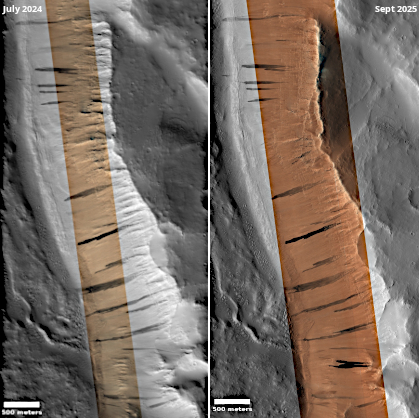
Cool image time! On October 7, 2025, the science team that operates HiRISE, the high resolution camera on Mars Reconnaissance Orbiter (MRO), took its 100,000th picture since entering Mars orbit in March 2006.

The objective of this observation is to better resolve sand dunes and the rocky material underneath them. These dark, eroded rocks may be the source for some of these Syrtis Major sand dunes. Our image was suggested by a high school student enrolled in the Jefferson County Executive Internship program in Colorado in 2023, one of many public outreach programs the HiRISE Team engages in.

To celebrate this accomplishment and the fantastic geology of the scene, students and staff in the HiRISE Photogrammetry lab constructed this digital terrain model. This oblique image highlights the hummocky mounds of the plains that border Jezero Crater, which are among the oldest on Mars.

That oblique image, cropped, reduced, and sharpened to post here, is to the right. The location is about 50 miles to the southwest of Jezero Crater where the rover Perseverance landed.
» Read more

6 comments

France and U.S. militaries complete rendezvous maneuvers in orbit

According to a statement by France’s military, the U.S. and France have successfully completed planned rendezvous maneuvers by two of their satellites in orbit.

These operations also apparently included the United Kingdom.

While the neither the US nor its allies have made public the satellites involved in any of the joint RPOs, the private space tracking firm COMSPOC said Sept. 19 that the maneuvers with the UK involved a US Geosynchronous Space Situational Awareness Program (GSSAP) neighborhood watch bird. The GSSAP satellite, USA 271, began moving on Sept. 5 and on Sept. 12 stopped just 13 kilometers (8.1 miles) from the UK’s SKYNET 5A military communications bird, the firm explained.

COMSPOC also watched the Franco-American pas-de-deux, which a company spokesperson told Breaking Defense involved another GSSAP, USA 324, and France’s SYRACUSE 3A. The satellites performed three sets of maneuvers: Nov. 11-14; Nov. 22-23; and Nov. 28-29, according to COMSPOC’s observations. “In all these movements, SYRACUSE 3A seems to lead and USA 324 seems to follow as the maneuvers performed by USA 324 is lagged by a day,” the spokesperson said, with the closest approach being about 25.1 kilometers (15.6 miles). [emphasis mine]

I have highlighted the distances above because these military maneuvers are actually quite unimpressive when compared with similar recent commercial rendezvous and proximity tests in orbit. The just completed Impulse/Starfish test for example got within 1.25 kilometers. And in 2024 Japan’s Astroscale did proximity operations within 50 meters of an old abandoned upper stage.

I suspect the best thing these militaries could do is to stop wasting money trying to do this themselves, and just hire the commercial companies instead. They’d do much better.

3 comments

Two launches early today

Both China and the American company ULA successfully completed launches since yesterday.

First, China placed the third satellite in an new Earth observation constellation, its Long March 4B rocket lifting off from its Taiyuan spaceport in northeast China.

Developed by the China Academy of Space Technology, the satellite will join the Ziyuan III 02 and 03 satellites already in orbit to form a high-precision observation constellation. Equipped with a stereoscopic mapping camera, multispectral camera, and laser altimeter, it will capture high-resolution 3D imagery critical for geographic data collection and natural resource management.

It appears however that this constellation is used by China’s military, so I suspect its purposes do not exactly match this description. China’s state-run press also provided no information as to where the rocket’s lower stages, using very toxic hypergolic fuels, crashed inside China.

Next, ULA launched another 27 Leo satellites for Amazon, its Atlas-5 rocket lifting off from Cape Canaveral in Florida. Amazon now has 181 satellites in orbit, with a requirement to get about 1,600 in orbit by July 2026 to meet its FCC license obligations. As it took about eight months to get those first 181 satellites into space (with SpaceX launching 72), Amazon’s three launch providers, ULA (42 launches), Arianespace (18 launches), and Blue Origin (27 launches), will have to ramp up their launch rate significantly to get even close to meeting those obligations in the next six months. There is also a question whether Amazon can manufacture enough satellites at a fast enough pace for those rockets.

As for the rocket, ULA now has only ten Atlas-5 rocket left in stock, with four reserved for Leo launches and six for Boeing’s Starliner manned capsule.

This was also ULA’s sixth launch in 2025. The leaders in the 2025 launch race:

166 SpaceX
84 China (a new record)
16 Rocket Lab
15 Russia

SpaceX now leads the rest of the world in successful launches, 166 to 138.

3 comments

Updates on the status of two Mars missions, Maven and Escapade

NASA today posted two separate updates on the status of two of its missions to or at Mars.

First, it appears there is an issue with one engine on one of the two Escapade orbiters on their way to their parking orbit where they will await the right moment to head to Mars.

During trajectory correction maneuvers for NASA’s twin ESCAPADE spacecraft on Dec. 8 and Dec. 12, the mission operations team noticed low thrust during the burn for one of the spacecraft. The team is working to identify the cause and will attempt a trajectory correction maneuver in the coming weeks.

The other spacecraft has successfully completed its two trajectory correction maneuvers, as planned. Both spacecraft are operating normally otherwise, and currently there are no long-term impacts from the trajectory correction delay.

While not the best news, this issue does not at this moment appear critical.

The second update however was even more negative. It appears engineers have not yet been able to re-establish contact and control of the Mars orbiter Maven.

To date, attempts to reestablish contact with the spacecraft have not been successful. Although no spacecraft telemetry has been received since Dec. 4, the team recovered a brief fragment of tracking data from Dec. 6 as part of an ongoing radio science campaign. Analysis of that signal suggests that the MAVEN spacecraft was rotating in an unexpected manner when it emerged from behind Mars. Further, the frequency of the tracking signal suggests MAVEN’s orbit trajectory may have changed. The team continues to analyze tracking data to understand the most likely scenarios leading to the loss of signal. Efforts to reestablish contact with MAVEN also continue.

It appears the loss of Maven is also impacting communications with the two Mars rovers Curiosity and Perseverance. While NASA has use of three orbiters at present, Mars Reconnaissance Orbiter, Mars Odyssey, and Europe’s Trace Gas Orbiter, to relay data from the ground to Earth, the loss of Maven reduces that communications network by 25%. Engineers are revising plans to make up some of the loss, but operations for both rovers will be for the time being reduced somewhat.

15 comments

An Impulse tug using Starfish equipment has successfully completed autonomous rendezvous maneuvers

Remora rendezvous
Images taken by Starfish’s camera.

A Mira orbital tug built by the startup Impulse Space has successfully completed rendezvous and proximity operations near a previously launched Mira tug, using software and equipment provided by the startup Starfish Space.

The Remora mission marked an industry first: a fully autonomous rendezvous executed by Starfish with a single lightweight camera system and closed-loop guidance, navigation and control software running on a peripheral flight computer.

Starfish and Impulse conducted the mission using Impulse’s Mira spacecraft that was flown on the Impulse LEO Express 2 mission. Starfish’s payloads enabled Mira to perform close-proximity maneuvers with another Impulse Mira spacecraft on orbit, which had been previously used for the LEO Express 1 mission. During operations in LEO, Starfish software autonomously controlled the LEO Express 2 Mira, guiding the satellite through a series of maneuvers which ultimately brought it to within approximately 1,250 meters of the LEO Express 1 Mira.

The significance of this test is its simplicity. Starfish has now demonstrated rendezvous technology that cubesats can use. Previously such precise maneuvers could only be done by larger satellites using more complex equipment. Starfish has orbital tug contracts using its own Otter tug, and will use this technology on those missions.

Impulse meanwhile demonstrated the maneuverability of its own Mira tug. And both companies demonstrated the ability to put this mission together quickly, in about nine months, and then launch it on a SpaceX rocket.

1 comment

SpaceX launches another 29 Starlink satellites

SpaceX last night successfully placed another 29 Starlink satellites into orbit, its Falcon 9 rocket lifting off from Cape Canaveral in Florida.

The first stage completed its 9th flight, landing on a drone ship in the Atlantic.

The leaders in the 2025 launch race:

166 SpaceX (a new record)
83 China
16 Rocket Lab
15 Russia

SpaceX now leads the rest of the world in successful launches, 166 to 136.

8 comments

House joins Senate in proposing a new space bureaucracy here on Earth

Gotta feed those DC pigs!

In mid-November a bi-partisan group of senators introduced legislation they claimed would help the U.S. beat China in space by creating a new government agency called the “National Institute for Space Research.”

The absurdity of creating a new agency to do this was obvious. Don’t we already have something called NASA that is tasked with this job? As I noted then, “This is just pork.”

Rather than funding real research or development in space, this legislation simply creates another Washington government agency supposedly functioning independent of presidential or even congressional oversight (a legal structure the courts have increasingly declared unconstitutional).

Well, it appears two congress critters in the House have decided they had to keep up with the Jones in the Senate, and have now introduced their own variation of this legislation.

Yesterday, Congresswoman Valerie Foushee [D-North Carolina], Ranking Member of the House Subcommittee on Space and Aeronautics, and Congressman Daniel Webster [R-Florida] introduced H.R. 6638, the Space Resources Institute Act, bipartisan legislation which directs the National Aeronautics and Space Administration (NASA) Administrator and the Secretary of Commerce to report to Congress on the merits and feasibility of establishing a dedicated space resources institute relating to space resources, the surface materials, water, and metals often found on the Moon, Mars, and asteroids.

The bill would give NASA 180 days to submit its report.

This is just more junk from Congress that will do nothing but distract NASA from its real business, fostering a new American aerospace industry capable of colonizing the solar system for profit. Note too that like the Senate bill, this House bill is a bi-partisan effort in stupidity.

As I said in reporting on the Senate version of this proposal, “Ugh. There are times I wish I didn’t have to read the news from DC. It almost always depresses me.”

9 comments

Components for the first Ariane-6 Amazon’s Leo launch shipped to French Guiana

The components for the first Ariane-6 launch in its 18-launch contract with Amazon are now on their way by boat to French Guiana for a launch earlier in 2026.

Amazon’s low Earth orbit satellite network, Amazon Leo, reached another milestone this week as Arianespace’s hybrid industrial cargo ship, Canopée, departed from Bordeaux, France, transporting essential components of the Ariane 6 rocket for its first Amazon mission planned for early next year.

…Canopée’s voyage is supporting Amazon Leo’s inaugural mission on Ariane 64—an Ariane 6 variant featuring four additional boosters for maximum satellite launch capacity. The vessel will transport the rocket’s central core stage, upper stage, and other critical components on a weeks-long journey across the Atlantic to the European Spaceport in Kourou, French Guiana. Once there, the components will undergo final assembly and integration in preparation for the LE-01 mission.

Though Ariane-6 has successfully launched four times, none of those versions were this most powerful version. The plan is for it to place in orbit 32 Leo satellites, some of which Amazon has already shipped to French Guiana.

Arianespace plans six Ariane-6 launches in 2026, though it is unclear how many of these launches will be for Amazon. Amazon, which has about 154 satellites in orbit, needs to get about 1,450 more launched by July to meet its FCC license obligations. Both ULA and Blue Origin say they will be ramping up their launch pace in 2026 to meet this need, but it remains unclear if all three rocket companies can get the job done on time.

4 comments

Vast opens Japanese office

As part of its recent push to establish links with as many foreign governments as possible, Vast announced earlier this week the opening of a new Japanese office, to be headed by a retired Japanese astronaut.

In November Vast announced preliminary agreements with Uzbekistan, the Maldives, and Columbia. This new office in Japan continues that trend. The company is clearly marketing its demonstration single module space station Haven-1 to these international customers. None have yet committed to a flight, but expect a lot of action once Haven-1 launches in the spring and is proven operational. The company wants to fly four 30-day manned missions to the module during its three year mission, and if launched successfully these international customers are likely to sign on for flights.

0 comments
1 52 53 54 55 56 1,328