Japanese investor sues Excalibur Almaz

The billionaire investor in the company Excalibur Almaz is suing the lawyer in charge for fraud.

Using the $49 million the billionaire invested, the lawyer purchased several Soviet-era capsules and a Almaz space station module from the Russians, claiming they would use this equipment, once refurbished, to establish a commercial space company. What the lawyer, Art Dura, did not tell anyone was, as the lawsuit explains:

“The purchase contracts had to be approved by the Russian government, and unbeknownst to plaintiff … expressly excluded the right to modify the Russian hardware, thus relegating it to display uses only! The items were only museum pieces, a secret Dula would keep until well after he acquired control of plaintiff’s investment.”

Dula’s vehicle for the scheme was Excalibur Almaz Limited, an entity he set up in the Isle of Man, into which he transferred Horie’s $49 million investment, according to the complaint.

What I find amazing is that the company, Excalibur Almaz, also put out a lot of press releases describing how they were going to use this Russian equipment as part of their space effort. I reported on these releases myself. That Dura was able to keep the contract terms secret, that even the Russians didn’t publicly protest his false statements, is most interesting. Apparently, the Russians were glad to take his money and even help with the fraud, by not revealing the truth when Dura made public claims that were impossible according to the contract.

This story illustrates one of the less obvious investment risks inherent in a new industry such as commercial space. Not only can vehicles crash and burn, there are also a lot of con artists out there willing to take advantage of naive individuals who are so passionate about space exploration that they don’t look closely at what they are doing.
0 comments

Philae’s status on the surface

European engineers have released an overall status update on Philae’s generally good condition after its landing on Comet 67P/C-G.

Later on 12 November, after analysing lander telemetry, the Lander Control Centre (in Cologne) and Philae Science, Operations and Navigation Centre (SONC, Toulouse) reported;There were three touchdowns at 15:34, 17:25 and 17:32 UTC; in other words, the lander bounced. The firing of the harpoons did not occur. The primary battery is working properly. The mass memory is working fine (all data acquired until lander loss of signal at 17:59 UTC were transmitted to the orbiter). Systems on board the lander recorded a rotation of the lander after the first touchdown. This is confirmed by ROMAP instrument data, which recorded a rotation around the Z-axis (vertical).

The lander did receive some power from the solar panels on Wall No. 2 (technical description of the lander’s solar walls here), but it appears that parts of the lander were in shadow during the time that last night’s surface telemetry were being transmitted.

An additional update here.

Philae is between a rock and a hard place. More specifically, it’s on its side, one leg sticking up in the air — and in the shadows of a looming crater wall a few meters away. Solar panels are receiving only about 1.5 hours of light a day, when the goal was for 6 or 7 hours per day to recharge the lander’s batteries. Drilling into the subsurface would have to wait until the very end of Philae’s 60 hours of battery life — for fear that it could upset the lander. Yet mission leaders were largely upbeat about being alive and doing science. Most of the lander’s 10 instruments were taking data, and engineers were exploring options to use the spring of the lander legs or other ground-poking instruments to jostle the lander into a more favorable position.

Even more here, including the first image from the surface.

1 comment

Philae might have bounced

Data from the Philae lander suggests that, when the spacecraft’s harpoons failed to fire, the probe might have bounced and then settled to the surface.

[T]elemetry from the craft suggested it might have drifted off the surface after landing and started to turn. This subsequently came to an end, which the German Space Agency official interpreted as a possible “second landing” on Comet 67P. This “bounce” was always a possibility, but had been made more likely by the failure of the harpoons to deploy, and the failure of a thruster intended to push the robot into the surface.

1 comment

A comet picture taken by Philae on the way down

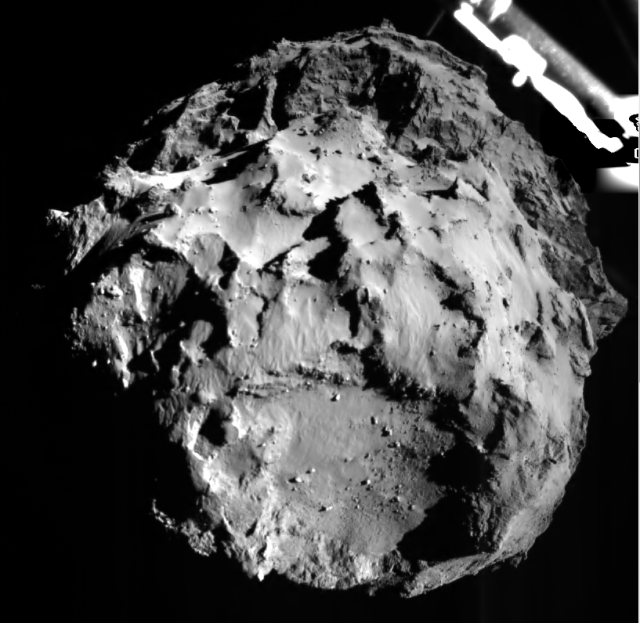
Comet 67P/C-G as seen by Philae during its descent

I am not sure if the actual landing site is visible in this image. I don’t think so as nothing seems to match what was on the earlier close-up. Moreover, the Rosetta website does not say.

No images on the surface have yet been released. There are also issues that could prevent a full success.

However, while the lander has touched down on the comet using its harpoons, scientists said that it had not yet deployed its anchors which meant that it was not completely attached to the surface. The surface was much softer than they expected, so there were some concerns that it was not securely fixed on the comet – although from a software point of view things seemed to be fine. Engineers will attempt to fire the anchors again soon in order to keep Philae attached to the surface of the comet.

3 comments

Philae has landed successfully!

Philae has landed successfully on Comet 67P/C-G.

Philae is on the surface, its harpoons have fired and the landing gear has been moved inside, and Philae is in contact. It’s incredible! Massive smiles on everyone’s faces. The room went mad. Twice — when we first had the hint, and then when Stephan Ulamec and Andrea Accomazzo confirmed it. Unbelievable.

More information and data will be coming in a few hours. Stay tuned.

3 comments

Philae is go for separation, despite problem

Engineers have given a go for the separation of the Philae lander from Rosetta, despite the failure of a thruster to operate.

During checks on the lander’s health, it was discovered that the active descent system, which provides a thrust upwards to avoid rebound at the moment of touchdown, cannot be activated.

At touchdown, landing gear will absorb the forces of the landing while ice screws in each of the probe’s feet and a harpoon system will lock Philae to the surface. At the same time, the thruster on top of the lander is supposed to push it down to counteract the impulse of the harpoon imparted in the opposite direction. “The cold gas thruster on top of the lander does not appear to be working so we will have to rely fully on the harpoons at touchdown,”says Stephan Ulamec, Philae Lander Manager at the DLR German Aerospace Center. “We’ll need some luck not to land on a boulder or a steep slope.”

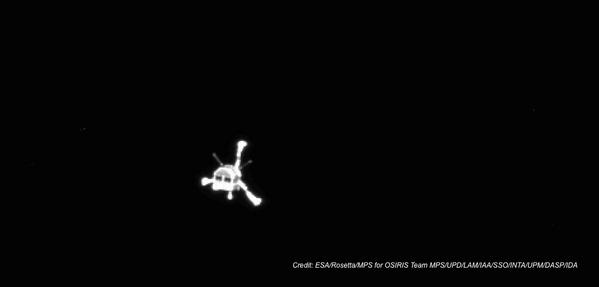
Update: Separation has occurred and signal reacquired from Philae. We wait for landing.

0 comments

Close-up image of Philae’s landing site


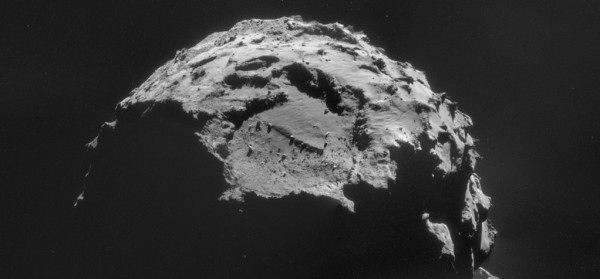
Agilkia landing site for Philae

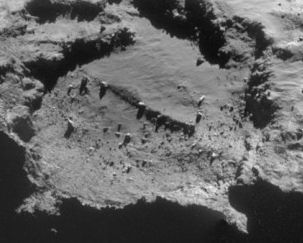
Inset of landing site

In the preparation to Wednesday’s landing of Philae on Comet 67P/C-G, Rosetta’s science team has released a great image of the landing site, shown above. To the right is a higher resolution inset of the site itself, with the smallest object visible about 8.5 feet across.

Looking at this inset, there are some obvious worries that we all should be aware of prior to the landing attempt. Though the Agilkia landing site is generally more smooth than most of the comet’s surface, it still has significant hazards. The lower part is strewn with boulders and rocks, many of which are quite large. Any one of these could do serious harm to Philae should it land on them.

Even more interesting is the upper part of the landing site. Though very smooth, the image suggests to me that this is a very thick pile of softly packed material. Philae might land there and quickly sink below the surface, where its cameras will be able to see nothing.

Nonetheless, the science team has also released this outline of Philae’s science timeline after landing. The lander will also be taking images of both Rosetta and the comet during its descent, so even if the landing is a failure we will still get some worthwhile data.

1 comment

Comet Siding Spring’s fly-by of Mars changed the planet’s atmosphere

Data obtained by the various Mars orbiters during the close fly-by of Comet Siding Spring of Mars has revealed that the comet created a new temporary layer in the planet’s atmosphere.

The European Space Agency’s Mars Express spacecraft detected an increase in electrons in Mars’ upper atmosphere, partly ionising it. This was attributed to fine cometary dust penetrating the atmosphere, which led to a meteor storm of thousands of meteors per hour. The increase in electrons led to the creation of a temporary new layer of charged particles in the ionosphere, which runs from an altitude of 120 kilometres to several hundred kilometres above. This is the first time such an event has been seen, even on Earth the extra density of electrons was measured to be five to ten times higher than normal by NASA’s Mars Reconnaissance Orbiter. Another NASA spacecraft, MAVEN, which also observed the new layer in the ionosphere, will monitor for any long-term events as it goes about its regular duties of studying Mars’ atmosphere.

MAVEN’s Imaging Ultraviolet Spectrograph was able to ascertain the species of ions that flooded into the ionosphere from the comet, the first time a comet that has come direct from the distant Oort Cloud has been sampled in this way. It detected the signal of magnesium, iron and sodium ions following the meteor shower, a signal that dominated Mars’ ultraviolet spectrum for hours afterwards, taking two days to dissipate.

The chemistry that MAVEN detected appears superficially somewhat similar to the chemistry that Rosetta is detecting at Comet 67P/C-G, though there are differences.

0 comments

China’s struggle to compete with SpaceX

This Aviation Week story provides a detailed update on China’s effort to build a new family of Long March rockets that are less expensive to operate and can effectively compete with SpaceX.

Two main take-aways from the article. First, the first flight of the Long March 7, a direct competitor with the Falcon 9, has been seriously delayed. Originally expected to fly in 2013, that first flight has apparently been pushed back to 2015.

Second, even with extensive cost savings, the Long March 7 will still cost a customer more than a Falcon 9, $70 million vs $61 million.

0 comments

Alternative rockets and 2015 launch dates for Cygnus

The heat of competition: Orbital Sciences has pinpointed available launch slots and alternative rockets for getting Cygnus into orbit in 2015.

[Orbital CEO David] Thompson said Wednesday the company has narrowed its options to three launch providers which have openings as early as the second quarter — between April 1 and June 30 — of next year. Two of the launch providers are based in the United States. Orbital could also launch Cygnus missions with a European-based company, Thompson said. The contractors under consideration are presumably United Launch Alliance, SpaceX and Arianespace.

Unlike Virgin Galactic’s claims in my previous post, I find Thompson’s prediction here quite likely. His main problem is not technical but political. He has to convince his competitors to help him, and this story is his first shot across the bow in that negotiation. By making these facts public, Thompson applies pressure on these other companies to agree. And though the request is unstated, he is also enlisting NASA’s aid, since the agency is certain to back him in this negotiation and apply its clout in his favor.

2 comments

Virgin Galactic vows to fly again by April

The heat of competition: During a press tour of its Mojave facilities this week Virgin Galactic’s CEO revealed that the company expects to begin flying its replacement to SpaceShipTwo by April.

George Whitesides, the company’s chief executive, said construction of the second spaceship is already 65 per cent complete. Like its doomed predecessor, Enterprise, the new spaceship’s name is a tribute to both Nasa and Star Trek. It will be called SS Voyager, the Sunday Times reports.

Whitesides also said that LauncherOne, designed to put very small payloads into orbit, is 18 months away from its first flight.

I hope this predictions are true, but coming from Virgin Galactic I think I can be forgiven if I am very skeptical. Nonetheless, in referring to the new ship I will make it a policy to call it Voyager from here on out to distinguish it from the first ship.

1 comment

Bringing Dream Chaser home

The competition heats up: At an space industry conference this week Sierra Nevada outlined the ability of Dream Chaser to land at almost any airport, including the many financial and safety advantages of that flexibility.

The story notes that because Dream Chaser would not need an unusually long runway, it could land at most airports. Also, because it would have no hazardous materials on board, removing it from the runway after landing would be simple and straightforward. You would simply tow it away. The biggest advantage of this, howevr, is that if the spacecraft was docked at ISS and there was an emergency that required immediate evacuation, bringing Dream Chaser and its passengers home to a runway will be possible any time.

This presentation is part of Sierra Nevada’s sales effort to find new backers for their spacecraft, now that NASA has begged out. I think they make a good sales pitch. I hope someone with money agrees.

15 comments
1 656 657 658 659 660 798