Roscosmos declares film crew fit for launch to ISS

Capitalism in space: Roscosmos last week announced that the actress and director who plan to fly to ISS in October to film scenes for a science fiction movie are fit to fly.

Director Klim Shipenko and actor Yulia Peresild got the thumbs-up after a meeting of the Chief Medical Commission at the Yuri Gagarin Cosmonaut Training Center near Moscow, Russia’s federal space agency Roscosmos announced last week.

Cosmonaut Anton Shkaplerov, who is scheduled to launch toward the orbiting lab with Shipenko and Peresild aboard a Russian Soyuz spacecraft on Oct. 5, also got final medical clearance. So did the backups for the mission: cosmonaut Oleg Artemyev, director Alexey Dudin and actor Alena Mordovina.

The movie script itself, about an astronaut who gets a heart attack while on a spacewalk and then has to have surgery in space before returning to Earth, actually sounds quite good and — most refreshing — well grounded in reality. American space films tend to go in absurd directions, often because the filmmakers are ignorant and have no interest in learning anything about the subject they are writing about.

So far, the schedule of upcoming space tourist flights appears on track to happen, as announced:

  • September 15, 2021: SpaceX’s Dragon capsule flies four private citizens on a three day orbital flight
  • October 2021: The Russians will fly two passengers to ISS for 10 days to shoot a movie
  • December 2021: The Russians will fly billionaire Yusaku Maezawa and his assistant to ISS for 12 days
  • cDecember 2021: Space Adventures, using a Dragon capsule, will fly four in orbit for five days
  • January 2022: Axiom, using a Dragon capsule, will fly four tourists to ISS
  • 2022-2024: Three more Axiom tourist flights on Dragon to ISS
  • 2024: Axiom begins launching its own modules to ISS, starting construction of its own private space station
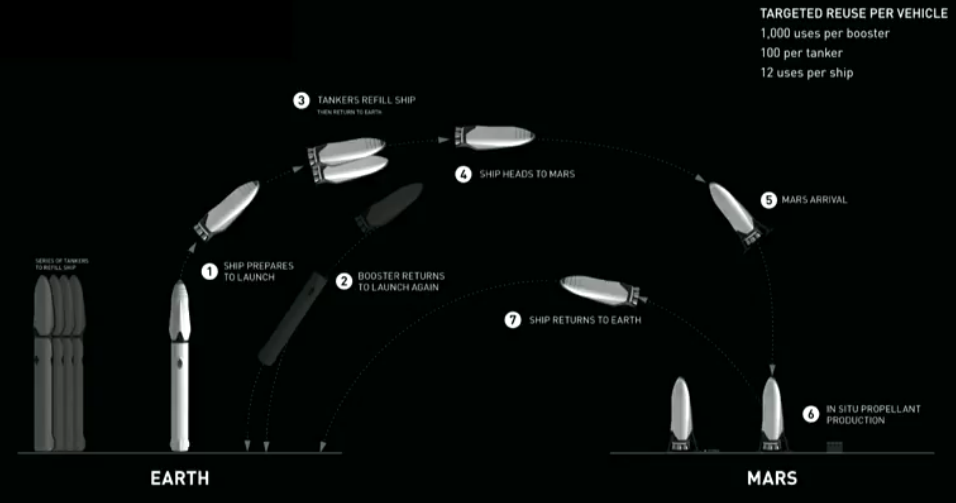
  • c2024: SpaceX’s Starship takes Yusaku Maezawa and several others on a journey around the Moon.
2 comments

The boom in commercial space continues

Starship on an early test flight
Modern rocketry soaring under freedom

Capitalism in space: In the last two days there have been so many stories about different space companies winning new contracts I think it is important to illustrate this in one essay, rather than in multiple posts. Below is the list:

The last two stories are possibly the most significant, because both show that the shift in space from government-built to privately-built, as I advocated in my 2017 policy paper, Capitalism in Space, is spreading to other countries. » Read more

13 comments

Update on status of first orbital Starship/Superheavy

Capitalism in space: The first planned orbital Superheavy booster, prototype #4, has been moved back to the orbital launch site, this time with all of its 29 engines fully installed.

It appears SpaceX engineers are about to begin an extensive test campaign of this booster and its engines. They need to test the fueling of all 29 engines. They need to test fire the engines as a unit. And they need to do a full static fire of them all to see if they will work together as planned.

All these tests, which based on SpaceX’s past pace, will likely take about three to four weeks, which means that the orbital test flight cannot occurr before the end of September, as previously guessed. More likely they will not be ready to fly before the end of October, at the soonest.

That schedule is also impacted by the FAA’s bureaucracy, which still needs to approve the environmental assessment required before any Starship orbital flight. That approval process has been ongoing, but could still take several more months, especially if the effort by some fearful environmentalists to stop the flight gains political momentum.

11 comments

The problem Starship poses to NASA and Congress

An interesting essay published earlier this week in The Space Review raises the coming dilemma that both NASA and Congress will soon have to face once Starship is operational and launching large cargoes and crews to orbit, both near Earth and to the Moon.

That dilemma: What do about SLS and Lunar Gateway once it becomes ridiculously obvious that they are inferior vessels for future space travel?

I think this quote from the article more than any illustrates the reality that these government officials will soon have to deal with in some manner:

[When] the Lunar Starship ever docks with Gateway, the size comparison with Gateway will appear silly and beg the question as to whether Gateway is actually necessary. Does this even make sense? Couldn’t two Starships simply dock with each other and transfer propellant from one to another. Is there really a need for a middleman?

The author, Doug Plata, also notes other contrasts that will make SLS and Lunar Gateway look absurd, such as when two Starships begin transferring fuel in orbit or when a Starship launches 400 satellites in one go, or when a private Starship mission circles the Moon and returns to Earth for later reuse.

All of these scenarios are actually being planned, with the first something NASA itself is paying for, since the lunar landing Starship will dock with Lunar Gateway to pick up and drop off its passengers for the Moon.

The bottom line for Plata is that the federal government needs to stop wasting money on bad programs like SLS and Lunar Gateway and switch its focus to buying products from commercial sources like SpaceX. They will get far more bang for the buck, while actually getting something accomplished in space.

Though he uses different words, and has the advantage of recent events to reference, Plata is essentially repeating my recommendations from my 2017 policy paper, Capitalism in Space [free pdf]. Plata draws as his proof for his argument the recent developments with Starship. I drew as my proof a comparison between SLS and what private commercial space was doing for NASA, as starkly illustrated by this one table:

The cost difference between SLS and private space

The government has got to stop trying to build things, as it does an abysmal job. It instead must buy what it needs from private commercial vendors who know how to do it and have proven they can do it well.

If the government does this, will not only save money, it will fuel an American renaissance in space. As we see already beginning to see happen now in rocketry and the unmanned lunar landing business.

20 comments

SpaceX successfully launches cargo Dragon to ISS

Capitalism in space: SpaceX tonight successfully used its Falcon 9 rocket to launch cargo Dragon to ISS.

The first stage completed its fourth flight, landing successfully on the drone ship in the Atlantic. The cargo Dragon is making its second cargo mission for NASA. It will dock tomorrow.

This was SpaceX’s first launch since June 30th, a gap of almost two months as they initiated operations of a new drone ship in the Atlantic and shifted an older drone ship to the Pacific. In the next few weeks expect their fast launch pace for ’21 to resume, with at least one Starlink launch and the September 15th Inspiration4 commercial manned orbital flight.

The leaders in the 2021 launch race:

29 China
21 SpaceX
13 Russia
4 Northrop Grumman

The U.S. now leads China 32 to 29 in the national rankings.

21 comments

Amazon protests SpaceX’s Starlink plan to FCC

Amazon on August 25, 2021 filed a protest with the FCC against SpaceX’s proposed expansion of its Starlink constellation that would allow almost 30,000 satellites to be launched.

“Should the Commission depart from its rules and precedent and endorse the approach of applying for multiple, mutually exclusive configurations, the consequences will extend far beyond the SpaceX Amendment,” wrote Mariah Shuman, corporate counsel for Amazon’s broadband megaconstellation venture Project Kuiper, in an Aug. 25 letter to the FCC. “However inefficient this strategy might be for the Commission and parties responding to applications, other prospective licensees will surely see the benefit in maximizing their optionality by describing multiple configurations in their license applications.”

Shuman asked the FCC to “dismiss SpaceX’s Amendment, and invite SpaceX to resubmit its amendment after settling on a single configuration for its Gen2 System.”

It appears Amazon does not want the FCC to approve multiple proposed satellite configurations put forth by SpaceX in a single application. Instead, it wants the FCC to force SpaceX to pick one, and submit that alone. It also appears that doing what Amazon requests would be more in line with past FCC policy.

While Amazon might have a point, the optics once again make another Jeff Bezos’ company look ugly, more interested in using the courts to stymie its competitors than actually launching anything. Amazon’s Kuiper internet constellation was first proposed in early 2019. More than two years have passed and none of its more than 3200 satellites have launched — not even one test satellite — with no clear indication yet on when launches will finally begin.

SpaceX began testing its Starlink system in 2018, and already has about 1,700 operational satellites in orbit. The comparison between the two companies is stark, and not favorable to Amazon.

In fact, Elon Musk was not shy in taking advantage of these optics to note them quite sharply in a tweet yesterday, saying, “Turns out Besos [sic] retired in order to pursue a full-time job filing lawsuits against SpaceX.”

Amazon is not Blue Origin, but both companies were founded by Bezos, and it appears right now that both prefer court battles to rocket engineering.

3 comments

Musk’s Boring Co offers to dig tunnel for resident transportation during launch closures

Capitalism in space: Elon Musk’s Boring Company has proposed digging a tunnel so that people can still access Boca Chica’s beaches even during periods when SpaceX is doing launch operations and needs to close the surface roads.

The Boring Company (TBC) met with Cameron County officials to discuss the possibility of a tunnel project running from South Padre Island (SPI) to Boca Chica Beach.

The Boring Company pitched the idea of an SPI-Boca Chica tunnel to Cameron County administrator Pete Sepulveda Jr. and county engineer Benjamin Worsham early this summer. Cameron County officials have been thinking of giving people access to part of Boca Chica Beach even during closures.

The county has said it likely cannot afford to pay for such a thing, but Musk’s company is still proposing to do an in-depth study to find out what will be necessary to make it happen.

It could very well be that Musk might find some cash to help pay for this himself. The public relations would be excellent, and it would I think be the right thing to do. It is also possible that the local communities will have more cash themselves because of the booming economy SpaceX is bringing them.

2 comments

Update on Starship/Superheavy preparations for orbital test flight

Starship prototype #20 being prepped
Screen capture from Labpadre live stream, available here.

Link here. In sum it appears that SpaceX is getting very close to launch, with the permit approval of the FAA increasingly becoming the biggest obstacle to progress.

Although the completion of all of this testing could take a long time, in Elon Musk’s mind, the path to returning B4 and S20 to being an integrated stack could be during this month.

A week ago, Musk tweeted that the “first orbital stack of Starship should be ready for flight in a few weeks, pending only regulatory approval.” Ultimately, once the vehicle is in its launch configuration, there will be a lengthy process of passing the aforementioned regulatory approval, with an environmental public comment period triggered ahead of launch. This has to be completed before the launch license can be granted by the Federal Aviation Administration (FAA).

The screen capture above shows Starship prototype #20 sitting on the suborbital flight test pad, as workers on cherry-pickers work on its exterior. The orange, green, and white tiles are likely tile locations still needing some level of installation work.

Based on SpaceX’s normal pace of operations, the engine testing for both Starship and Superheavy will take several weeks, once both are ready for such testing. While Starship appears just about ready, Superheavy apparently needs more work. When SpaceX stacked both together on the orbital launchpad several weeks ago, it suggested both were closer to launch than they were. Their present status suggests engine testing will likely begin in September, with Starship at the beginning of the month and Superheavy at the end of the month. That would make a launch possible sometime in late October, assuming the federal government doesn’t decide to shut this entire operation down by refusing to issue a permit.

7 comments

NASA freezes work on SpaceX’s lunar lander version of Starship

In response to Blue Origin’s lawsuit that is attempting to cancel the contract award to SpaceX for adapting its Starship upper stage rocket as a manned lunar lander, NASA yesterday officially paused all work by it and SpaceX on this project.

From NASA’s statement:

NASA has voluntarily paused work with SpaceX for the human landing system (HLS) Option A contract effective Aug. 19 through Nov. 1. In exchange for this temporary stay of work, all parties agreed to an expedited litigation schedule that concludes on Nov. 1. NASA officials are continuing to work with the Department of Justice to review the details of the case and look forward to a timely resolution of this matter.

The optics for Blue Origin remain ugly. Not only does the company appear more interested in fighting court battles than building spaceships and rockets, it now is acting to prevent others from doing so.

The timeline of events however is interesting. Blue Origin filed its lawsuit on August 13th. NASA issued the first $300 million payment to SpaceX for this $2.9 billion contract on August 16th. Even with this announcement today, the payment suggests that NASA is doing what it can to make the contract award an accomplished fact that the courts will not find easy to overturn.

1 comment

The knives aimed at SpaceX are getting sharpened

Starship must be banned!
Banning Starship: The new goal of our leftist masters.

Two stories today mark what appears to be a growing political campaign focused on squelching by any means possible the continued unparalleled success of the company SpaceX. And the simultaneous publication of both stories on the same day also suggests that this campaign is deliberately timed to force the FAA to shut down SpaceX at Boca Chica.

First we have a story at Space.com aimed at SpaceX’s Starlink constellation, making it the big villain in the growing threat of satellite collisions.

SpaceX’s Starlink satellites alone are involved in about 1,600 close encounters between two spacecraft every week, that’s about 50 % of all such incidents, according to Hugh Lewis, the head of the Astronautics Research Group at the University of Southampton, U.K. These encounters include situations when two spacecraft pass within a distance of 0.6 miles (1 kilometer) from each other.

Lewis, Europe’s leading expert on space debris, makes regular estimates of the situation in orbit based on data from the Socrates (Satellite Orbital Conjunction Reports Assessing Threatening Encounters in Space ) database. This tool, managed by Celestrack, provides information about satellite orbits and models their trajectories into the future to assess collision risk.

Though his data appears accurate and the growing risk of collisions is real, it appears from the story that Lewis, one of only two experts interviewed, has a strong hostility to SpaceX. He doesn’t like the fact that SpaceX is so successful in such a short time, and appears to want something done to control it.

The article also nonchalantly sloughs off one very significant fact: Very few satellite collisions have actually occurred. While the risk is certainly going to increase, that increase is not going to be fueled just by SpaceX. At least four large constellations are presently in the works, all comparable to Starlink in some manner. To focus on SpaceX in particular makes this article appear like a hatchet job.

Then we have a news story from CBS and its very partisan and leftist news show, Sixty Minutes+, providing a loud soapbox for the very small number of anti-development environmentalists fighting to block SpaceX’s operations in Boca Chica, Texas.
» Read more

31 comments

Firefly hires noted SpaceX engineer

Capitalism in space: Firefly Aerospace announced earlier this week that it has hired as it chief operating officer Lauren Lyons, a former SpaceX engineer familiar to many for her regular appearances as a announcer on SpaceX’s launch telecasts.

The company said that Lyons will focus on “transitioning Firefly from an R&D environment to a production environment” for its Alpha small launch vehicle, Space Utility Vehicle tug and Blue Ghost lunar lander. “Firefly is entering a pivotal and exciting phase of its growth,” Lyons said in the statement. “I’m thrilled to take on the challenge of leading the efforts in scaling the company’s infrastructure to support rapid growth, high execution rate, and deliver exceptional value and service to our customers.”

Translation: Using Lyons expertise from SpaceX, Firefly intends to operate much like SpaceX, upgrading its rockets and spacecraft continuously even as they operate commercially.

The launch date for the company’s first orbital attempt remains unannounced, though it says it will occur before the end of the year. It appears they are ready to go, except for one component of their flight termination system.

7 comments

Blue Origin files lawsuit against Starship lunar contract award

What a joke: Jeff Bezos’s company Blue Origin on August 13th filed a lawsuit in federal court, attempting to overthrow the contract award NASA gave SpaceX’s Starship in its manned lunar lander Artemis project

In a court filing on Friday, Blue Origin said it continued to believe that two providers were needed to build the landing system, which will carry astronauts down to the Moon’s surface as early as 2024. It also accused Nasa of “unlawful and improper evaluation” of its proposals during the tender process. “We firmly believe that the issues identified in this procurement and its outcomes must be addressed to restore fairness, create competition and ensure a safe return to the Moon for America,” Blue Origin said.

The article then goes on to list the basic facts that make this lawsuit absurd. First, NASA had not been appropriated enough money by Congress to award two contracts, and had it done so, it would have violated the law. Second SpaceX’s bid was the lowest bid, far less than Blue Origin’s expensive price. Third, SpaceX was already test flying early prototypes of its Starship lander, while Blue Origin had built nothing. Fourth, many other technical issues made SpaceX’s bid superior.

Finally, the GAO, as an independent arbitrator, has already ruled against a Blue Origin protest, stating unequivocally that NASA had done nothing wrong in its contract process.

This lawsuit makes Blue Origin appear to be a very unserious company. Rather than putting its energies towards building rockets and spacecraft to demonstrate its capabilities, it focuses its effort on playing legal games in the courts. Such behavior will only make it seem less appealling when next it bids on a NASA or Space Force contract.

15 comments
1 110 111 112 113 114 234