SpaceX wins launch contract for seven SES satellites

Capitalism in space: SES yesterday announced that it has awarded SpaceX’s Falcon 9 the launch contract for the next seven satellites in its next generation communications constellation.

This is a big win for SpaceX, made even more clear by a briefing held yesterday with reporters by Arianespace CEO Stéphane Israel. In that briefing Israel outlined that company’s upcoming launch contracts, where he also claimed that this launch manifest is so full he had to turn down SES’s launch offer.

Because of its full manifest, Arianespace was unable to offer SES launch capacity in 2021 for its next generation of medium Earth orbit satellites, mPOWER. SES announced plans Sept. 9 to fly mPOWER satellites on SpaceX Falcon 9 rockets from Florida’s Cape Canaveral. Arianespace launched the 20 satellites in the SES O3B constellation.

It was important to SES to launch in 2021, Israel said. Given Arianespace’s full manifest, it was difficult “to offer the guarantee they were asking for,” he added.

If you believe that I have a bridge I want to sell you. Arianespace has been struggling to get launch contracts for its new Ariane 6 rocket. They have begun production on the first fourteen, but according Israel’s press briefing yesterday, Ariane 6 presently only has eight missions on its manifest. That means that six of the rockets they are building have no launch customers. I am sure they wanted to put those SES satellites on at least some of those rockets, and couldn’t strike a deal because the expendable Ariane 6 simply costs more than the reusable Falcon 9.
4 comments

Update on SpaceX’s plans for Starship

According to FAA regulatory documents, SpaceX has updated its development plan for Starship, including changes in its overall plans for its Boca Chica facility.

The document also lays out a three-phase test program, which it says “would last around 2 to 3 years”:

Phase 1: Tests of ground systems and fueling, a handful of rocket engine test-firings, and several “small hops” of a few centimeters off the ground. The document also includes graphic layouts, like the one above, showing the placement of water tanks, liquid methane and oxygen storage tanks (Starship’s fuels), and other launch pad infrastructure.

Phase 2: Several more “small hops” of Starship, though up to 492 feet (150 meters) in altitude, and later “medium hops” to about 1.9 miles (3 kilometers). Construction of a “Phase 2 Pad” for Starship, shown below, is also described.

Phase 3: A few “large hops” that take Starship up to 62 miles (100 kilometers) above Earth — the unofficial edge of space — with high-altitude “flips,” reentries, and landings.

The first phase is now complete, with the company shifting into Phase 2.

Boca Chica meanwhile is no longer being considered a spaceport facility. Instead, its focus will now be a development site for building Starship and Super Heavy.

3 comments

SpaceX issues explanation for nonresponse in potential satellite collision issue

SpaceX today issued an explanation for why it had not responded when ESA officials had asked them to change the orbit of one of its Starlink smallsats to protect against a possible collision with ESA’s Aeolus spacecraft.

SpaceX, in a statement Sept. 3, said it was aware of a potential conjunction Aug. 28 and communicated with ESA. At that time, though, the threat of a potential collision was only about 1 in 50,000, below the threshold where a maneuver was warranted. When refined data from the U.S. Air Force increased the probability to within 1 in 1,000, “a bug in our on-call paging system prevented the Starlink operator from seeing the follow on correspondence on this probability increase,” a company spokesperson told SpaceNews.

“SpaceX is still investigating the issue and will implement corrective actions,” the spokesperson said of the glitch. “However, had the Starlink operator seen the correspondence, we would have coordinated with ESA to determine best approach with their continuing with their maneuver or our performing a maneuver.”

This incident increasingly strikes me as a tempest in a teapot created by ESA for any number of reasons, including their overall dislike of SpaceX (for generally making all government-run space programs look foolish). There is also this quote from an ESA official in the article above:

“The case just showed that, in the absence of traffic rules and communication protocols, collision avoidance has to rely on the pragmatism of the involved operators,” Krag said. “This is done today by exchange of emails. Such a process is not viable any longer with the increase of space traffic.” He said that, if the Space Safety initiative is funded, ESA would like to demonstrate automated maneuver coordination by 2023. [emphasis mine]

I can just see ESA officials drooling with eager anticipation the coming of more “traffic rules and communication protocols,” partly inspired by this fake crisis they just created. Imposing more rules and getting increased funding is what they do best, since it certainly isn’t exploring space with creative and efficient innovation.

6 comments

SpaceX declines to shift Starlink satellite to avoid collision

When European Space Agency (ESA) engineers realized there was a greater than normal chance that a new SpaceX Starlink satellite could collide with ESA’s already orbiting Aeolus satellite, they asked SpaceX to shift its orbit, only to have SpaceX decline.

According to Holger Krag, head of the Space Debris Office at ESA, the risk of collision between the two satellites was 1 in 1,000 – ten times higher than the threshold that requires a collision avoidance maneuver. However, despite Aeolus occupying this region of space nine months before Starlink 44, SpaceX declined to move their satellite after the two were alerted to the impact risk by the U.S. military, who monitor space traffic. “Based on this we informed SpaceX, who replied and said that they do not plan to take action,” says Krag, who said SpaceX informed them via email – the first contact that had been made with SpaceX, despite repeated attempts by Krag and his team to get in touch since Starlink launched. “It was at least clear who had to react. So we decided to react because the collision was close to 1 in 1,000, which was ten times higher than our threshold.”

As to why SpaceX refused to move their satellite, that is not entirely clear (the company did not respond to a request for comment). Krag suspected it could be something to do with SpaceX’s electric propulsion system, which “maybe is not reacting so fast” as the chemical propulsion on board Aeolus.

The article is clearly spun to make SpaceX look bad, though based on the stated facts the company shot itself in the foot quite ably. If their propulsion system could not have done the job as well as the other satellite, they should have simply said so and worked with ESA to get the issue fixed, rather than simply saying they would do nothing.

6 comments

FAA required SpaceX to up its insurance for Starhopper test

The FAA’s office that regulates commercial space required SpaceX to increase its insurance coverage for this week’s Starhopper test to $100 million, thirty three times higher than their coverage for the previous Starhopper hops.

Lots of information at the link, though in summary it all makes perfect sense.

There are a number of likely reasons the federal regulator required SpaceX to boost its insurance coverage, says George Nield, a former FAA associate administrator who led its Office of Commercial Space Transportation (OCST) for more than a decade.

One is that Tuesday’s launch took Starhopper hundreds of feet higher than in July; during the prior flight, SpaceX’s vehicle only went about 60 feet (18 meters) up before landing. “The higher you want to go, the more propellant you’re going to have to load, and the more propellant you load, the bigger the boom if it were to explode,” Nield told Business Insider prior to Tuesday’s launch.

More importantly, their Boca Chica launch site is only a mile and a half from a small village of about twenty people, much closer than any other launchpad in the world. How SpaceX will manage this issue should they wish to test fly their fullscale Starship prototype from this site I really do not know. It could be that they won’t, and will confine all test flights to Kennedy, where they are also building a second Starship prototype.

2 comments

SpaceX begins hunt for Starship landing sites on Mars

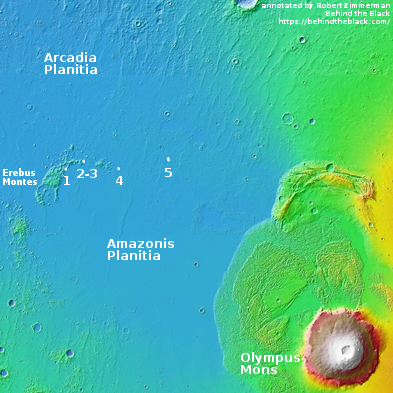
Candidate landing sites for SpaceX's Starship

In the August image release from the high resolution camera of Mars Reconnaissance Orbiter (MRO) were five images whose title immediately caught my interest:

The overview map on the right shows the location on Mars for these five photographs. The second and third images are of the same location, taken to produce a stereo pair.

To put it mildly, it is most intriguing to discover that SpaceX is beginning to research a place where it can land Starship on Mars. I immediately emailed Nathan Williams, the JPL scientist who requested these images from SpaceX, but he was bound by a non-disclosure agreement with SpaceX and could not comment. I have since tried to get some information directly from SpaceX but so far the company has not responded. A 2017 news story had indicated the company’s interest in this Mars’ location, but gave no details either.

Based on what we now know of Mars, however, it is possible to figure out why they favor this location, on the border between the two large northern lowland plains Arcadia and Amazonis Planitia.
» Read more

43 comments

What Starhopper achieved

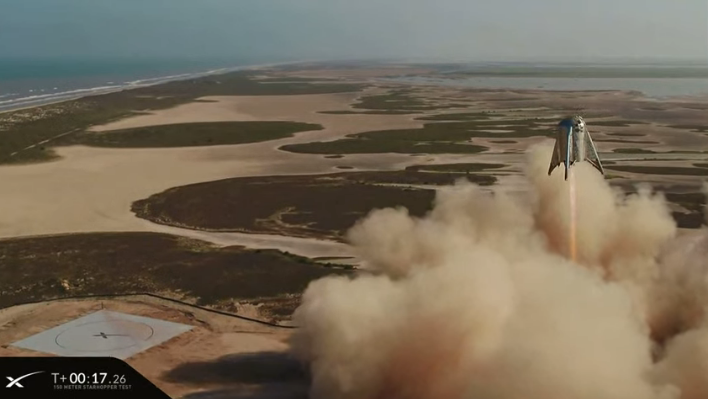
Starhopper in flight
Click for full image.

Captalism in space: While most news reports (including mine yesterday) have focused on the spectacular 150-meter flight of Starhopper, the real story here is the Raptor engine. As one of my readers said most succinctly in a comment:

As impressive as the flight was, there is so much more going on here. This is the most efficient rocket engine ever, with all fuel and LOX running through the combustion chamber – including exhaust from the turbopumps. The Russians tried it, and NASA tried it, but this is the first time such a design has flown. It’s also the first major engine using methane, so SpaceX is learning all the ground support processes for storing, fueling, and detanking methane (mostly) safely. (Still causing grass fires at launch…) They’re aiming for production cost below $2M per Raptor, and they’re about ready to go full production on the engines, around 500 engines per year.

In fact, Musk himself reveals the truth of Diane Wilson’s comment in a tweet, found in this news story about yesterday’s flight:

Starhopper’s flying days may be done, but the stubby prototype will be retasked rather than put out to pasture.

“Yes, last flight for Hopper. If all goes well, it will become a vertical test stand for Raptor,” Musk said via Twitter on Saturday.

In a sense, yesterday’s flight was no different. Starhopper was essentially a flying test stand for Raptor, which is in itself an incredible concept, when you think about it. Now it will continue to be used as a test stand, but will no longer fly.

I have been told by rocket engineers more than once that you need to build and test your engine before you can really start your rocket design. Once you know its capabilities you can then design and construct the rocket.

This is why Virgin Galactic’s SpaceShipTwo has generally been a failure. They built the ship before the engine, and when the engine had issues they had to improvise redesigns that have limited the ship’s capability and seriously delayed its launch.

SpaceX now has its engine ready. Construction on its two prototype Starships, in Boca Chica and Florida, will now proceed quickly. Based on how quickly it took SpaceX to do the first Starhopper test flights (announced in late 2018 and flying in about eight months), expect test flights within six to eight months. (Note that in this last link I expressed doubt they could get those Starhopper flights off in 2019. SpaceX proved me wrong.)

Finally, a minor news note: SpaceX today successfully brought a Dragon cargo capsule back to Earth after a month at ISS, completing its third flight in space. That this multi-use flight is hardly mentioned in the news illustrates how far SpaceX has reshaped space engineering in only a few years.

4 comments

Starhopper: Success!

Starhopper in flight
Click for full image.

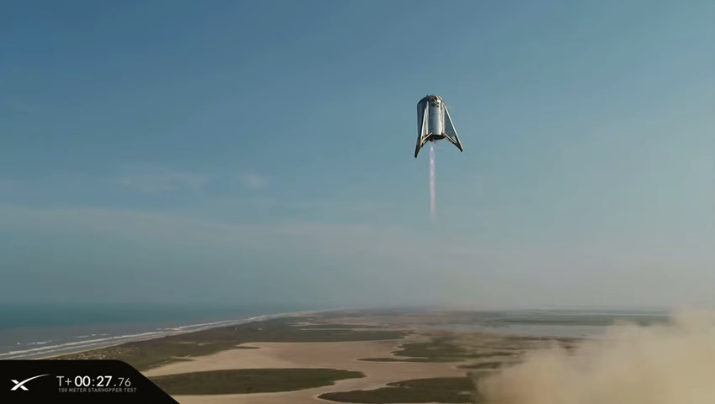
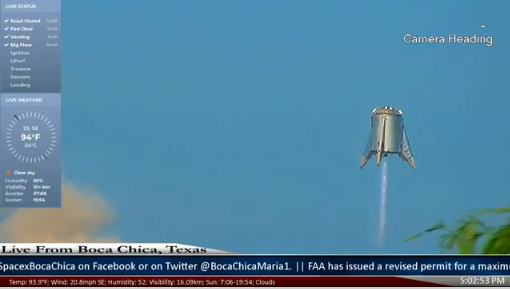
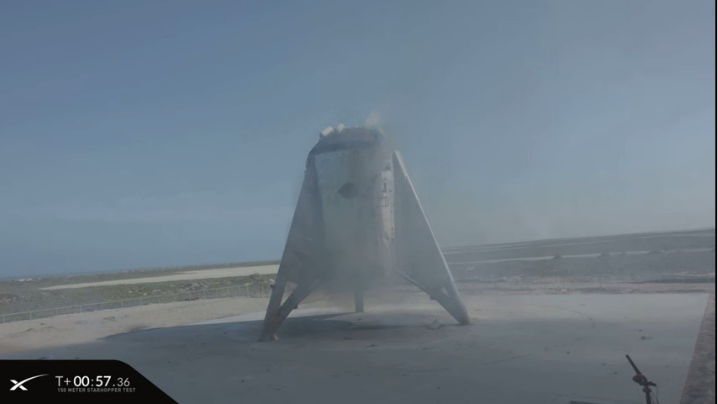
It appears today’s 150 meter hop (about 500 feet) of SpaceX’s Starhopper prototype was a complete success. To the right, and also below, are screen captures grabbed by me from one private live stream as well as from SpaceX’s own live stream.

In fact, this quick hop appears to have gone amazingly smoothly. It launched almost exactly at the target time, and landed quite softly on the launchpad, as intended. You can see the nozzle of the Raptor engine shifting and adjusting throughout the flight, also another indication that their engineering here is working perfectly. Congratulations SpaceX!

I have embedded SpaceX’s video below the fold. The flight begins around 30 minutes in.

Starhopper near the top of its flight

Starhopper beginning its descent

Starhopper on the ground
» Read more

24 comments

Starhopper test flight scrubbed

The planned 150-meter-high test flight of SpaceX’s Starhopper test prototype was aborted at T-0 seconds last night when the Raptor engine did not ignite as expected.

A live video feed provided by SpaceX showed the squat, 30-foot-wide (9-meter) Starhopper vehicle counting down to a planned liftoff shortly after 6 p.m. CDT (7 p.m. EDT; 2300 GMT) Monday from the company’s facility in South Texas. The vehicle’s single methane-fueled Raptor engine could be seen swiveling side-to-side in a preflight steering check, as the Starhopper pad’s sound suppression system dumped water under the vehicle.

But the Raptor engine did not ignite as the countdown clock reached zero.

“Test aborted just after T-0,” read a text banner on SpaceX’s webcast. “Teams evaluating next test opportunity.”

They say they will try again today. If you want to watch this link provides some suggestions.

These test flights are testing the Raptor engine more than they are testing vehicle take-off and landing. This engine is a significant advancement from not only SpaceX’s Merlin engine but from almost every rocket engine previously built. It has the potential to set the record for the most efficient and powerful engine. It is therefore not unexpected that there will be issues during these test flights.

0 comments

Planned Starhopper test shuts down Boca Chica

SpaceX’s planned next hop of its Starhopper test vehicle is apparently forcing local residents from their homes, as well as threatening damage to buildings as much as two miles away.

Those residents live in tiny Boca Chica Village, Texas, which sits less than 2 miles (3 km) from a SpaceX-operated launch site near the US-Mexico border along the Gulf Coast. SpaceX’s test of the so-called “Starhopper”—a prototype of a reusable shuttle meant for human transit—may well create an “overpressure event” capable of breaking glass in buildings nearby. The police-delivered warnings advise residents to, at a minimum, exit their homes when they hear police sirens around the 4pm launch window.

Comments posted under the Brownsville Herald article include, “Doesn’t sound good to me that they have to evacuate their homes all because Space X is testing” and “I think spacex should be prepared to pay for the window replacements.”

The test is also forcing the closure of roads required by residents to access or leave their neighborhoods.

It seems that SpaceX’s decision to conduct their Starhopper tests in Boca Chica rather than at their McGregor, Texas, engine test facility might have been a mistake. Unlike Boca Chica, McGregor is a much larger facility, which means tests are farther away from local residences. While Boca Chica gives SpaceX great visibility (hence some great publicity) for Starhopper, it appears to also be causing some bad press because of these negative impacts on the local community.

Either way, expect news of Starhopper’s biggest hop in the next day or so.

9 comments

Satellite company switches from Falcon Heavy to Ariane 5

Capitalism in space: The communications satellite company Ovzon has switched from SpaceX’s Falcon Heavy to Arianespace’s Ariane 5 for the launch of its first wholly owned satellite in 2021.

In an interview Aug. 24, Ovzon CEO Magnus René told SpaceNews the company received a more appealing launch offer from Arianespace. “It’s nothing political or anything like that, it’s not that we don’t trust SpaceX — it’s just that we could get a better deal in cost and time and so on from Ariane at this time,” René said.

SpaceX charges $100 million for a Falcon Heavy launch, about the same as Arianespace charges for one of the two berths on its Ariane 5. Arianespace must have therefore cut its standard price to make it more attractive, and win the deal.

Ain’t competition wonderful? Governments have been trying (and failing) to get us into space for half a century, using the model of international cooperation. Introduce some competition and suddenly it becomes both easier and cheaper to do it. Who woulda thunk it?

1 comment

SpaceX’s Tesla has completed its first solar orbit

Capitalism in space: The first privately launched car, a Tesla placed in solar orbit on SpaceX’s first launch of its Falcon Heavy, has now completed its first orbit around the sun.

Its future?

Car and driver will probably make many more laps around our star. Last year, an orbit-modeling study calculated that the Roadster will eventually slam into either Venus or Earth, likely within the next few tens of millions of years. But there’s just a 6 percent chance of an Earth impact, and a 2.5 percent chance of a Venus impact, within the next million years, the study’s authors found.

3 comments
1 146 147 148 149 150 234