SpaceX wins launch contract for NASA privately-built lunar lander

Intuitive Machines, one of the three companies awarded NASA contracts to build unmanned lunar landers, has awarded SpaceX the launch contract for its planned 2021 mission.

The Houston-based company’s first robotic Nova-C lander will carry up to 220 pounds, or 100 kilograms, of payloads to the moon’s surface. Launch and landing are scheduled for July 2021, according to Trent Martin, vice president of aerospace systems at Intuitive Machines.

Intuitive Machines previously stated plans to launch the first Nova-C mission on a SpaceX rocket, but Martin said in an interview Wednesday that the company held a “fully open competition” among multiple launch service providers before signing a contract for a Falcon 9 launch.

In a statement, Intuitive Machines said it “ultimately selected SpaceX for its proven record of reliability and outstanding value.” The company said the Nova-C mission will take off from pad 39A at NASA’s Kennedy Space Center in Florida. [emphasis mine]

That “outstanding value” almost certainly was the lowest price by far offered by any rocket company, a reality that continues to bring SpaceX business while taking market share from everyone else.

1 comment

NASA in negotiations to buy more Russian Soyuz astronaut seats

Collusion with Russia discovered! NASA has begun negotiations with Russia’s Roscosmos space agency to buy more astronaut flights to ISS using Russia’s Soyuz rocket and capsule.

According to the story at the link, NASA’s last purchased ticket will fly in March of 2020, and these negotiations would buy flights beginning in the fall of 2020 and beyond into 2021. The story also cites statements by NASA administrator Jim Bridenstine to CNN, confirming these negotiations.

Apparently NASA thinks the manned capsules being built by Boeing and SpaceX will not be ready by the fall of 2020, and needs to buy tickets from Russia because of this.

However, the only reason those American capsules will not have been approved and flown by then will be because NASA’s timidity in approving their launch. The agency’s safety panel as well as its management have repeatedly delayed these private American capsules, sometimes for very strange reasons, including a demand that lots of paperwork be filled out, and what I consider to be an unjustified demand for perfect safety.

Had NASA adopted a reasonable criteria for launch, SpaceX’s Dragon capsule could have flown three years ago.

Meanwhile, NASA seems quite willing to put Americans on a Soyuz rocket, launched by a foreign power whose safety record in the past half decade has been spotty, at best. In that time Russia has experienced numerous quality control problems, including mistakes that led to an Soyuz abort during a launch and a Soyuz parachute failure during a landing, corruption that forced them to recall all rocket engines and freeze launches for almost a year, and sabotage where someone drilled a hole in a Soyuz capsule prior to launch, a sabotage that Russia still refuses to explain.

It is unconscionable for NASA to favor putting Americans on a Soyuz with many documented safety issues, but block the launch of Americans on American-made capsules, for imagined safety issues that have mostly made no sense. In fact, the contrast makes me wonder about the loyalty of NASA’s bureaucracy. They certainly seem to favor Russia and Roscosmos over private American companies.

8 comments

Musk on Starship, engineering, and management

Several listeners have sent me the link to a fifteen minute interview with Elon Musk that took place the day of his big Starship speech on September 30.

I have embedded it below. Watch it. It reveals several very important overarching things about SpaceX and Musk.

1. Musk calls himself SpaceX’s chief engineer, and during this interview he demonstrates why. He understands this stuff at more fundamental level that I think most similar big rocket company heads. This gives him the ability to distinguish good engineering from bad, and thus shape the company’s design direction more forcefully. It also makes him more similar to the early owners of American airplane companies (Douglas, Boeing, McDonnell, Northrop, etc), all of whom were engineers first and managers second. Too often today CEOs know little about the engineering behind their company, and therefore can be easily sidetracked by bad ideas.

2. At several points in discussing his management approach, Musk clearly wants to give an example of how bad management leads to bad engineering, but it is clear he censors himself. I suspect he is thinking of SLS, but does not want to say so to avoid a controversy he doesn’t need.

3. Much of the interview revolves around the aerospike nozzle, and why SpaceX hasn’t used it. It appears Musk’s reason is that while it might make the exhaust of a rocket more efficient, it causes a loss of efficiency in combustion, and the trade-off isn’t worth it.

4. Finally, Musk’s openness to new ideas, even if they prove him wrong, is quite obvious. As he says,

If someone could show that we’re wrong, that would be great. If someone can show you a way to make your design better, this is a gift. I would be like, thank you! Wow, this is awesome. The worst thing would be that we want to do a dumb design and stick with our dumb design. That would be insane.

This is one of those moments where I think he is thinking of SLS, but doesn’t come right out and say so.

15 comments

Musk’s speech: Starship is coming on fast!

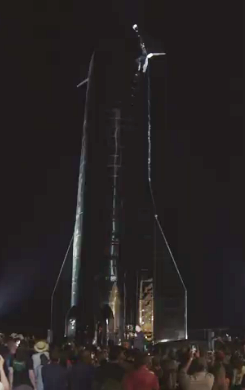
Musk standing at base of Starship Mk1

Elon Musk has begun his speech. The image to the right shows him as a tiny figure at the base of the just completed Starship Mk1 prototype. I will be adding details here as the speech proceeds.

First, he wants to inspire and thinks making humanity a multi-world species is the way to do it.
Then, to make us multi-world species requires a completely reusable rocket, what he called “the holy grail of space.”
Next, he goes back to the beginning of SpaceX, the first launch of Falcon 1 on this date years ago. “Getting to orbit is hard. We were very naive.”

From here he discussed Grasshopper, and noted that Starship Mk1 will do the a bigger version of that “in one to two months.” To repeat, they will be doing that quickly, and will be aiming for orbital flights in six months.

He is interspersing the speech with videos, of Falcon 1 launching, of Grasshopper, of Falcon Heavy, I think to illustrate how far SpaceX has come in such a short time. For example, he notes that Falcon Heavy’s first launch was only last February.

He is now outlining Starship as planned. Starship is now expected to be at 120 tons in mass, more than first planned. It will be able put 150 tons in orbit with full reuseability.

Next, getting it back to Earth in reusable form: It will return in many ways like the shuttle, but with its own uniqueness. “It will fall like a skydiver, then become vertical, and land.”

Next, the Raptor engines: Starship will have six, three able to adjust their nozzle and three fixed and optimized for efficiency. The Mk1 prototype has the three adjustable, since these will be used for landing. The other three engines will be for getting into orbit.

The heat shield and hull: They are going to use hexagonal ceramic tiles in the thermally critical areas. Everything else will use stainless steel, which he says is actually stronger when hot them some traditional rocket materials. It also has a high melting point. “You don’t need any shielding on the leeward side.” It is also much cheaper than carbon fiber, and much easier to use, shape, weld, install.

Super Heavy booster: Now estimating it will have 37 Raptor engines, but this number will be changeable, even when it is operational. The fins will be legs (just like the 1950s sci-fi movies!).

Final complete stack, both Starship and and Super Heavy, will be 2 1/2 times taller than Starship Mk1, as shown in the image above. They then showed a simulation of a launch, which I am sure will be online very shortly.

To get to either the Moon or Mars Starship will require refueling in orbit. This technology he considers essential. It will require rendezvous and docking, a skill they are learning with their manned Dragon.

He is also outlining the need to go to both the Moon and Mars, and then beyond. However, his first focus is on finding “the fastest path to building a city on Mars.”

His larger focus is making us multi-planetary, in order to preserve both our existence and all life on Earth. “And we should do it now!”

To sum up, the gist of the speech was to outline how far the entire company has come in a very short time, where they think they are going in the near future with Starship — and that’s the very near future — and then to conclude with Musk’s longer term vision for space exploration. Overall, it appears the goal was to once again sell Starship and the magnificent possibilities it might achieve.

34 comments

More Starship teasers from Musk

Musk continues to tweet out tiny teasers about the construction and design of the first Starship prototype being built at Boca Chica, dubbed Mk1.

[T]his prototype — the second Starship test vehicle, after the single-engine Starhopper, which was retired last month — will stand 165 feet (50 meters) tall and weigh 1,400 tons when fueled up (and 200 tons when “dry”). But that weight should come down in subsequent iterations, Musk added. “Mk1 ship is around 200 tons dry & 1400 tons wet, but aiming for 120 by Mk4 or Mk5. Total stack mass with max payload is 5000 tons,” he said in one of yesterday’s tweets.

In another tweet, Musk revealed the number of landing legs the Mk1 will have: “Six. Two windward, one under each fin & two leeward. Provides redundancy for landing on unimproved surfaces.”

Musk has previously said that the Mk1 and the Mk2 — a similar prototype being built at SpaceX’s Florida facilities — will be powered by at least three of the company’s next-generation Raptor engines. And today (Sept. 26), he tweeted three photos showing what that three-engine alignment looks like.

Both the Mk1 and Mk2 will start out making suborbital flights, but the goal is to get them to orbit eventually, Musk has said.

He will be giving a major speech on Starship tomorrow at Boca Chica. I have not been able to find any information as yet detailing the time and where to watch, but this will come clear I am sure very soon.

9 comments

Musk shows off Starship

Capitalism in space: In a tweet on September 22 Elon Musk gave an update on the status of its Starship rocket.

His tweet provided a picture of crews attaching “rear moving fins” the what they are now calling Starship Mk1.

The photo showed the stainless steel hull of the rocket as SpaceX attached two large fins to the base. Starship is a massive, next-generation vehicle that Musk’s company is building to send cargo and as many as 100 people to the moon and Mars.

Musk is expected to make a major speech on September 28 on Starship’s status.

0 comments

Some Boca Chica landowners reject SpaceX offer

Capitalism in space: SpaceX’s offer to buy the last homes in the hamlet of Boca Chica for its Starship spaceport has been rejected by some of the landowners.

Their reasons are obvious. They don’t want to move, and they also claim the appraisals SpaceX used to set its price, which the company claims is three times the value of the homes, are too low.

Although the Hawthorne, Calif.-based rocket company, in a letter dated Sept. 12 and sent via FedEx, is offering the Heatons three times the appraised value of their home, they say the offer isn’t close to what they’d need to sell. The appraisal conducted by SpaceX is several thousand dollars less than an appraisal the Heatons got through their bank five years ago, Terry said.

“I sent them an email the day after we got this letter, not being sarcastic or anything else,” he said. “I just told them the facts, that (their) appraisal is extremely low.”

If they obtained an appraisal five years ago that is less than SpaceX’s now, than SpaceX is certainly not offering them three times the value of their home.

SpaceX does not have the right to condemn these properties, as does the government. It must reach an equable deal with the landowners. In the case of the Heatons and several others, it sounds like this is going to take a lot of money. They want enough so that they can buy something comparable elsewhere.

20 comments

Progress on Dragon parachute tests

It appears that SpaceX’s parachute testing for its Dragon manned capsule is finally satisfying the concerns of NASA and its safety panel, based on a Sept 17 NASA blog post.

In fact, SpaceX’s success has even forced NASA “to reevaluate its own [parachute] standards and certification processes.”

The article at the link also notes quite correctly NASA’s tendency to miss the forest for the trees, which is why it has forced SpaceX to do so much additional parachute testing, even though the company apparently had a solid understanding of its parachutes a long time ago.

[T]he space agency has been focused on parachutes and COPVs [the tank issues that caused the 2016 launchpad explosion] for years. This is primarily a result of NASA’s notoriously reactive approach to safety: SpaceX suffered two COPV-related Falcon 9 failures in 2015 and 2016 and has experienced an unknown number (likely 1-3) of anomalies during Crew Dragon parachute testing.

As a result, NASA has focused extensively on these two stand-out concerns. To an extent, this is reasonable – if you know things have a tendency to fail, you’re going to want to make sure that they don’t. However, prioritizing reactive safety measures at the cost of proactive safety would be a major risk, akin to getting in a car crash because you didn’t use a turn signal and then prioritizing turn signal use so much that you forget to look both ways before making turns. Sure, you will probably never get in the same crash, but you are raising the risk of new kinds of accidents if you overcorrect your attention distribution.

Either way, it increasingly appears that a manned Dragon mission might finally be getting close to launch.

0 comments

Starlink satellite launches to dominate SpaceX’s 2020 launch schedule

According to statements made by an SpaceX official on September 10, in 2020 the bulk of all the company’s launches will be to launch satellites in its Starlink internet constellation.

SpaceX plans as many as 24 launches next year to build out the company’s Starlink network to provide broadband Internet service from space, following up to four more Starlink missions before the end of this year, according to SpaceX’s chief operating officer.

The rapid-fire launch cadence for SpaceX’s Starlink fleet will take up the majority of the company’s launch manifest next year with a series of missions taking off from Florida’s Space Coast, adding new nodes to a network that could eventually contain nearly 12,000 small satellites.

If they complete this schedule, then SpaceX could complete as many as 40 launches in 2020, when all its other backlogged launches are included.

At the same time, this schedule indicates the slowdown in the launch of geosynchronous satellites, as predicted by many in the launch business. The communications industry appears to be shifting to lower orbit constellations and smaller satellites, as illustrated by Starlink itself.

2 comments

SpaceX offers to buy all nearby property to Boca Chica launchsite

SpaceX has made a purchase offer to all the remaining property owners living in close proximity to its Boca Chica launchsite.

The company has sent a letter to all the owners, stating that the company is

…committed to a fair and equitable process for acquiring this real estate” and, to that end, the company hired an independent firm to appraise each property. … SpaceX is offering you three times the independently appraised fair market value of your property. The offer is good through two weeks from the date of this letter.”

It appears from the article at the link that a number of landowners are unwilling to accept this offer. It appears they to want more money, and also do not like the hard-nosed language of SpaceX’s offer.

Since there are not very many landowners, I would not be surprised if they team-up and get their own negotiating team.

4 comments

More potential Starship landing sites on Mars

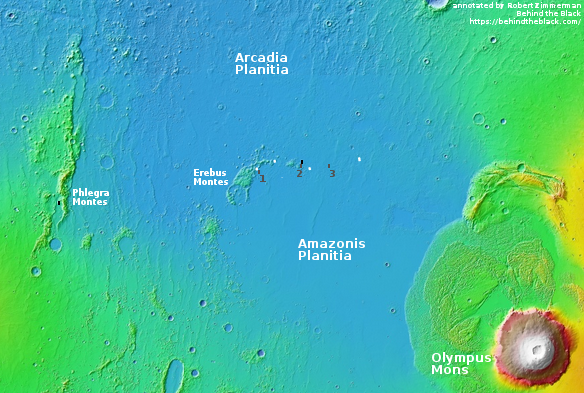
Starship landing sites

On August 28, 2019 I broke the story that SpaceX is beginning to obtain images of candidate Starship landing sites from Mars Reconnaissance Orbiter (MRO).

Many news sources, skilled in their ability to rewrite press releases, saw my article and immediately posted stories essentially repeating what I had found, including my geological reasoning. Some did some more digging and, because they came out a few days later they were able to take advantage of the next MRO team image release, issued on August 30th, to find a few more candidate site images.

Those additional images included the remaining stereo images for all the images in my August post, indicated by the white boxes in the overview map above. They also included two new locations, indicated by the black boxes. One was of one more location in the easternmost hills of Erebus Montes. The other was a stereo pair for one entirely different landing location, farther to the west in the mountains dubbed Phlegra Montes, a location that SpaceX had previously been considering, but until this image had not been included in its MRO image requests.

The grey boxes in the map above show the approximate locations of images not yet officially released by MRO. Though unreleased, their existence is still public knowledge, as they are listed as already acquired images in the HiWish database. Below are links to the three upcoming new images (the second stereo images for locations #1 and #2 are not included)

Both the Phlegra Montes location and #3 above appear to be looking at soft slushy material that might have a lot of water just below the surface.
» Read more

0 comments
1 145 146 147 148 149 234