
Voyager Space signs cooperative deal with Azerbaijan

Capitalism in space: Voyager Space, the subsidiary of Nanoracks that is building its Starlab private space station, has signed a cooperative agreement with Azercosmos, Azerbaijan’s space agency.

The press release is very vague about what the deal entails.

This strategic multi-year collaboration paves the way for Azercosmos and Voyager Space to proactively develop mutually beneficial space infrastructure, technology, and manufacturing initiatives, research programs, and further opportunities for innovation. With the potential to exchange experience and knowledge, the organizations will focus on commercial and educational opportunities in-country to foster a thriving local space ecosystem.

I suspect it will eventually lead to Azerbaijan sending research payloads to Starlab, once it is in orbit and operational.

The number of recent deals made by American private space companies, either to fly foreign astronauts in space, provide payload space on planetary missions, or provide space station capabilities for foreign science research, is beginning to be difficult to count. With at least four different American private space stations under construction, with at least one more proposed, the rush to sign up customers by these companies is accelerating.

Expect the business to be very brisk once these get launched. It appears that practically every government on Earth wants to claim it has a space program, and buying space and seats from these American commercial companies is going to be the quickest and cheapest way to do it.
2 comments

Hilton chosen to design hotel suites on Nanoracks’ Starlab private space station

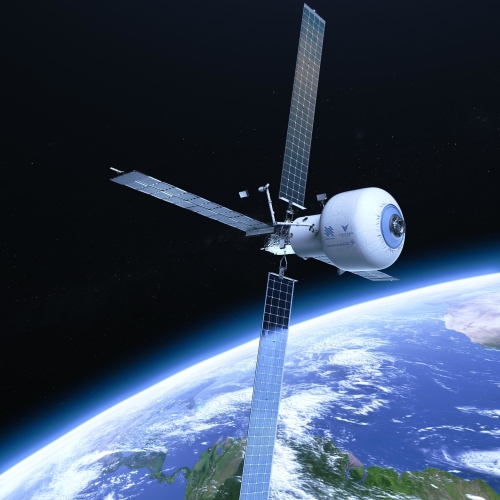
Nanoracks' Starlab space station
Nanoracks’ Starlab space station

Capitalism in space: Hilton has been chosen to design the hotel suites inside the Starlab private space station that Nanoracks is building and hopes to launch sometime this decade.

Voyager and Hilton will partner in the areas of architecture and design, leveraging Hilton’s word-class creative design and innovation experts, to develop Space Hospitality crew headquarters aboard Starlab, including communal areas, hospitality suites, and sleeping arrangements for the astronauts.

The announcement was made by Voyager Space, the Nanoracks’ division that is building Starlab, and already has a $160 million development contract from NASA.

11 comments

NASA awards contracts to three private space station projects

Capitalism in space: NASA today announced development contract awards to three different private space station projects.

  • Nanoracks Starlab concept won $160 million. Partners include Voyager Space and Lockheed Martin.
  • Blue Origin’s Orbital Reef project was awarded $130 million, partnering with Sierra Space, Boeing, and Redwire.
  • Northrop Grumman won $125.6 million on a concept based on upgrades to its Cygnus freighter.

All three contracts are Space Act agreements, designed by NASA to jumpstart the companies and their design efforts. All three are in addition to the effort by Axiom to build its own ISS modules that will eventually detach to form its own independent station.

That’s four private American space stations now in the works. All are aiming to launch before this decade is out.

7 comments

Nanoracks and Lockheed Martin to partner in building commercial space station

Capitalism in space: The companies Nanoracks and Lockheed Martin have announced that they have formed a partnership to build their own private commercial space station, dubbed Starlab.

Nanoracks, its majority owner Voyager Space and Lockheed Martin, will collaborate on the development of a commercial space station as others in industry warn of a potential space station gap.

Nanoracks said Oct. 21 that it was partnering with Lockheed Martin and Voyager Space on a commercial space station called Starlab. Nanoracks will be the prime contractor with Voyager handling strategy and investment and Lockheed serving as the manufacturer and technical integrator.

Starlab would consist of a docking node with an inflatable module attached to one side and a spacecraft bus, providing power and propulsion, attached to the other side. Starlab will have a volume of 340 cubic meters, about three-eighths that of the International Space Station, and generate 60 kilowatts of power. Starlab will be equipped with a robotic arm and “state-of-the-art” lab, and be able to host four astronauts at a time.

They are aiming for a 2027 launch.

8 comments
1 2 3