
SpaceX completes 1st round of Starship’s Mars landing site images
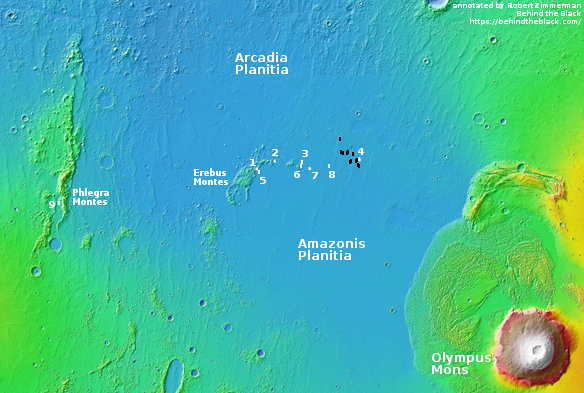
All locations photographed of the candidate landing region for SpaceX's planned Mars missions

On August 28, 2019 I broke the story that SpaceX is beginning to obtain images of candidate Starship landing sites from Mars Reconnaissance Orbiter (MRO).

It now appears that SpaceX has completed its first round of Starship requests from MRO. In the image releases from Mars Reconnaissance Orbiter (MRO) since September, only three new Starship locations were taken, and all three were the unreleased candidate sites I noted in my September 16, 2019 update.

Below is the full list of all of the Starship images, their locations indicated on the map above by the numbered white boxes:

With the release of these last photographs, the initial list of proposed images of candidate Starship landing sites on Mars has apparently been completed. No additional images at any other locations appear to have been suggested. The MRO science team has taken stereo images of each one of the nine locations, eight of which were in Amazonis Planitia, and one in Phlegra Montes.

This however is not the first round of pictures requested by SpaceX of the Arcadia Planitia region in connection with the company’s desire to land spacecraft on Mars.
» Read more

9 comments

Starship manned lunar landings by 2022?

Capitalism in space: According to SpaceX’s CEO Gwynne Shotwell at a conference on October 25, the company is targeting the first unmanned cargo landing of Starship on the Moon by 2021, with manned missions shortly thereafter.

Shotwell, speaking at Baron Fund’s annual investment conference at the Metropolitan Opera House on Friday, gave an update on SpaceX’s goals for Starship. “We want Starship in orbit next year; we want to land it on the moon before 2022 with cargo and with people shortly thereafter,” Shotwell said.

However, much like Musk in his presentation last month, Shotwell hedged her estimate, saying that “every time I make a prediction about schedule I turn myself into a liar.”

If they even come close to doing this they will certainly make NASA’s SLS rocket look ridiculous. They began serious development of Starship in early 2019. Even if development takes twice as long as Shotwell’s prediction, they will be landing on the Moon in about six years, in 2025. SLS has been in development since 2004, and its total cost once launched is expected to be more than $25 billion, a cost that does not include an extra $1.6 billion NASA has said it needs to land on the Moon by 2024 and that Congress has so far refused to appropriate.

SpaceX meanwhile has raised $1.3 billion, from private sources, to build Starship.

If you were a customer which product would you buy?

4 comments

SpaceX extends Boca Chica purchase deadline, will do new appraisals

SpaceX has agreed to do new appraisals on the private homesites in Boca Chica that it wishes to purchase, while also agreeing to extend the deadline for owners to accept their offer.

It appears that Musk invited the owners to his Starship presentation on September 28, and then met with some of them afterward to discuss the situation face to face.

Musk met with seven villagers following the presentation, though others … gave up waiting for him to show.

Cheryl Stevens, who owns a house down the street from the Heatons, did stick around. The meeting was “sort of testy” at first, as the owners confronted Musk with their concerns after waiting a long time, though the mood eventually lightened, she said. “We all had things we wanted to say,” Stevens said. “He was good about listening to what we said, then referring to what we said. … I left there feeling OK. Overall it was fairly cordial, just testy at the beginning. At least we felt like we were heard.”

At the same time, she said, “I’m not interested in giving my house away.”

This is the kind of thing that Musk does very well. Rather than stay in his ivory tower, as most modern big corporate heads, he talks with people directly. I expect SpaceX will end up offering these people deals where they can buy homes relatively comparable to what they have now, in a similar location. This will engender good will, and good press for the company.

6 comments

Musk shows off Starship

Capitalism in space: In a tweet on September 22 Elon Musk gave an update on the status of its Starship rocket.

His tweet provided a picture of crews attaching “rear moving fins” the what they are now calling Starship Mk1.

The photo showed the stainless steel hull of the rocket as SpaceX attached two large fins to the base. Starship is a massive, next-generation vehicle that Musk’s company is building to send cargo and as many as 100 people to the moon and Mars.

Musk is expected to make a major speech on September 28 on Starship’s status.

0 comments

More potential Starship landing sites on Mars

Starship landing sites

On August 28, 2019 I broke the story that SpaceX is beginning to obtain images of candidate Starship landing sites from Mars Reconnaissance Orbiter (MRO).

Many news sources, skilled in their ability to rewrite press releases, saw my article and immediately posted stories essentially repeating what I had found, including my geological reasoning. Some did some more digging and, because they came out a few days later they were able to take advantage of the next MRO team image release, issued on August 30th, to find a few more candidate site images.

Those additional images included the remaining stereo images for all the images in my August post, indicated by the white boxes in the overview map above. They also included two new locations, indicated by the black boxes. One was of one more location in the easternmost hills of Erebus Montes. The other was a stereo pair for one entirely different landing location, farther to the west in the mountains dubbed Phlegra Montes, a location that SpaceX had previously been considering, but until this image had not been included in its MRO image requests.

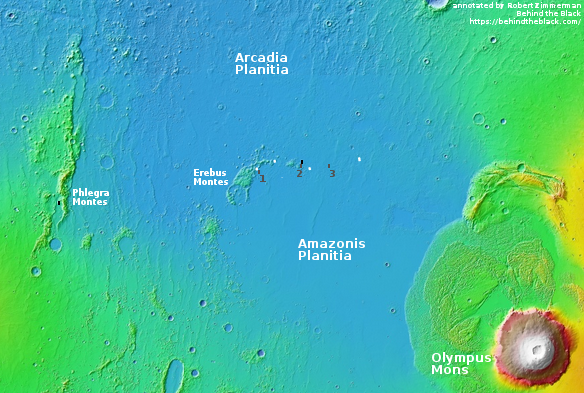
The grey boxes in the map above show the approximate locations of images not yet officially released by MRO. Though unreleased, their existence is still public knowledge, as they are listed as already acquired images in the HiWish database. Below are links to the three upcoming new images (the second stereo images for locations #1 and #2 are not included)

Both the Phlegra Montes location and #3 above appear to be looking at soft slushy material that might have a lot of water just below the surface.
» Read more

0 comments

Update on SpaceX’s plans for Starship

According to FAA regulatory documents, SpaceX has updated its development plan for Starship, including changes in its overall plans for its Boca Chica facility.

The document also lays out a three-phase test program, which it says “would last around 2 to 3 years”:

Phase 1: Tests of ground systems and fueling, a handful of rocket engine test-firings, and several “small hops” of a few centimeters off the ground. The document also includes graphic layouts, like the one above, showing the placement of water tanks, liquid methane and oxygen storage tanks (Starship’s fuels), and other launch pad infrastructure.

Phase 2: Several more “small hops” of Starship, though up to 492 feet (150 meters) in altitude, and later “medium hops” to about 1.9 miles (3 kilometers). Construction of a “Phase 2 Pad” for Starship, shown below, is also described.

Phase 3: A few “large hops” that take Starship up to 62 miles (100 kilometers) above Earth — the unofficial edge of space — with high-altitude “flips,” reentries, and landings.

The first phase is now complete, with the company shifting into Phase 2.

Boca Chica meanwhile is no longer being considered a spaceport facility. Instead, its focus will now be a development site for building Starship and Super Heavy.

3 comments

FAA required SpaceX to up its insurance for Starhopper test

The FAA’s office that regulates commercial space required SpaceX to increase its insurance coverage for this week’s Starhopper test to $100 million, thirty three times higher than their coverage for the previous Starhopper hops.

Lots of information at the link, though in summary it all makes perfect sense.

There are a number of likely reasons the federal regulator required SpaceX to boost its insurance coverage, says George Nield, a former FAA associate administrator who led its Office of Commercial Space Transportation (OCST) for more than a decade.

One is that Tuesday’s launch took Starhopper hundreds of feet higher than in July; during the prior flight, SpaceX’s vehicle only went about 60 feet (18 meters) up before landing. “The higher you want to go, the more propellant you’re going to have to load, and the more propellant you load, the bigger the boom if it were to explode,” Nield told Business Insider prior to Tuesday’s launch.

More importantly, their Boca Chica launch site is only a mile and a half from a small village of about twenty people, much closer than any other launchpad in the world. How SpaceX will manage this issue should they wish to test fly their fullscale Starship prototype from this site I really do not know. It could be that they won’t, and will confine all test flights to Kennedy, where they are also building a second Starship prototype.

2 comments

SpaceX begins hunt for Starship landing sites on Mars

Candidate landing sites for SpaceX's Starship

In the August image release from the high resolution camera of Mars Reconnaissance Orbiter (MRO) were five images whose title immediately caught my interest:

The overview map on the right shows the location on Mars for these five photographs. The second and third images are of the same location, taken to produce a stereo pair.

To put it mildly, it is most intriguing to discover that SpaceX is beginning to research a place where it can land Starship on Mars. I immediately emailed Nathan Williams, the JPL scientist who requested these images from SpaceX, but he was bound by a non-disclosure agreement with SpaceX and could not comment. I have since tried to get some information directly from SpaceX but so far the company has not responded. A 2017 news story had indicated the company’s interest in this Mars’ location, but gave no details either.

Based on what we now know of Mars, however, it is possible to figure out why they favor this location, on the border between the two large northern lowland plains Arcadia and Amazonis Planitia.
» Read more

43 comments

SpaceX to launch Super Heavy/Starship from Florida

Capitalism in space: According to a SpaceX environmental report submitted to NASA, the company now plans to launch Super Heavy/Starship missions from Florida, and only Florida.

The report details the work they want to do at launch complex 39A, where they presently launch both Falcon 9s and Falcon Heavies.

The facilities will be able to support up to 24 Starship/Super Heavy launches a year, the company said in the report, with a corresponding decline in Falcon launches from the complex. “Due to the higher lift capability, Starship/Super Heavy could launch more payloads and reduce the overall launch cadence when compared to Falcon 9 and Falcon Heavy,” the report states.

SpaceX ruled out performing Starship/Super Heavy launches from its other two existing launch sites, Space Launch Complex 40 at Cape Canaveral and Space Launch Complex 4 at Vandenberg Air Force Base in California. The company ruled out the sites because they would require more modifications and because the Vandenberg site didn’t support trajectories for the “vast majority” of missions.

Falcon Heavy launches especially will vanish once this new rocket is operational, as it will be cheaper to use and have greater capabilities, should it succeed in being everything SpaceX hopes it to be.

9 comments

New NASA development contracts include refueling work by SpaceX

Capitalism in space: Yesterday NASA announced a bunch of partnership agreements with thirteen companies, where those companies will get NASA assistance at no cost to help them develop new engineering that would aid future solar system exploration.

The partnerships covered everything from helping small companies develop new space electronics, heat shields, and new types of thrusters to helping Blue Origin develop the technology for for landing on the Moon.

An article at Ars Technica today about this NASA announcement focused specifically on the SpaceX deal, mainly for its important political implications.

The partnership will have two different NASA agencies helping SpaceX develop the refueling technology it needs for Starship to reach Mars. The key is that this deal has NASA openly supporting technologies that are in direct competition with its own SLS rocket. When such research work was proposed back in 2010, it was opposed quite strongly by past agency officials as well as powerful politicians in Congress, for exactly that reason.

It was a contentious time in space policy, as the White House was pushing for more funding for new space companies—and new space ideas such as fuel-storage depots—while Congress wanted to keep NASA in the rocket-building business.

Eventually, Congress got the upper hand, putting NASA on track to build the large SLS rocket at a development cost of more than $2 billion a year. The rocket program mostly benefited the Alabama space center and was championed by Alabama State Senator Richard Shelby. The potential of in-space fuel storage and transfer threatened the SLS rocket because it would allow NASA to do some exploration missions with smaller and cheaper rockets. As one source explained at the time, “Senator Shelby called NASA and said if he hears one more word about propellant depots he’s going to cancel the Space Technology program.”

The line from other NASA officials was that as a technology, propellant depots were not ready for prime time. In 2011, former NASA Administrator Mike Griffin and current Executive Secretary of the National Space Council Scott Pace—both SLS advocates—wrote a withering criticism of the technology for Space News.

Now however the Trump administration is helping SpaceX develop refueling for Starship, which if successful will help make SLS irrelevant. This is more evidence that the Trump administration is laying the political groundwork that will allow it to shut SLS down, actions that were impossible in the political culture of Washington only two years ago.

This quote in the article is probably the most startling of all:

“Administrator Bridenstine is clearly executing on President’s Trump’s guidance to increase commercial public-private-partnerships at NASA,” Miller, now chief executive of UbiquitiLink, told Ars. “The game-changing technology that NASA has discovered is capitalism. This program proves NASA leadership has figured out the future is reusability mixed with commercial public-private-partnerships.” [emphasis mine]

Imagine that. An American government agency has learned that capitalism is the way to go. Will wonders never cease?

Update: See this related Ars Technica article: The SLS rocket may have curbed development of on-orbit refueling for a decade (Hat tip reader Calvin Dodge.)

8 comments

Fire at SpaceX Starhopper facility in Florida

A fire in SpaceX’s Florida facility yesterday, where it is building a Starship prototype, caused between $50,000 to $100,000 damages.

City spokesperson Yvonne Martinez confirmed a small fire broke out at the facility on Cidco Road around noon and that the Cocoa Fire Department was able to quickly extinguish it. She said crews suspected an electrical fault as the source of the fire.

“This afternoon, a small fire occurred at a SpaceX facility in Cocoa,” SpaceX spokesperson James Gleeson told FLORIDA TODAY. “The fire was contained to a sea van on site and extinguished thanks to the Cocoa Fire Department, which responded within minutes.”

“There were no injuries as a result of the fire, and the cause is under investigation,” he said.

Martinez said the fire department estimates about $50,000 to $100,000 in damages were sustained by the shipping container and equipment inside, as well as the adjacent building.

This will be a blow to the Florida SpaceX unit that is competing with the Boca Chica unit on the construction of Starship.

1 comment
1 40 41 42 43 44