SpaceX raises $346 million more in investment capital

Capitalism in space: According to Elon Musk, SpaceX has raised an additional $346 million more in investment capital.

According to the very short article at the link, this brings the total raised during this latest fund-raising round to $567 million. This is puzzling, as in March SpaceX announced that it had raised $500 million in this round. If the company has raised an additional $346, the total should be higher.

Either way, this brings the total raised by the company to close to $2 billion, almost all of which is being dedicated to building Starship & Super Heavy. Compared to what NASA spends on SLS/Orion — about $3 billion per year with a total about $50 billion when its first manned mission occurs finally in 2024 — this is chicken feed. However, for a private company fueled by competition and good management (unlike NASA), it is likely more than enough to get the job done.


6 comments

SpaceX’s first Starship tourist customer accused of tax evasion

Capitalism in space: Yusaku Maezawa, the first person to buy a ticket to fly on SpaceX’s Starship around the Moon, has now been accused in the Japanese press to have evaded $4.6 million in taxes.

The reports, which first appeared in the Yomiuri newspaper, suggested that Mr Maezawa had failed to fully declare the personal use of a corporate jet owned by his asset management firm over a three-year period.

Japan’s national tax agency declined to comment.

Maezawa has vigorously denied the allegations on Twitter.

1 comment

Fire during most recent Starship prototype test

Capitalism in space: A fire during most recent Starship prototype test that did not do any apparent serious damage has however left that prototype in limbo.

The fate of SpaceX’s fourth full-scale Starship prototype appears to be in limbo after a third (seemingly successful) engine ignition test unintentionally caught the rocket on fire.

Now more than 12 hours after Starship SN4 fired up its new Raptor engine, the ~30m (~100 ft) tall, 9m (~30 ft) wide prototype is apparently trapped with one or both of its propellant tanks still partially filled with liquid (or gaseous) methane and/or oxygen. An initial road closure scheduled from noon to 6pm local quickly came and went and SpaceX and Cameron County Texas have since modified the paperwork, extending the closure a full 24 hours. In other words, SpaceX has reason to believe that Starship SN4 may continue to be unsafe (i.e. pressurized) as many as ~30 hours after it technically completed its third static fire test – extremely unusual, to say the least.

The article at the link offers a lot of speculation. The bottom line is that the first actual hop of this prototype is probably delayed. SpaceX had said it wanted to do it before the end of the month (probably to maximize publicity by having it occur about the same time as the manned Dragon launch). They will need to get this prototype safed, review the data and damage from the fire, and then make repairs before doing that hop. I would also expect SpaceX to do another tank and engine test first as well, to make sure those repairs worked.

This is not to say that the delay will be long. SpaceX does not waste time in these matters. It just probably means the hop won’t occur until mid- to late June.

2 comments

The salty liquid water on Mars

Map of seasonal salty liquid water on Mars
Click for full unannotated image.

The map above, reduced and annotated by me, comes from a new science paper that has attempted to model where on Mars we might find liquid very salty water, based on the planet’s known temperature and make-up. From the press release:

The team of researchers used laboratory measurements of Mars-relevant salts along with Martian climate information from both planetary models and spacecraft measurements. They developed a model to predict where, when, and for how long brines are stable on the surface and shallow subsurface of Mars. They found that brine formation from some salts can lead to liquid water over 40% of the Martian surface but only seasonally, during 2% of the Martian year.

“In our work, we show that the highest temperature a stable brine will experience on Mars is -48°C (-55° F). This is well below the lowest temperature we know life can tolerate,” says Dr. Rivera-Valentín. “For many years we have worried about contaminating Mars with terrestrial life as we have sent spacecraft to explore its surface. These new results reduce some of the risk of exploring Mars,” noted Dr. Alejandro Soto at the Southwest Research Institute and co-author of the study. [emphasis mine]

I have added a red rectangle to the map, showing the candidate landing zone for SpaceX’s Starship. This paper illustrates again that this choice is a good one. We know from other research that there is a lot of ice very close to the surface here. This research indicates that for a little less than one percent of each year, some of that ice will turn to liquid brine.

Whether it will be easier to process the ice or the brine into drinkable water remains unknown. This location however will give future colonists that option.

That this model also suggests that there is little risk of contaminating Mars accidently with terrestrial life is really not a surprise. All the research of Mars for decades has found that it is inhospitable to terrestrial life. This data however is further confirmation, and tells us once again that worrying about contaminating the planet is a irrelevancy. For scientific reasons some precautions should be taken, but to spend a lot of time and money sterilizing the spacecraft we send there will be a fool’s errand. For humans to settle Mars will require a very very high level of engineering and adaptation, something we humans are very naturally good at, but something that shouldn’t be burdened with unnecessary tasks or restrictions.

3 comments

A relaxed crater on Mars

A relaxed crater on Mars
Click for full image.

Cool image time! The photo to the right, rotated, cropped, and reduced to post here, shows what the science team for the high resolution camera on Mars Reconnaissance Orbiter (MRO) call a “Relaxed Crater.” This particular image was taken in July 2014. A more recent photo was taken in March 2020 to create a stereo pair, but because this older image shows more of the crater I decided to highlight it.

The crater is considered relaxed because it is very shallow and appears as if, after impact, some process caused the interior to in-fill with material even as the rim became less pronounced and degraded (as explained in this paper [pdf]). The process could have involved either molten magma or melted ice. As this crater is located in the northern highlands to the southwest of Erebus Mountains, in a region that research has consistently suggested has a great deal of ice just below the surface, the latter seems likely. This assumption is further reinforced in that the crater is also located in the mid-latitudes where scientists have found a lot of craters they think are filled with buried glaciers. This certainly seems the case here.
» Read more

0 comments

Successful static fire Raptor engine test on 4th Starship prototype

Capitalism in space: SpaceX yesterday successfully completed the first static fire Raptor engine test on its fourth Starship prototype, laying the foundation for a planned 150-meter vertical hop later this month.

The test lasted about three seconds.

I want to make a quick comparison between SpaceX’s approach for developing Starship, and NASA’s development of SLS. The differences are stark.

First, SpaceX began cutting metal a little over one year ago, and is already testing a full scale prototype, fully fueled, with its planned flight engine.

SLS began development officially around 2011. It uses the engines from the Space Shuttle, so those are already flight proven. However, even after almost a decade of development NASA as yet to do a single static fire test with those engines actually installed on an SLS rocket, either a prototype or the real thing.

Second, in the past year SpaceX has been aggressively testing the fueling of Starship, using a series of prototypes. With this fourth iteration they have apparently gotten the fueling process and the tanks to work effectively. Further tests of course will increase their confidence in the system’s reliability.

SLS, even after almost a decade of development, has yet to do any similar tank tests. Instead, NASA has done separate individual tests of the rocket’s tanks, but never with everything fully assembled. The agency, and its lead contractor Boeing, hope to finally do their first full scale SLS tank test and static fire test sometime later this year. As they have never filled the tanks in this manner before, they have admitted that problems could arise, including the possibility that the tanks could leak.

Note the big difference. SpaceX has done this testing very early in development. NASA is doing it very late in development. Which to you seems the better approach?

7 comments

Funding breakdown for three lunar landing contracts

Capitalism in space: The contracts awarded by NASA yesterday to build manned lunar landers totaled almost a billion dollars, distributed as follows:

  • Blue Origin: $579 million
  • Dynetics: $253 million
  • SpaceX: $135 million

That Blue Origin got the biggest amount might have to do with the bid’s subcontractors, Lockheed Martin and Northrop Grumman. This gives these traditional big space partners, who normally rely on these kinds of government contracts and have little ability to make money outside them, some financing. This will also please their political backers in Congress.

For SpaceX, this is the first time they have taken any government money in connection with Starship. It also appears that NASA is going to stay back and generally let SpaceX develop it without undue interference.

2 comments

4th Starship prototype passes tank pressure test

Capitlism in space: SpaceX’s fourth Starship prototype has successfully passed a tank pressure test, the first to do so, allowing engine testing to now begin.

In the end, SN4 passed the cryogenic proof test – hitting 4.9 bar. SpaceX CEO Elon Musk admitted in a tweet that this was “kind of a soft ball…” However, “that’s enough to fly,” he added. It is now expected to move on to engine testing within the coming days.

Currently, SpaceX has three flight-ready Raptor engines waiting for the opportunity to participate in the testing. One of these engines will be installed on SN4. A Raptor engine is not installed until after the cryogenic proof test, as that test uses hydraulic pistons to simulate the forces created by Raptors during flight.

After SpaceX performs the Raptor installation on SN4, teams will need to conduct checkouts of the engine on the vehicle. These will include gimbal, ignitor, and fuel pre-burner tests, among others. Only then will SpaceX be ready to attempt a static fire. April 29 was originally the target for a static fire test, but a one day delay with the cryogenic proof test means that the static fire is now likely targeting no earlier than April 30

All in all, the company’s target of doing a hop with this prototype this summer appears increasingly likely.

2 comments

SpaceX rolls out next Starship prototype

Capitalism in space: SpaceX has completed construction of its next Starship prototype and has moved it to its test stand in preparation for further tests.

This is the fourth prototype. If the tank pressure tests go well, they hope to add engines and do a twelve mile hop with this prototype, landing vertically. If not, they will try again with later prototypes. Regardless, the goal is to do that hop this year.

0 comments

SpaceX reuses sections of damaged Starship prototype for next version

Capitalism in space: In building its fourth Starship prototype for testing, SpaceX has decided to reuse large sections of the previous Starship prototype, badly damaged during a pressure test several weeks ago.

On April 15th, eight days after Starship SN3’s [the damaged third prototype] remaining aft section was cut in half, the rearmost half – known as the skirt – was spotted stacked beneath a brand new engine section built for SN4. While confirming that a significant part of SN3 will be reused on SN4, it also indicates that only a less critical SN3 remnant was fit to join SpaceX’s next prototype.

Though they are not reusing the engines from that third prototype, I have full confidence they will, as they were part of the same bottom section of that prototype that was damaged during the test. This statement is incorrect. I had mistakenly assumed that because SpaceX had said it planned actual test hops eventually with this third prototype that three engines were already in place. They were not.

3 comments

Third Starship prototype collapses during tank pressure test

During the final part of a tank pressure test the third SpaceX Starship prototype apparently collapsed, its outer welded hull failing.

Video below the fold. The prototype is on the right, and it appears it fall inward along its hull welds.

The SN3 (Serial Number 3) vehicle incorporated lessons learned from previous vehicles and test articles, and took advantage of improved manufacturing techniques and expanded facilities at SpaceX’s South Texas launch facility.

The next round of testing began this week with cryogenic proof testing. These tests saw the vehicle filled with liquid nitrogen at cryogenic temperatures and flight pressures. Proof testing began in Thursday and continued through to Friday morning when SN3 failed during what appeared to be the end of the test.

With Elon Musk noting “we will see what data review says in the morning, but this may have been a test configuration mistake,” on Twitter and the first-look observations, the fault may have been related to detanking, rather than another failure under pressure.

I’m no engineer, so I wonder how detanking could cause such a failure.
» Read more

19 comments

SpaceX prepares next Starship prototype; releases Starship user manual

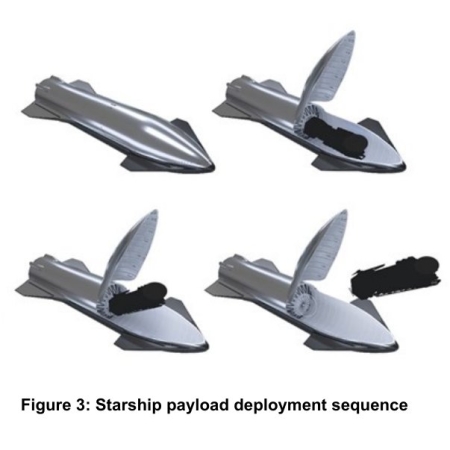
From SpaceX's first user manual for Starship

Capitalism in space: Even as SpaceX has begun preparing its third Starship prototype for new testing, it has also released a first user manual for the rocket, outlining its proposed capabilities and potential uses by customers.

From the first link:

The next round of testing is anticipated to begin this week with cryogenic proof testing. These tests will see the vehicle filled with liquid nitrogen at cryogenic temperatures and flight pressures. Prior Starship test vehicles have had their campaigns cut short by failed cryogenic testing, including the last flight vehicle SpaceX rolled to the Boca Chica launch pad, Starship SN1.

If all goes right, they hope to begin short flight tests with this prototype, moving to longer and higher flights with the next.

The user manual [pdf] is mostly a short description of what they hope they will be able to accomplish with Starship. It notes that they will build both a cargo and manned variety, and that both will be available for point-to-point transportation on Earth. It also notes:

Starship has the capability to transport satellites, payloads, crew, and cargo to a variety of orbits and
Earth, Lunar, or Martian landing sites. Potential Starship customers can use this guide as a resource for preliminary payload accommodations information.This is the initial release of the Starship Users Guide and it will be updated frequently in response to customer feedback.

I guarantee that much of what is written and drawn here, such as the illustration above, will change significantly as development proceeds.

8 comments
1 38 39 40 41 42 44