Sunspot update: May sunspot activity jumps

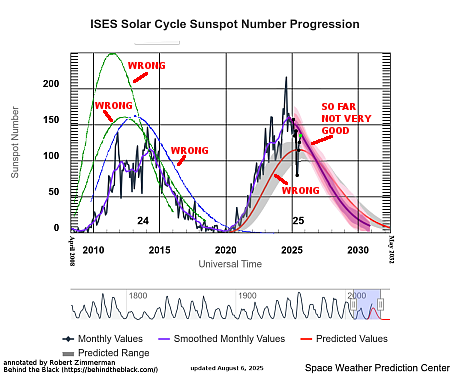
It is the beginning of the month, so it is time for my monthly sunspot update. According to NOAA’s June update of its monthly graph of the sunspot activity on the Earth-facing hemisphere, the amount of sunspots in May surprised us once again by increasing upward, though the totals continue to be below prediction.

That graph is below, annotated with extra information by me to illustrate the larger scientific context.
» Read more

0 comments

New long term analysis of solar activity suggests the Sun is undergoing some form of internal structural change

Sunspot activity for the past two cycles
NOAA’s chart of sunspot activity.
Click for the most recent update.

The uncertainty of science: Scientists doing a new analysis of more than forty years of solar data have concluded that some form of “subsurface structural changes associated with successive 11-year [sunspot] cycles” are taking place, with those changes “ever more progressively confined just beneath the solar surface.”

Using almost 40 years of helioseismic data from six telescopes around the world in the Birmingham Solar Oscillations Network (BiSON), the researchers uncovered a gradual change in structure just beneath the surface that has spanned multiple cycles, with the current solar cycle 25 showing particularly strong signatures of these changes.

Lead author Professor Bill Chaplin, from the University of Birmingham, said: “The Sun has its own ‘active biorhythm’ creating rising and falling magnetic activity that shapes space weather. However, traditional surface measures don’t capture the full story – that the Sun may be entering a different mode of behaviour unfolding over decades.

“We have uncovered evidence of systematic changes in the solar activity cycle. Crucially, magnetic activity is becoming more tightly confined near the surface with each cycle.”

The confinement appears to be within the first 600 miles below the surface, which for the Sun is barely skin deep.

In reading the paper [pdf], it is very clear they have detected these changes, but are as yet unable to apply them to any larger fundamental processes. They are observing the Sun change, but don’t know why. It could be simply random fluctuations of behavior, or it could be part of the Sun’s normal behavior related to its magnetic field and the nuclear fusion that makes it burn.

In either case, this lack of deeper understanding means it is impossible as yet to predict what will happen next, or how those future changes will impact us here on Earth.

1 comment

Sunspot update: The number of sunspot continues to decline

For only the second time since I started this website in 2010, I forgot last month to do my monthly sunspot update. No matter. The Sun’s behavior in producing sunspots in the past two months was actually amazingly similar, so doing both months at once works.

According to NOAA’s monthly graph of the sunspot activity on the Earth-facing hemisphere, the amount of sunspots in both March and April continued to be low, well below the predictions put forth by NOAA’s panel of scientists in their April 2025 prediction.

That graph is below, annotated with extra information by me to illustrate the larger scientific context.
» Read more

11 comments

Solar scientists: We finally think we know the location of the Sun’s dynamo

The Sun's interior
NASA graphic used in the press release and
annotated to post here.

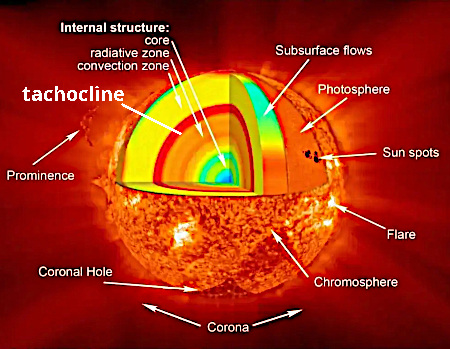
The uncertainty of science: Using three decades of data gathered during the last three solar cycles, scientists now think they have finally determined the location of the Sun’s dynamo in its interior, at a transition point about 125,000 miles below the surface called the tachocline. From the abstract of their paper [pdf]:

The exact location of the solar dynamo remains uncertain–whether it operates primarily in the near-surface shear layer, throughout the entire convection zone, or near the tachocline – a region of sharp transition in the solar rotation, located at the base of the convection zone, approximately 200,000 km [125,000 miles] beneath the surface. Various studies have supported each of these possibilities.

…Our analysis reveals that the gradient of rotation displays ‘butterfly’–like behavior near the tachocline, which is similar to the magnetic butterfly diagram at the surface. This result supports the idea that the solar dynamo has a deep-seated origin, likely operating either near the tachocline or throughout the convection zone, thereby disfavoring the recent scenario of a shallow, near-surface dynamo. This finding may also have important implications for understanding how stellar dynamos operate in general. [emphasis mine]

Even though scientists have known for more than a century that the Sun’s eleven-year cycle of flipping the polarity of its magnetic field is the fundamental cause of the sunspot cycle, they actually know very little about the dynamo that causes that magnetic field, as this study implies. They not only don’t have any understanding of the fundamental processes that creates that dynamo or causes it to flip polarity every eleven years, they still aren’t entirely sure where it is located within the Sun.

Thus, the highlighted sentence above is one large understatement. Of course knowing the dynamos location will have “important implications for understanding stellar dynamics.” This study is a first good stab at the problem, but it also shows us how little we actually know.

Remember this when anyone tells you “the science is settled” about climate change. The Sun is the number one influence on the Earth’s climate, and its solar cycle appears to be an important factor in that influence. Until we have a better understanding of the Sun, its magnetic field, and the dynamo that creates it, no climate prediction will be worth anything. Such predictions will be all guesswork, and likely put forth for political reasons.

6 comments

Sunspot update: Sunspot activity tumbles in February, including the 1st blank days since ’22

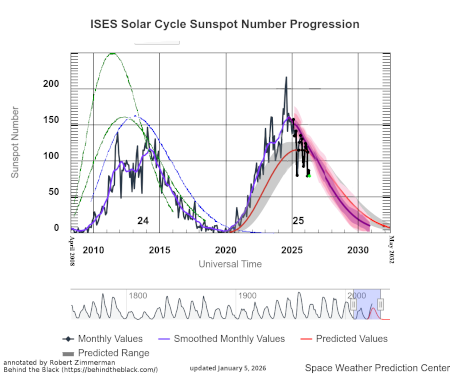
The uncertainty of science! It is the start of the month, and thus time for another sunspot update, using NOAA’s monthly graph of the sunspot activity on the Earth-facing hemisphere, updated by NOAA to include the activity in February but annotated with extra information by me to illustrate the larger scientific context.

Last month I lambasted NOAA’s solar science panel for its consistently failed predictions, and made a tentative prediction of my own, suggesting the ramp down to solar minimum might not be occurring as they had predicted in April 2025.

This month I can lambast myself, because the Sun in February saw a significant drop in sunspots, including three consecutive days in which the Sun was blank of spots, for the first time since 2022. This drop supports the NOAA panel prediction and makes my prediction look foolish, but it also suggests the ramp down is continuing to go faster than predicted.
» Read more

2 comments

Sunspot update: Maybe solar maximum isn’t over?

The uncertainty of science! It is time for another sunspot update. It is also time to note that once again the Sun appears to be confounding the predictions of NOAA’s solar science panel. Below is NOAA’s monthly graph of the sunspot activity on the Earth-facing hemisphere, updated by NOAA to include the activity in January but annotated with extra information by me to illustrate the larger scientific context.

Since April 2025 that science panel has been predicting that the solar maximum has passed and the Sun was beginning the ramp down to solar minimum, now expected to occur around 2031-32. And in the ten months since, sunspot activity has appeared to more or less track that prediction, as indicated by the purple/magenta curve line on the graph below.

It now appears that this prediction might very well have been premature.
» Read more

2 comments

Sunspot update: Ramp down to minimum continues?

Another year, another month, another sunspot update! Time to post my monthly update of the never-ending sunspot cycle on the Sun, using NOAA’s own monthly update of its graph of sunspot activity and annotating it with extra information to illustrate the larger scientific context.

The green dot on the graph below indicates the level of sunspot activity on the Sun’s Earth-facing hemisphere during the month of December. Unlike November, when activity plunged, in December the sunspot count recovered, producing more sunspots, though the number still reflected the ramp down to solar minimum that NOAA’s panel of solar scientists had predicted in April 2025 (as indicated by the purple/magenta line).
» Read more

2 comments

Sunspot update: Sunspot activity again crashes far below predictions

It is the start of another month, so it is time again to post my monthly update of the never-ending sunspot cycle on the Sun, using NOAA’s own monthly update of its graph of sunspot activity and annotating it with extra information to illustrate the larger scientific context.

The green dot on the graph below indicates the level of sunspot activity on the Sun’s Earth-facing hemisphere during the month of November. And once again, the Sun surprised us, producing far less sunspots than expected, based on the April 2025 prediction by NOAA’s panel of solar scientists (as indicated by the purple/magenta line).
» Read more

3 comments

Sunspot update: Solar activity continues to decline as predicted

Another month has passed, and so it is time for my monthly update on the never-ending sunspot cycle on the Sun. using NOAA’s own monthly update of its graph of sunspot activity and annotating it with extra information to illustrate the larger scientific context.

The green dot on the graph below indicates the level of sunspot activity on the Sun’s Earth-facing hemisphere during the month of October. Not only did the number of sunspots decline from the count in the previous month, as predicted in April 2025 by NOAA’s panel of solar scientists (as indicated by the purple/magenta line), it dropped below their prediction.
» Read more

5 comments

Sunspot update: For one month the Sun does what the scientists predicted!

It is the start of the month, which means it is time for my monthly sunspot update, using NOAA’s own monthly update of its graph of sunspot activity and annotating it with extra information to illustrate the larger scientific context.

This graph is below, with the green dot showing the sunspot number for activity on the Sun’s Earth-facing hemisphere in September. As you can see, the count closely matched the April 2025 prediction by NOAA’s panel of solar scientists, which posited that the Sun was finally beginning its ramp down from solar maximum (as indicated by the purple/magenta line).
» Read more

2 comments

Scientists at JPL now predict a major long term uptick in sunspot activity

The solar science community's failed predictions
The many failed recent predictions of the
solar science community

The uncertainty of science: According to a NASA press release today, scientists at JPL now predict that the Sun will see a major increase in sunspot activity in the coming decades, ending the relatively quiet period seen in the two past solar maximums.

In their paper, the scientists say they come to this conclusion due to changes seen in solar wind activity since 2008. From their abstract:

Over the course of two decades until 2008, the solar wind became significantly weaker with a constant declining trend in many important solar wind parameters, and solar cycle 24 being the weakest on record since the start of the space age. Here we show that since 2008, the Sun has reversed this long-term weakening trend with a steady increase in various solar wind proton parameters observed at 1 au. Furthermore, comparison of values from a fitted trend to data between 2008 and 2025 show the following increases in solar wind proton parameters: speed (~6%), density (~26%), temperature (~29%), thermal pressure (~45%), mass flux (~27%), momentum flux or dynamic pressure (~34%), energy flux (~40%), interplanetary magnetic field magnitude (~31%), and the radial component of the magnetic field (~33%).

This has important implications on long-term solar trends, implying that the exceptional weakness of solar cycle 24 was most likely a recent outlier and that the Sun is not entering a modern era Maunder/Dalton-like minimum phase in its solar variation, but is instead recovering from a ~20 yr decline.

This analysis and conclusion is most intriguing, but we must also remember that every prediction by the solar science community in the past two decades has turned out to be wrong, as illustrated by the graph above. This prediction is just like all those others, in that it is based not on any fundamental understanding of why these changes in the solar wind are occurring, but simply extrapolating this past behavior into the future, a very unreliable method of prediction.

These scientists might be correct, but I would not bet any money on it.

2 comments

Sunspot update: In August sunspot activity continued to rise

Time for this month’s sunspot update. To do this each month I begin by taking NOAA’s own monthly update of its graph of sunspot activity and annotating it with extra information to illustrate the larger scientific context.

This annotated graph showing the August activity is below, and for the third month in a row sunspot activity increased (as indicated by the green dot), so that the August number of sunspots now closely matched the April 2025 prediction by NOAA’s panel of solar scientists that the Sun was finally beginning its ramp down from solar maximum.
» Read more

2 comments

Sunspot update: The Sun appears ready to once again confound the experts

It is the start of the month and time once again for my monthly sunspot update, using the update that NOAA posts each month to its own graph of sunspot activity but annotated by me with extra information to illustrate the larger scientific context.

This month’s update graph is below, and it shows once again that it is a big mistake to put any faith into any prediction anyone makes about the Sun’s eleven-year sunspot cycle, tracked by scientists since the 1700s. Beginning in April 2025 the NOAA solar science panel has been predicting that the solar maximum had hit its peak and that we should expect the Sun to begin its ramp down to solar minimum, expected around 2031.

NOT!
» Read more

1 comment

Sunspot update: Sunspot activity rebounds somewhat in June

As I have done since I started this website fifteen years ago, I post at the start of every month an update of the Sun’s ongoing sunspot activity, using the update that NOAA posts each month to its own graph of sunspot activity but annotated by me with extra information to illustrate the larger scientific context.

Below is that graph, showing that in June sunspot activity rebounded upward somewhat from the shocking drop in activity that occurred in May.

» Read more

0 comments

Sunspot update: The Sun confounds the predictions again!

It is time for my monthly update of the Sun’s ongoing sunspot activity, using the update that NOAA posts each month to its own graph of sunspot activity but annotated by me with extra information to illustrate the larger scientific context.

The activity in May was shocking in that it completely contradicted all expectations by everyone in the solar science community, with the Sun’s sunspot count changing in a way that was somewhat unprecedented. The graph below makes this very clear:

» Read more

6 comments

Sunspot update: Activity rises slightly in April

It is the start of the month, so it is of course time for my monthly report on sunspot activity, based on the update that NOAA posts each month to its own graph of sunspots activity. As I have done since the start of Behind the Black in 2010, I take that graph each month and annotate it with extra information to illustrate the larger scientific context.

Sunspot activity in April did nothing to tell us anything about the Sun’s future activity. It rose slightly, but not by enough to suggest that the prediction put forth last month by NOAA scientists that the ramp down to solar minimum has begun is wrong.
» Read more

4 comments

Sunspot update: Sunspot activity remains high but stable

The uncertainty of science Time for my monthly update on our Sun’s sunspot cycle, based on NOAA’s monthly graph of the sunspot activity on the Earth-facing hemisphere of the Sun, but annotated by me with additional information.

The graph below shows that the number of sunspots in February continued the trend during this solar maximum of being significantly higher than the consensus prediction by a panel of NOAA solar scientists, as indicated by the red curve. At the same time, the count in February was well below the high point during the summer of 2024. Instead, though it went up slightly in February it remains at about the same level we have seen since September.
» Read more

1 comment

Sunspot update: Sunspot activity continued its decline in January

Another month has passed, meaning it is time for another update on the Sun’s sunspot cycle, based on NOAA’s monthly graph tracking that activity but annotated by me with additional information.

In January the decline in sunspot activity on the hemisphere facing Earth since August 2024 continued, with the number of sunspots dropping to a level not seen since May 2023, when the Sun’s was ramping up from solar minimum to solar maximum.
» Read more

5 comments

Sunspot update: Is this sunspot maximum over, or will it become another doubled peaked maximum?

Well, after almost fifteen years it had to happen at last. In preparing to do my monthly sunspot update today, which I had done every month since I started Behind the Black in 2010, I discovered that I had completely forgotten to do the update in December. Sorry about that.

No matter, the changes from month-to-month are not often significant, and fortunately that turned out to be the case in November and December of 2024. Since my last update at the beginning of November 2024, sunspot activity on the Earth-facing hemisphere of the Sun has been relatively stable, based on NOAA’s monthly graph tracking that activity. In November the activity dropped slightly, only to recover a small amount in December.
» Read more

2 comments

Sunspot update: in October solar activity increased after September’s crash

Time for this month’s sunspot update. As I have done every month since I started this website in 2010, I am posting NOAA’s most recent update of its monthly graph tracking the number of sunspots on the Sun’s Earth-facing hemisphere, adding some additional details to provide context.

In October, following a crash in activity in September, the Sun showed a slight increase the number of sunspots. The increase did not match the drop from the month before, but it brought the activity back up to the level seen during the summer.
» Read more

1 comment
1 2 3 15