China to expand Tiangong space station

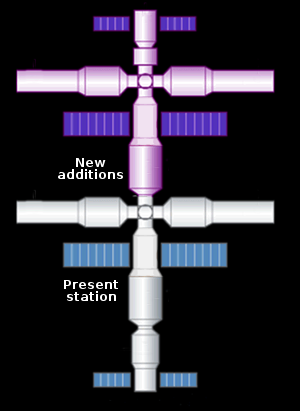
Tiangong-2 station after expansion

The new colonial movement: At the 47th International Astronautical Congress in Baku, Chinese officials yesterday revealed that they intend to expand their Tiangong space station, almost doubling it in size.

The graphic to the right illustrates this, with the proposed new modules in magenta at the top.

β€œWe will build a 180 tons, six-module assembly in the future,” Zhang said. Tiangong currently has three modules, each with a mass of around 22 tons.

A multi-functional expansion module with six docking ports will first be launched in the coming years to allow this expansion. This will dock at the forward port of the Tianhe core module. Full size modules can then be added to Tiangong. SpaceNews understands that the timeline for such launches is around four years from now. An expanded Tiangong would be just over a third of the mass of the roughly 450-metric-ton International Space Station (ISS).

The officials also said that they plan to add additional inflatable modules to the existing part of the station, as well as attachment points allowing for external experiments exposed to the environment of space.

1 comment

China deorbits Tiangong-2

China yesterday successfully deorbited its second space station test module, Tiangong-2, landing it harmlessly over the south Pacific.

Meanwhile the date of next launch of Launch March 5, the rocket that China must have operational in order to launch its full space station, remains unknown. It had been expected in July, but it appears this will not happen, and there is no indication when it will fly.

0 comments

Deorbit soon for China’s second test space station module?

China has lowered the orbit of Tiangong-2, its second test space station module, suggesting that they intend to deorbit the station in a controlled manner in the near future.

Orbital information published by the U.S. Strategic Command’s Joint Force Space Component Command, through the Joint Space Operations Center, indicates that Tiangong-2 has moved from an altitude of around 380 by 386 kilometers down to 292 by 297 kilometers.

No announcement regarding the status of the Tiangong-2 space lab has been made. The China Manned Space Engineering Office (CMSE), which manages China’s human spaceflight and space station related missions, did not respond to a SpaceNews request for comment.

Jonathan McDowell, an astrophysicist at the Harvard-Smithsonian Center for Astrophysics, told SpaceNews that, β€œit seems likely that the lowering of Tiangong-2’s orbit is the first step in safely disposing of it.”

Like Tiangong-1, this module was built to test a variety of technologies required for China’s full size station, planned for assembly in the next two years. Unlike Tiangong-1, they have not lost control of it, so they will be able to deorbit it properly.

0 comments

China successfully completes third robotic docking

China’s Tianzhou-1 test cargo freighter successfully completed its third docking with the prototype test space station module Tiangong-2 today.

Commands for the rendezvous and docking were issued at 17:24 Beijing time, according to the China Manned Space Agency, with the new ‘fast’ process taking 6.5 hours to complete.

Previously the rendezvous and docking process took around two days, or 30 orbits. The breakthrough will be used to allow crewed Shenzhou craft to reach the future Chinese Space Station (CSS) much sooner after launch.

Tianzhou-1 will soon perform a third and final refuelling test with Tiangong-2, before the cargo spacecraft is carefully deorbited over the South Pacific.

No word yet on when China might resume launches however. Since the July launch failure of their largest rocket, Long March 5, the country has launched nothing. There have also been stories that suggest the planned December launch of their Chang’e 5 lunar mission will be delayed now until the spring.

1 comment

China’s Tianzhou-1 freighter completes second refueling test

Tianzhou-1, China’s first unmanned freighter, has successfully completed its second refueling test while docked with that country’s Tiangong-2 space module.

The test was successfully completed at 18:28 Beijing time on June 15th (10:28 UTC), according to an announcement (Chinese) from the China Manned Space Agency (CMSA).

Tianzhou-1 and the Tiangong-2 space station test bed module have been coupled for 54 days in orbit at around 390 kilometres above the Earth since April 22, following launch of Tianzhou-1 on April 20.

A first 29-step, five-day refuelling process was successfully concluded on April 27, marking a major step in China’s space station plans. The second test is understood to have taken two days.

The freighter will next undock, fly free for several months, and then attempt a third docking, this time doing so in only six hours versus the two day maneuvers it has so far completed.

1 comment

Refueling tests begin on Chinese test space station

China has begun the refueling tests between its first unmanned freighter, Tianzhou-1, docked to its test space station, Tiangong-2.

Refuelling tests began at 07:26 Beijing time on Sunday (23:26 UTC Saturday), monitored from the Beijing Aerospace Control Centre (BACC). The refuelling process involves 29 steps and will take five days to complete.

To allow refuelling to take place, the propellant tube and coupling components needed to be perfectly matched after docking, with a margin error of less than 1 millimetre, according to Tianzhou-1 deputy chief designer Chen Qizhong.

The mission involving the Tianzhou and Tiangong spacecraft was designed to prove on-orbit resupply and refuelling technologies and techniques necessary for safe, long-term operation of the Chinese Space Station, which will be permanently crewed by at least three astronauts.

“After refuelling is completed, the residual propellant needs to be drained off. In order to identify security issues during the draining process, it needs to go through a number of tests and verification,” Bai Mingsheng, chief designer of Tianzhou-1, told CCTV+

The article also provides a great deal of information on the station and the freighter.

0 comments

China’s first unmanned freighter successfully docks with test station

Tianzhou-1, China’s first unmanned space freighter, today successfully docked with that nation’s test station module, Tiangong-2.

Tianzhou-1, China’s first cargo spacecraft, which was launched Thursday evening from Wenchang Space Launch Center in south China’s Hainan Province, began to approach Tiangong-2 automatically at 10:02 a.m. Saturday and made contact with the space lab at 12:16 p.m.

The Tianzhou-1 cargo ship and Tiangong-2 space lab will have another two dockings. The second docking will be conducted from a different direction, which aims to test the ability of the cargo ship to dock with a future space station from different directions. In the third docking, Tianzhou-1 will use fast-docking technology. It normally takes about two days to dock, while fast docking will take only six hours.

This testing program by China is very well thought out. They are performing a whole range of docking tests, and they are doing it with an unmanned prototype station that well simulates the full scale station they eventually plan to build.

0 comments

China launches first unmanned freighter in test flight

China today successfully launched its first unmanned cargo freighter, Tianzhou-1.

After entering orbit, according to CCTV-Plus interviews with Chinese space officials, Tianzhou-1 is slated to conduct a first docking with Tiangong-2 in a few days. The two spacecraft will then have a two-month in-orbit flight to test the liquid-propellant refueling as well as the cargo spaceship’s control of the combined vehicles, CMSA officials said.

The two spacecraft will also fly separately for three months, during which time the cargo spaceship will complete its own space science experiments. Then the two will have the third docking to test the automatic fast-docking technology, a test to complete the docking within 6 hours.

This was also the second launch of their most powerful rocket, Long March 7, and the second launch from their new spaceport at Wenchang.

0 comments

China launches advanced communications satellite

China today successfully launched an experimental communications satellite, outfitted to test the use of ion engine attitude thrusters as well as ground-to-orbit laser communications tests.

The article also outlines China’s busy launch schedule in April, which will include the launch and first test flight of their Tianzhou-1 cargo freighter. That flight will test the freighter’s ability to rendezvous and dock with their Tiangong-2 test space station module. This article notes that the freighter has been mounted on its Long March 7 rocket in preparation for launch in mid-April.

Posted in the air, now past Nova Scotia and moving into the Atlantic.

I must say that I am very glad to get out of Newark Airport. Though they have recently upgraded the airport, they have done so at the cost of providing affordable services to the traveler. All the restaurants there are very over-priced, and provide tiny portions. I actually ended up eating two dinners at two different restaurants in order to get enough food, and paid almost $40 for the pleasure. In addition, the tip was automatically added to the bill. I had no choice about that, even though the service was routinely bad. (They had installed tablets at every table so that you could order by computer. Getting a waiter to provide water however was practically impossible, and when I did get one they were slow to bring it.)

In addition, there were no fast food restaurants, which I normally avoid but would have been a far better choice in this case.

Newark is part of the New York urban area, a decidedly leftwing Democratic enclave. Thus, I am not surprised that things there cost too much, provided poor service, and also provided few choices.

1 comment

A glimpse at China’s unmanned cargo freighter

The competition heats up: A Chinese state media report just released included footage showing China’s unmanned cargo freighter, Tianzhou-1, as engineers prepare it for its April launch to their test space station module, Tiangong-2.

Two important take-aways from this report. First, note in the simulation showing the docking of the freighter to Tiangong-2 the size comparison. The two craft are almost the same size, showing that Tiangong-2 really is nothing more than a test module, not large enough for long sustained space station operations. The freighter meanwhile is quite substantial.

Second, the report says they are aiming for a 2018 launch of the first module of their full size station.

0 comments

Chinese astronauts to return to Earth this week

The competition heats up: After spending a month in orbit in their country’s second orbiting space station module, two Chinese astronauts are expected to return to Earth this week.

The article provides a lot of details about China’s upcoming space station plans. For example, this will likely be the last manned mission to the Tiangong-2 module. It will be used next year to test the docking of an unmanned freighter, but the next manned mission will be to the core unit of their full-sized space station, now set to launch in 2018 on a Long March 5 rocket, which successfully completed its first test launch two weeks ago.

0 comments
1 2