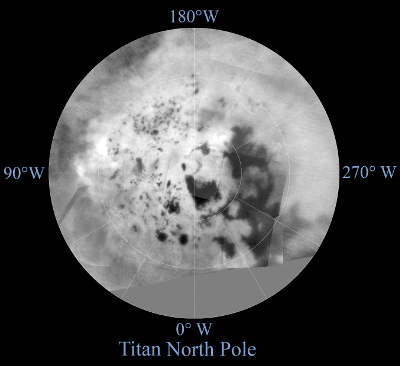
Cassini’s last view of Titan

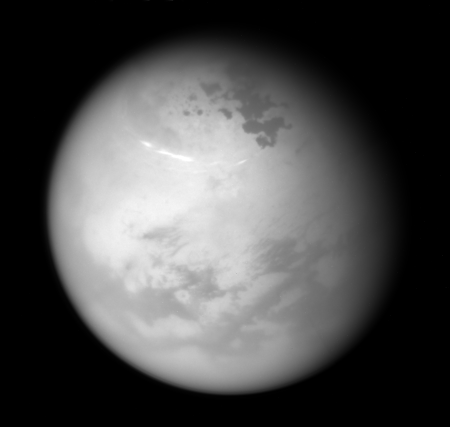
The Cassini science team today released a mosaic of the last images Cassini took of Titan before it crashed into Saturn’s atmosphere four days layer.

The mosaic shows Titan’s north polar region, and shows seas, lakes, and spotty clouds. The lack of clouds is a puzzle to scientists, as they had expected the north polar region to be cloud-covered at this time as summer arrived there, as had been seen at the south pole.

During Titan’s southern summer, Cassini observed cloud activity over the south pole.

However, typical of observations taken during northern spring and summer, the view here reveals only a few small clouds. They appear as bright features just below the center of the mosaic, including a few above Ligeia Mare. “We expected more symmetry between the southern and northern summer,” said Elizabeth (“Zibi”) Turtle of the Johns Hopkins Applied Physics Lab and the Cassini Imaging Science Subsystem (ISS) team that captured the image. “In fact, atmospheric models predicted summer clouds over the northern latitudes several years ago. So, the fact that they still hadn’t appeared before the end of the mission is telling us something interesting about Titan’s methane cycle and weather.”

The truth is we haven’t the slightest idea whether the clouds over the south pole during its previous summer were normal or an aberration. We have barely seen a full year of seasons at Saturn and Titan. To confidently extrapolate any pattern from this slim data is silly.
1 comment

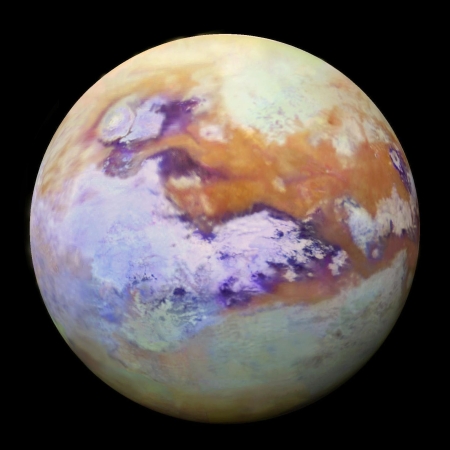
Global mosiacs of Titan in infrared

Titan in infrared

The Cassini science team today released global infrared mosaics of Titan, created from images accumulated during the more than 100 fly-bys of the moon during the spacecraft’s thirteen years in orbit around Saturn.

The image on the right, cropped and reduced in resolution to post here, is only one such global mosaic. Go to the story to see them all.

Making mosaics of VIMS images of Titan has always been a challenge because the data were obtained over many different flybys with different observing geometries and atmospheric conditions. One result is that very prominent seams appear in the mosaics that are quite difficult for imaging scientists to remove. But, through laborious and detailed analyses of the data, along with time consuming hand processing of the mosaics, the seams have been mostly removed. This is an update to the work previously discussed in PIA20022.

Any full color image is comprised of three color channels: red, green and blue. Each of the three color channels combined to create these views was produced using a ratio between the brightness of Titan’s surface at two different wavelengths (1.59/1.27 microns [red], 2.03/1.27 microns [green] and 1.27/1.08 microns [blue]). This technique (called a “band-ratio” technique) reduces the prominence of seams, as well as emphasizing subtle spectral variations in the materials on Titan’s surface. For example, the moon’s equatorial dune fields appear a consistent brown color here. There are also bluish and purplish areas that may have different compositions from the other bright areas, and may be enriched in water ice.

1 comment

Titan’s liquid hydrocarbon seas have a global sea level

New research using Cassini data has revealed that the liquid hydrocarbon oceans of Saturn’s moon Titan have a global sea level, with some small lakes perched at higher elevations.

The new study suggests that elevation is important because Titan’s liquid bodies appear to be connected under the surface in something akin to an aquifer system at Earth. Hydrocarbons appear to be flowing underneath Titan’s surface similar to the way water flows through underground porous rock or gravel on Earth, so that nearby lakes communicate with each other and share a common liquid level.

6 comments

Two finalists for 2020 deep space planetary mission picked by NASA

NASA has narrowed its choice for a 2020s deep space planetary mission to two finalists, either a sample return mission to Comet 67P/C-G or a drone that would fly through Titan’s atmosphere.

The sample return mission sounds very doable with today’s technology. The Titan drone mission however is far more intriguing.

Dragonfly is a dual-quadcopter lander that would take advantage of the environment on Titan to fly to multiple locations, some hundreds of miles apart, to sample materials and determine surface composition to investigate Titan’s organic chemistry and habitability, monitor atmospheric and surface conditions, image landforms to investigate geological processes, and perform seismic studies.

If it was up to me and I had unlimited funds, I’d go with Dragonfly. We know far less about the outer solar system, and this mission would be an ideal way to increase that knowledge. It is also far more daring, which carries the risk that the costs to build and launch will rise uncontrollably.

1 comment

Storms on Titan dump a lot of liquid methane, quickly

A new climate model for Titan that suggests the planet’s methane rainstorms occur about once a Saturn year (29.5 years) and at about 60 degree latitude correlates with Cassini surface data that found a high concentration of alluvial fans at that latitude.

“The most intense methane storms in our climate model dump at least a foot of rain a day, which comes close to what we saw in Houston from Hurricane Harvey this summer,โ€ said Mitchell, the principal investigator of UCLAโ€™s Titan climate modeling research group.

Sean Faulk, a UCLA graduate student and the studyโ€™s lead author said the study also found that the extreme methane rainstorms may imprint the moonโ€™s icy surface in much the same way that extreme rainstorms shape Earthโ€™s rocky surface. On Earth, intense storms can trigger large flows of sediment that spread into low lands and form cone-shaped features called alluvial fans. In the new study, the UCLA scientists found that regional patterns of extreme rainfall on Titan are correlated with recent detections of alluvial fans, suggesting that they were formed by intense rainstorms.

1 comment

Cassini’s last close look at Titan

Titan's magic lake district

The Cassini science team has released the last radar swath that the spacecraft will take of Titan, imaged on April 22.

You can see the full swath up close here. The image above is my crop of the section on the swath’s right portion, showing the shoreline of the hydrocarbon lake Ligeia Mare, where periodically an island has been seen by radar to intermittently appear and disappear.

No “island” feature was observed during this pass. Scientists continue to work on what the transient feature might have been, with waves and bubbles being two possibilities.

The fly-by also took the first, and last, depth measurement of 8 other lakes, finding that they all had the same depth, suggesting they are connected by an underground “water” table. In this case, it ain’t water, but liquid hydrocarbons like methane.

1 comment

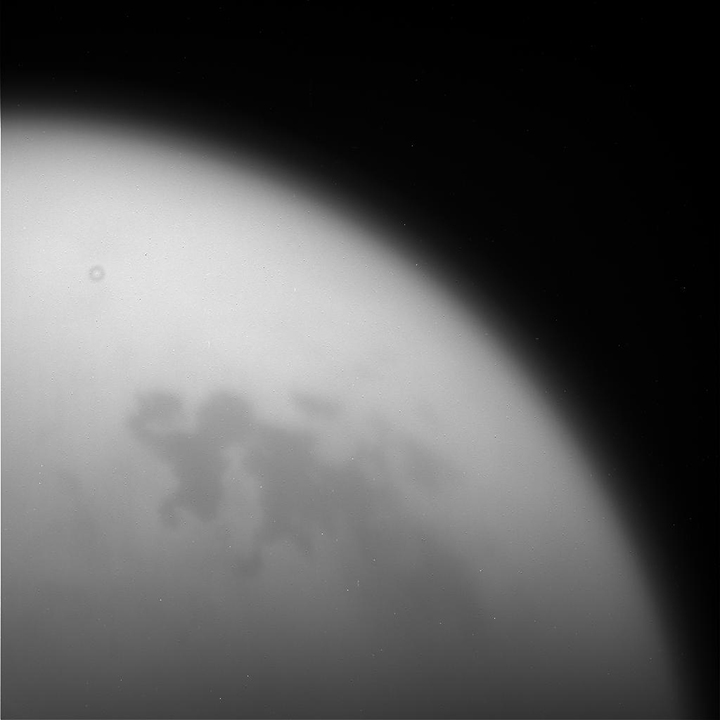
Titan’s clearing northern skies

Titan's clearing northern skies

The image of Titan on the right, reduced in resolution to show here, was taken by Cassini less than a week ago, on June 9, as it continues its last orbits of Saturn prior to crashing into the gas giant’s atmosphere in September.

NASA’s Cassini spacecraft sees bright methane clouds drifting in the summer skies of Saturn’s moon Titan, along with dark hydrocarbon lakes and seas clustered around the north pole. Compared to earlier in Cassini’s mission, most of the surface in the moon’s northern high latitudes is now illuminated by the sun. …Summer solstice in the Saturn system occurred on May 24, 2017.

When Cassini arrived more than a decade ago, it was winter on Titan’s northern hemisphere, and the atmosphere was thick with haze. Now the sky is clearing as the stormy weather shifts to the winter in the southern hemisphere.

As with yesterday’s global map of Mimas, this image is in many ways a farewell look at Titan. While Cassini will likely get a few more global images of the Saturn moon before the mission ends in September, this image essentially marks the end of our ability to observe this strange planet closely, for decades to come. When Cassini crashes into Saturn, our vision at Saturn will go blind. And no one knows when our sight there will return, as no mission is presently in the works, or is even being considered, to return to Saturn.

0 comments

Cassini makes last fly-by of Titan

Cassini on April 21 made its last fly-by of Titan as the spacecraft is prepared for its final 22 orbits of Saturn.

The flyby also put Cassini on course for its dramatic last act, known as the Grand Finale. As the spacecraft passed over Titan, the moon’s gravity bent its path, reshaping the robotic probe’s orbit slightly so that instead of passing just outside Saturn’s main rings, Cassini will begin a series of 22 dives between the rings and the planet on April 26. The mission will conclude with a science-rich plunge into Saturn’s atmosphere on Sept. 15. “With this flyby we’re committed to the Grand Finale,” said Earl Maize, Cassini project manager at JPL. “The spacecraft is now on a ballistic path, so that even if we were to forgo future small course adjustments using thrusters, we would still enter Saturn’s atmosphere on Sept. 15 no matter what.”

The flyby zipped past Titan only a little more than 600 miles above its surface.

7 comments

Titan’s fizzy oceans?

New research suggests that the hydrocarbon lakes of Titan might periodically fizz with nitrogen bubbles.

A recent NASA-funded study has shown how the hydrocarbon lakes and seas of Saturn’s moon Titan might occasionally erupt with dramatic patches of bubbles.

For the study, researchers at NASA’s Jet Propulsion Laboratory in Pasadena, California, simulated the frigid surface conditions on Titan, finding that significant amounts of nitrogen can be dissolved in the extremely cold liquid methane that rains from the skies and collects in rivers, lakes and seas. They demonstrated that slight changes in temperature, air pressure or composition can cause the nitrogen to rapidly separate out of solution, like the fizz that results when opening a bottle of carbonated soda.

These results might help explain the mysterious islands that seem to appear and disappear and then reappear in Titan’s lakes. Rather than islands, they might be patches of nitrogen bubbles.

2 comments

Changing seasons on Titan

Since entering Saturn orbit in 2004, Cassini has seen the seasons on Titan shift through half a Saturn year.

As Titan approaches its northern summer solstice, NASAโ€™s Cassini spacecraft has revealed dramatic seasonal changes in the atmospheric temperature and composition of Saturnโ€™s largest moon. Winter is taking a grip on the southern hemisphere and a strong vortex, enriched in trace gases, has developed in the upper atmosphere over the south pole. These observations show a polar reversal in Titanโ€™s atmosphere since Cassini arrived at Saturn in 2004, when similar features were seen in the northern hemisphere.

Sadly, there will not be any spacecraft at Saturn during the second half of this Saturn year. After Cassini ends its mission in 2017 it will likely be many decades before another spacecraft arrives, since at this moment none has even been proposed.

9 comments

Rivers of liquid carved deep gorges on Titan

Cassini radar data of Via Flumina

Cool image time! New data from Cassini has now both confirmed that there is liquid inside some of the river-like formations on Titan, and that this liquid has carved these formations into very deep gorges.

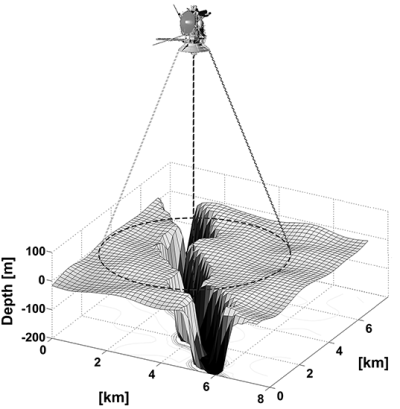
The Cassini observations reveal that the channels — in particular, a network of them named Vid Flumina — are narrow canyons, generally less than half a mile (a bit less than a kilometer) wide, with slopes steeper than 40 degrees. The canyons also are quite deep — those measured are 790 to 1,870 feet (240 to 570 meters) from top to bottom.

The branching channels appear dark in radar images, much like Titan’s methane-rich seas. This suggested to scientists that the channels might also be filled with liquid, but a direct detection had not been made until now. Previously it wasn’t clear if the dark material was liquid or merely saturated sediment — which at Titan’s frigid temperatures would be made of ice, not rock.

The diagram on the above right is from the paper itself, and shows some of the radar data obtained by Cassini. It also illustrates the deep and narrow nature of Via Flumina. This is almost the equivalent of what we call slot canyons on Earth, formed by periodic flash floods that cut their way down as the surface is slowly uplifted by other processes.

The new radar data showed that the surface at the base of the gorge was smooth and flat, just as you’d find if that base was filled with liquid.The altimeter data showed that gorge’s elevation matched that of Titan’s lakes at its insurgence, but as you traveled upstream the elevation rose, just as it does on any river on Earth. Moreover, this data was reasonably trustworthy as they had already used Cassini to successfully do exactly the same thing — identify a known river — when it flew past Earth on its way to Saturn.

Be prepared for one piece of misinformation when the press reports on this story, almost certainly caused by the American Geological Union’s press release about this paper. That press release incorrectly claims that the paper confirmed that these are methane rivers. It does no such thing. It only shows that the gorges have a liquid in them, and that the liquid almost certainly formed the gorges. Though methane is a very likely candidate for this liquid based on what we know of Titan, the actual make-up of the river remains uncertain.

I therefore predict our incompetent modern mainstream press will only read this press release and not the paper itself, and thus they will tout these incorrectly as methane rivers.

Below is a cropped Cassini radar image of Via Flumina, showing its river-like appearance. Scientists always suspected these were formed by flowing liquid. Now they have strong evidence from within the gorge to justify that suspicion.

Via Flumina on Titan

2 comments

Titan over Saturn’s rings

Titan over Saturn's rings

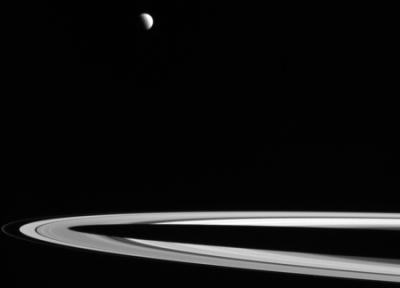
Cool image time! The picture on the right, taken on January 26, 2016 by Cassini and reduced and cropped to show here, captures Titan above Saturn’s rings, which are themselves partly obscured by the shadow of Saturn (unseen on the right) that falls across them.

Make sure you go to look at the full image. This is the kind of vista that artists in the 1950s imagined we’d see once we began to explore the solar system.

0 comments

The methane seas of Titan

Scientists have used the data that Cassini has gathered in more than a hundred fly-bys of Titan to assemble a rough outline of the geology and make-up of Titan’s liquid lakes.

There are three large seas, all close to the north pole, surrounded by dozens of smaller lakes in the northern hemisphere. Just one lake has been found in the southern hemisphere. The exact make-up of these liquid reservoirs remained elusive until recently. A new study using scans from Cassiniโ€™s radar during flybys of Titan between 2007 and 2015 confirms that one of the largest seas on the moon, Ligeia Mare, is mostly liquid methane.

โ€œWe expected to find that Ligeia Mare would be mostly ethane, which is produced in abundance in the atmosphere when sunlight breaks methane molecules apart,โ€ explains Alice Le Gall from the Laboratoire Atmosphรจres, Milieux, Observations Spatiales and Universitรฉ Versailles Saint-Quentin, France, and lead author of the new study. โ€œInstead, this sea is predominantly made of pure methane.โ€

The data is also giving them the first understanding of the weather and geology that forms the lakes, including why methane instead of ethane dominates.

0 comments

Titan’s changing shorelines

Shoreline changes on Titan

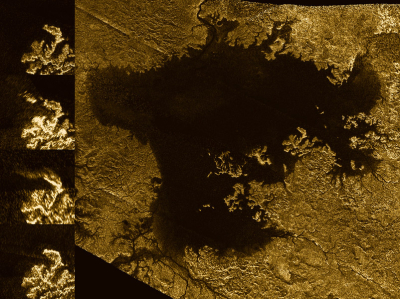
Cool image time! Using radar images taken during the past decade by Cassini scientists have discovered changes taking place along the shorelines of Titan’s hydrocarbon seas.

Analysis by Cassini scientists indicates that the bright features, informally known as the “magic island,” are a phenomenon that changes over time. They conclude that the brightening is due to either waves, solids at or beneath the surface or bubbles, with waves thought to be the most likely explanation. They think tides, sea level and seafloor changes are unlikely to be responsible for the brightening.

The images in the column at left show the same region of Ligeia Mare as seen by Cassini’s radar during flybys in (from top to bottom) 2007, 2013, 2014 and 2015.

These shoreline changes are not the only ones spotted by Cassini. However, because these are radar images, not visual, there are many uncertainties about what causes the changes, which is why they list several possibilities. For example, with radar, a simple roughness on the surface (such as waves) could cause a brightening.

1 comment

New global maps of Titan

Titan's North Pole

The Cassini science team has released new maps of Titan, including new maps of both poles, assembled from images taken during the 100 flybys that the spacecraft has made of the moon since it arrived in orbit around Saturn.

The scale is rough, just less than a mile at best, and there is no topographic information because the thick atmosphere allows for no strong sunlight or shadows. The images show differences in surface brightness, which does tell us where Titan’s dark methane lakes are.

This is likely the best we will get of Titan for decades, until another spacecraft is sent there.

0 comments
1 2 3 4