First image of possible asteroid in orbit around the Earth

asteroid orbiting the Earth?
Click for full image.

The Gemini telescope in Hawaii has produced the first image of what might be only the second asteroid ever discovered in orbit around the Earth.

The newly discovered orbiting object has been assigned the provisional designation 2020 CD3 by the International Astronomical Union’s Minor Planet Center. If it is natural in origin, such as an asteroid, then it is only the second known rocky satellite of the Earth ever discovered in space other than the Moon. The other body, discovered in 2006, has since been ejected out of Earth orbit. 2020 CD3 was discovered on the night of 15 February 2020 by Kacper Wierzchos and Teddy Pruyne at the Catalina Sky Survey operating out of the University of Arizona’s Lunar and Planetary Laboratory in Tucson, Arizona.

The photo to the right has been cropped to post here. The streaks are stars, since the telescope was tracking the asteroid in an attempt to cull the most resolution of it from the image.

This object is only a few yards across, and could very well be a piece of space junk from a mission launched many decades ago. It is also not in a stable orbit around the Earth, and is expected to be ejected from that orbit in April.

5 comments

New OSIRIS-REx close-up image of secondary asteroid landing site

Osprey landing site on Bennu
Click for full image.

The OSIRIS-REx science team today released one of the images taken during the spacecraft’s recent close reconnaissance of its secondary touch-and-go landing site on the asteroid Bennu.

I have cropped their oblique image to focus, in full resolution, on that landing site, dubbed Osprey, which is the crater on the left side of the photo. The boulder in that crater “is 17 ft (5.2 m) long, which is about the length of a box truck.”

After the fly-by, the science team had announced that the spacecraft’s laser altimeter had failed to operate, and the images taken by its highest resolution camera (not the camera that took today’s image) “are likely out of focus.”

Based on this image, what look like tiny pebbles inside the crater are actually boulders ranging in size from mere inches to as much as five feet across. If their high resolution images are soft, it will thus be hard to map out the terrain sufficiently to safely make a touch-and-go landing here.

More important, there is still no word on whether they have fixed the laser altimeter. Without it I suspect a landing will be very difficult, if not impossible.

0 comments

Anomaly during OSIRIS-REx flyover of secondary landing site

During its close fly-over of its secondary candidate touch-and-go landing site on the asteroid Bennu, OSIRIS-REx’s laser altimeter failed to work as planned.

On Feb. 11, NASA’s OSIRIS-REx spacecraft safely executed a 0.4-mile (620-m) flyover of the backup sample collection site Osprey as part of the mission’s Reconnaissance B phase activities. Preliminary telemetry, however, indicates that the OSIRIS-REx Laser Altimeter (OLA) did not operate as expected during the 11-hour event. The OLA instrument was scheduled to provide ranging data to the spacecraft’s PolyCam imager, which would allow the camera to focus while imaging the area around the sample collection site. Consequently, the PolyCam images from the flyover are likely out of focus.

They are analyzing their data to figure out what went wrong and whether it can be fixed. The press release implies that this loss will not impact the touch-and-go at the primary landing site, but does not say so directly. Without the laser altimeter I wonder, how they will know their exact distance as they approach?

Then again, they have not yet downloaded the full dataset from the fly-over, so they might be able to get the instrument working again.

1 comment

An update on Comet 2I/Borisov

Link here.

Overall, this second known interstellar object to pass through the solar system appears to be a very typical comet. They have found however that its nucleus is much smaller than at first thought, only 200 to 500 meters across, which means that radiation pressure from the Sun could cause its rotation to spin up, with the possibility that this spin could get fast enough to cause the comet to break up.

The comet made its closest approach to the Sun in December, and will spend the next year-plus flying outward to beyond Saturn.

2 comments

OSIRIS-REx completes close fly-over of Bennu touchdown site

OSIRIS-REx has successfully completed the first of a series of increasingly closer fly-overs of its primary sample grab sites on the asteroid Bennu.

The spacecraft got as close as about 2,000 feet in order to take more high resolution images of the Nightingale landing site where they hope in August to do a touch-and-go sample grab.

A similar flyover of the backup sample collection site, Osprey, is scheduled for Feb. 11. Even lower flybys will be performed later this spring – Mar. 3 for Nightingale and May 26 for Osprey – as part of the mission’s Reconnaissance C phase activities. The spacecraft will perform these two flyovers at an altitude of 820 feet (250 m), which will be the closest it has ever flown over asteroid Bennu’s surface.

0 comments

The oldest known meteorite strike?

The uncertainty of science: Scientists think they have identified the oldest meteorite strike known on Earth, dated at 2.33 billion years ago, located in a known impact site in Yarrabubba, Western Australia.

Lead author Dr Timmons Erickson, from Curtin’s School of Earth and Planetary Sciences and NASA’s Johnson Space Center, together with a team including Professor Chris Kirkland, Associate Professor Nicholas Timms and Senior Research Fellow Dr Aaron Cavosie, all from Curtin’s School of Earth and Planetary Sciences, analysed the minerals zircon and monazite that were ‘shock recrystallized’ by the asteroid strike, at the base of the eroded crater to determine the exact age of Yarrabubba.

The team inferred that the impact may have occurred into an ice-covered landscape, vaporised a large volume of ice into the atmosphere, and produced a 70km diameter crater in the rocks beneath.

Professor Kirkland said the timing raised the possibility that the Earth’s oldest asteroid impact may have helped lift the planet out of a deep freeze. “Yarrabubba, which sits between Sandstone and Meekatharra in central WA, had been recognised as an impact structure for many years, but its age wasn’t well determined,” Professor Kirkland said. “Now we know the Yarrabubba crater was made right at the end of what’s commonly referred to as the early Snowball Earth – a time when the atmosphere and oceans were evolving and becoming more oxygenated and when rocks deposited on many continents recorded glacial conditions”.

Associate Professor Nicholas Timms noted the precise coincidence between the Yarrabubba impact and the disappearance of glacial deposits. “The age of the Yarrabubba impact matches the demise of a series of ancient glaciations. After the impact, glacial deposits are absent in the rock record for 400 million years. This twist of fate suggests that the large meteorite impact may have influenced global climate,” Associate Professor Timms said. [emphasis mine]

I truly believe they have determined the approximate age of this impact, making it one of the oldest known impacts. Implying however a “precise” linkage to other only vaguely known climate events, and inferring that the former was the cause of the latter seems to me to be a very large overstatement. Their data might suggest this conclusion, but the uncertainties here demand a bit less certitude..

8 comments

First asteroid discovered that circles Sun closer than Venus

Astronomers have detected the first asteroid circling the Sun in an orbit that lies entirely inside Venus’s orbit.

In addition to being the first known asteroid with this orbit, the space rock, called 2020 AV2, has the smallest aphelion, or distance from the sun, of any known natural object in the solar system, excluding Mercury. Moreover, by traveling around the sun in a mere 151 days, 2020 AV2 has the shortest orbital period of any known asteroid, according to The Virtual Telescope Project, an online observatory based in Italy.

The reason this is a first is because it is very hard to find such small objects orbiting closer to the Sun than Earth. The glare of the Sun limits what can be spotted. This fact is also why the scientists are unsure of the size of 2020 AV2.

0 comments

Stardust found in meteorite older than Earth

Scientists studying what they think is grains of stardust in a meteorite the hit the Earth in 1969 have discovered the oldest material ever found on Earth, material that is actually older than the Earth itself.

The meteorite, dubbed the Murchison meteorite after the nearest city in Australia where it landed, has been a treasure trove of information for planetary scientists because so much of it was recovered right after impact.

About 30 years ago it was found that the rocks housed “presolar grains” – tiny grains of silicon carbide older than the Sun. But their exact age hadn’t been determined until now.

To figure that out, the researchers on the new study measured how long these presolar grains had been exposed to cosmic rays. These high-energy particles flit around space and can pass through solid matter, creating new elements inside the existing minerals as they interact with them. That means the scientists can measure the amount of these new elements in the grains to determine how long they were floating around in space – and, ultimately, how old they are.

In doing so, the team found that most of the grains were between 4.6 and 4.9 billion years old. The Sun itself is at the younger end of that range, at 4.6 billion years old, while the Earth didn’t form until 4.5 billion years ago.

But the oldest of the grains were dated to more than 5.5 billion years, making them the oldest known material on Earth. The team says that the history of these grains could be traced back even further, to the stars that birthed them some 7 billion years ago. According to the researchers, this finding suggests that our galaxy went through a period of intense star formation around that time.

Obviously there are uncertainties with this result, though their age estimates are quite reasonable and largely robust.

2 comments

Probe to visit 8 asteroids, not 7

Scientists developing the Lucy mission to visit seven Trojan asteroids that share an orbit with Jupiter have found an eighth satellite they will also be able to visit.

This first-ever mission to the Trojans was already going to break records by visiting seven asteroids during a single mission. Now, using data from the Hubble Space Telescope (HST), the Lucy team discovered that the first Trojan target, Eurybates, has a satellite. This discovery provides an additional object for Lucy to study.

“If I had to bet that one of our destinations had a satellite, it would have been this one,” said SwRI’s Hal Levison, principal investigator of the mission. “Eurybates is considered the largest remnant of a giant collision that occurred billions of years ago. Simulations show that asteroid collisions like the one that made Eurybates and its family often produce small satellites.”

The mission is targeting a 2021 launch date.

0 comments

The importance of small telescopes to science and civilization

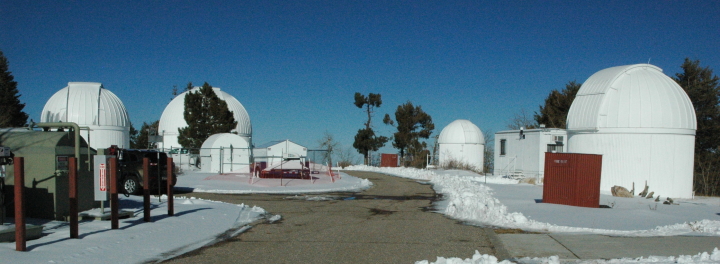
The main cluster of telescopes, on Mount Lemmon
Largest cluster of telescopes on Mount Lemmon, six visible with three just out of view.

On December 11, 2019 I was kindly given a personal tour by Alan Strauss, director of the Mount Lemmon Sky Center, of the telescopes located on the mountaintops of the Santa Catalina Mountains overlooking Tucson. Strauss runs the educational outreach program for the University of Arizona astronomy department and the Steward Observatory, both of which operate the mountaintop facility.

The telescopes, numbering almost a dozen, are in two groups, two telescopes on the peak of Mount Bigelow and the rest clustered on the higher peak of Mount Lemmon. None are very gigantic by today’s standards, with their primary mirrors ranging in size from 20- to 61-inches. For comparison, the largest operating telescope in the world on the Canary Islands is 409 inches across. Hubble has a 94-inch mirror. And the new giant telescopes under design or being built have mirrors ranging from 842 inches (Giant Magellan) to 1,654 inches (European Extremely Large Telescope).

Thus, the small telescopes in the Santa Catalinas generally don’t make the news. They are considered passe and out-of-date, not capable of doing the kind of cutting edge astronomy that all the coolest astronomers hunger for.

Yet, without them, we likely would not have future astronomers. » Read more

11 comments

OSIRIS-REx team picks primary sample site

Four candidate landing sites
Click for full image.

The OSIRIS-REx science team has picked the site they have dubbed Nightingale as the primary landing site where they will attempt to obtain a sample from the asteroid Bennu in the summer of 2020. The back-up site is Osprey at the equator.

I have embedded the replay of the NASA live stream of the press event below the fold. The first 21 minutes of the video are an overview of the mission, leading up to the announcement by Dante Lauretta, OSIRIS-REx’s principal investigator. He notes then that the site “does have some hazards” but they chose it for its “scientific value.” While its higher latitude location has some advantages, it also makes it more difficult for landing. The one large boulder there, which Lauretta calls “Mt Doom,” also carries risk for the touch-and-go operations.

The back-up site, Osprey, is on the equator with less hazards, but will present more problems obtaining the tiny-sized particles the sample grab equipment was designed to get.

Not that this matters, but if I have been in a betting pool I would have won, since Nightingale has been my guess for which site they’d pick since early November.
» Read more

0 comments

OSIRIS-REx completes reconnaissance of four candidate sample sites

Four candidate landing sites
Click for full image.

OSIRIS-REx has completed its high resolution reconnaissance of the four candidate sites on the asteroid Bennu, chosen for possible sample capture during touch-and-go operations planned for the summer of 2020.

In the next few days the science team will decide which of these four sites, shown above, will be the primary and back-up landing locations. The decision however appears challenging, based on the information gathered.

Bennu has also made it a challenge for the mission to identify a site that won’t trigger the spacecraft’s safety mechanisms. During Recon A, the team began cataloguing Bennu’s surface features to create maps for the Natural Feature Tracking (NFT) autonomous navigation system. During the sample collection event, the spacecraft will use NFT to navigate to the asteroid’s surface by comparing the onboard image catalog to the navigation images it will take during descent. In response to Bennu’s extremely rocky surface, the NFT system has been augmented with a new safety feature, which instructs it to wave-off the sampling attempt and back away if it determines the point of contact is near a potentially hazardous surface feature. With Bennu’s building-sized boulders and small target sites, the team realizes that there is a possibility that the spacecraft will wave-off the first time it descends to collect a sample.

Based on the information at the link, plus the presentation by Dante Lauretta, OSIRIS-REx’s principal investigator, given at the asteroid conference I attended in November, I suspect that Nightingale will be primary landing site.

Regardless, it appears the science team has recognized that the landing will difficult, and will likely require multiple attempts before the spacecraft’s navigation system lets it happen.

0 comments

Hayabusa-2 fires main ion engines for return to Earth

After spending two weeks testing its main ion engines just beyond the gravitational sphere of influence of the asteroid Ryugu, Japanese engineers today initiated full engine operation, beginning the spacecraft’s journey back to Earth.

Hayabusa-2 is expected to return to Earth space in December 2020, where it will release a small capsule containing the two samples it obtained of Ryugu will be released to land on Earth and be recovered. At that point, if Hayabusa-2 is still in good condition it will be available to send to other locations in the solar system.

3 comments

Hayabusa-2 begins journey back to Earth

The Hayabusa-2 science team has fired up the spacecraft’s ion engine to leave the asteroid Ryugu and began its begins journey back to Earth.

It will take about six days to exit the gravitational sphere of influence of Ryugu. During that time period they will be continually releasing real time images of the asteroid from the spacecraft’s navigation camera, as it slowly gets farther away.

In mid-December they will fire the spacecraft’s main engines for an arrival near Earth in late 2020. At that point the small return capsule holding the samples from Ryugu will separate and land in the Australian desert. Hayabusa-2, still operational, might then be given a new subsequent mission.

0 comments

New Horizons team renames “Ultima Thule” to “Arrokoth”

The New Horizons team has renamed the Kuiper Belt object that the spacecraft flew past on January 1, 2019 from its informal nickname of “Ultima Thule” to “Arrokoth,” which means “sky” in Powhatan/Algonquian language.

This official, and very politically correct, name has apparently gotten the stamp of approval from the IAU.

In accordance with IAU naming conventions, the discovery team earned the privilege of selecting a permanent name for the celestial body. The team used this convention to associate the culture of the native peoples who lived in the region where the object was discovered; in this case, both the Hubble Space Telescope (at the Space Telescope Science Institute) and the New Horizons mission (at the Johns Hopkins Applied Physics Laboratory) are operated out of Maryland — a tie to the significance of the Chesapeake Bay region to the Powhatan people.

“We graciously accept this gift from the Powhatan people,” said Lori Glaze, director of NASA’s Planetary Science Division. “Bestowing the name Arrokoth signifies the strength and endurance of the indigenous Algonquian people of the Chesapeake region. Their heritage continues to be a guiding light for all who search for meaning and understanding of the origins of the universe and the celestial connection of humanity.” [emphasis mine]

It is a good name, especially because its pronunciation is straight-forward, unlike the nickname.

The blather from Glaze above, however, is quite disingenuous. The Algonquian people have had literally nothing to do with the modern scientific quest for “meaning and understanding of the origins of the unverse.” They were a stone-age culture, with no written language. It was western civilization that has made their present lives far better. And it was the heritage of western civilization, not “the indigenous Algonquian people” that made the New Horizons’ journey possible. Without the demand for knowledge and truth, as demanded by western civilization, we would still not know that Arrokoth even existed.

6 comments

Bennu & Ryugu: Two very old and strange asteroids

Bennu as seen by OSIRIS-REx
Bennu’s equatorial ridge. Click for full image.

This week the science team operating the OSIRIS-REx spacecraft at the asteroid Bennu hosted a joint conference in Tucson, Arizona, with the scientists operating the Hayabusa-2 spacecraft at the asteroid Ryugu. Both gave up-to-date reports on the science so far obtained, as well as outlined upcoming events. I was fortunate enough to attend.

First an overview. Both Bennu and Ryugu are near earth asteroids, with Bennu having an orbit that might even have it hit the Earth in the last quarter of 2100s. Both are very dark, and are rubble piles. Both were thought to be of the carbonaceous chondrite family of asteroids, sometimes referred to as C-type asteroids. This family, making up about 75% of all asteroids, includes a bewildering collection of subtypes (B-types, F-types, G-types, CI, CM, CV, CH, CB, etc), all of which were initially thought to hold a lot of carbon. We now know that only a few of these categories, the CI and CM for example, are carbon rich.

Even so, we actually know very little about these types of asteroids. They are very fragile, so that any that reach the Earth’s surface are not a good selection of what exists. About 90% of the material gets destroyed in the atmosphere, with the remnant generally coming from the innermost core or more robust nodules. We therefore have a biased and limited sample.

It is therefore not surprising that the scientists are finding that neither Bennu nor Ryugu resembles anything else they have ever seen. Both have aspects that resemble certain types of carbonaceous chondrite asteroids, but neither provides a very good fit for anything.
» Read more

13 comments

Smallest spherical planet so far found

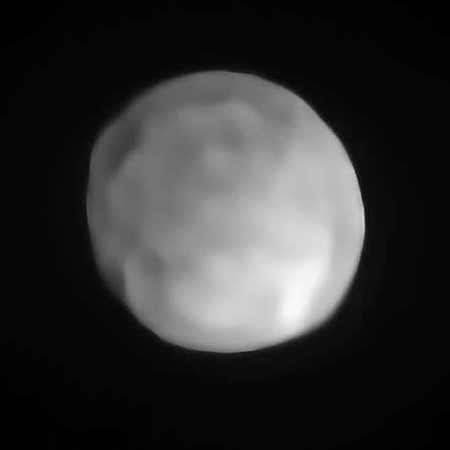
Hygiea

A new image of the asteroid Hygiea has revealed that this main belt object is actually spherical, making it the smallest spherical asteroid so far discovered and suggesting that it could be defined as a planet.

The image, taken by the Very Large Telescope (VLT) in Chile, is to the right. The asteroid was first discovered in 1849 and is the fourth largest in the asteroid belt, after Ceres, Pallas, and Vesta, with a diameter of 267 miles.

The image once again challenges the definition of what makes a planet. It also makes difficult the vague term “dwarf planet.” At what point does a dwarf become a full planet? This has never been clarified, which is why I tend to avoid using the term dwarf planet.

In my many interviews of planetary scientists, they generally dismiss the IAU’s poor definition of a planet and define a planet as anything that has settled into a spherical shape. In the case of Hygiea, that seems to apply.

5 comments

Planet X a small black hole?

In one of the wilder theories attempting to explain the orbits of the outer objects found beyond Neptune, two physicists have proposed that the reason Planet X has not been located is because it might be a small black hole.

Previous studies have suggested Planet Nine, which some astronomers refer to as “Planet X,” has a mass between five and 15 times that of Earth and lies between 45 billion and 150 billion kilometers from the sun. At such a distance, an object would receive very little light from the sun, making it hard to see with telescopes.

To detect objects of that mass, whether planets or black holes, astronomers can look for weird blobs of light formed when light “bends” around the object’s gravitational field on its journey through the galaxy (simulated image above). Those anomalies would come and go as objects move in front of a distant star and continue in their orbit.

But if the object is a planet-mass black hole, the physicists say, it would likely be surrounded by a halo of dark matter that could stretch up to 1 billion kilometers on every side. And interactions between dark matter particles in that halo—especially collisions between dark matter and dark antimatter—could release a flash of gamma rays that would betray the object’s presence, the researchers propose in a forthcoming paper posted on the preprint server arXiv.

Anything is possible, but some things are certainly less likely than others. If these scientists turn out to be right, however, they will have achieved one of the biggest coups in the history of science.

And yes, the undiscovered planet out there should be referred to as “Planet X”, not “Planet Nine.” Not only is Pluto a planet, so are a lot of other objects in the solar system that up to recently were not considered so.

2 comments
1 13 14 15 16 17 47