
NASA considering consolidating two Gateway launches into one

Capitalism in space: NASA’s Artemis program is now considering using a single launch to place two different Gateway modules into space, rather than two separate launches.

Originally, NASA wanted to launch the PPE and HALO modules – together representing the absolute bare minimum needed to build a functional Gateway – on separate commercial rockets in 2022 and 2023, respectively. Now, according to NASA associate administrator Doug Loverro, the space agency has made the decision to launch both modules simultaneously on the same commercial rocket.

This decision was made in large part because it makes sense from a technical simplicity and overall efficiency standpoint but also because several commercial launch vehicles – either currently operational or soon to be – are set to debut extremely large payload fairings. As a combined payload, the Gateway PPE and HALO modules would be too big for just about any existing launch vehicle, while the tiny handful it might fit in lack the performance needed to send such a heavy payload to the Moon.

Falcon Heavy apparently has the performance needed, as NASA used the rocket and a new stretched fairing developed by SpaceX for military customers as a baseline to determine whether PPE and HALO could launch together. Given that NASA could have technically used any of the vehicles expected to have large payload fairings for that analysis, the explicit use and mention of Falcon Heavy rather strongly suggests that the SpaceX rocket is a front runner for the new combined launch contract. This isn’t exactly surprising, given that the massive rocket has already completed three successful launches and will attempt at least another four missions between now and 2023.

Note the rocket that is not mentioned: SLS.

My regular readers know my consistent opposition to Gateway. That opposition was based on its initial design, depending for launch and operations entirely on NASA’s SLS rocket, and requiring it to be built before we landed on the Moon. Based on the SLS program’s track record, I believed Gateway would become, like SLS, nothing more than a pork barrel project accomplishing nothing but funneling government payroll to congressional districts while failing to launch any missions into space.

If NASA however is shifting gears, and aiming to allow private enterprise to build, launch, and operate Gateway, for considerably less cost and time, than Gateway might actually be of some value, mostly because there is actually a chance it might really be built, within a few short years.

I remain skeptical however. I still have questions about this lunar station’s utility, at this time. We might be spending a lot of money for a space station that won’t get us anywhere. Or maybe if NASA rethinks it properly it could provide us the real opportunity to test construction of an interplanetary spaceship, in lunar orbit.

We will have to see how this plays out. This story does appear encouraging however.
4 comments

NASA awards SpaceX deal to provide cargo to Gateway

Capitalism in space: Should NASA ever decide to build its proposed Gateway space station in orbit around the Moon (the odds of which have gone down recently), it announced today that it has signed a deal with SpaceX to use its Falcon Heavy rocket and an upgraded larger version of its Dragon capsule to ship cargo to that station.

The deal calls for at least two missions, and is SpaceX’s first deal in NASA’s Artemis program.

This deal is a major blow to SLS and Boeing, which up to now had a monopoly on all launches to supply and launch Gateway. In fact, Gateway was invented by Lockheed Martin, Boeing, and NASA (not Congress) in order to justify SLS’s existence. That NASA has now decided it is better off using the much cheaper and already operational Falcon Heavy for some Gateway missions suggests that SLS is increasingly vulnerable to cancellation. NASA is making it obvious that other commercial options exist. No need to wait years and spend billions for SLS, when they can go now, for much less.

8 comments

Falcon Heavy wins launch contract for NASA’s Psyche asteroid mission

Capitalism in space: NASA today awarded the launch contract for its Psyche asteroid mission, set to launch in July 2022, to SpaceX’s Falcon Heavy rocket.

The total bid price was $117 million, which according to the release includes “the launch service and other mission related costs.” Though this is higher than the normal price SpaceX charges for a Falcon Heavy launch ($100 million), it is far lower than the typical price of a ULA launch. Furthermore, Falcon Heavy has more power, so it can get the spacecraft to the asteroid faster.

0 comments

SpaceX proposing big launch rate increase in Florida

Capitalism in space: According to documents filed with the FCC, SpaceX is planning a big increase in the number of launches from its two launchpads in Florida in the next few years.

SpaceX projects performing 38 launches from Florida in 2020, 30 from SLC-40 and eight from LC-39A. By 2023, the company projects as many as 70 launches, 50 from SLC-40 and 20 from LC-39A, an annual rate that holds steady through 2025. The vast majority would be Falcon 9 launches, although it expects as many as 10 Falcon Heavy launches a year, all from LC-39A.

These numbers include both Dragon cargo and crew launches, Starlink satellite launches, and a variety of other commercial customers, including launches into polar orbits, something that in the past was reserved for Vandenberg on the west coast, not Florida. The launch estimates are also likely high, as they come from an environmental assessment. SpaceX probably wants to get clearance for this many launches, just in case things go far better than expected. They will likely do less, though I would not be surprised if the numbers are still record-setting.

In addition, the documents outline SpaceX’s plans to build a mobile launch tower to accommodate national security payloads that must be installed on their rocket vertically. Falcon Heavy could provide this service, but right now its payloads get installed horizontally.

0 comments

Europa Clipper faces budget overruns

NASA’s $4.25 billion dollar mission to orbit the Jupiter moon Europa now faces cost overruns that threaten its launch in 2023.

The management of NASA’s Europa Clipper mission, facing dwindling cost reserves while still years away from launch, is looking at cost saving options that would preserve the mission’s science.

In a Feb. 3 presentation at a meeting of the Outer Planets Assessment Group in Houston, Jan Chodas, project manager for Europa Clipper at the Jet Propulsion Laboratory, said she was looking for ways to restore cost reserves that had declined precipitously in the last year.

Chodas said that Europa Clipper had met a JPL recommendation of 25% cost reserves, known at the lab as unallocated future expenses (UFE), when it completed a final “delta” preliminary design review in June 2019. By November, though, those reserves had fallen to just 12%, a level deemed “unacceptably low” for a mission not scheduled for launch until at least 2023.

To save money, they are “streamlining hardware testing and scaling back work on flight spare hardware. The project has also reduced the frequency of meetings of the mission’s science team.”

When the reserves in a government budget get this low, it almost always guarantees that the budget will go over. When the reserves get this low this early in the project, it almost always guarantees that the budget will go over, by a lot.

There have been other indications that Europa Clipper’s budget is in trouble. In March NASA canceled one science instrument to save money.

Making matter worse has been our lovely Congress, which has required this mission fly on its bloated, over-budget, and behind schedule SLS rocket, a mandate that is also costing the project an additional $1.5 billion (for the launch) while threatening its launch date (because of SLS delays). NASA would rather have the option to launch Clipper on the more reliable commercial and already operational Falcon Heavy, for about $100 million, thereby saving more than a billion dollars while guaranteeing its launch date. Congress so far has refused to budge, and has in fact insisted that the mission be delayed several years if necessary for getting it on SLS.

Meanwhile, Clipper itself is doing what too many big NASA projects routinely do, go overbudget.

Our federal government. Doesn’t its management skills just warm your heart?

8 comments

SpaceX wins first new launch contract in 2020

Capitalism in space:The Egyptian communcications satellite company Nilsat this week announced that it has awarded SpaceX the launch contract for its next satellite.

This was SpaceX’s first contract award in 2020.

The article goes into great detail about SpaceX’s present launch manifest, which according to the company has contracts for future launches equaling $12 billion.

Based on public info, SpaceX has roughly 55 customer launches on its manifest. The company also intends to launch as many as 24 dedicated Starlink missions this year and will need at least another 40-50 on top of that to complete the first phase of the broadband internet satellite constellation (~4400 spacecraft). Meanwhile, SpaceX has won at least nine separate launch contracts – two Falcon Heavy missions and seven Falcon 9s – in the last 18 months, but has launched 22 customer payloads in the same period.

In fewer words, SpaceX is effectively launching its existing commercial missions much faster than it’s receiving new contracts. In 2019, for example, the company launched only 11 commercial missions – 13 total including two internal 60-satellite Starlink launches. SpaceX launched 21 times in 2018, a record the company initially hoped to equal or even beat last year, but – for the first time ever – the launch company was consistently ready before its customers were.

It appears SpaceX intends to pick up any slack in launch contracts with Starlink satellite launches, which once in orbit are another major income source for the company.

Overall, it seems to me that SpaceX is quite awash with capital, which reinforces their decision to not take government money to develop Starship. Using their own capital they are free to build as they see fit, with no one from the government who knows less than they do looking over their shoulder and kibitzing.

13 comments

Satellite company switches from Falcon Heavy to Ariane 5

Capitalism in space: The communications satellite company Ovzon has switched from SpaceX’s Falcon Heavy to Arianespace’s Ariane 5 for the launch of its first wholly owned satellite in 2021.

In an interview Aug. 24, Ovzon CEO Magnus René told SpaceNews the company received a more appealing launch offer from Arianespace. “It’s nothing political or anything like that, it’s not that we don’t trust SpaceX — it’s just that we could get a better deal in cost and time and so on from Ariane at this time,” René said.

SpaceX charges $100 million for a Falcon Heavy launch, about the same as Arianespace charges for one of the two berths on its Ariane 5. Arianespace must have therefore cut its standard price to make it more attractive, and win the deal.

Ain’t competition wonderful? Governments have been trying (and failing) to get us into space for half a century, using the model of international cooperation. Introduce some competition and suddenly it becomes both easier and cheaper to do it. Who woulda thunk it?

1 comment

SpaceX’s Tesla has completed its first solar orbit

Capitalism in space: The first privately launched car, a Tesla placed in solar orbit on SpaceX’s first launch of its Falcon Heavy, has now completed its first orbit around the sun.

Its future?

Car and driver will probably make many more laps around our star. Last year, an orbit-modeling study calculated that the Roadster will eventually slam into either Venus or Earth, likely within the next few tens of millions of years. But there’s just a 6 percent chance of an Earth impact, and a 2.5 percent chance of a Venus impact, within the next million years, the study’s authors found.

3 comments

SpaceX to launch Super Heavy/Starship from Florida

Capitalism in space: According to a SpaceX environmental report submitted to NASA, the company now plans to launch Super Heavy/Starship missions from Florida, and only Florida.

The report details the work they want to do at launch complex 39A, where they presently launch both Falcon 9s and Falcon Heavies.

The facilities will be able to support up to 24 Starship/Super Heavy launches a year, the company said in the report, with a corresponding decline in Falcon launches from the complex. “Due to the higher lift capability, Starship/Super Heavy could launch more payloads and reduce the overall launch cadence when compared to Falcon 9 and Falcon Heavy,” the report states.

SpaceX ruled out performing Starship/Super Heavy launches from its other two existing launch sites, Space Launch Complex 40 at Cape Canaveral and Space Launch Complex 4 at Vandenberg Air Force Base in California. The company ruled out the sites because they would require more modifications and because the Vandenberg site didn’t support trajectories for the “vast majority” of missions.

Falcon Heavy launches especially will vanish once this new rocket is operational, as it will be cheaper to use and have greater capabilities, should it succeed in being everything SpaceX hopes it to be.

9 comments

SpaceX catches a fairing

Capitalism in space: During last night’s Falcon Heavy launch SpaceX was for the first time able to catch one of the rocket’s fairings using its ship, GO Ms. Tree (formerly called Mr. Steven).

As noted at the link, SpaceX now has in its hands a fairing untouched by salt water that it can analyze for future reuse, something no other rocket company has been able to do. Moreover, that the ship was able to make the net catch at night bodes well for future fairing recoveries.

Hat tip commenter geoffc.

5 comments

Falcon Heavy launches successfully

Capitalism in space: The Falcon Heavy successfully launched tonight, and is presently deploying the 24 satellites on board.

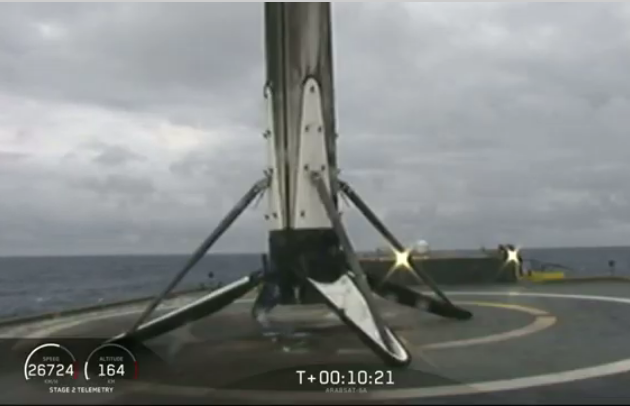
They successfully landed the two first stage side boosters, but the core stage apparently just missed hitting the drone ship in the Atlantic. You could see it come down, but not on the pad. While SpaceX has now successfully recovered all six side boosters on all three Falcon Heavy launches, they have not yet succeeded in recovering the core stage.

The mission’s full success will not be known for several hours, as the satellite deployments unfold. So far the first two satellites have been deployed successfully.

The leaders in the 2019 launch race:

8 China
8 SpaceX
5 Russia
5 Europe (Arianespace)
3 India

The U.S. has now widened its lead over China in the national rankings, 13 to 8.

10 comments

Falcon Heavy launch a go for 2:30 am (Eastern) tonight

Capitalism in space: SpaceX’s third Falcon Heavy launch is now a go for launch at 2:30 am (Eastern) tonight.

You can watch it live at SpaceX’s website here or at the embedded video below the fold.

This launch should be especially spectacular, as it will be at night, and the sky is clear. Moreover, they will once again be trying to land all three first stage boosters, with the side boosters flying for the second time only two months after their first flight on the last Falcon Heavy launch.
» Read more

0 comments

Justice charges man with falsifying inspection reports for rocket parts

The Justice Department has charged an employee of a company now out of business for falsifying inspection reports of rocket parts intended for use on both the Falcon 9 and Falcon Heavy rocket.

The complaint states that in January 2018, an internal audit by SQA Services, Inc. (SQA), at the direction of SpaceX, revealed multiple falsified source inspection reports and non-destructive testing (NDT) certifications from PMI Industries, LLC, for Falcon 9 and Falcon Heavy flight critical parts. SpaceX notified PMI of the anomalies. Source inspections and NDT are key tools used in the aerospace industry to ensure manufactured parts comply with quality and safety standards. Specifically, the signed source inspection report had a forged signature of the SQA inspector. SpaceX and SQA officials believed the signature of the inspector was photocopied and cut and pasted onto the source inspection report with a computer.

On February 16, 2018, the NASA Launch Services Program alerted the NASA Office of Inspector General (OIG), and Kennedy Space Center (KSC) Resident Agency, regarding the falsified source inspection reports and false NDT certifications created by PMI. Some of the false source inspection reports and false NDT certifications were related to space launch vehicle components that, at the time of discovery, were to be used for the upcoming Transiting Exoplanet Survey Satellite (TESS) mission, which launched from a SpaceX Falcon 9 rocket on April 18, 2018.

Based on this report, it appears that SpaceX identified the problem before launch and that none of the questionable parts ever flew.

8 comments

SpaceX booster damaged on barge but not lost

According to an Associated Press report today, the Falcon Heavy core stage was damaged when it toppled over in heavy seas, but was not entirely lost.

The company confirmed Tuesday that the unsecured core booster toppled onto the platform over the weekend, as waves reached 8 to 10 feet. SpaceX chief Elon Musk says the engines seem OK. There’s no immediate word on how many of the booster pieces remain on board.

Musk says custom devices to secure the booster weren’t ready in time for this second flight of the Falcon Heavy.

From this report it sounds like the engine part of the stage remained on the barge. We shall see. Also, this report might explain the lack of a robot to secure the stage. The robot wasn’t ready, but rather than delay the launch for this reason they went ahead.

8 comments

SpaceX loses Falcon Heavy core stage in rough seas

SpaceX announced today that it lost the Falcon Heavy core stage in rough seas on its way back to port.

“Over the weekend, due to rough sea conditions, SpaceX’s recovery team was unable to secure the center core booster for its return trip to Port Canaveral,” SpaceX spokesman James Gleeson told FLORIDA TODAY. “As conditions worsened with eight- to ten-foot swells, the booster began to shift and ultimately was unable to remain upright.” “While we had hoped to bring the booster back intact, the safety of our team always takes precedence. We do not expect future missions to be impacted,” he said.

While SpaceX does have hardware on its drone ship designed to secure first stages – often referred to as a flat “robot” that holds them in place – it was not used for this mission, which successfully took an Arabsat satellite to orbit last Thursday. The connections between the robot and center core aren’t compatible like they would be with a standard Falcon 9 booster, but SpaceX is expected to upgrade both in the future.

This is unfortunate. At the same time, it illustrates how far ahead of its competitors SpaceX is. While others throw their first stages away, SpaceX is disappointed when it loses one.

24 comments

The Falcon Heavy reported by modern shoddy journalism

Yesterday’s magnificent successful launch of SpaceX’s Falcon Heavy rocket elicited numerous news stories from the general press, most of which were reasonably accurate if very superficial in their coverage. As a space guy who focuses on this stuff, I find that much of the reporting in the mainstream press reads as if the author has just discovered the subject, and is scrambling to come up to speed quickly.

This CNN article is typical. The journalist gets most of her facts right, but her lack of context because she hasn’t been following the subject closely causes her to not understand the reasons why the Falcon Heavy will fly less than the Falcon 9.

Falcon Heavy is not expected to fly nearly as often as its smaller counterpart, which has completed more than 20 missions since last February. Falcon Heavy only has five missions on its manifest so far.

The basic facts in this quote are entirely true, but it somehow implies that the Falcon Heavy is simply not that much in demand, which isn’t true. The reason Falcon Heavy has approximately one quarter of the missions of the Falcon 9 is because it is still new and it hasn’t yet garnered the customers. Also, as a slightly more expensive rocket than the Falcon 9 ($90 million per launch vs $60 million) fewer customers are going to buy it.

Still, the Falcon Heavy has more than five missions upcoming, with contracts for at least seven launches, by my count, and having this many contracts this quickly is remarkable, considering the rocket’s newness. It is more than the Russians are getting for their Proton rocket, around since the 1960s. And it is almost as many contracts as both Arianespace and ULA are each getting on a yearly basis.

Falcon Heavy is clearly becoming a big financial success, and will in the next few years I think routinely fly three to four times per year. There is a lot of demand for it, which will only grow with time.

This flaw in getting the background right by the CNN reporter is not really a big deal, but it does illustrate why it is better for ordinary citizens to get their news not from generalists in the mainstream press but from specialists in each field (such as myself), who understand the details more closely and can get the context right.

However, every once in awhile the mainstream press publishes a story that is so egregious and badly written that I think it necessary to give it a public pan, if only to make others aware of that this kind of bad journalism is not unusual. I also admit that it can be quite entertaining to highlight this pitifully bad journalism.

Yesterday one of Houston’s local television stations, KPRC-TV, published its own quick report on the Falcon Heavy launch. And boy, was that report a facepalm.
» Read more

12 comments

The second Falcon Heavy launch

I have embedded the live stream of Falcon Heavy launch below the fold. It does not go live until just before launch, which is now scheduled for 6;35 pm (Eastern).

The live stream is now live. I will post updates below, so refresh your screen to see them.

This is not a routine SpaceX launch, where we have become nonchalant about the company’s ability to vertically land a first stage. They admit getting the core stage back will be challenging. They also admit that this is essentially a countdown of three rockets, so they are going to be very conservative. If anything pops up during countdown, they will scrub and try another day.

They have launched.

The side boosters have successfully separated.

The center core stage has successfully separated.

Re-entry burns for the two side boosters has been completed.

Falcon Heavy core stage on drone ship

Re-entry burn on the core stage has been completed.

Both side boosters have landed.

The payload is in orbit.

The core stage has landed successfully on the drone ship.

Though the satellite has not yet been deployed, the rest of this mission is almost certainly going to go as planned, as it is essentially identical to a normal Falcon 9 launch. Update: payload successfully deployed!

Getting all three stages back is a notable achievement. They intend to recycle the two side cores and use them on the very next Falcon Heavy launch in June. The core stage will likely be reused as well but when has not yet been announced.

The leaders in the 2019 launch race:

4 SpaceX
4 China
4 Europe
3 Russia

The U.S. leads the pack 7 to 4 in the national rankings.

In the heavy lift launch race, SpaceX is by far in the lead in successful launches:

2 SpaceX
1 China
0 SLS (NASA)

I should add that I am being generous to include China’s Long March 5 in this heavy lift list. It really doesn’t qualify, but it remains the only other near competitor.
» Read more

29 comments

Falcon Heavy launch now set for tomorrow evening, April 10

Capitalism in space: SpaceX’s second launch of its Falcon Heavy rocket, the world’s most powerful, has now been rescheduled for 6:36 pm (eastern) on April 10.

This will definitely be worth watching. (I will post the SpaceX live stream link when it goes up.) If all goes well, the three first stage boosters will all land themselves after first stage separation, with two coming in simultaneously on neighboring landing pads in Florida, with the third landing very shortly thereafter on its landing barge in the Atlantic.

A success here will also give the Falcon Heavy two successful launches, two more than SLS (with none), and one more than China’s Long March 5, which is half as powerful but has not launched in almost two years after it failed on its second launch attempt.

The comparison with SLS is more pertinent. Tomorrow’s launch, if successful, will once again demonstrate the complete failure of NASA’s SLS rocket. This government boondoggle has been in development since 2004 in various iterations, for a cost that is likely to exceed $25 billion, fifty times more than it cost SpaceX to develop and make operational the Falcon Heavy. SLS’s first launch, originally scheduled for 2017, is now set to launch in June 2020, but is also more likely to be delayed months, if not more. Beyond that it will likely be more years before its second launch.

Falcon Heavy meanwhile is scheduled to do its third launch in mere months, should tomorrow go off without a hitch. It also has contracts for at least seven future launches. Nor would I be surprised if it completes most of these launches before SLS flies for the first time.

At some point the dimwits in Washington will I hope finally notice the contrast, and stop wasting money on SLS. Give it time, however. They are not very smart, and aren’t really interested in the needs of the American nation.

5 comments
1 2 3 4 5 8