ESA funds Danish lunar orbiter

The European Space Agency (ESA) has agreed to fund the first Danish-built interplanetary probe, a smallsat lunar orbiter dubbed Mani that will launch in ’29 and map the Moon’s surface.

The Máni mission is a lunar mission that will use a satellite to map the Moon’s surface with high-resolution images and create detailed 3D maps. The goal is to make it safer for astronauts and lunar rovers to land and move around on the Moon. The satellite will orbit the Moon’s north and south poles, which are key areas for future human missions.

The mission will also map how light reflects from areas on the Moon that are used to study Earth’s ability to reflect sunlight onto the lunar surface – the so-called earthshine. This knowledge could improve our understanding of how Earth’s climate will evolve.

The University of Copenhagen leads the mission and is responsible for the mission’s Science Operations Center, which will plan which areas to map and analyze the vast number of images generated.[emphasis mine]

I love how this European press release about a lunar orbiter somehow makes its most important mission studying climate change on Earth. Utterly idiotic.

Mani will use the changing shadows to create detailed topographic maps. As it is unlikely it will be capable of providing better data than produced over the past sixteen years by Lunar Reconnaissance Orbiter (LRO), this mission is mostly an engineering demo by Denmark and the Danish startup, Space Inventor, that is building the satellite for a consortium of universities. If successful the satellite will possibly be able to replace LRO (which is going to fail sooner or later), and provide data on any lunar surface changes that occur in the future.

5 comments

New Trump executive order today guarantees major changes coming to NASA’s Moon program

Change is coming to Artemis!

The White House today released a new executive order that has the typically grand title these type of orders usually have: “Ensuring American Space Superiority”. That it was released one day after Jared Isaacman was confirmed as NASA administrator by the Senate was no accident, as this executive order demands a lot of action by him, with a clear focus on reshaping and better structuring the entire manned exploration program of the space agency.

The order begins about outlining some basic goals. It demands that the U.S. return to the Moon by 2028, establish the “initial elements” a base there by 2030, and do so by “enhancing sustainability and cost-effectiveness of launch and exploration architectures, including enabling commercial launch services and prioritizing lunar exploration.” It also demands this commercial civilian exploration occur in the context of American security concerns.

Above all, the order demands that these goals focus on “growing a vibrant commercial space economy through the power of American free enterprise,” in order to attract “at least $50 billion of additional investment in American space markets by 2028, and increasing launch and reentry cadence through new and upgraded facilities, improved efficiency, and policy reforms.”

To achieve these goals, the order then outlines a number of actions required by the NASA administrator, the secretaries of Commerce, War, and State, as well as the Director of the Office of Management and Budget (OMB) and the Assistant to the President for Domestic Policy (APDP), all coordinated by the assistant to the President for Science and Technology (APST).

All of this is unsurprising. Much of it is not much different than the basic general space goals that every administration has touted for decades. Among this generality however was one very specific item, a demand to complete within 90 days the following review:
» Read more

29 comments

Yesterday’s Senate nomination hearing for Jared Isaacman was irrelevant; America’s real space “program” is happening elsewhere

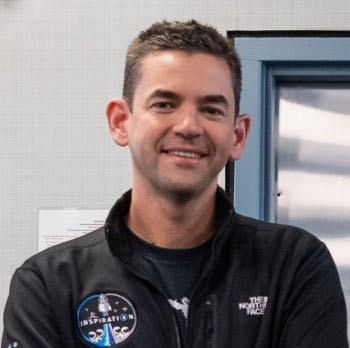
Jared Isaacman
Billionaire Jared Isaacman

Nothing that happened at yesterday’s Senate hearing of Jared Isaacman’s nomination to be NASA’s next administrator was a surprise, or very significant, even if most media reports attempted to imply what happened had some importance. Here are just a small sampling:

To be fair, all of these reports focused on simply reporting what happened during the hearing, and the headlines above actually provide a good summary. Isaacman committed to the Artemis program, touted SLS and Orion as the fastest way to get Americans back to the Moon ahead of the Chinese, and dotted all the “i”s and crossed all the “t”s required to convince the senators he will continue the pork projects they so dearly love. He also dodged efforts by several partisan Democrats to imply Isaacman’s past business dealings with Musk and SpaceX posed some sort of conflict of interest.

What none of the news reports did — and I am going to do now — is take a deeper look. Did anything Isaacman promise in connection with NASA and its Artemis program mean anything in the long run? Is the race to get back to the Moon ahead of China of any importance?

I say without fear that all of this is blather, and means nothing in the long run. The American space program is no longer being run by NASA, and all of NASA’s present plans with Artemis, using SLS, Orion, and the Lunar Gateway station, are ephemeral, transitory, and will by history be seen as inconsequential by future space historians.
» Read more

16 comments

The orbital propulsion module for India’s Chandrayaan-3 lunar lander drifts back into lunar orbit

When India’s Chandrayaan-3 spacecraft arrived in lunar orbit in August 2023, it separated into three units, the lander, a lunar orbiter, and a propulsion unit used to get everything to the Moon.

While the Vikram lander successfully touched down several hundred miles from the Moon’s south pole and the Chandrayaan-3 orbiter continues to make observations of the Moon, in October 2023 engineers had the propulsion module do a burn that sent it out of lunar orbit and into an Earth orbit that was close to one of the Lagrange points where the gravity of the Earth and Moon are balanced.

Now, three years later, that module has drifted back into lunar orbit, where it has since done two close fly-bys of the surface.

This intricate orbital dance culminated when the module once again entered the Moon’s SOI [sphere of influence] on November 4, 2025, an event marking the transition where lunar gravity dominates its motion.

The first recorded lunar flyby occurred on November 6, 2025, at a distance of 3,740 km from the lunar surface, though it was outside the Indian Deep Space Network’s (IDSN) visibility range. A second, closely monitored flyby took place on November 11, 2025, bringing the module within 4,537 km of the Moon and well within observation capabilities.

These events noticeably altered the satellite’s orbital parameters, expanding its orbit size from 100,000 x 300,000 km to a massive 409,000 x 727,000 km and shifting its inclination from 34° to 22°.

It is not clear what happens next. Having this module in lunar orbit could be an issue for present and later orbiters, as no orbit around the Moon can ever be stable. At some point India’s space agency ISRO needs to properly dispose of this unit, either by sending into the Moon or out of the Moon-Earth system entirely. I am of course assuming it has the fuel to do so.

2 comments

Space energy startup Star Catcher successfully tests power beaming using lasers

StarCatcher laser transmitting to solar panel
StarCatcher laser transmitting power during Florida tests.

Space energy startup Star Catcher last week successfully completed a demonstration in Florida of its power beaming technology, transmitting energy using lasers to off-the-shelf solar panels used by satellites and spacecraft.

Using an advanced suite of multi-wavelength lasers, the team delivered more than 1.1 kW of electrical power to commercial off-the-shelf solar panels at Space Florida’s Launch and Landing Facility. … During the demonstration, Star Catcher delivered one to ten Suns of optical energy to multiple commercial off-the-shelf single- and triple-junction solar panels commonly used in space, confirming compatibility with standard spacecraft hardware, and validating the company’s approach to “supercharge” satellites with significantly more power via highly concentrated beams of light. Among them was an Astro Digital triple-junction solar panel — the same hardware used on the company’s flight-proven satellite buses — demonstrating readiness to power customer missions in orbit.

Star Catcher also delivered power to several customer payloads representing key market segments such as space data centers, in-space manufacturing, and remote sensing. The systems operated on beamed power as customers conducted live experiments, demonstrating both hardware compatibility and strong interest in this emerging power infrastructure.

Among the demonstrations, Star Catcher wirelessly transmitted energy to Intuitive Machines’ Lunar Terrain Vehicle (LTV) and recharged its onboard batteries.

The company plans to fly an orbital power-beaming demonstration satellite next year. If successful, it will try to raise the investment capital to launch power-beaming satellites in both Earth and lunar orbits by 2030, where they can more efficiently provide power. It already has signed six preliminary agreements with a variety of space-based companies such as Intuitive Machines. In the case of rovers like Intuitive Machines LTV, this technology will be an excellent way to charge batteries in the permanently shadowed craters on the Moon, where direct sunlight will not be available.

Hat tip to BtB’s stringer Jay.

4 comments

China will launch its upgraded manned Mengzhou-1 capsule in 2026

Mengzhou as of 2023
Mengzhou mock-up from 2023. Click for source.

China this week revealed that it plans the first flight of its new larger Mengzhou-1 manned capsule next year, launching from its coastal Wengchang spaceport on its new Long March 10 rocket.

Mengzhou features a modular design consisting of a return capsule and a service capsule and will operate as the primary link between Earth and the space station.

The first flight of Mengzhou-1 will utilize the Long March-10A rocket from the Wenchang Space Launch Site in Hainan, targeting a docking with the space station’s core module radial port. This debut mission will validate the craft’s systems while transporting environmental monitoring devices, technical payloads, astronaut supplies, and experimental gear for science and technology demonstrations.

Both capsule and rocket are intended as China’s future mainstays for its manned program, both in Earth orbit and beyond. Mengzhou is intended as the manned capsule that will get its astronauts to lunar orbit, where its Lanyue lunar lander will take them to and from the surface. Both will be launched separately by the Long March 10 rocket.

Long March 10 has been in development since 2017, and will have the ability to place 70 tons in low Earth orbit and 27 tons to lunar orbit. It is thus comparable to SLS, but costing far less with its first stage incorporating recovery and reuse. It will also be capable of launching much more frequently and at a much faster pace.

5 comments

Two former NASA administrators express wildly different opinions on NASA’s Artemis lunar program

At a symposium yesterday in Alabama, former NASA administrators Charles Bolden and Jim Bridenstine expressed strong opinions about the state of NASA’s Artemis lunar program and the chances of it getting humans back to Moon before the end of Trump’s term in office and before China.

What was surprising was how different those opinions were, and who said what. Strangely, the two men took positions that appeared to be fundamentally different than the presidents they represented.

Charles Bolden
Charles Bolden

Charles Bolden was administrator during Barack Obama’s presidency. Though that administration supported the transition to capitalism, it also was generally unenthusiastic about space exploration. Obama tasked Bolden with making NASA a Muslim outreach program, and in proposing a new goal for NASA he picked going to an asteroid, something no one in NASA or the space industry thought sensible. Not surprisingly, it never happened.

Bolden’s comments about Artemis however was surprisingly in line with what I have been proposing since December 2024, de-emphasize any effort to get back to the Moon and instead work to build up a thriving and very robust competitive space industry in low Earth orbit:

Duffy’s current messaging is insisting it’ll be accomplished before Trump’s term ends in January 2029, but Bolden isn’t buying it. “We cannot make it if we say we’ve got to do it by the end of the term or we’re going to do it before the Chinese. That doesn’t help industry.

Instead the focus needs to be on what we’re trying to accomplish. “We may not make it by 2030, but that’s okay with me as long as we get there in 2031 better than they are with what they have. That’s what’s most important. That we live up to what we said we were going to do and we deliver for the rest of the world. Because the Chinese are not going to bring the rest of the world with them to the Moon. They don’t operate that way.” [emphasis mine]

In other words, the federal government should focus on helping that space industry grow, because a vibrant space industry will make colonizing the Moon and Mars far easier. And forget about fake deadlines. They don’t happen, and only act to distort what you are trying to accomplish.

Meanwhile, Jim Bridenstine, NASA administrator during Trump’s first term, continued to lambast SpaceX’s Starship lunar lander contract, saying it wasn’t getting the job done on time, and in order to beat the Chinese he demanded instead that the government begin a big government-controlled project to build a lander instead.
» Read more

25 comments

SpaceX: Starship will be going to the Moon, with or without NASA

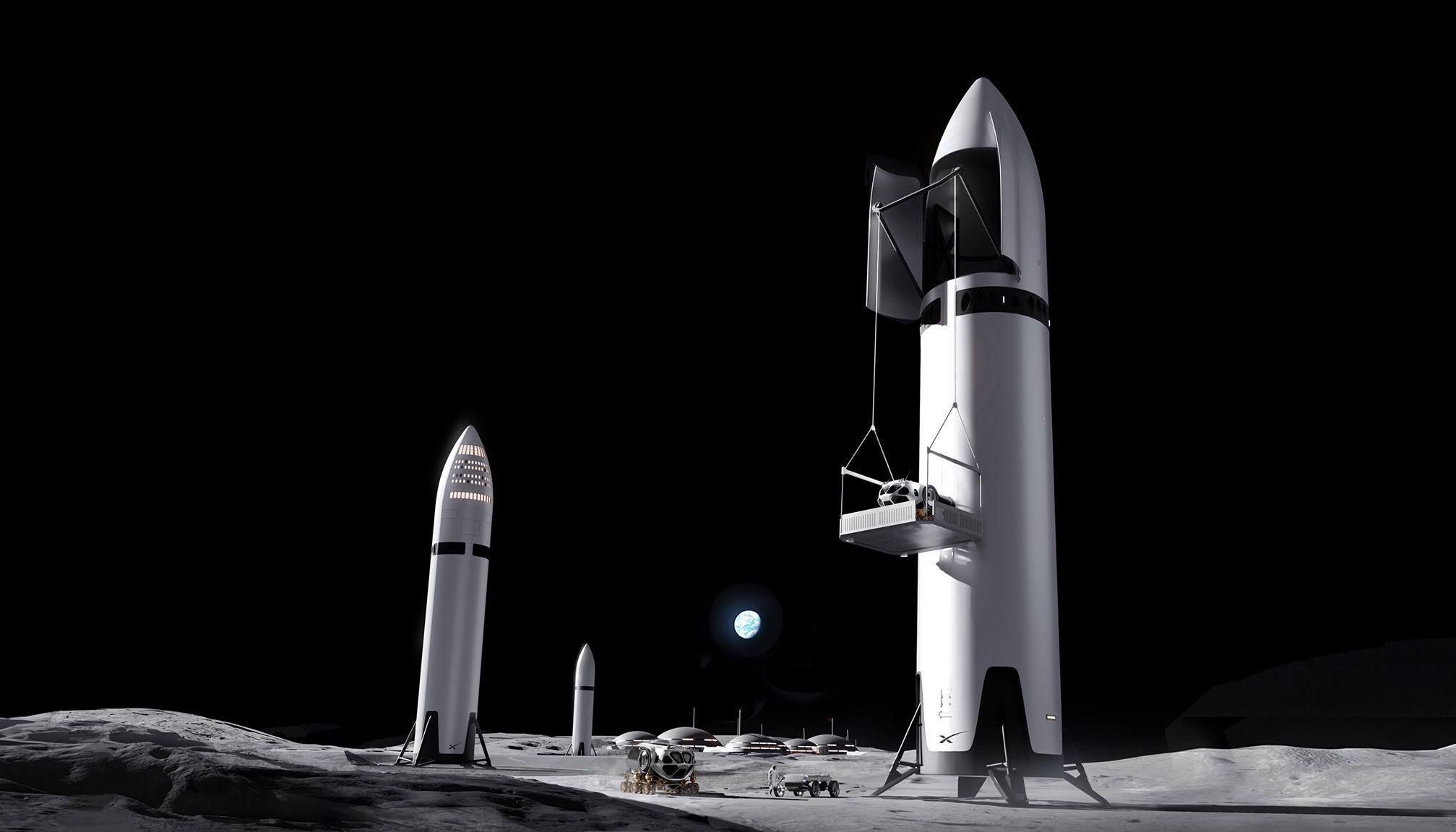
Artist's rending of Starships on the Moon
SpaceX’s artist’s rending of Starships on the Moon.
Click for original.

In what appears to be a direct response to the claim by NASA’s interim administrator Sean Duffy that SpaceX is “behind” in developing a manned lunar lander version of Starship, SpaceX today posted a detailed update of the status that project, noting pointedly the following in the update’s conclusion:

NASA selected Starship in 2021 to serve as the lander for the Artemis III mission and return humans to the Moon for the first time since Apollo. That selection was made through fair and open competition which determined that SpaceX’s bid utilizing Starship had the highest technical and management ratings while being the lowest cost by a wide margin. This was followed by a second selection [Blue Origin’s Blue Moon lander] to serve as the lander for Artemis IV, moving beyond initial demonstrations to lay the groundwork that will ensure that humanity’s return to the Moon is permanent.

Starship continues to simultaneously be the fastest path to returning humans to the surface of the Moon and a core enabler of the Artemis program’s goal to establish a permanent, sustainable presence on the lunar surface. SpaceX shares the goal of returning to the Moon as expeditiously as possible, approaching the mission with the same alacrity and commitment that returned human spaceflight capability to America under NASA’s Commercial Crew program.

The update then provides a list of the testing and engineering work that SpaceX has been doing on the Starship lunar lander, including full scale drop tests simulating lunar gravity, qualification of the docking ports, and the construction of a full scale mock-up of the Starship cabin to test its systems.

A close list of the work done is actually not that impressive, but at the same time this is not surprising. SpaceX is now mostly focused on getting Starship into orbit, proving it can be refueled there, and proving it can fly for long enough to get to the Moon. This part of the update was most exciting, as it confirms what I have suspected for next year’s flight program:
» Read more

52 comments

A slew of propaganda today from China’s state-run press attempts to hide the delays in its manned lunar program

The Tiangong-3 station, as presently configured

Generally China’s state-run news agency Xinhua posts no more than one to two short space-related articles per day, with most confined to simply announcing the launch of a rocket.

Today however that state-run agency posted a dozen short articles, linked it appeared to the two press conferences held in connection with tomorrow’s launch of a new crew to China’s Tiangong-3 space station.

The list above is not complete, leaving out a few other short propaganda pieces. Some of these stories — such as those directly related to that new crew launch tomorrow — could have easily been folded into one report. They were not, however, in order to create a large number of separate reports, which in turn hides the fact that there is only one news outlet reporting anything from those two press conferences.

Out of this plethora of stories, two news items stand out however. One, China has now agreed to fly a Pakistani to Tiangong-3. Negotiations for that mission began in 2018. Training has now finally begun. China is also moving forward on flying astronauts from Hong Kong and Macao, two places formally run by western powers that China now controls, quite oppressively. Like the Soviet Union, it is using its space program for propaganda stunts to distract those regions from its iron rule.

Second and more important, Chinese officials claim their program to do a manned lunar landing is still on schedule for a 2030 launch.
» Read more

2 comments

Blue Origin officials provide update on their lunar lander program

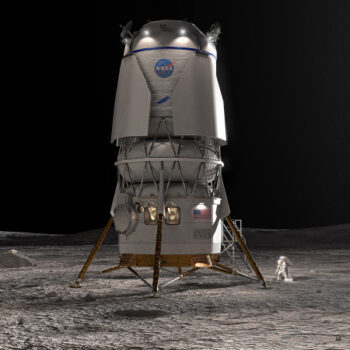
2023 artist rendering of the manned Blue Moon lander

Link here. According to the article, the company is presently stacking its first unmanned version of its Blue Moon lander, dubbed Blue Moon Mark 1, scheduled for launch now next year.

The 8.1-meter-tall cargo lander will help with ongoing development of their crewed lander, named Blue Moon Mk. 2, which is 15.3 meters tall. Both are powered by Blue Origin’s BE-7 engines, which are being tested on stands in Alabama, Texas and Washington.

…“A big milestone for you to look out for online is that Mk. 1 is three modules that are being stacked as we speak: aft, forward and mid. And once it is stacked in its finished configuration, we will be barging it over to NASA Johnson Space Center Chamber A to do a full up thermal vac campaign,” said [Jacqueline Cortese, Blue Origin’s Senior Director of Civil Space]. “So when you see that on its boat, you will know that big things are happening.”

Both versions of the lander are powered by a combination of liquid hydrogen and liquid oxygen. A key difference though is that Mk.1 can be launched to the Moon with a single launch of Blue Origin’s New Glenn rocket while Mk. 2 requires orbital refueling. [emphasis mine]

The highlighted sentence above is important because it illustrates the absurdity of the comments last week by interim NASA administrator Sean Duffy, claiming SpaceX’s program to make Starship a manned lunar lander is “behind”, forcing him to open up the competition to Blue Origin, who might get it done sooner.

One of the big issues used against SpaceX is that Starship will need to be refueled once in orbit to work as a lunar lander, and that technology needs to be developed and tested. The problem with this criticism is that, as noted above, Blue Origin’s manned lunar lander also needs to be refueled.
» Read more

11 comments

Ispace signs deals with companies in India and Japan

The Japanese lunar lander startup Ispace today announced it has signed partnership deals with two different companies, OrbitAid in India and Toyota in Japan.

The startup OrbitAid is India’s first “on-orbit refueling company”. It will provide Ispace’s landers with standardized docking ports as well as refueling capabilities.

The two companies aim to demonstrate the critical capabilities required for mission extension in the cislunar environment, enabling long-duration lunar operations and paving the way for a sustainable lunar economy. The integration of OrbitAID’s SIDRP interface is expected to not only optimize refueling, recharging, and data transmission capabilities but also support ispace’s efforts to enhance the performance and reliability of its landers. By enabling lunar refueling, both companies plan to facilitate deep-space exploration beyond Earth’s orbit.

Toyota meanwhile will provide technical support to Ispace as it develops its own second generation lunar rover, dubbed Lunar Cruiser. Ispace is already prepping a smaller rover that will fly on its next lunar landing mission.

Ispace has been signing on a range of customers and commercial partners in recent months, even though its only two attempts to land on the Moon both failed just before touch down. It has contracts with NASA, ESA, and JAXA for future missions. These new deals appear designed to strengthen and extend its capabilities beyond simply landing on the Moon, but also to provide interplanetary spacecraft as well.

0 comments

Astrobotic’s Griffin lunar lander delayed again

Moon's south pole, with landers indicated

According to an update on the status of Astrobotic’s Griffin lunar lander posted on October 24, 2025, the company has now delayed the launch from the fall of 2025 to July 2026, apparently because the spacecraft is not yet assembled and its many components are still undergoing testing.

For example, none of Griffin’s four propellant tanks have yet been installed. Nor apparently has its core structure been fully integrated, with “tanks, ramps, attitude control thrusters, and solar panels” only now having completed “fit checks.”

The map to the right indicates the location where Griffin is supposed to land, about 100 miles from the Moon’s south pole. Nova-C, Intuitive Machines first attempt to soft land on the Moon, landed at the green dot, but failed when it fell over at landing. Intuitive Machines second lunar lander, Athena, also fell over when it landed in the same region that is now Griffin’s target landing zone.

Griffin has experienced repeated delays since the contract was issued to Astrobotic in 2020. The mission was originally supposed to launch in November 2023, carrying NASA’s Viper rover. In July 2022 however it was delayed one year to November 2024 because Astrobotic said it needed more time.

Sometime after the failure of Astrobotic’s first lunar lander, Peregrine, in January 2024, NASA once again delayed the Griffin mission, pushing it back another year to November 2025.

In July 2024 NASA canceled Viper, removing it as a payload from Griffin, because Viper was significantly overbudget and would not be ready for that fall 2025 launch. NASA however did not cancel Griffin. It appears however that Astrobotic wasn’t ready either for a launch in November, and thus this further delay.

Whether it will be ready by July remains unknown. Based on Astrobotic’s own update I have serious doubts. For a spacecraft that was supposed to originally launch in 2023, Griffin seems woefully unready now, two years past that date.

2 comments

Duffy’s shiny object worked

Pay no attention to the man behind the curtain!

As expected, Elon Musk responded yesterday with anger and insults to the announcement by interim NASA administrator Sean Duffy that he will consider other manned lunar landers besides Starship for the first Artemis landing on the Moon.

And as expected, our brainless and generally uneducated propaganda press grabbed the shiny object that Duffy had put out with this announcement to focus entirely on the public spat. Here is just a sampling of the typical reports:

Not one of these articles reported the fact that Duffy’s announcement also included an admission that NASA is now delaying this manned Moon mission until 2028. Not one went into any depth as to why this program is delayed, if they discussed it at all. And any articles that did discuss the program’s overall slow pace, the focus was always entirely on SpaceX, as if its Starship program was the sole cause of all the problems. Essentially, they picked up Duffy’s talking points and ran with them, blindly. In fact, for almost all of these articles, it appeared as if the reporter was writing about NASA’s Artemis program for the first time, and really knew nothing about it.

Only the Ars Technica story attempted some thoughtful analysis, but it focused on the office politics of choosing NASA’s next administrator, missing entirely the fundamentals of this story, that the Artemis program is and has always been a mess, and that Duffy’s decision will do nothing to fix the problem.

Musk of course foolishly played into Duffy’s hands by reacting so violently, with insults, helping Duffy distract from the real issues. At the same time, Musk also spoke truth with this one tweet:
» Read more

25 comments

Fake blather from NASA administrator Sean Duffy to hide more Artemis delays

Sean Duffy
Sean Duffy: “Look at the shiny object!”

During a press interview yesterday, interim NASA administrator Sean Duffy revealed almost as an aside that NASA’s mid-2027 launch for the first Artemis manned lunar landing is no longer realistic, and that NASA is now targeting a 2028 launch date instead.

Duffy managed to hide this revelation by also announcing that he is re-opening the bidding for the manned lunar lander NASA will use on that third Artemis mission. To quote Duffy:

Now, SpaceX had the contract for Artemis III. By the way, I love SpaceX and it’s an amazing company, but the problem is, they are behind. They pushed their timelines out and we are in a race against China. The president and I want to get to the moon in this president’s term. So, I’m going to open up the contract and I’m going let other space companies compete with SpaceX, like Blue Origin. Whatever one gets us there first to the moon, we are going to take. If SpaceX is behind and Blue Origin can do it before them, good on Blue Origin.

By the way we might have two companies that can get us back to the Moon in 2028.

The propaganda press of course is going wild about this SpaceX announcement, making believe it signifies something of importance. “SpaceX is behind! Elon Musk can’t do it! Duffy is giving Jeff Bezos the job!” And as I think Duffy intended, everyone is ignoring the fact that NASA has now admitted it won’t meet that 2027 launch target.

The irony is that Duffy’s decision to re-open bidding on that manned mission is utterly meaningless. » Read more

34 comments

Orbital tug startup Impulse Space to develop its own unmanned lunar lander

Impulse's tug and proposed lunar lander
Click for original image.

The orbital tug startup Impulse Space, founded by Tom Mueller (one of SpaceX’s first engineers), is now proposing to build its own unmanned lunar lander, with a target for delivering six tons of cargo on two missions, starting in 2028.

Our proposed architecture combines our existing Helios kick stage and a new lunar lander, to be developed by our team in-house. Helios would launch on a standard medium- or heavy-lift rocket. Our lunar lander would ride as a payload on Helios. Once Helios and the lander are deployed in Low Earth Orbit (LEO), Helios serves as a cruise stage, transporting the lander to low lunar orbit within one week. The lunar lander then separates from Helios and descends to the surface of the Moon. By taking advantage of Helios’s high delta-v capabilities, this mission architecture doesn’t require in-space refueling.

This solution can bridge the existing cargo delivery gap by offering direct transportation of the necessary mass to kickstart infrastructure, resource utilization, and economic activities on the Moon. We’ve already begun engine development for our lunar lander solution, and we stand ready to execute as dictated by industry demand and interest.

With this Helios and Impulse-made lander combination, we estimate delivering up to 6 tons of payload mass to the Moon (across two missions) per year starting in 2028 at a cost-effective price point. Each Helios + lander combo would take approximately 3 tons of cargo to the Moon.

It appears the company has identified a need (transporting cargo to the Moon cheaply and quickly) that no one (including NASA) is presently considering. SpaceX will be able to do it with Starship. Blue Origin is also proposing to do it with various versions of its Blue Moon manned lander. Impulse has decided however that both of those spacecraft are too large and tied to SLS and Lunar Gateway, with Starship requiring refueling, that makes their cargo missions more costly than a direct mission. Impulse proposes a simpler option.

This decision is also another indication that the demand for low orbital tugs is not developing as expected. It appears satellite companies and the available rocket companies have worked out ways to get most of their satellites to the orbits they require without tugs.

It will be interesting to watch if this proposal gains traction. If it does, than it will likely encourage other orbital tug as well as the other lunar lander companies to propose their own alternatives.

0 comments

New study claims the giant impact that created the Moon’s South Pole-Aitken Basin was oblique, from the south

South Pole-Aitken Basin
Click for original. Blue indicates the basin, red
the “thorium-rich and iron-rich ejecta deposit”

While previous work had suggested the giant bolide that had created the Moon’s South Pole-Aitken Basin came in from the north, a new study now proposes that the impact was instead oblique from the south. From the paper’s abstract:

The ancient South Pole–Aitken impact basin provides a key data point for our understanding of the evolution of the Moon, as it formed during the earliest pre-Nectarian epoch of lunar history, excavated more deeply than any other known impact basin, and is found on the lunar far side, about which less is known than the well-explored near side. Here we show that the tapering of the basin outline and the more gradual topographic and crustal thickness transition towards the south support a southward impact trajectory, opposite of that commonly assumed. A broad thorium-rich and iron-rich ejecta deposit southwest of the basin is consistent with partial excavation of late-stage magma ocean liquids.

These observations indicate that thorium-rich magma ocean liquids persisted only beneath the southwestern half of the basin at the time of impact, matching predictions for the transition from a global magma ocean to a local enrichment of potassium, rare-earth elements and phosphorus (KREEP) in the near-side Procellarum KREEP Terrane.

In other words, when this impact occurred, part of the impact site in the south was still a magma ocean.

This result, if confirmed, has research implications for the missions targeting the Moon’s south pole. It suggests the geology will have that KREEP materials readily available, which will provide important information about the Moon’s early geological history.

1 comment

Two Japanese startups partner to fly the first private lunar sample return mission

Two Japanese startups, the lunar landing company Ispace and the orbital capsule startup ElevationSpace, have signed an agreement to develop the first private mission to bring samples back to Earth from the Moon.

Based on the agreement, Ispace and ElevationSpace will jointly pursue development to undertake a lunar return mission. Ispace has already demonstrated the technology to deploy a lander into lunar orbit through its two lunar missions operated in 2023 and 2025. The company is currently considering the development of an Orbital Transfer Vehicle (OTV), derived from its existing lunar lander development technology.

The collaboration aims to conduct a technology demonstration to verify the feasibility of missions utilizing an and the sample return re-entry capsule being developed by ElevationSpace, as well as to evaluate the overall system characteristics.

At the moment this project is only a PowerPoint proposal. Though Ispace has made two attempts to soft land an unmanned spacecraft on the Moon, neither was a success. It has three further contracts with NASA, ESA, and Japan’s space agency JAXA, but none has flown yet, and its orbital vehicle is only under development.

As for ElevationSpace, it has flown nothing yet as well. Its first demo satellite, designed to test re-entry and recovery, won’t fly until late next year, assuming its launch rocket, Isar’s new Spectrum, gets to orbit.

Nonetheless, this project illustrates the continuing shift to the private sector in space. The companies are doing this to demonstrate their capabilities in order to win contracts from both commercial and government customers.

1 comment

Blue Origin wins contract to bring NASA’s Viper rover to the Moon

NASA yesterday awarded Blue Origin a contract to use its Blue Moon lunar lander to transport the agency’s troubled Viper rover to the Moon’s south pole region.

The CLPS task order has a total potential value of $190 million. This is the second CLPS lunar delivery awarded to Blue Origin. Their first delivery – using their Blue Moon Mark 1 (MK1) robotic lander – is targeted for launch later this year to deliver NASA’s Stereo Cameras for Lunar-Plume Surface Studies and Laser Retroreflective Array payloads to the Moon’s South Pole region.

With this new award, Blue Origin will deliver VIPER to the lunar surface in late 2027, using a second Blue Moon MK1 lander, which is in production. NASA previously canceled the VIPER project and has since explored alternative approaches to achieve the agency’s goals of mapping potential off-planet resources, like water.

The contract does not guarantee this mission. NASA has several options along the way to shut things down, depending on the milestones Blue Origin achieves. The first of course is the success of that first lunar lander.

The announcement does not make clear how NASA is going to pay for the work needed to finish Viper. VIPER was originally budgeted at $250 million. When cancelled in 2024 its budget had ballooned to over $600 million, and that wasn’t enough to complete the rover for launch. Moreover, after getting eleven proposals from the private sector companies to finish and launch Viper, in May 2025 NASA canceled that solicitation.

It is very likely Blue Origin is picking up the tab, but if so the press release does not say so.

10 comments

Yesterday’s Senate hearing on Artemis: It’s all a game!

Ted Cruz, a typical
Ted Cruz, a typical Congressional porkmeister

The Senate hearing that was held yesterday, entitled “There’s a Bad Moon on the Rise: Why Congress and NASA Must Thwart China in the Space Race”, was clearly organized by Senator Ted Cruz (R-Texas) to promote a continuation of the SLS, Orion, and Lunar Gateway parts of NASA’s Artemis program. And he was able to do so because senators from both parties felt the same way. They all want to continue this pork, and don’t really care whether those expensive assets can really accomplish what they promise.

Furthermore, the hearing was also structured to allow these politicians to loudly proclaim their desire to beat China back to the Moon, using this pork. They want the U.S. first, but they are almost all want to do this through a government-run program.

As such, the choice of witnesses and the questions put to them were carefully orchestrated to push this narrative. To paraphrase: “We have to beat China to the Moon! And we have make sure a NASA program runs the effort! And above all, we mustn’t let Donald Trump cut any of NASA’s funding, anywhere!”

It was therefore not surprising that the most newsworthy quote from the hearing was the comments by former NASA administrator Jim Bridenstine about Starship and how its choice as a manned lunar lander was a bad one, and that it was likely going to the prime reason China will put humans back on the Moon ahead of us.
» Read more

43 comments

Jim Lovell, the world’s first space cadet, passes away at 97

Jim and Marilyn Lovell
Jim and Marilyn Lovell aboard the
U.S. Navy sailboat Freedom in 1950

Today we learned the sad news of the passing of Jim Lovell, the last of the three Apollo 8 astronauts as well as a veteran of two Gemini missions and the ill-fated Apollo 13 mission. Lovell was 97.

In a statement released Friday, the Lovell family highlighted his “amazing life and career accomplishments” and his “legendary leadership in pioneering human space flight.”

“But, to all of us, he was Dad, Granddad, and the Leader of our family. Most importantly, he was our Hero,” the family said in its statement. “We will miss his unshakeable optimism, his sense of humor, and the way he made each of us feel we could do the impossible. He was truly one of a kind.”

“One of a kind” is an understatement. » Read more

25 comments
1 2 3 4 5 57