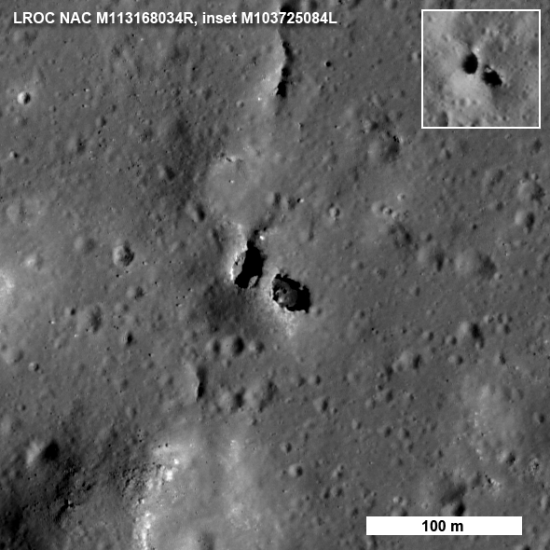
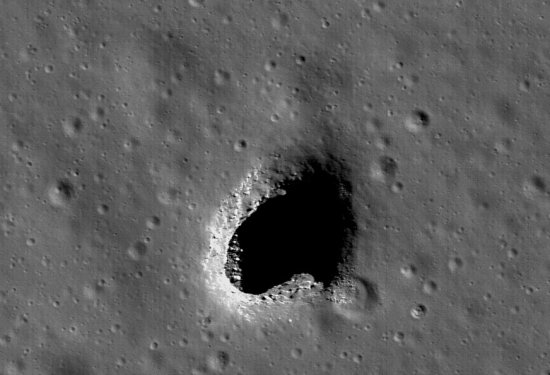
The Lunar Reconnaissance Orbiter has released another lunar cave image, this time showing a double pit entrance with a natural bridge between them. [Thanks to reader James Fincannon for the tip.]
From the caption: “The bridge is approximately 7 meters wide on top and perhaps 9 meters on the bottom side, and is a 20 meter walk for an astronaut to cross from one side to the other.”
India announced today the scientific instruments it plans for its second lunar probe, scheduled for launch in 2013. India is building the orbiter and Russia is building the lander/rover.
Using data from the Japanese lunar orbiter Kaguya, scientists have identified several locations near the Moon’s south pole that are in daylight from 86 to 94 percent of the time. Key quote from abstract:
The place receiving the most illumination (86% of the year) is located close to the rim of Shackleton crater at 88.74°S 124.5°E. However two other areas, less than 10 km apart from each other, are collectively lit for 94% of the year. We found that sites exist near the south pole that are continuously lit for several months during summer. We were also able to map the locations and durations of eclipse periods for these areas. Finally we analyzed the seasonal variations in lighting conditions, from summer to winter, for key areas near the south pole. We conclude that areas exist near the south pole that have illumination conditions that make them ideal candidates as future outpost sites. [emphasis mine]
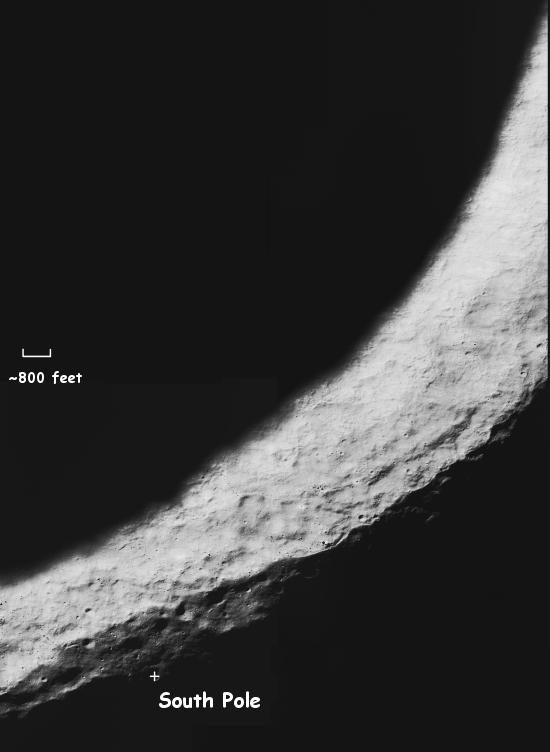
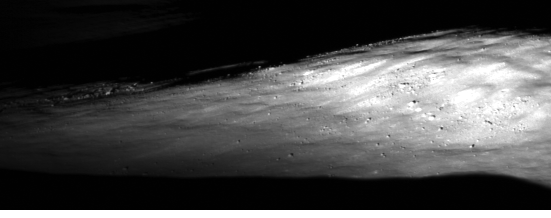
Below is a composite close-up image of the rim of Shackleten crator that I assembled using this Lunar Reconnaissance image. The key quote from the full caption :
The full [Narrow Angle Camera] mosaic reveals a shelf on the southeast flank of the crater that is more than two kilometers across and perfectly suitable for a future landing. The extreme Sun angle gives the surface an exaggerated rough appearance, but if you look closely at this scale any area that is between the small craters might make a good landing site.
Scientists studying Apollo lunar samples have found evidence that most of the Moon appears very dry, with no water at all. These results obviously contradict the recent findings of water in the craters near the lunar poles, and will require some explaining.
Two NASA probes, originally launched to study the Sun and having completed their mission, have had their orbits adjusted so that they can study the Moon instead.
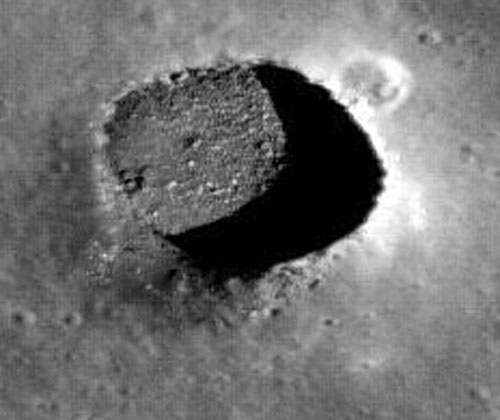
James Fincannon of NASA took the two images of the Marius Hills lunar pit taken at different times by Lunar Reconnaissance Orbiter (which I posted here) and did an overlay so that the shadow produced by pit’s rim could be easily compared with the rim itself (see below). He then did some calculations based on the sun’s angle of light shining into the cave and came up with the following calculations:
I estimate it is 60 meters from rim to bottom. The floor is flat below the surface. The rocks on the flat surface below ground are in stark relief (hard shadows) compared to above ground due to the sun coming only at one angle while above ground the albedo/reflections makes for soft shadows at this high sun angle (65 deg elevation). I cannot tell if the black portion of the combo image is a slope or more flat floor. Need a different high sun angle or azimuth to fill that in. Still I like the general pattern of the rim matching the shadow on the floor, although the image I found originally has that edge of the cave rim in shadow for a large extent.
A 60 meter drop is about 200 feet deep. This result is reasonably close to the depth estimated by Japanese scientists, 88 meters or 288 feet, based on images of the same lunar pit taken by their Kaguya probe.
Knowing the approximate depth of the entrance pit raises the much more important question: How will future lunar explorers to get to the bottom of this pit? It is ironic » Read more
On the subject of caves on the Moon, Paul Spudis has directed me to his very cogent October 2009 post for Air & Space magazine. Here he notes correctly that though lava tube caves on the Moon have value, they are unfortunately apparently not located in the best places for settlement.
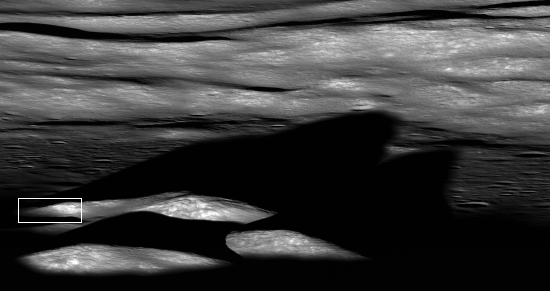
As the sun sets on Bhabha crater on the Moon’s farside, small boulders on the crater’s central peaks become visible in this Lunar Reconnaissance Orbiter image, with inset below. (It is very worthwhile to click on the link above and stroll through the full resolution image.) Scientists believe that the impact which created this crater excavated these boulders from deep within the Moon’s crust, thereby making them valuable tools for determining the geological history of the Moon. Of course, to use these tools requires the geologist to be there, something that might not happen for a while.
An evening pause: Since it is the anniversary of the Apollo 11 landing, let’s watch it as it happened on July 20, 1969. This footage, in a single continuous shot, shows the view out of the lunar module window, beginning when the spacecraft was approximately 40,000 feet above the lunar surface. The key quote as they drop to less than 100 feet off the surface is a voice that first says “60 seconds,” than later “30 seconds.” This is astronaut Charlie Duke, the capsule communicator (capcom) in mission control, telling Neil Armstrong exactly how much time he has left before running out of fuel. Despite these warnings, Armstrong took a careful, almost deliberate look at the surface, realized they were heading for a crater and decided he needed to reposition the landing site. As a result he used almost all the fuel in his tanks, which had people in mission control going nuts as they watched.
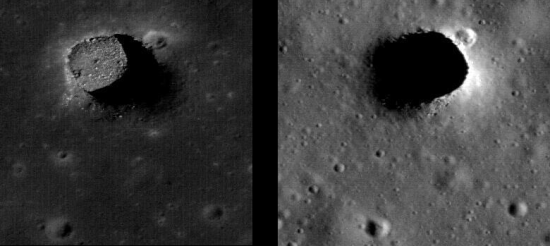
James Fincannon of NASA has forwarded me two additional pictures of the same cave on the Moon, taken recently at different times by the camera on Lunar Reconnaissance Orbiter and made available by the Goddard Space Flight Center and Arizona State University.
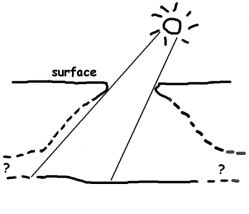
These images clearly show that the skylight looks down into a much larger space, with the underground room belling out from the skylight in all directions. This can be seen by how the angle of sunlight hitting the floor of the cave changes over time. Below is a very crude cartoon I have drawn to illustrate what I think we are seeing in the image on the left. The dashed lines indicate unseen walls whose precise location is not yet determined.
James also forwarded me this link, showing even more images of additional lava tube skylights on the Moon.
The third annual Lunar Science Forum is being held July 20-22 at the Ames Research Center in California. The list of papers, some of which are quite intriguing, can be found here. Fun quote from one abstract: “Purity levels of the ice suggest a degree of comingling of ice and regolith grains within the permanently shadowed crater.”