
The north pole of Mars in summer
The north pole of Mars in summer: the dry ice is gone, leaving an icecap of water only.
The north pole of Mars in summer: the dry ice is gone, leaving an icecap of water only.
Don’t you feel safer now? The TSA screener in Denver decided a pregnant woman’s insulin and ice packs were a threat and confiscated them.
She asked 7NEWS not to use her name for fear of retaliation for speaking out. “I got a bottle of nail polish. I got hair spray bottles. I got needles that are syringes. But yet I can’t take through my actual insulin?” she asked. [emphasis mine]
Stand by for space weather: three coronal mass ejections were released by the sun in the past few days and are aimed directly at the earth. The first hit tonight, without doing much damage.
Though it is important to prepare for these solar storms, don’t expect them to do much harm. Power companies use the warnings to protect their grids. What you can expect is an increased chance of seeing the aurora at lower latitudes.
A truck 400 feet long with 192 wheels crosses California to Utah.
An evening pause: This lovely and poignant scene from the 1945 film, A Bell for Adano, showcases the superb acting of Gene Tierney and John Hodiak. He is an American commander of Italian descent put in charge of an Italian village now under U.S. rule near the end of World War II. She is a local Italian girl longing to find her sweetheart who went off to fight for Italy and is now missing.
The movie was based on a short but profound book by John Hersey. And what I remember most from that book is this speech by the Hodiak character in trying to explain to the Italians the right way for government officials to act:
» Read more
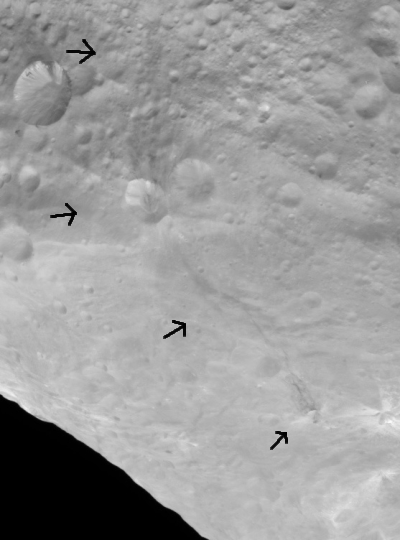
The Dawn mission team released another image today of the giant asteroid Vesta, this time taken from about 2,300 miles away. At this distance the resolution is still somewhat coarse, with the smallest visible detail about 0.43 miles in size.
To the right is a cropped section of the full image, focusing in on what appears to be a very strange geological feature, indicated by the arrows. From what I can tell, the dark meandering streak looks like a rille or flow coming out of the mound or peak near the bottom of the image. Yet, this dark meander continues directly across a crater as if it were a wind-blown dust streak.
I really have no idea what geological process created this. I also suspect that the scientists don’t quite know yet either, though I am sure they have some good theories, mostly based on the very light gravity that should exist on a world only 330 miles in diameter. As I’ve already noted, however, it is going to take them a couple of months to digest the data they are getting and come up with some reasonable conclusions. It will be fun to finally find out what they have learned.

More evidence that there are active flows of water on Mars.
Dark, finger-like features appear and extend down some Martian slopes during late spring through summer, fade in winter, and return during the next spring. Repeated observations have tracked the seasonal changes in these recurring features on several steep slopes in the middle latitudes of Mars’ southern hemisphere.
Though there are a number of unsolved issues about these features, the best explanation appears to be a liquid brine.
Saltiness lowers the freezing temperature of water. Sites with active flows get warm enough, even in the shallow subsurface, to sustain liquid water that is about as salty as Earth’s oceans, while pure water would freeze at the observed temperatures.
Go here to see the full image.
Boeing has now officially chosen the Atlas 5 rocket to launch is manned capsule.
A new Rasmussen poll finds that 69% of the public now believe that climate scientists falsified data to support their own theories about global warming. Moreover, these numbers are up ten points since December 2009, which happens to be just after the climategate emails were released.
These terrible numbers are further evidence that the willingness of the scientific community to whitewash their investigations of the climategate scientists, what I consider to be the equivalent of a community-wide cover-up, has done serious harm to science and its reputation.
» Read more
The government war on kid-run businesses. With a map.
Repeal it: Five insurers have announced they are canceling their healthcare coverage in Indiana due to Obamacare regulations. The reason?
Aetna was leaving the Indiana individual market over a rule in the federal health care overhaul that insurers essentially must dedicate 80 percent of the premiums they collect to medical care. Anything less than 80 percent would be paid as rebates to policyholders the following year.
In other words, Obamacare tries to legislate the percentage of overhead a company spends, something that in the real world is simply impractical. Under this kind of regulation, every private company will eventually go out of business, leaving us stuck with a nationalized healthcare system run by our government.
And we all can see how efficiently the government runs things, right? Imagine a visit to the doctors’ office being like going to the motor vehicle administration.
New research on the influence of a large moon to a habitable planet.
Gun groups to sue over new Obama gun regulations in the southwest border states.
Two Russians have completed a spacewalk today at ISS. They not only prepared the station for future Russian upgrades, they released an amateur radio microsat.
Cost issues might force Europe to downsize its 2016 Mars mission.
An evening pause: Dirt biking in southern Utah.
Did the Earth once have two moons?
Both satellites would have formed from debris that was ejected when a Mars-size protoplanet smacked into Earth late in its formation period. Whereas traditional theory states that the infant Moon rapidly swept up any rivals or gravitationally ejected them into interstellar space, the new theory suggests that one body survived, parked in a gravitationally stable point in the Earth–Moon system.
This new model also posits that the two moons eventually collided, producing the moon we have today.
The future of American medicine: Israeli doctors protested their socialized working conditions last week, closing clinics and delaying treatment in emergency rooms.
The Atlas 5 is the rocket that Boeing, Blue Origin, and Sierra Nevada plan to use to get astronauts into orbit.
