The red cliffs of Mars

Red cliffs on Mars

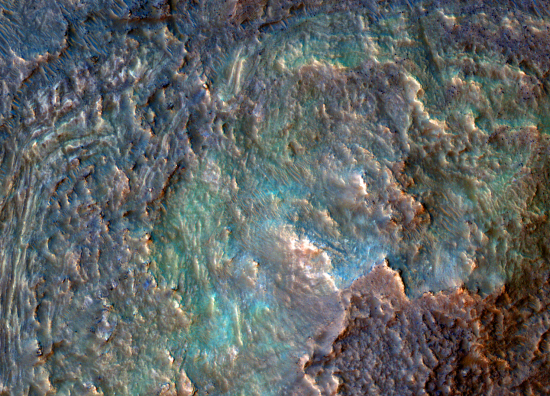
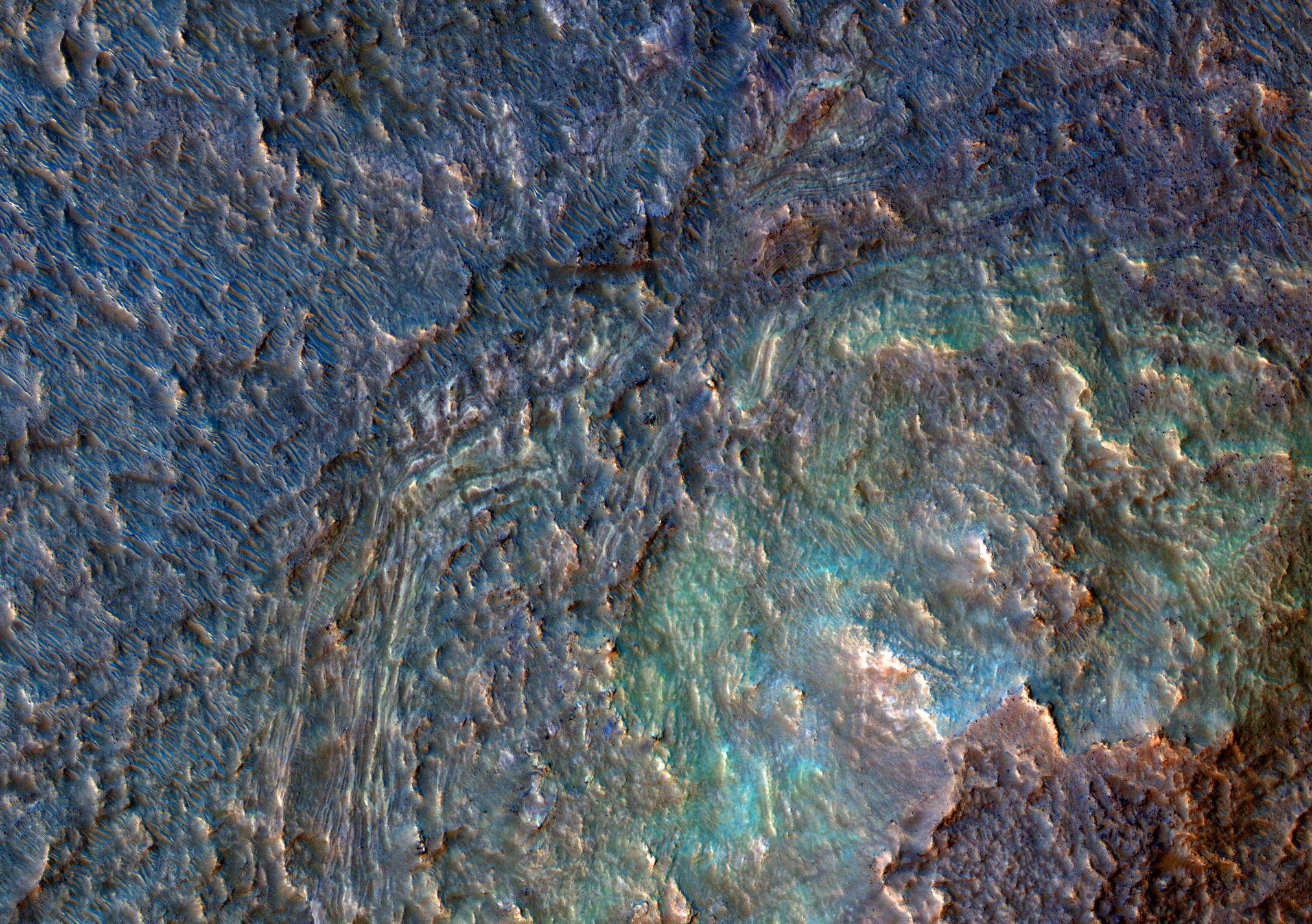
Last week the Mars Reconnaissance Orbiter team released this beautiful image of what they call “layered yardangs” on Mars.

What creates these sharp ridges? This layered terrain has been sculpted by the wind. The aligned ridges are called yardangs, which are formed in areas where the dominant erosional force is the wind. Yardangs are also found on Earth, usually in very dry areas.

What I see are majestic red cliffs rising out of a aqua-colored sand desert. What a place to visit!

0 comments

Test flights of SpaceShipTwo resume

After a summer break, the flight tests of SpaceShipTwo have resumed. Thursday’s test appeared to a bit more exciting that previous flights:

Test card called for releasing the Spaceship from WhiteKnightTwo and immediately entering a rapid descent. Upon release, the Spaceship experienced a downward pitch rate that caused a stall of the tails. The crew followed procedure, selecting the feather mode to revert to a benign condition. The crew then defeathered and had a nominal return to base. Great flying by the team and good demo of feather system.

0 comments

Scientist proposes that the superluminal neutrinos are merely measuring the true speed of light

On Thursday physicist Susan Gardner of the University of Kentucky proposed in a preprint on the Los Alamos astro-ph website that the neutrinos measured at CERN that appeared to be going faster than light were merely giving us a much more accurate measure of the speed of light.

This is only one of a plethora of papers published this last week on astro-ph discussing and attacking the CERN neutrino results. I expect the scientists will solve this mystery before too long.

0 comments

Arctic ozone loss at record level

The ozone levels over the Arctic this past year were the lowest on record, caused by unusually cold temperatures.

No records for low temperature were set this year, but the air remained at its coldest for an unusually long period of time, and covered an unusually large area. In addition, the polar vortex was stronger than usual. Here, winds circulate around the edge of the Arctic region, somewhat isolating it from the main world weather systems.

“Why [all this] occurred will take years of detailed study,” said Dr. [Michelle] Santee [from NASA’s Jet Propulsion Laboratory]. “It was continuously cold from December through April, and that has never happened before in the Arctic in the instrumental record.”

0 comments

Santa Catalina Mountains – hike to Romero Pools

An evening pause: A hike to Romero Pools in the Santa Catalina Mountains just outside Tucson, Arizona. The hiker in the video calls this one of the toughest hikes he’s ever done, but it is only 5.6 miles round trip, with only a thousand foot elevation gain. Compared to most of the other Santa Catalina hikes, which routinely require elevation gains of 3000 to 5000 feet, this one is easy.

0 comments

Five myths about China’s space effort

Five myths about China’s space effort. Key recommendation:

Recognize the significance of space as a field of competition. Beijing is not engaged in a space race with Washington. But China is engaged in a great power competition with the U.S. in which space is one arena. American decision makers should come to terms with this duality. In this regard, the Chinese are unlikely to be manipulated by American proposals on β€œcodes of conduct” or meetings with the head of NASA. As long as Beijing and Washington are in competition, space will be one of the major venues.

And competition is not a bad thing. It is going to be the fuel that gets the human race into space.

2 comments
1 61 62 63 64 65 263