
Falcon Heavy static fire test delayed one day
SpaceX has rescheduled the launchpad static fire test of its first Falcon Heavy rocket 24 hours, with a test window beginning at 1 pm Eastern.
SpaceX has rescheduled the launchpad static fire test of its first Falcon Heavy rocket 24 hours, with a test window beginning at 1 pm Eastern.
The uncertainty of science: A survey of climate papers published in 2017 shows that 485 directly challenged the so-called “consensus” that activists claim exists about global warming.
Author Kenneth Richard found that during the course of the year 2017, at least 485 scientific papers were published that in some way questioned the supposed consensus regarding the perils of human CO2 emissions or the efficacy of climate models to predict the future.
According to Richard’s analysis, the 485 new papers underscore the “significant limitations and uncertainties inherent in our understanding of climate and climate changes,” which in turn suggests that climate science is not nearly as settled as media reports and some policymakers would have people believe.
This really is not a surprise for anyone who spends even a little time reading actual climate research. If you do, you immediately realize that the absurd claims of politicians (mostly Democrats) and activists about the certainty of human-caused global warming are based on their complete ignorance of the science. Some examples:
My point isn’t to say that human-caused global warming isn’t happening. We simply don’t know. The evidence so far is very inconclusive. And for those who advocate this theory, their own models have consistently failed to match the data. Skepticism is called for, which by the way is actually the hallmark of good science.
Capitalism in space: Arianespace yesterday announced that it has purchased the last ten Ariane 5 rockets as part of the company’s transition to its new Ariane 6 rocket in 2020.
These rockets appear to be for launches from 2020 to 2023, during a time period when they will be testing Ariane 6 and initiating its first operational flights.
Doug Messier today has written a sad summary of the status of the Google Lunar X-Prize, and it does appear that no one is going to meet the March 31, 2018 deadline.
The news yesterday that Team Indus failed to raise the cash to pay for its rocket launch appears to have killed both it and the Japanese competitor. Lack of funds also appear to have stopped the Israeli team. Meanwhile, delays in getting the rockets operational for Moon Express and Synergy Moon leave both stranded on the ground.
Just a quick note that I have just begun a 90 minute plus appearance on the Space Show. Check it out and feel free to call in to ask questions. Phone: 1-866-687-7223.
The podcast for this show can now be downloaded here.
An evening pause: I previously posted a biography of Robert Mitchum by this same filmographer. This one, about James Garner, is equally worth a viewing. And like the Mitchum biography, it shows how humble and ordinary a man Garner was.
Hat tip Willi Kusche.
The law is such an inconvenient thing: Texts between FBI agent Peter Strzok and FBI lawyer Lisa Page suggest they were trying to dig up dirt about the private life of at least one journalist, to use against him.
The two agents also spent extensive time shortly before the 2016 election trying to track down information — including an address and a spouse’s job — about The New York Times reporter Matt Apuzzo, who has reported on numerous developments in the Russia case.
“We got a list of kids with their parents’ names. How many Matt Apuzzo’s (sic) could there be in DC,” Page texted. “Showed J a picture, he said he thinks he has seen a guy who kinda looks like that, but always really schlubby. I said that sounds like every reporter I have ever seen.”
A minute later, Page added another text: “Found what I think might be their address, too.”
Strzok writes back, “He’s TOTALLY schlubby. Don’t you remember?”
Page responded later by saying she found information on the reporter’s wife too. “Found address looking for her. Lawyer.”
Strzok cautions Page against using the work phone to track down information on the reporter. “I wouldn’t search on your work phone, ,,, no idea what that might trigger,” he texted.
“Oops. Too late,” she responded back.
The article above is focused mostly on the texts that suggest these two Democratic Party operatives (who were also having an adulterous love affair at the time) were the source of many illegal news leaks, but I consider the quote above more significant. It clearly shows that they had no respect for the law or the First Amendment and were quite willing to abuse their power at the FBI. If anything proves they were willing to overthrown a legally elected president, this does.
Capitalism in space: SpaceX has raised its first Falcon Heavy rocket onto the launchpad in preparation for the static fire test required before the rocket can do its first launch.
SpaceX’s first Falcon Heavy rocket has been raised vertical at pad 39A for the second time in advance of a planned hold-down test-firing of its main engines tomorrow during a window that extends from 1-7 pm EST (1800-0000 GMT). Kennedy Space Center employees were told to expect an estimated 15-second firing.
Capitalism in space: Several large hotel chains are putting up new hotels in the Boca Chica area near SpaceX’s new spaceport, expressly because they are anticipating a tourist demand once launches begin.
None of this is a surprise. It is good news, nonetheless.
ULA has settled a lawsuit with a whistleblower who claimed the company had defrauded the federal government of at least $90 million by overbilling employee work hours.
Unlike the commercial marketplace where prices of goods and services are determined by market forces including competition, sellers in the aerospace industry face little or no competition and contract pricing is based largely on a contractor’s estimated costs, the lawsuit says.
ULA charged the government tens of millions of dollars for work that was never performed and inflated the estimated labor hours including the time required to buy parts and materials from vendors, the lawsuit says.
ULA retaliated against Scott [the whistleblower] by forcing him out of the company after he revealed the alleged illegal activities. ULA officials placed a camera above his desk, monitored and questioned his cell phone and computer use, and suggested he violated the law or engaged in improper bidding practices himself, the lawsuit says.
ULA used a system called the Keith Crohn model that creates a grid using the cost of equipment to reach an employee cost. A labor value was placed on the grid for every item ordered through the company’s purchasing department. For example, any item that cost between $1 and $1,000 would be assigned a labor value of 8 hours. It didn’t matter what part it was, the lawsuit said. The U.S. bans arbitrary cost estimates when actual data is available that establishes the cost.
The first paragraph of the quote above actually describes the bad deal that the Air Force made with ULA back in the early 2000s, giving the company a monopoly on launches while subsidizing it to the tune of $1 billion per year. That deal is now dead, and ULA is instead forced to compete with SpaceX (and soon others I hope) for launch contracts. Not surprisingly, their prices have dropped considerably.
The competition heats up: Arianespace officials told reporters today that it plans to complete 14 launches in 2018, which would be a record for the company.
For 2018, the company is targeting seven launches of the Ariane 5 model, four launches for the Soyuz model and three launches of the Vega satellite launcher.
Isn’t competition wonderful? SpaceX forces everyone to lower their launch prices, and instead of going out of business, which the old rocket companies were saying would happen for decades should they be forced to drop prices, everyone gets more customers, more business, and more profits. I am shocked, shocked!
Whether Arianespace can maintain this growth however is another story. As newer rocket companies, such as Blue Origin, come on line with even lower costs, I am not sure their more expensive rockets will survive.
Link here. The article provides a nice summary of all the reports on the SpaceX launch and its mysterious top secret payload Zuma, including outlining the various failure possibilities. The one scenario they do not mention, however, is that the failure story itself is entirely bogus, a misinformation campaign by the unknown government agency that launched it.
I have no idea what happened, though it still appears to me most likely that SpaceX’s rocket performed as contracted.
India’s competitor for the the Google Lunar X-Prize, Team Indus, has exited the competition because it could not raise the funds needed to buy a launch on an Indian PSLV rocket.
It is unclear how this will effect Japan’s team, Hakuto, which was going to fly on the same rocket, mounted to the Team Indus lander. I suspect that their effort is over as well.
An online pubic program designed to allow ordinary people to use their computers to identify previously unknown prime numbers has found the largest so far, 23 million digits long.
It was discovered on December 26, 2017 by electrical engineer Jonathan Pace, and it initially took six days of non-stop number crunching to show that it was indeed a prime number. Pace was using a consumer-level PC running an Intel i5-6600 processor, and after it was identified it was then independently verified by other users, with a range of other programs and hardware setups.
China completed its first launch of 2018, launching two civilian high resolution Earth observation satellites.
The launch standings in 2018 is presently a tie between SpaceX and China. I expect it to be a neck and neck race between both for the rest of the year.
The first six mirror segments of the European Southern Observatory’s Extremely Large Telescope have been successfully cast.
These segments will form parts of the ELT’s 39-metre main mirror, which will have 798 segments in total when completed. The ELT will be the largest optical telescope in the world when it sees first light in 2024.
The 39-metre-diameter primary mirror of ESO’s Extremely Large Telescope will be by far the largest ever made for an optical-infrared telescope. Such a giant is much too large to be made from a single piece of glass, so it will consist of 798 individual hexagonal segments, each measuring 1.4 metres across and about 5 centimetres thick. The segments will work together as a single huge mirror to collect tens of millions of times as much light as the human eye.
The segments must now be cooled, then their surfaces ground and polished to the right shape. If all goes right, they will make more than 900 segments (with about a 130 as spares), manufactured to have the telescope operational by 2024.
Capitalism in space: Blue Origin has released a short video showing a recently completed successful static fire test of its BE-4 rocket engine.
You can see the test here. The article above actually doesn’t provide much information about the engine’s testing program, other than claiming that the company is ramping up its testing.
An evening pause: Performed live in 1996.
Hat tip Edward Thelen.
Anonymous sources are suggesting that the top secret government payload that SpaceX successfully placed in orbit two days ago might have been lost.
Very little is presently known. Statements from SpaceX suggest that its Falcon 9 rocket worked perfectly, which would suggest the problems occurred after second stage separation. However, one source seems to suggest otherwise.
Until I get more information, I am therefore still counting this launch as a success for SpaceX.
The precipitous decline in sunspots continues. While November 2017 remains the most inactive month for sunspots since the middle of 2009, December was a very close second.
Below is my annotated version of NOAA’s monthly update of the solar cycle, covering sunspot activity for December, which they posted on Sunday.
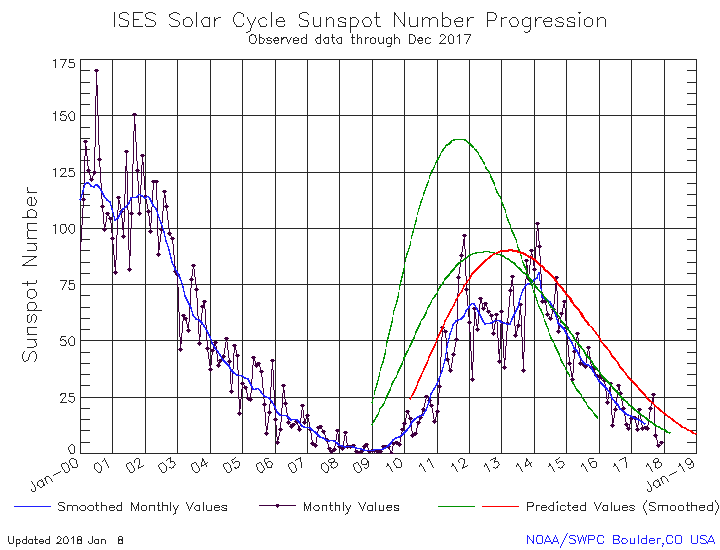
The graph above has been modified to show the predictions of the solar science community. The green curves show the community’s two original predictions from April 2007, with half the scientists predicting a very strong maximum and half predicting a weak one. The red curve is their revised May 2009 prediction.
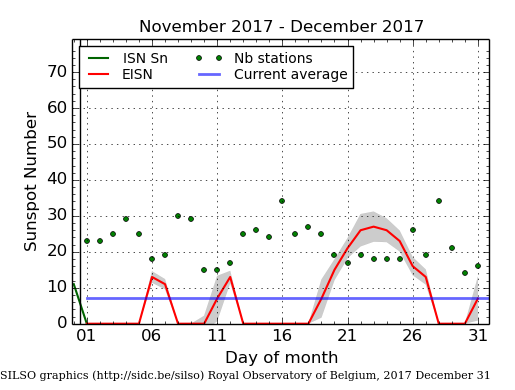
The graph on the right, produced by SILSO (Sunspot Index and Long-term Solar Observations) on December 31, shows only 14 days during the month when there were sunspots active on the Sun’s visible hemisphere. This is only four more days then seen in November. And like November, the few sunspots were weak, resulting in tiny sunspot numbers total.
The first graph above illustrates how weak this on-going sunspot cycle has been. While the curve most closely matches the 2007 weak prediction of half the solar science community, it has one very notable difference. The actual ramp up to solar maximum started two years later than predicted, even though it appears to be ending when that prediction expected. The result is a very very short solar cycle, something that has historically always been associated with very active and intense sunspot activity. Instead, this short cycle has only seen weak activity, generally below all the predictions.
All signs continue to point to an early arrival of solar minimum. They also suggest that the next maximum will also be weak, and might even not come at all, as some solar scientists have proposed. Instead, we might be heading toward another Grand Minimum, with no significant sunspots for decades.
So, is it cold outside right now? Well, that’s weather, not climate. Nonetheless, there is a lot of circumstantial evidence that few sunspots correspond with a cooling climate on Earth. (The last grand minimum occurred in the 1600s, during what was called the Little Ice Age.) There is even some preliminary evidence to suggest that cosmic rays might be a cause. (Watch the video at the end of this link.).
Whether any of this will happen however remains unknown. We will need to wait to find out.