
Update on Chang’e-4 and Yutu-2
Link here. The rover, Yutu-2, has entered a planned safe mode to protect it from the high temperatures of the lunar mid-day, while the lander, Chang’e-4 has been testing and deploying its instruments.
Link here. The rover, Yutu-2, has entered a planned safe mode to protect it from the high temperatures of the lunar mid-day, while the lander, Chang’e-4 has been testing and deploying its instruments.
Elon Musk has now confirmed that the first unmanned test flight of the manned Dragon capsule has been delayed, and is now scheduled for sometime next month.
SpaceX is about a month away from launching its first commercial crew mission, the company’s founder, Elon Musk, tweeted this weekend. This will be a demonstration flight, without humans on board.
Officially, NASA had been holding to a January 17 launch date, but that has become untenable due to ongoing work to resolve technical issues, two sources said, as well as the partial government shutdown. More than 90 percent of the space agency’s employees are presently furloughed during the shutdown, which is affecting the agency’s ability to make final approvals for the launch. Some key government officials are continuing to work on the program without pay.
As far as I can tell, the “technical issues” are bureaucratic maneuvers by NASA designed solely to delay the launch. The article makes a big deal about the risks of this first test flight, as if none of its systems have ever flown before. That is absurd, While Dragon has been significantly modified, this can hardly be called a first flight for this capsule or rocket.
I repeat: The launch will occur on a SpaceX launchpad, run entirely by SpaceX employees. The only time NASA employees need get involved is during the docking procedures, and right now those employees at mission control and on ISS have been deemed essential and are working. If Trump ordered it, this mission could fly, even during this partial government shutdown.
The private businesses that make their living from tourism at Yellowstone have picked up the tab for all services the National Park Service is no longer doing because of the the government shut down.
Xanterra Parks and Resorts, which runs the only hotels inside Yellowstone that remain open during the winter, is leading the effort to cover the $7,500 daily tab for keeping the roads plowed and the snowmobile trails groomed during the shutdown, according to NPR. Thirteen other private businesses that offer tours of the park are chipping in $300 a day to help cover that expense.
Meanwhile, Xanterra has some of its own employees assigned to clean park bathrooms during the shutdown, and snowmobile tour guides are packing their own toilet paper for customers to use.
These private businesses have a financial self-interest in keeping the park clean and functioning. And they also have an incentive to get the job done as efficiently as possible. In fact, they are demonstrating how little we need much of the park service.
I imagine similar things are occurring in many other national parks and forests. And if they are not, they should be. And those cases where their aren’t private businesses to pick up the slack, the local state governments should move in. They too have a financial incentive to keep these natural wonders open and unharmed.
They’re coming for you next: Portland State University has moved to punish one of its professor who participated in a project to uncover bad and corrupt leftwing scholarship in the social sciences by writing fake papers and getting them published.
Peter Boghossian, an assistant professor of philosophy at Portland State University in Oregon, led a trio of scholars last year who submitted what they called “intentionally broken” papers to leading publications on gender, race and sexuality. Several of the absurd pieces were published.
Now, Portland State has initiated disciplinary action against Mr. Boghossian for an alleged breach of the institution’s ethical guidelines.
…The punishment Portland State may impose on Mr. Boghossian was unclear Monday morning, and the university did not immediately respond to questions posed about its process.
It must be emphasized that the three academics who participated in this project loudly considered themselves leftwing and liberal. No matter. They did something that revealed the hollowness and dishonesty of the entire “race, gender, and sex” academic community. That must not be allowed.
An evening pause: Hat tip Danae.
The Transiting Exoplanet Surveying Satellite (TESS) has successful spotted its first exoplanets.
NASA’s Transiting Exoplanet Survey Satellite (TESS) has found three confirmed exoplanets, or worlds beyond our solar system, in its first three months of observations.
The mission’s sensitive cameras also captured 100 short-lived changes — most of them likely stellar outbursts — in the same region of the sky. They include six supernova explosions whose brightening light was recorded by TESS even before the outbursts were discovered by ground-based telescopes.
These discoveries confirm that the spacecraft is operating exactly as designed. Now comes the herculean task of analyzing the gigantic amount of data it is pouring down to see what is hidden there.

Cool image time! The image on the right, rotated, cropped, and reduced to post here, comes from the December image release of the high resolution camera of Mars Reconnaissance Orbiter (MRO. Uncaptioned, the release titles this image “Cracks in Crater Deposit in Acheron Fossae.” If you click on the image you can see the entire photograph at full resolution.
Clearly the cracks appear to be caused by a downward slumping to the north, almost like a glacier made of mud. We can also see places on the image’s right edge where the mud appears to have flowed off a north-south trending ridge, then flowed downhill to the north. All of this flow is away from the crater’s central peak, which is only partly seen in the photograph near the bottom. That section is the central peak’s southwestern end, with the whole peak a ridge curving to the northeast beyond the edge of the image.
At the north edge of this mud flow the cracks become wider canyons, as if long term erosion is slowing washing the mud away. The flow then stair steps downward in a series of parallel benches. Meanwhile, in the flat central area of the mud flow above can be seen oblong depressions suggesting sinks that also flow to the north.
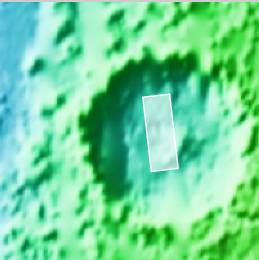
You can get a better idea of the crater’s overall floor and central peak by the low resolution context image to the right. The white rectangular box indicates the area covered by the full image above. A close look at this part of the crater floor suggests to me a circular feature like a faint eroded smaller crater that includes as its eastern rim the larger crater’s central peak. This impression suggests that the flows seen in the full resolution image are heading downhill into the lowest point of this smaller crater, that upon impact had reshaped the larger crater’s floor.
This impression however is far from conclusive. The features in the large crater could simply be the random geology that often occurs in the floors of impact craters.
What makes this particular mud slide most interesting, as is usually the case for most Martian terrain, is its location.
» Read more
Embedded below the fold in two parts
» Read more
Time for the monthly solar cycle update! NOAA today posted its monthly update of the solar cycle, covering sunspot activity for December 2018. As I do every month, I am posting it below, annotated to give it some context.
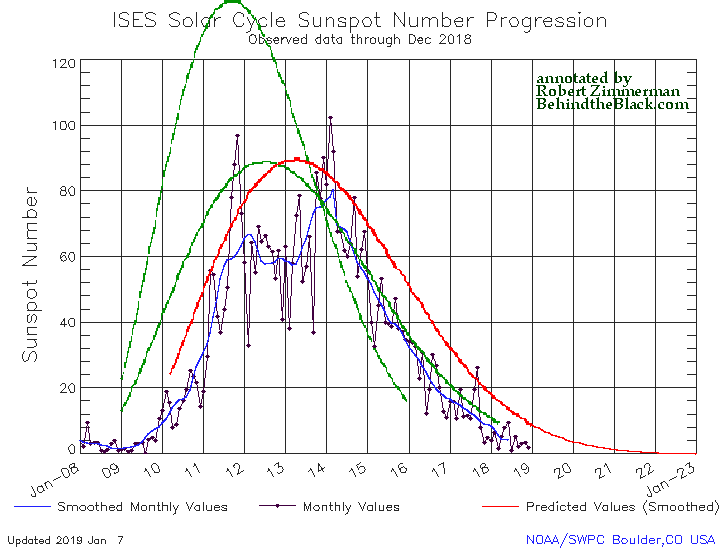
The graph above has been modified to show the predictions of the solar science community. The green curves show the community’s two original predictions from April 2007, with half the scientists predicting a very strong maximum and half predicting a weak one. The red curve is their revised May 2009 prediction.
There really isn’t much to say about the sunspot activity in December. It continued to show a steady decline to solar minimum, exhibiting activity very comparable to what we saw in mid-2008 when the previous unusually long and extended solar minimum began.
One interested detail however: When NOAA issued this graph last month, it finally extended it out beyond the end of 2019 to the end of 2022. In doing so, it also extended out the 2009 prediction of the solar science community, as indicated by the red curve. I hadn’t commented on this last month, but if you look at that curve it drops to zero and then flatlines for the entire year of 2022.
If this is what the solar science community now expects for this upcoming minimum, it means that community is now expecting a record-breaking minimum, lasting far longer than any previous minimum, two to three years at least. It also means that they have not dismissed the possibility that the Sun is about to enter a Grand Minimum, where no significant sunspot activity is seen for literally decades.
Should such a grand minimum occur, it bodes ill for global warming advocates. The track record of the Earth’s climate consistently shows that when sunspot activity declines, the global climate gets colder. Why this happens is not clearly understood, though there is at least one theory backed up by good experimental data. Should this happen, we shall discover that global cooling is a far worse thing to fear than global warming.
An evening pause: From the 1944 movie, Broadway Rhythm. It might be cheesy, but who cares.
Hat tip Phill Oltmann.
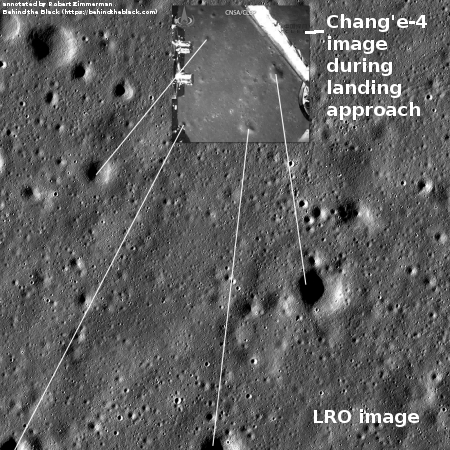
The Lunar Reconnaissance Orbiter (LRO) science team has released a high resolution image from 2010 pinpointing the area on the floor of Von Kármán crater where Chang’e-4 landed. On the right is a reduced and partly annotated version.
They have not actually found the lander/rover, since this image was taken long ago before Chang’e-4 arrived. However, this image, combined with the Chang’e-4 landing approach image, tells us where the lander approximately landed. It also pinpoints where to look for it when LRO is next able to image this region, around the end of January.
By then, Yutu-2 will hopefully have traveled some distance from Chang’e-4, and LRO will be able to spot both on the surface.
The new colonial movement: China’s second lunar rover, Yutu-2, has rolled off of the Chang’e-4 lander and begun its roving.
Yutu will rove within Von Kármán craterand analyse the variations of composition of the lunar surface the Visible and Near-Infrared Imaging Spectrometer (VNIS), while also returning unprecedented images with a panchromatic camera.
The rover’s two offer science payloads, the Lunar Penetrating Radar (LPR) and Advanced Small Analyser for Neutrals (ASAN), the latter developed by the Swedish Institute of Space Physics in Kiruna, will provide insight into the lunar subsurface to a potential depths of hundreds of metres and the space environment and interactions with the surface respectively.