SpaceX rolls manned Dragon/Falcon 9 to launchpad

Capitalism in space: This week SpaceX rolled to the launchpad the stacked manned Dragon capsule and Falcon 9 rocket that will fly the first unmanned test flight no early than January 17, 2019.

it is understood that the rollout is a dry simulation and thus will not include any propellant. However, a static fire test including propellant load and a short burn of the first stage’s nine Merlin engines will occur at a later date.

While this week’s rollout and subsequent fit checks do not seem to have been impacted by the ongoing U.S. government shutdown, other aspects of the launch campaign will be delayed.

The launch is expected to slip past the latest official no-earlier than launch date of January 17th. Many aspects of the launch campaign require NASA oversight and thus cannot proceed without NASA’s approval. It is understood that each additional day of the government shutdown translates into about a one day delay with the launch.

The irony here is that there are really no NASA employees required for SpaceX to do the launch. It is occurring on their leased property using their equipment and their launch team. Only when the capsule arrives at ISS will NASA employees be required, and those slots have been deemed “essential” in this government shutdown and are still operating on ISS and at mission control in Houston.

If Trump ordered it, this flight could happen. SpaceX is clearly ready. It is only NASA and its bureaucracy that stands in the way.
9 comments

More results from New Horizons

Today’s press conference did not release any significantly new images. In fact, they did not provide much new information at all. They noted that based on the data obtained so far, they have confirmed that Ultima Thule has no moons closer than 100 miles, or further than 500 miles, but they have not yet gotten the data that looks in that gap.

They created a stereoscopic image using two images produced thirty minutes apart. This helps tell us where the bumps and depressions are on the surface, something that cannot be clearly determined from the first image because the sun was shining directly on it, producing no shadows. From this it appears that the smaller lobe has a very significant bump. More data from New Horizons will have to be downloaded to confirm this.

The reddish color of Ultima Thule places it in the center of a class of Kuiper Belt objects dubbed cold classical objects. This will help them better determine its make-up as more data arrives.

Overall, this press conference was mostly hype. They don’t yet have enough data from the spacecraft, and won’t have it for weeks. I’m therefore puzzled why they bothered today, unless they did it simply to keep the hype up about the mission so as to encourage funding to look for another object to fly past.

16 comments

2018 – One Of The Least Extreme Weather Years On Record

Link here. For the past half decade or so global warming activists both in and out of the climate science community have been pitching the idea, based on literally no evidence, that increased CO2 in the atmosphere would cause an increase in extreme weather events.

The article at the link illustrates how badly that prediction is turning out. In fact, it was clear five years ago that there was no trend visible in the amount of extreme weather events, and that lack of a trend has continued since.

The bottom line remains: The uncertainties in the field of climate science remain gigantic. Our knowledge of how the climate functions remains poor and somewhat limited. And any theory about the consequences of the increase in CO2 in the atmosphere remains tentative and unproven, at best.

Good science is based on cold-hearted skepticism and a recognition of the uncertainties in our knowledge. To be a good scientist you have to strive for intellectual honesty every moment of your life.

For the past two decades the climate science community has decided to abandon these fundamentals, and pushed hard instead to confirm the theory that a trace gas in the atmosphere (carbon dioxide) can cause significant global warming. And they have pushed this theory regardless of the facts. Sometimes they have even pushed this theory despite the facts. Sometimes they have even changed the facts to conform to the theory.

This corruption of scientific principle has harmed the reputation of science badly, and made future work in this field difficult, because much of the data that exists now has been tampered with in ways that make much of it untrustworthy.

Worse, it appears that this is all a terrible indicator of the corruption of our entire society. Everywhere I look, intellectual honesty has been abandoned. Instead, we have become a society of unruly children, picking petty twitter fights based on minor details we pick and choose at our convenience in order to prove our point. Thoughtful consideration of all the facts has become abandoned. And if you try to encourage it, you are called names and blackballed.

Under these circumstances, I do not see a civilized way to recover our society. It seems that very bad times must happen first. Whether we can then recover our civilization afterward remains an open question.

36 comments

Dust devil tracks on the Martian southern highlands

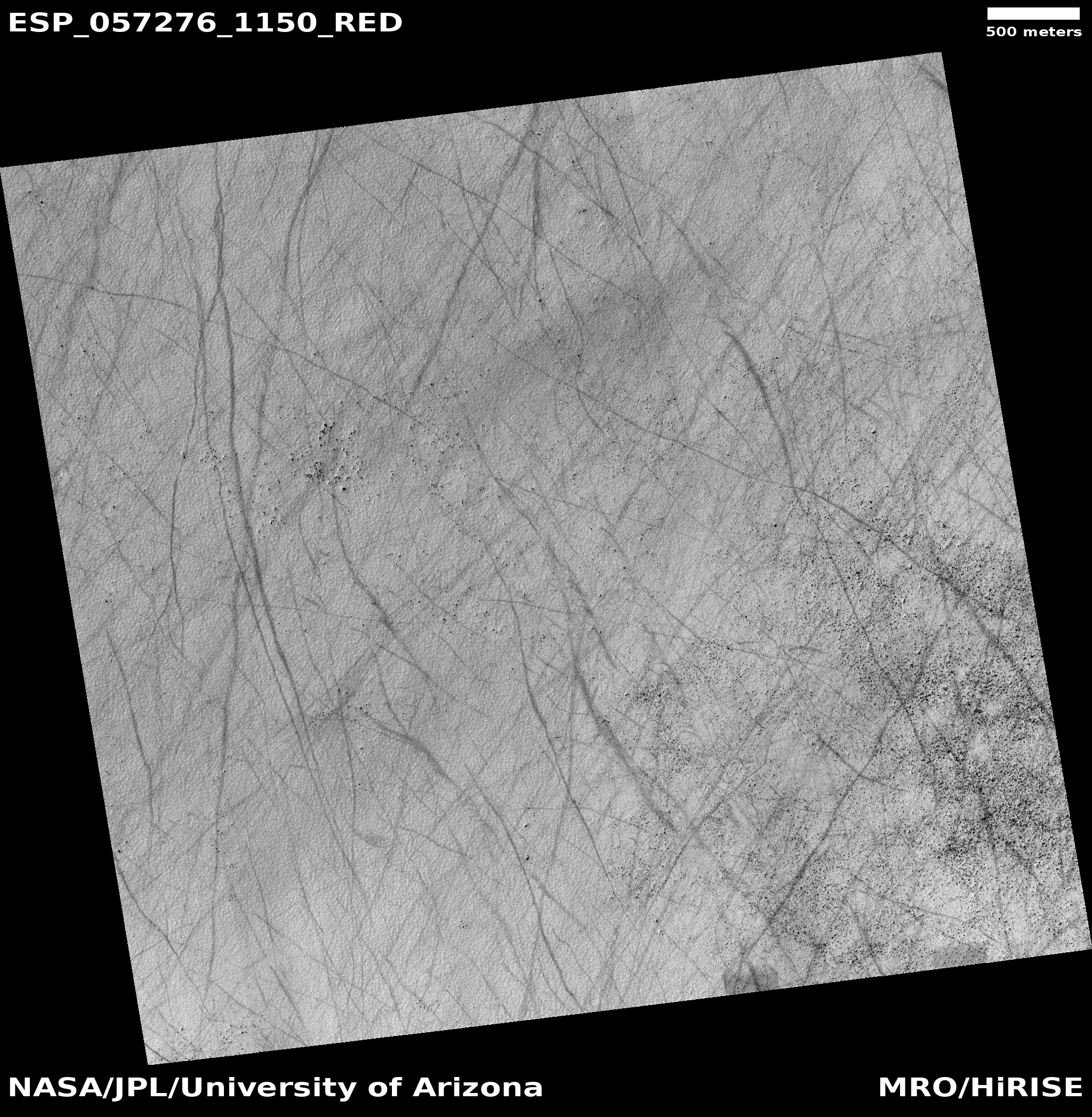
Dust devil tracks

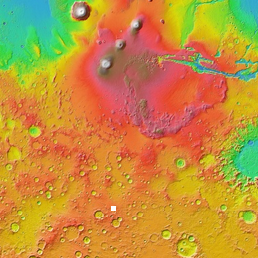
Today’s cool image is cool because of how little is there. The image to the right, cropped to post here, was part of the December image release from the high resolution camera on Mars Reconnaissance Orbiter (MRO). The uncaptioned release labeled this image simply as “Southern Intercrater Plains.” Located in the Martian southern highlands, this location is located almost due south of Arsia Mons, the southernmost in the chain of three giant volcanoes to the west of Marineris Valles (as indicated by the white dot on the overview image below).

If you click on the image you can see the entire photograph, though in this case it won’t show you much else than in the excerpt to the right. The terrain here appears flat. The only features of note are some small knobs and the random dark lines that are almost certainly accumulated dust devil tracks. There are also many dark spots, which might also be the shadows of even smaller knobs, but could also be instrument artifacts. I am not sure.

Location of dust devil image

The southern highlands are mostly cratered, with few signs that water ever flowed there. This image for example gives the impression of a vast lonely terrain that has changed little since the very earliest days of Mars’ history.

I expect that scientists could possibly assign some age to this terrain, merely by studying the dust devil tracks. If we calculate how often dust devils might traverse this place, and then count the tracks, assigning their order by faintness, with the faintest being the oldest, it could be possible to obtain a rough age of the oldest tracks.

Still, all that would do would tell us the approximate length of time in which a dust devil track can remain visible. And even if this is a long time, it doesn’t constrain the age of the surface very much, as the weather on Mars has certainly changed with time, especially because we think the atmosphere was once thicker.

What formed this flat terrain? My first guess would be a lava flow, caused when the numerous nearby craters were formed by impact. These craters were likely created during the great bombardment between 3 and 4 billion years ago, and while they have certainly been modified more than lunar craters because of the presence of an atmosphere on Mars, they are likely to have not changed much during that time. Similarly, this flat terrain is likely much like it was, several billion years ago. Dust devils have deposited dust and their tracks, but the hard bedrock remains as it was soon after it solidified.

6 comments

India delays launch of Chandrayaan-2

India announced today that it is delaying the January 3, 2019 launch of its second lunar mission, the lander/rover Chandrayaan-2.

They have not announced a new launch date. Nor did they explain the cause of the delay. My suspicion is that K. Sivan, the head of their space agency ISRO, was not happy about some engineering issue, and demanded a review.

Unlike most such administrators, Sivan is an actual engineer who helped design and build India’s two rockets, the PSLV and GSLV. Last year, after the failure of one Indian satellite already in orbit, he recalled another Indian satellite from French Guiana only weeks before launch, had it brought back to India for a careful inspection to make sure it did not have the same problem. The move saved the satellite.

1 comment

OSIRIS-REx’s first survey of Bennu

The OSIRIS-REx science team has released a short movie of Bennu made up of images taken by the spacecraft’s navigation camera during its preliminary approaches to the asteroid from November 30 to December 31, 2018.

You can watch it here. Because this is the navigation camera, the view is generally from far away. Nonetheless, you can see that during the passes over the north pole, the equator, and the south pole, the asteroid’s entire surface became visible as the asteroid rotated. From this they will be able to use the images taken by the high resolution cameras to create an excellent detailed global.

0 comments

Chang’e-4 successfully lands on far side of Moon

The new colonial movement: China’s Chang’e-4 lander/rover has successfully landed on far side of Moon.

Early reports of a successful landing sparked confusion after state-run media China Daily and CGTN deleted tweets celebrating the mission. China Daily’s tweet said: ‘“China’s Chang’e 4 landed on the moon’s far side, inaugurating a new chapter in mankind’s lunar exploration history.”

Official confirmation of the landing came two hours later via state broadcaster CCTV, which said the lunar explorer had touched down at 10.26am (2.26am GMT). The Communist party-owned Global Times also said the probe had “successfully made the first-ever soft landing” on the far side of the moon.

No reason has been given for the deletion of the tweets, though I suspect they did so because they were simply premature.

Update: More information here, including images.

11 comments

“We have a snow-man!”

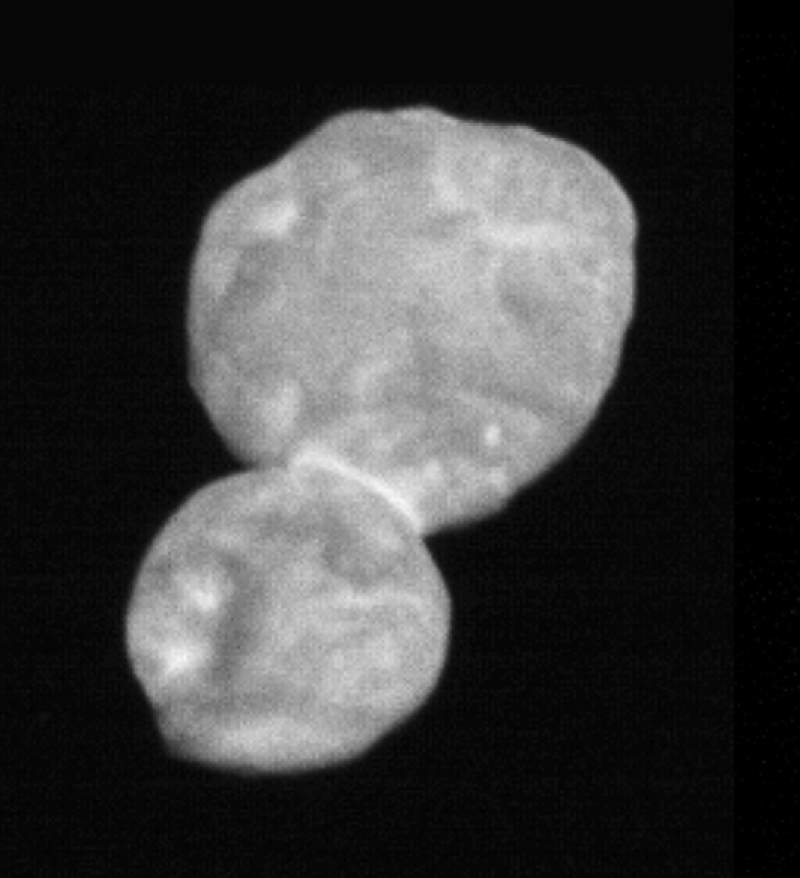
Ultima Thule, the snowman

The quote in the headline comes from Alan Stern, the principle scientist for New Horizons, during today’s press conference revealing the first high resolution images of Ultima Thule. The press release for this conference is now online. The image on the right is a reduced cropped version of the main release image today. If you click on it you can see the full resolution version.

The images reveal that Ultima Thule actually is two objects in contact with each other. In addition, the snowman description is apt, as it has a mottled appearance as if it was shaped roughly and somewhat gently over time. Tiny pebbles and rocks softly came together to form two snowballs that then eventually came to touch and join.

They describe this as the most primitive object ever observed. It is also dark, and red in color, like dark reddish dirt.

More images and data is still coming in, to be released in another press conference tomorrow.

16 comments

The 2018 global launch race plus predictions for 2019

In 2018 the global launch industry turned a significant corner. While there have been strong signs in 2016 and 2017 that we were about to see the arrival of a boom, it was not until this past year that we finally saw the beginnings of this boom.

Below is my updated launch graph showing what was accomplished in 2018. To put what was done in context, the graph shows all launches by every nation and private company for each year beginning in 1980, with 1968 added to provide a sense of what the launch industry was like during the height of the Cold War space race.

Before reading further, however, it is worthwhile to review what I wrote in my 2017 launch industry assessment, written in January 2018. My assessment then, as well as my predictions, provide some worthwhile context for understanding what actually happened this past year.
» Read more

11 comments
1 153 154 155 156