
Whitney Houston – Didn’t We Almost Have It All
An evening pause: Hat tip Cotour.
An evening pause: Hat tip Cotour.

Click for full image.
Cool image time! The photograph on the right, rotated, cropped, and reduced to post here, was taken by the high resolution camera on Mars Reconnaissance Orbiter (MRO) on December 21, 2019. It shows the eastern half of the floor and interior rim of a large squarish-shaped crater or depression in what seems to be an unnamed region of chaos terrain located in the transition zone between the Martian southern highlands and the northern lowland plains.
The floor of this depression has many of the features that indicate the presence of a buried ice glacier, including flow features on the depression floor, linear parallel grooves, and repeating moraine features at the slope base. In fact, all these features give the strong impression that this crater is ice-filled, to an unknown depth.
Chaos terrain, a jumble of mesas cut by straight canyons, are generally found in this transition zone, and could be an erosion feature produced by the intermittent ocean that some believe once existed in the northern lowlands. Whether or not an ocean lapped against these mesas and created them, this chaos terrain is believed to have been caused by some form of erosion, either wind, water, or ice.
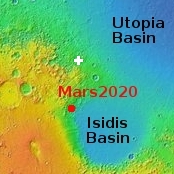
The location is of this chaos terrain in that transition zone is illustrated by the context map to the right. It sits on the edge of the vast Utopia Basin, one of the largest and deepest northern lowland plains. It also sits several hundred miles due north of the planned landing site of the Mars2020 rover in Jezero Crater. There is a lot of chaos terrain in this region, with lots of evidence of buried glaciers flowing off the sides of mesas.
Today’s image, with its numerous features suggesting the presence of a buried glacier filling the depression, reinforces this evidence.
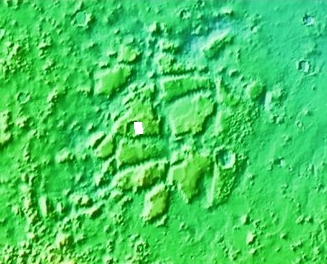
What impresses me most about this particular depression — should it be ice-filled — is its size. I estimate from the scale of the image that the depression is about six miles across, somewhat comparable though slightly smaller than the width of the Grand Canyon. And yet, unlike the Canyon it appears to have a wide flat floor across its entire width. The second context map to the right zooms in on this chaos region to show how relatively large the depression is. It would not be hard to spot it from orbit. We don’t know the depth, but even if relatively shallow this depression still holds a heck of a lot of water ice.
While the depression appears like a crater in lower resolution wider photographs, higher resolution images suggest it is not round but squarish. Why is not clear, and unfortunately MRO’s high resolution camera has taken no other images of it. This image was also one of their terrain sample photographs, taken not because of any specific research request, but because they need to use the camera regularly to maintain its temperature. This location, having few previous images, fit this schedule and made sense photographing.
Thus, no one appears to be specifically studying this location, making it a ripe subject for some postdoc student who wants to put their name on some Martian geology.
Capitalism in space: SpaceX yesterday shipped to Florida the Dragon capsule it will use for its first manned mission, now set for sometime between April and June.
No official word yet on any specific launch date, though there are reports that they are targeting May 7.
In that same story at the second link a NASA official admitted that one of the big issues is filling out the paperwork.
“Even though it sounds mundane, there is a load of paper that has to be verified, and signed off, and checked to make sure we’ve got everything closed out,” [said chief of human spaceflight Doug Loverro.] “It is probably one of the longest things in the tent to go ahead and do. It’s underappreciated but critically important. You’ve got to make sure you’ve done everything you need to do along the way.”
Properly documenting what you are doing is always essential, but if you over do it you raise costs unnecessarily while simultaneously delaying things. And isn’t it interesting that both of these issues — budget overruns and scheduling delays — have been systemic on all of NASA’s projects for decades?
Furthermore, while good documentation can help prevent problems and help you figure out what went wrong, when things go wrong, doing more of it will not further reduce problems or failures. If anything, too much paperwork will likely increase mistakes by focusing workers on the wrong things. This seems to be one of NASA’s problems in recent years.
Regardless, it does look like that first privately built launch will happen in mere months. The one decision remaining that could legitimately delay it would be if NASA decides to make it a longer mission, requiring more training for its astronauts.
An evening pause: Today is the birthday of Abraham Lincoln. As I try to do every year, I honor his memory on this date. As I wrote last year,
it is once again time to remember a man who stands as one of our nation’s — and possible one of the world’s — greatest leaders. Of our Presidents possibly only George Washington is more significant. We must above all not forget the incredible and now all too rare good will he held for everyone, even to those who hated him and wished to kill him.
Lincoln stood for freedom for all humans, the central heart of the American experiment. He was willing and did die for that stance. We should all be willing to do no less.
The video below shows probably every photograph ever taken of Lincoln, in chronological order. You can see him age and mature. You can also see a gaunt and serious man who appears to care deeply about whatever he does.
They’re coming for you next: Much has been made of the onerousness gun control laws passed by the Democrats in the Virginia state legislature this past week.
When it became clear that the Democrats were going to pass such laws, having gained control of both the legislature and the governorship, 95 counties and cities in the state made it publicly clear they would not enforce these laws, announcing that they were now second amendment sanctuary counties. Then, more than 22,000 Virginians gathered in protest at the statehouse, peacefully but forcefully declaring their opposition to these proposed laws.
None of that mattered to the modern Democrats now in charge in Virginia. They passed the laws, one of which gives the state “the authority to confiscate certain types of magazines that are considered ‘high capacity.'” I don’t know how they think they will enforce that confiscation right, but since they think it appropriate and just, don’t be surprised if they impose new laws to strengthen their ability to do so, including the right to do house-to-house searches.
Most of the the discussion about this story has been focused on the opposition to the laws themselves. I want to focus on what it tells us about the modern Democratic Party. You see, these fascist actions — which do nothing to reduce violence or crime while making law-abiding citizens criminals — are being planned by practically every local Democratic Party operation across the nation. All they require to make them law is to obtain power, as they have in Virginia.
My proof? Consider the comparable gun control law proposed yesterday by the Democrats in the Arizona state legislature:
» Read more
Astronomers are baffled by a fast radio burst, a phenomenon that is a mystery in its own right, that also repeats its bursts in what appears to be a regular pattern.
Researchers looking at data from the Canadian Hydrogen Intensity Mapping Experiment Fast Radio Burst Project (CHIME/FRB) first spotted this FRB, known as FRB 180916.J0158+65, in 2019. In January 2020, they published a paper in the journal Nature that reanalyzed old data and found more than one burst from FRB 180916.J0158+65. They traced this FRB back to a relatively nearby spiral galaxy. What’s new in this latest paper, published Feb. 3 to the arXiv database, is the regular pattern in the bursts. The FRB, they found, goes through four-day cycles of regular activity, bleating out radio waves into space on an almost hourly basis. Then it goes into a 12-day period of silence. Sometimes the source seems to skip its usual four-day awake periods, or lets out only a single burst. CHIME/FRB is able to watch the FRB only some of the time, they noted, so it’s likely the detector misses many FRBs during the awake period.
At present they have no idea what is causing the pattern, other than a realization that it defies all the theories for explaining the previously discovered fast radio bursts.
NASA has broken ground on the construction of the first new communications antenna since 2003 at its Goldstone, Californa, site, one of three the agency maintains worldwide for communicating with its planetary probes.
There has been a desperate need to both expand and upgrade this network, dubbed the Deep Space Network, for years, a need that will grow even more desperate next year with the addition of two more rovers on Mars.
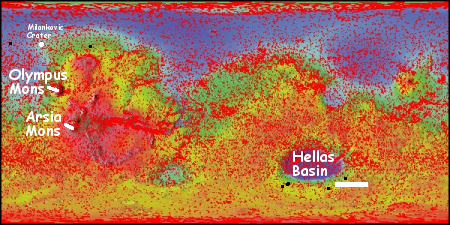
In January 2018 scientists announced the discovery of eight cliffs with visible exposed ice layers in the high mid-latitudes of Mars. At the time, those eight ice scarps were limited to a single crater in the northern hemisphere (Milankovic Crater) and a strip of land in the southern highlands at around latitude 55 degrees south.
In the past two years scientists have been using the high resolution camera on Mars Reconnaissance Orbiter (MRO) to monitor these scarps for changes. So far they have seen none, likely because the changes are below the resolution of the camera.
They have also been able to find more scarps in the southern hemisphere strip beyond that strip at 55 degrees south.
Now they have found more scarps in the northern hemisphere as well, and these are outside Milankovic Crater. As in the south, the new scarps are still all along a latitude strip at about 55 degrees.
The map above shows with the black dots the newer scarps located in the past two years. The scarp to the east of Milankovic Crater is typical of all the other scarps, a steep, pole-facing cliff that seems to be retreating away from the pole..
The scarp to the west of Milankovic Crater is striking in that it is actually a cluster of scarps, all inside a crater in the northern lowland plains. Moreover, these scarps are more indistinct, making them more difficult to identify. According to Colin Dundas of the U.S. Geological Survey’s Astrogeology Science Center in Arizona,
» Read more
SpaceX has hired NASA’s former manager of its human exploration program, Bill Gerstenmaier, as a consultant working with their “reliability team.”.
It appears that SpaceX wants to take advantage of Gerstenmaier’s expertise on human spaceflight as it is about to begin manned Dragon flights. It also appears that Musk wants to return a favor as well, as Gerstenmaier was likely the main person behind the decision to award SpaceX its initial Dragon cargo contract in December 2008. Musk has said repeatedly that this decision in many ways saved his company.
Overall, a wise decision by SpaceX. In his later years at NASA, Gerstenmaier lost sight of the importance of budget and schedule in his management of SLS and Orion, leading to his ouster. However, his knowledge of human spaceflight and the political mechanics needed to do it with NASA is unsurpassed. SpaceX will definitely benefit from this hire.
Link here.
Overall, this second known interstellar object to pass through the solar system appears to be a very typical comet. They have found however that its nucleus is much smaller than at first thought, only 200 to 500 meters across, which means that radiation pressure from the Sun could cause its rotation to spin up, with the possibility that this spin could get fast enough to cause the comet to break up.
The comet made its closest approach to the Sun in December, and will spend the next year-plus flying outward to beyond Saturn.
Read any analysis by any mainstream news or science publication of Trump’s 2021 proposed science budget, released this week, and you will come away thinking that the future of science research in the U.S. is doomed and that Donald Trump is a neanderthal who wishes to send us back to the dark ages.
Consider for example this article from the journal Science, Trump’s new budget cuts all but a favored few science programs, which begins like so:
For the fourth straight year, President Donald Trump has proposed sizable reductions in federal research spending. To be sure, it’s no longer news that the president wants deep cuts to the budgets of the National Institutes of Health (NIH), the National Science Foundation (NSF), and science programs at the Department of Energy (DOE) and NASA. And in past years, Congress has rejected similar proposals and provided increases. But Trump’s 2021 request brings into sharper focus what his administration values across the research landscape—and what it views as unimportant.
The article then outlines how Trump is slashing spending on science research across the board, even to the point of spinning the NASA budget to make a significant budget increase appear as a cut, by cherry-picking only some of that budget’s science programs.
This article is typical of the mainstream press. These articles never provide any context for the proposed budget numbers. They look at what was spent the year before, see what is being proposed for the next year, and if they see any reduction they scream. And if it is an evil Republican president proposing the cuts they scream far harder, implying that those cuts will guarantee the coming of a new dark age.
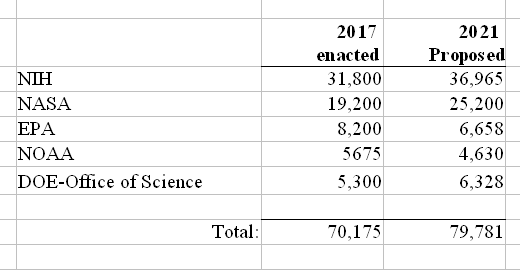
To the right however are the budget numbers (shown in thousands) for five of the biggest science agencies in the federal government, comparing Trump’s 2021 proposed budget numbers with the last science budget approved at the end of the Obama administration in 2016.
Notice anything? » Read more
An evening pause: Reminds me of every single commercial I see on television these days. Only smarter.
Hat tip Mike Nelson.