
Starliner launch scrubbed; no launch date yet set

For reasons that have not yet been revealed, ULA scrubbed today’s unmanned demo test flight of Boeing’s Starliner capsule just prior to launch, rescheduling the launch for tomorrow.

The launch tomorrow wiill occur at 12:57 am (Eastern).

UPDATE: It appears the scrub occurred because of a valve issue in the propulsion system of Boeing’s Starliner capsule.

“During pre-launch preparations for the uncrewed test flight of the CST-100 Starliner spacecraft, Boeing engineers monitoring the health and status of the vehicle detected unexpected valve position indications in the propulsion system,” the company said in a statement. “The issue was initially detected during check outs following yesterday’s electrical storms in the region of Kennedy Space Center.”

…The propulsion system valves in question are inside the Starliner’s service module, which has an array of rocket thrusters designed to propel the spacecraft away from its launcher during an in-flight emergency. Other thrusters on the service module are used for in-orbit maneuvers and spacecraft pointing control.

Boeing cannot afford more failures during this second demo flight. The company has been plagued with numerous debilitating technical failures during the past four years, from Starliner to its airlines. Right now the failure to get Starliner operational is losing them business in the emerging orbital tourist market. They need to get it working, and working reliably.

UPDATE: They have decided to cancel the launch plans for tomorrow, to roll the rocket back into the assembly building so they can do more tests on the capsule’s service module where the troublesome valves are.

8 comments

Nauka shook up ISS more than first revealed

According to new reporting, when the new Russian module Nauka unexpectedly began firing its engines, it rotated the International Space Station far more than first revealed, requiring a much more complicated effort to bring the station back to its correct orientation.

Zebulon Scoville, the flight director at NASA mission control in Houston, revealed that the 45 degrees that was initially reported as the amount ISS rotated was incorrect.

According to Scoville, the event has “been a little incorrectly reported.” He said that after Nauka incorrectly fired up, the station “spun one-and-a-half revolutions — about 540 degrees — before coming to a stop upside down. The space station then did a 180-degree forward flip to get back to its original orientation,” according to the report.

Scoville also shared that this was the first time that he has ever declared a “spacecraft emergency.”

It appears that though the station spun far more than first reported, the rate of rotation was still relatively slow, so it apparently did no harm to the station.

Scoville also revealed that, based on the data on hand during the event, it appeared Nauka was also trying to undock itself from the station. Mission controllers tried to counter this by firing engines on a Russian Progress freighter as well as on the Zvezda module.

Had Nauka’s engines had not stopped firing (for unknown reasons, though probably because they ran out of fuel), there was the real chance the accelerations could have shaken the station apart. Moreover, that other engines were brought into play suggests that the Russians not only did not know why Nauka’s engines fired, they had at the time no way to shut them down, and were thus forced to improvise other actions to try to save the increasingly dangerous situation.

19 comments

Blender FLIP Fluids Addon

An evening pause: What you are looking at here appears to be a demo video of a software addon that provides users with all types of liquid visuals. And creating realistic flowing water is not easy, as the splashes and waves represent chaotic behavior which is very hard to model.

Hat tip Cotour, who adds, “At some point in the future there will be ‘reality’ and no one will be able to tell the difference.”

2 comments

The sublimating surface of Mars’ northern plains?

Sublimating patches on Mars?
Click for full image.

Cool image time! The photograph to the right, cropped and reduced to post here, was taken by the high resolution camera on Mars Reconnaissance Orbiter on May 27, 2021. A sample image, likely taken not as part of any specific scientist’s research but by the camera team in order to maintain the camera’s temperature, shows an area of the Martian northern plains that appears filled with rough scattered depressions, possibly caused by sublimation of buried ice.

The location, at 54 degrees north latitude, is far enough north to easily have a lot of buried ice. It is also only about 40 miles to the east of Milankovič Crater, where scientists have found many scarps that appear to have exposed layers of ice in their cliff faces.

However, the location has other components that must raise questions about this sublimating ice hypothesis.
» Read more

0 comments

Today’s blacklisted American: Biracial physician demoted by hospital for criticizing the left

What apparently passes for medical treatment at the Hennepin Healthcare system
Beliefs apparently required of doctors at the Hennepin Healthcare system

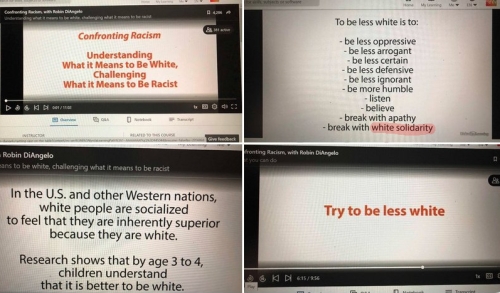
The new dark age of silencing: Tara Gustilo, a biracial physician from the Philippines, found herself quickly demoted from her position as chairwoman of the OB-GYN department for the Hennepin Healthcare system in Minnesota when she dared to post on social media commentary against the Marxist and bigoted Black Lives Matter organization and the equally bigoted critical race theory being pushed by leftist educators in the public schools.
» Read more

1 comment

Upcoming Zimmerman public lecture available for all – Last Call!

Tomorrow I will be giving a lecture on the Artemis Accords to the Arizona Space Business Roundtable, a monthly event in Tucson, founded by space businessman and local all-around good guy Stephen Fleming, to bring together the business-oriented space community of this city and southern Arizona.

From Stephen Fleming’s announcement:

Bob has spoken to the Roundtable before; this time, I’ve asked him to focus on the Artemis Accords… the USA’s attempt to “to create a safe and transparent environment which facilitates exploration, science, and commercial activities for all of humanity to enjoy.” What does that mean? It’s an attempt to break the international logjam that has blocked the private sector development and exploitation of resources on the Moon, asteroids, and other celestial bodies. How is it working, who has joined on, and what does China think about all this? Come find out from Bob!

The event will be open to the public, no charge, and will also be available on Zoom. It is scheduled for Tuesday, August 3, 2021, from 5:00 — 6:30 pm (Arizona time, which presently corresponds to Pacific time).

If you wish to come in person, the event will be at 110 E. Pennington St, Room 215, in Tucson.

If you want to attend via Zoom, you will need to express your interest as a comment below, and I will then email you the Zoom url and password. We are not publishing this information publicly to avoid a hacking during the event.

Let me repeat: You need to express an interest in attending by Zoom by posting a comment. Otherwise you will not get the password and will not be able to watch. (I will send out the password tomorrow to all those in the comment thread.)

If you are coming in person Stephen would appreciate it if you say so in a comment below also, so that he can estimate a count. He provides, out of his own pocket, cookies and coffee for in-person attendees, and needs to gauge how much to provide.

Note that I have written these essays previously about other Arizona Space Roundtable events:

19 comments

Sunspot update: Another month of greater activity than predicted

NOAA this past weekend released an update of its monthly sunspot cycle graph, showing the Sun’s sunspot activity for the past month. That graph is below, annotated to show the previous solar cycle predictions and thus provide context.

In July the Sun’s hot streak of sunspot activity continued. The number of sunspots on its visible hemisphere continued to exceed the prediction of NOAA’s solar science panel, with the numbers in July easily topping June’s numbers. Only at the very end of July was there a streak of five blank days, the first time the Sun has been blank of sunspots since May 6th, a stretch of activity not seen for years, since the last solar maximum was ramping down to solar minimum in ’16-’17.

The political consequences of this continuing high activity could be quite profound.
» Read more

3 comments
1 13 14 15