Elvis Costello – She
An evening pause: Performed live on television in 1999.
Hat tip Jim Mallamace.
An evening pause: Performed live on television in 1999.
Hat tip Jim Mallamace.
Capitalism in space: Sierra Nevada today announced that it has now gotten clearance to land its Dream Chaser-class Tenacity spacecraft at the Kennedy Space Center, with a hoped-for first flight in ’22.
The Use Agreement makes SNC the first commercial user of Space Florida’s FAA Re-entry Site Operator License and provides the runway and support facilities needed during testing and landing. It also takes SNC one step further in applying for its own FAA re-entry license, something needed ahead of the first Dream Chaser mission next year.
Because Tenacity is a cargo freighter only, they do not plan a significant test program prior to that first launch to ISS.
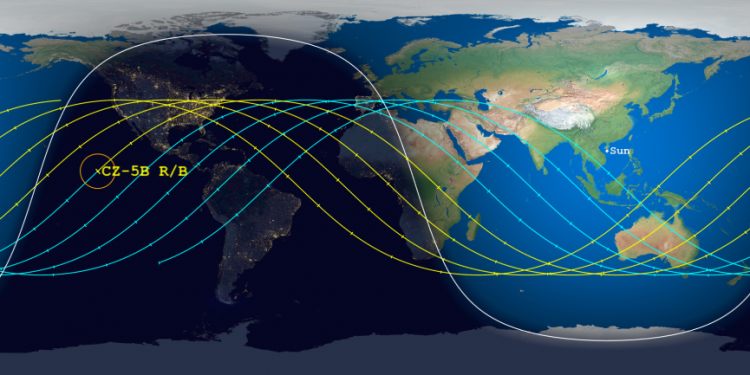

The reentry window of the 21-ton core stage for China’s Long March 5B rocket, launched on April 29th, has now narrowed to only 28 hours, with the centerpoint of that window on May 9th over the Pacific, only about 20 minutes before reaching Mexico and the continental U.S.
The update by the Aerospace Corporation is shown in the maps above and to the right. With the right map I have zoomed into the section over the U.S. to show the potential path of this core stage should it come down a bit later than presently predicted.
The circled point is centerpoint of the reentry window. The yellow orbital tracks are after that point, with the blue tracks previous. The tick marks indicate 15-minute intervals.
As you can see, the centerpoint is only about 20 minutes before the stage crosses Mexico and begins a half hour traverse above the continental United States from Texas to Maryland. If the stage should manage to stay up for another full orbit it will once again traverse the continental U.S., this crossing from San Diego to Cape Cod.
If the stage comes down early instead it could land anywhere from southern Europe to Australia, with the Middle East and India in between.
As I have noted already, China designed and launched this rocket knowing it was creating a giant piece of space junk that was going to fall on someone’s head. Just as that communist government has not cared that it has been dumping first stages on its own people for decades, it apparently does not care that it is dumping even bigger first stages on everyone else. The Long March 5B is the rocket they are using to launch the modules to their space station, as well as many of the future planetary missions to the Moon and Mars. And every time they launch it they will be dumping a core stage on someone, a direct violation of the Outer Space Treaty that China has signed.
The world’s governments should be outraged, and teaming up to demand that either China change this situation or delay future Long March 5B launches, or face serious financial consequences. Sadly, I do not expect this, as our present political class is either incompetent or corrupt and in the deep financial pockets of the Chinese.

Click for full image.
Cool image time! The photo to the right, cropped and reduced to post here, was taken on January 29, 2021 by the high resolution camera on Mars Reconnaissance Orbiter (MRO). It shows what the science team labels as “Fresh Shallow Valleys”. The section I have focused on shows a particularly interesting meander next to a small crater. The full image shows additional similar channels to the north, with one draining into a larger 3.7 mile wide crater.
The location is in the southern cratered highlands, at about 41 degrees south latitude, where much evidence of buried glacial features are found. That certainly is what we appear to see here. In fact, the wider view afforded by MRO’s context camera reveals many more such channels. That wider view also shows a much larger 18-mile-wide crater just to the north that appears filled with buried ice.
That the scientists label these fresh suggests they think they are relatively young, probably dating from when the most recent cycle of glacial growth probably ended. This would make them about 6 million years ago, based on this paper [pdf] and the second figure from that paper below.
» Read more
Capitalism in space: SpaceX today successfully launched another 60 Starlink satellites into orbit, using its Falcon 9 rocket.
This raises the number of Starlink satellites to more than 1,600. The first stage also landed safely, completing its ninth flight.
The leaders in the 2021 launch race:
13 SpaceX
11 China
7 Russia
2 Rocket Lab
The U.S. now leads China 18 to 11 in the national rankings.

Show trials: Debate as Twitter sees it.
Blacklists are back and Twitter’s got ’em: Rather than write today about a single specific individual being blacklisted and destroyed by today’s intolerant left, let’s take a look at one of that left’s most intolerant and oppressive blacklister, Twitter.
Like all the big tech social media companies such as Google and Facebook, Twitter is essentially run like a leftwing fiefdom. Though it allows conservative writers to post there, it makes it very clear that they are always under a probation that can be withdrawn immediately if someone in company’s workforce finds itself offended or disagreeing with something that conservative posted.
For example, in January religious radio host Michael Brown got banned from Twitter for twelve hours for simply posting a tweet where he asked this simple question: “Will I get punished by Twitter for saying that, in God’s sight, ‘Rachel’ Levine (nominated by Biden to be his assistant secretary for HHS) is a man?”
» Read more
Capitalism in space: Firefly announced today that it has raised an $75 million in investment capital, with plans for a future fund-raising round aimed at bringing in another $300 million following the inaugural launch of its Alpha rocket.
The launch itself has been delayed several times, from December and March. It now appears they are targeting mid-June.
The company claims the delays were caused by two factors, the failure of a subcontractor to deliver on time the flight termination system, and the company taking longer than expected to prepare its launchpad at Vandenberg.
On a positive note, the company received its FCC launch license a few weeks ago, which had been held up due to security concerns over the company’s former main investor, Ukrainian billionaire Max Polykov. It appears that when Polykov sold off much of his stock so that he no longer controls the company, this eliminated the security concerns.
Capitalism in space: While there appear to presently be about 100+ new rocket company startups competing to garner market share in the growing satellite launch industry, it appears there is only one startup, Ursa Major Technologies, focused solely on building rocket engines for those rockets.
The company’s business model is based on the idea that while many launch providers make their own propulsion systems, others will choose outsourcing so they don’t have to invest money and time in risky engine development.
It presently has a small engine, dubbed Hadley, that is set to launch on another company’s rocket in ’22, and a larger engine, dubbed Ripley, that is being developed and has a contract for use by the new rocket startup Phantom Space.
In a sense this company is conceivable in competition with Momentus, which builds and sells a space tug, essentially an upper stage engine, for moving smallsats from one orbit to another. Both are aiming for a niche within the new smallsat industry by providing rockets and satellites engines.
If the industry grows as big as hoped, both will likely have plenty of business.
The core stage of NASA’s SLS rocket has arrived in Florida and has now begun the processing to get it ready for launch anywhere from six to ten months from now.
Approximately six months of work is anticipated to finish assembly and complete a long series of tests and checkouts of SLS and the Orion spacecraft it will send to the Moon, but current forecasts of this first-time integration work estimate closer to ten months to complete the necessary operations. After the vehicle is put together, weeks and weeks of testing to make sure SLS and Orion are properly talking to each other, as well as the EGS ground infrastructure, will follow.
…Recent schedules showed the remainder of work to reach launch readiness extending for ten months once the core stage arrived. That time includes six months of operations to the “work to” launch readiness and four months of “risk factor”. The “work to” launch readiness date, which would still have to synchronize to a lunar launch window, is currently early-November 2021. With risk factored in, a date of early-March 2022 is derived.
NASA has not yet changed that November ’21 target for launch, though all reports strongly suggest it cannot be met.
Regardless, even if they can get this thing launched by November, the long prep time shows once again how cumbersome and inefficient this rocket would be if anyone tried to use it to explore space. NASA says that after this first launch the prep time will be shorter, but even if it is trimmed to three months (the best estimate I’ve seen) it simply isn’t good enough. SpaceX has already demonstrated that is can fly two different Starship prototypes in less than thirty days (with #10 flying March 3rd and #11 flying March 30th). The company’s goal is many flights frequently, and it so far is proving that this goal will be achievable. And it will do it placing more payload in orbit for pennies (compared to the cost of SLS).
I still predict that there is a better than 50% chance that the first orbital launch of Starship/Superheavy will occur before SLS, even though the former began actual hardware development only two years ago.
I also think that we are now in the final stages of the entire SLS program. As with all similar big NASA-led rocket projects started since the mid-1980s, it will die stillborn. The previous projects never even got built after spending billions on blueprints and powerpoint presentations. SLS will likely get at least two flights (assuming nothing goes wrong with the first). After that NASA and the federal government will shut it down because by that time there will be far better and cheaper options available.
An evening pause: I honestly don’t understand how this works, and the video doesn’t really explain it. It is quite amazing nonetheless. More information here if you want to dig about to figure it out.
Hat tip Cotour.

Banned by the Biden administration
Blacklists are back and the Dems’ have got ’em: Routinely called a racist, bigot, white supremacist, and (of course) an alt-right conservative by the mainstream press, controversial Nick Fuentes’ track record is far from that straight-forward. Though it appears he has often taken some ugly positions and made some even more ugly statements, he apparently has never done anything illegal or outright bigoted.
No matter to the Biden administration and the TSA. They have blacklisted him, banning him from flying on any American airline.
Moreover, the federal government is not the only one blacklisting Fuentes because they don’t like his opinions. As Fuentes himself noted in a April 27th tweet:
Since attending President Trump’s rally on the Ellipse on January 6th I’ve been:
-Banned from AirBnB, Facebook, Instagram, DLive, and Coinbase
-Banned from every payment processor
-Had a bank account frozen
-Put on the no-fly listAnd I haven’t even done anything wrong!
The most important line in his tweet is the last one. What he has said might be wrong-headed, bigoted, or stupid, but in a free country that defends its first amendment, he would be within his rights to say it, and would have broken no laws by doing so.
We no longer live in that long gone free nation. Now we live in a place that routinely uses power to squash radical positions, except when those opinions happen to be leftist radical positions. Those Marxist opinions are always blessed with immunity, no matter how bigoted or vile. In fact, if you dare to criticize the dominant Marxist and bigoted culture in any way at all, you are guaranteed to be called a bigot and are likely to be blacklisted, like Fuentes, for doing so.

Click for full image.
I’ve said it before and I’ll say it again. Mars is strange, Mars is wonderful, but above all, Mars is alien. Today’s cool image illustrates this saying quite nicely.
The photo to the right, cropped and reduced to post here, was taken on February 1, 2021 by the high resolution camera on Mars Reconnaissance Orbiter (MRO) and was simply labeled “Sacra Sulci Lava”. Sacra Sulci is a section of the Kasei Valles canyon that runs from the north rim of Valles Marineris north about 600 miles where it turns east for about 400 miles to drain out into the northern lowlands plains of Mars. Sacra Sulci is the region where that valley narrows and then turns east.
Apparently the flat smoother areas on the east and south on this image that rise about 60 feet above the surrounding terrain and that also seem to flow around mesas and into canyons are believed to be the edge of a massive lava flow that occurred about 150 to 200 million years ago and drained through Kasei Valles, just like water.
What makes this puzzling, however, is that everything I had read previously about Kasei Valles said that it was thought to have been formed from catastrophic floods of water on early Mars, when the planet was warmer and wetter. In fact, I had posted previously about this theory, and included the map below, taken from figure 8 of this paper [pdf], showing part of the process that some scientists believe occurred.
» Read more