November 10, 2021 Zimmerman/Batchelor podcast
Embedded below the fold in two parts.
To listen to all of John Batchelor’s podcasts, well worth your time, go here.
» Read more
Embedded below the fold in two parts.
To listen to all of John Batchelor’s podcasts, well worth your time, go here.
» Read more

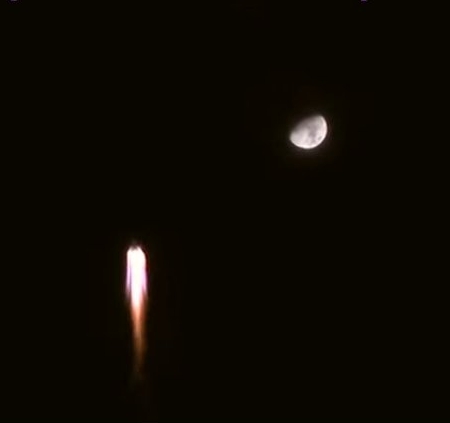
Falcon 9 lifts off from Cape Canaveral.
Capitalism in space: SpaceX tonight successfully used its Falcon 9 rocket to launch four astronauts to ISS on its new Endurance capsule.
SpaceX now has three capsules in its manned fleet, Endeavour, Resilience, and Endurance. This was the company’s fifth manned launch, and its fourth for NASA. The crew will dock with ISS tomorrow in the early evening.
The company also successfully landed its first stage, which was also making its second flight.
The leaders in the 2021 launch race:
41 China
24 SpaceX
18 Russia
4 Northrop Grumman
4 ULA
4 Europe (Arianespace)
China now leads the U.S. 41 to 37 in the national rankings.
My quick one week fund-raising campaign for Behind the Black is now over.
Thank you to everyone that donated or subscribed. As always I am surprised by the number of people who do so, considering that my work here is free for the taking. Because of this, to make sure everyone sees this message of thanks I will keep it on the to of the page for the next few days.
You of course can still donation or subscribe, if you wish. All you need to do is go to the tip jar below or in the right column, depending on the technology you use to view the webpage. There you will find four options for supporting me, including by subscription or donation.
An evening pause: Jeff Beck on guitar.
Hat tip Dan Morris.
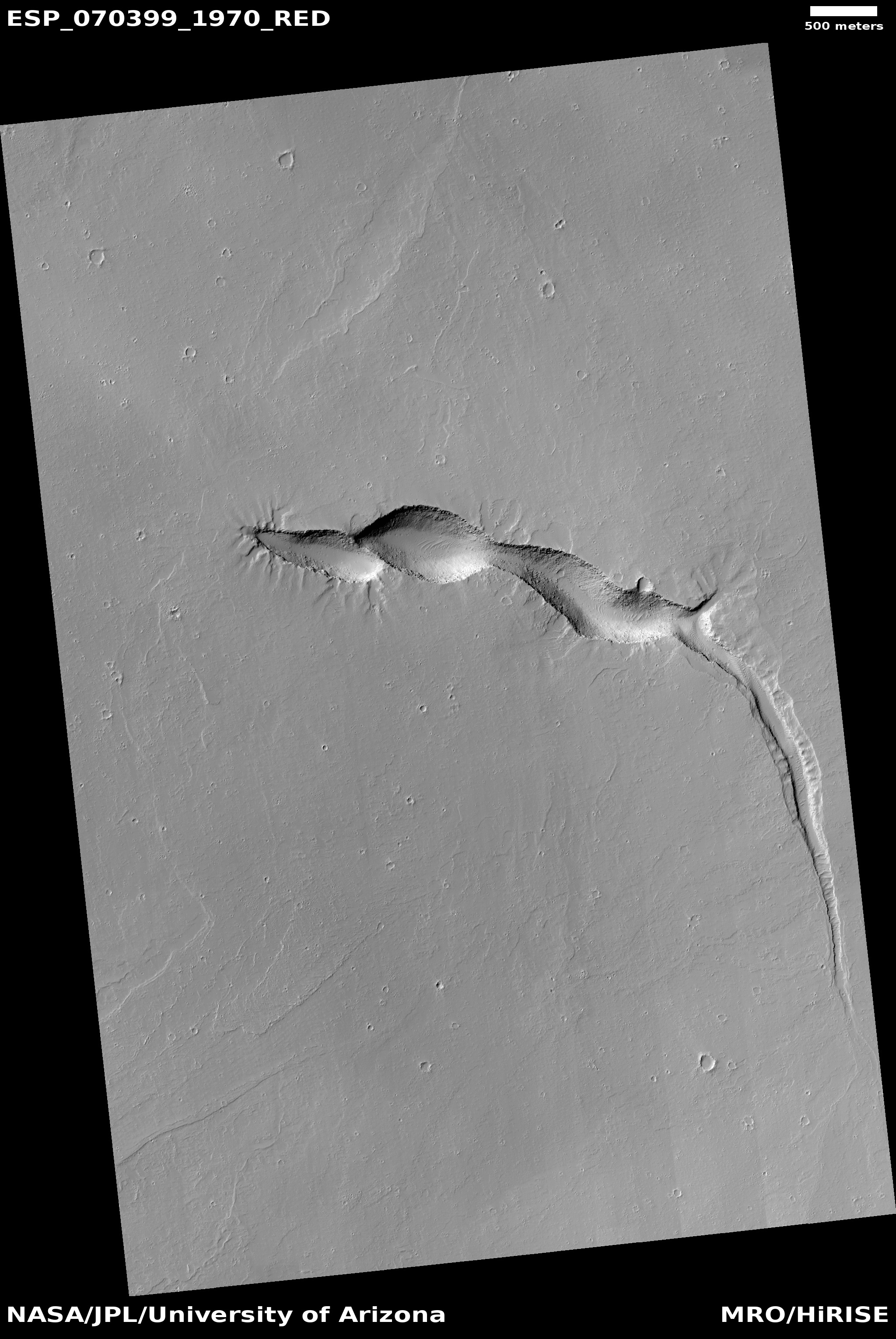
Cool image time! The photo to the right, rotated, cropped, and reduced to post here, was taken on August 31, 2021 by the high resolution camera on Mars Reconnaissance Orbiter (MRO). It shows what the science team labels a “possible contact between two units.”
I think that contact is the point where that eroded mountain touches the surrounding smooth canyon floor. The mountain itself looks to me to be a very eroded extrusion of lava that was placed there from below a very very long time ago, covered later by material, and now exposed for a long enough period that its surface appears to have been carved by wind and even possibly flowing water or ice.
Because it is lava it is more resistant to erosion, which is why it sits higher than the smooth terrain around it. Even though both experienced the same processes of wear over time, the mountain’s surface was only carved away partly, while the material that had been in the floor was washed away entirely.
This is all a guess. However, a look below at the overview map, showing this mountain’s location on Mars, as well as MRO’s wider view from its context camera, I think strengthens my hypothesis.
» Read more

Dictatorial clowns are running UCLA.
They’re coming for you next: Christian Walker, an online student who never comes on campus was threatened with expulsion by UCLA if he did not reveal whether he had gotten his COVID shots or not.
“You are calling to tell me you will drop my classes after we’ve already paid $70,000 for the year if I don’t upload something about my vaccine status when all of my classes are online,” Walker is heard saying in his video. A UCLA official responded, “Correct.” “Got it.” responded Walker.
“All of my classes are online. I don’t step onto campus. I’ve already paid. We’re a week into classes. My university just called to tell me they are dropping my classes if I don’t report to them about my vaccination.” Walker commented on Twitter.
You can listen to Walker’s recording of this conversation at the link.
» Read more
NASA has published an updated schedule for the launch tonight of four astronauts to ISS in SpaceX’s new Endurance Dragon capsule.
The launch now is targeted for no earlier than 9:03 p.m. EST Wednesday, Nov. 10, on a SpaceX Falcon 9 rocket from Launch Complex 39A at NASA’s Kennedy Space Center in Florida. The launch follows a successful return of the agency’s SpaceX Crew-2 mission.
The Crew Dragon Endurance is scheduled to dock to the space station at 7:10 p.m. Thursday, Nov. 11. Launch and docking coverage will air live on NASA Television, the NASA app, and the agency’s website.
You can also watch it on SpaceX’s website, as well as the embedded live stream below, which begins around 4 pm (Eastern).
This will be the fourth manned flight SpaceX has launched for NASA, the fifth overall using three spacecraft.
» Read more
Capitalism in space: Spinlaunch on October 22, 2021 successfully completed the first launch of a prototype using its radical spin technology that spins the payload to high speeds and then releases it upward.
On October 22, the company completed its first test flight at its Spaceport America base in New Mexico, successfully launching a prototype vehicle from its Suborbital Accelerator which reached supersonic speeds and was recovered for reuse thereafter. It plans to conduct further test flights across 2022 with different vehicles and at different launch velocities, as it plans for its first customer launches in late 2024.
In the photo to the right, note the vehicles and cherry-pickers in the lower right corner. They provide some scale. There is also a video showing this test flight on the company’s webpage. Lots of music, few details, but the video does show the prototype rocket-shaped payload rising upward after release.
If this technology becomes viable, it offers the possibility of an incredibly cheap method for putting bulk payloads into space, such as water, fuel, and other resources that will not be harmed by the initial high accelerations.
Episode three of the six part series, The Age of Discovery 2.0, from the podcast, History Unplugged, is now available here.
This episode features Robert Zubrin. From the description:
A new space race has begun. But the rivals, in this case, are not superpowers but competing entrepreneurs. These daring pioneers are creating a revolution in spaceflight that promises to transform the near future. Astronautical engineer Robert Zubrin spells out the potential of these new developments in an engrossing narrative that is visionary yet grounded by a deep understanding of the practical challenges.
Fueled by the combined expertise of the old aerospace industry and the talents of Silicon Valley entrepreneurs, spaceflight is becoming cheaper. The new generation of space explorers has already achieved a major breakthrough by creating reusable rockets. Zubrin foresees more rapid innovation, including global travel from any point on Earth to another in an hour or less; orbital hotels; moon bases with incredible space observatories; human settlements on Mars, the asteroids, and the moons of the outer planets; and then, breaking all limits, pushing onward to the stars.
Zubrin shows how projects that sound like science fiction can actually become reality. But beyond the how, he makes an even more compelling case for why we need to do this—to increase our knowledge of the universe, to make unforeseen discoveries on new frontiers, to harness the natural resources of other planets, to safeguard Earth from stray asteroids, to ensure the future of humanity by expanding beyond its home base, and to protect us from being catastrophically set against each other by the false belief that there isn’t enough for all.
Listen to it. It is definitely worth your time.
The next episode is mine.
An evening pause: This aired in 1967. That’s John Cleese, Marty Feldman, and Graham Chapman, with Tim Brooke-Taylor supervising.
Hat tip Cotour.
Capitalism in space: A ew space tug, designed and built by the company Spaceflight, is set to launch in January ’22 on a SpaceX Falcon 9 rocket and deploy 13 satellites in two different orbits.
In a mission Spaceflight dubs SXRS-6, the OTV [orbital transfer vehicle] will first place four microsatellites and five cubesats in Sun Synchronous Orbit (SSO) at 525 kilometers altitude, after being deployed from SpaceX’s Falcon 9 rocket.
About a month later, following various commissioning and system tests, Sherpa-LTC1 will use its bipropellant, green propulsion subsystem from Benchmark Space Systems to maneuver to 500 kilometers, where it will deploy its remaining four cubesats.
This technology gives cubesat owners greater flexibility. Even if they launch as a secondary payload that is not placed in the right orbit, the tug can still get them to their preferred orbit.
NASA administrator Bill Nelson admitted today that the goal of landing Americans back on the Moon by 2024 was impossible, and that the agency has now delayed that target date one year to 2025.
Nelson attempted to blame the delay on Blue Origin’s lawsuit against NASA for its award of the manned lunar lander contract to SpaceX.
He blamed the shifting timeline on a lawsuit over the agency’s moon lander, to be built by SpaceX, and delays with NASA’s Orion capsule, which is to fly astronauts to lunar orbit. “We’ve lost nearly seven months in litigation, and that likely has pushed the first human landing likely to no earlier than 2025,” Mr. Nelson said, adding that NASA will need to have more detailed discussions with SpaceX to set a more specific timeline.
This however is a bald-faced lie. The Trump 2024 deadline was never realistic. Moreover, delays in SLS and Orion have been continuous and ongoing for years, all of which made a ’24 landing quite difficult and if attempted extremely unsafe. Even as it is, trying this mission by ’25 is risky, especially if it depends on SLS. Moreover, as the article notes, how SLS, Orion, and SpaceX’s Starship will team up to get this mission — designed by a committee — to and from the Moon remains exceedingly unclear.
With great confidence I predict that if the lunar mission depends on SLS in any manner, it will not launch in ’25 either.