Caroline Jones – Being A Woman (Is Like Being the Sun)
An evening pause: These performers are obviously biologists.
Hat tip Dan Morris.
An evening pause: These performers are obviously biologists.
Hat tip Dan Morris.

What a Wisconsin school district apparently thinks of your kids.
They’re coming for you next: The Kiel school district in Wisconsin is now investigating three eighth grade children for daring to use the wrong pronouns. Worse, according to the evidence that the school itself presented, it appears the school and the investigating principal, Chad Ramminger, has been on a fishing expedition looking for any evidence it can find to punish the kids in question.
From the letter [pdf] sent to the school by the Wisconsin Institute for Law and Liberty:
During the interviews with our clients on April 26–27, Mr. Ramminger asked various questions, many of which were unrelated to the incidents described in the subsequently provided statement from the music teacher, suggesting a fishing expedition to find evidence of sexual harassment. And when one family considered
halting the interview to get a lawyer, Mr. Ramminger responded with something to effect of, “you could, but how would that look”? All of this leaves the impression that the District is weaponizing its Title IX process to strong-arm minor students into compliance with its preferred mode of speech. This is wrong and illegal.
The incident itself, as described by the parent of one of the kids, Rosemary Rabidoux, illustrates the tyrannical nature of the school and the girl trying to impose speech on others.
» Read more
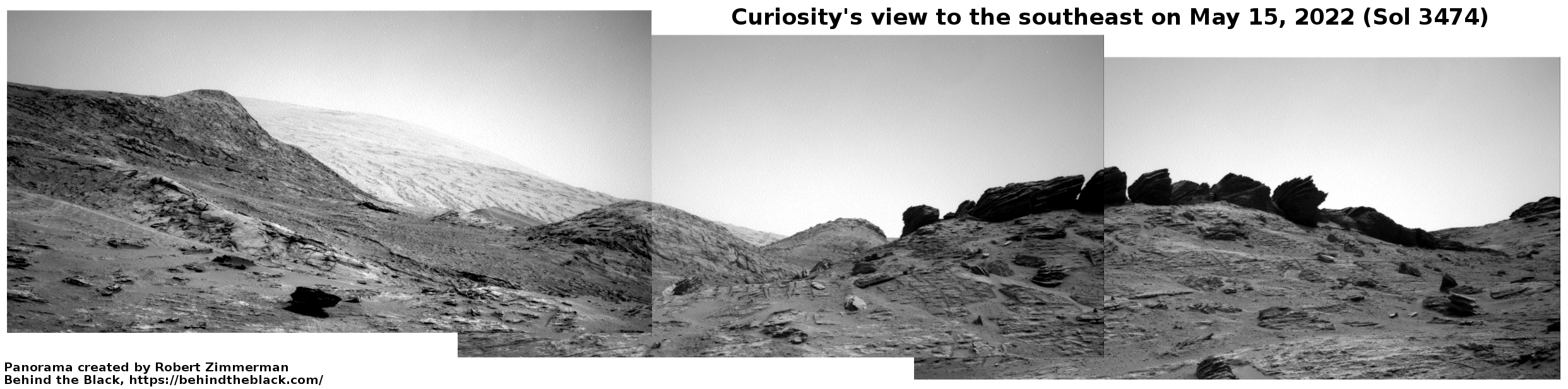
Click for full resolution. Original images can be found here, here, and here.
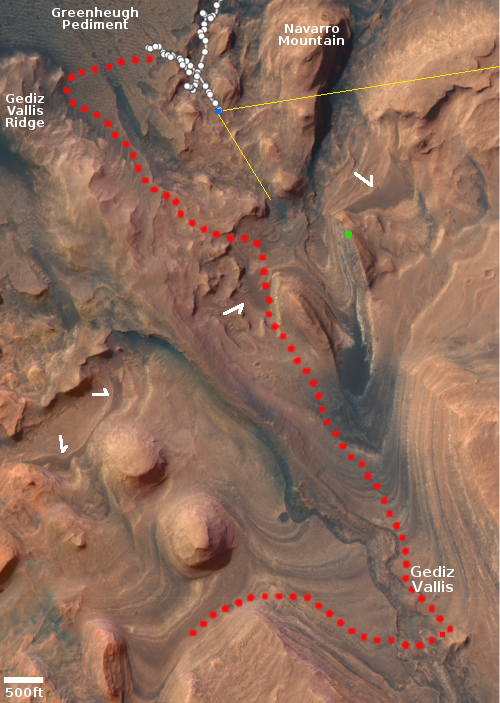
Click for interactive map.
Cool image time! The panorama above, created from three photos taken on May 15, 2022 by the right navigation camera on Curiosity, shows the rocky and hilly terrain directly ahead of the rover’s present course. In the far distance in the center left can faintly be seen the lower flanks of Mount Sharp itself. The dust in the winter air acts to partly obscure those distant slopes.
The overview map to the right shows us what we are looking at. The yellow lines are my rough guess at the terrain covered by the panorama. The blue dot marks Curiosity’s present position. The red dotted line the rover’s original planned route. The white arrows indicate one of the more interesting upcoming geological features, dubbed by scientists the “marker horizon,” a distinct layer found in many places on the flanks of Mount Sharp.
The green dot marks the approximate location of a recurring slope lineae, a place where the cliff is seasonally darkened by a streak that appears each spring and then fades.
The navigation panorama taken on May 15th also included four more shots covering terrain to the southwest, so what we see above is not necessarily where the rover is heading. The eventual goal is to get back to that red dotted line, but how the rover does so is apparently still being discussed by the science team. It appears they are trying to decide whether to head west again to reach Gediz Vallis Ridge, or instead cut south heading directly for Gediz Vallis.
Either way, that teethlike row of boulders in the near foreground is certainly impressive.
Tim Dodd of Everyday Astronaut has posted another 44 minute long interview with Elon Musk that took place as Musk gave him a recent tour at Boca Chica, walking around the base of the Starship and Superheavy boosters being prepared for that first orbital launch.
I have embedded the interview below. It has the following interesting take-aways:
Dodd also notes this video is the first of a new series.
» Read more
According to a study comparing the changes in the brain experienced during long term missions on ISS, it appears that the Russians have developed better protocols for preparing themselves for return to Earth that prevents the enlargement in one part of the brain seen in American astronauts.
From the link:
The study focused on 24 Americans, 13 Russians, and a small, unspecified number of astronauts from the ESA. The researchers collected MRI scans of the astronauts’ brains before and after they spent six months on the ISS (only 256 individuals have visited the space station).
After being in space, all the space travelers exhibited similar brain changes: cerebrospinal fluid buildup and reduced space between the brain and the surrounding membrane at the top of the head. The Americans, however, also had more enlargement in the regions of the brain that serve as a cleaning system during sleep, e.g. the perivascular space (PVS).
…The Russian astronauts did not exhibit enlarged PVS, suggesting there might be differences in protocol that are neuro-protective.
From the paper itself:
[Russian C]osmonauts undergo six lower body negative pressure (LBNP) sessions starting two weeks prior to landing, while NASA and ESA astronauts do not typically do it. LBNP induces caudal displacement of fluids from the upper body by placing the legs and pelvis in a semiairtight chamber with negative pressure.
An advanced resistive exercise device (ARED) is regularly used by space flyers to perform free weight exercises on the ISS, but the load and frequency of use are lower for [Russian] cosmonauts compared with NASA and ESA astronauts. Lifting heavy loads during resistive exercise is often accompanied by a brief Valsalva maneuver, inducing increased ICP and decreased cerebral blood flow and cerebrovascular transmural pressure, which can result in PVS fluid accumulation. Although the effects of LBNP and ARED on the brain during spaceflight are unknown, they could partly explain the different WM-PVS changes detected in astronauts and cosmonauts. We cannot exclude that other factors (e.g., diet) might play a role in this difference. Further studies are required to confirm these hypotheses.
Apparently two protocols are different that seem to help the Russians. First, the LBNP, developed by the Russians on their earlier space stations, is essentially a pair of pants that sucks fluids down to the legs, simulating the situation normally found on Earth, and thus reduces the fluids in the upper body sooner than landing. Second, doing exercises simulating lower weight loads apparently helps the Russians as well.
India’s space agency ISRO announced on May 13, 2022 that it had successfully tested the man-rated version of the solid rocket strap-on booster used on its GSLV Mark 3 rocket that will launch its first manned mission into space.
The 20 m long and 3.2 m diameter booster is the world’s second-largest operational booster with solid propellant. During this test, about 700 parameters were monitored and the performance of all the systems was normal.
Launch of the Gaganyaan manned mission is now targeting ’23.
Link here. Essentially, engineering teams are going through all the equipment that had problems during the first dress rehearsal that prevented its completion, and are fixing each.
Though NASA officials are targeting June for the next dress rehearsal, no date has been set yet. The agency is first waiting for this work on SLS to be completed.
Capitalism in space: The FAA announced on May 13, 2022 that it has approved use of Huntsville International airport for landing Sierra Space’s reusable Dream Chaser cargo mini-shuttle, once it begins flying.
The approval covers “up to eight reentry operations at the airport from 2023 to 2027.” Though Sierra Space will still need to get its launch license from the FAA before those flights can happen, it looks like the company is finally getting close to the first flight of Tenacity, its first Dream Chaser ship.
Capitalism in space: SpaceX today successfully launched another 53 Starlink satellites, the company’s second launch in less than 24 hours.
The most newsworthy component of this launch is that for first time since February 2, 2022, and only the fourth time since the beginning of 2020, the Falcon 9 rocket used a new first stage, which successfully landed on its drone ship in the Atlantic. It appears that SpaceX is adding about two new boosters per year to its first stage fleet, based on the evidence from these launches.
The leaders in the 2022 launch race:
20 SpaceX
15 China
6 Russia
3 Rocket Lab
2 ULA
The U.S. now leads China 28 to 15 in the national rankings, and the entire world combined 28 to 24.
Embedded below the fold in two parts.
To listen to all of John Batchelor’s podcasts, well worth your time, go here.
» Read more
An evening pause: The animation created to go with Troup’s jazzy version of this song is utter fantasy, imagining America as portrayed in culture, not reality. No matter. Sometimes the myth is better.
This also makes a nice pause to usher in the weekend.
Hat tip Mike Nelson.
Capitalism in space: SpaceX today successfully launched another 53 Starlink satellites, using a Falcon 9 first stage for the fifth time.
The first stage landed successfully on a drone ship.
The leaders in the 2022 launch race:
19 SpaceX
15 China
6 Russia
3 Rocket Lab
2 ULA
The U.S. now leads China 27 to 15 in the national rankings, as well as the entire world combined 27 to 24, leads that should widen in the next week with two more SpaceX launches as well as Boeing’s Starliner unmanned demo mission launch on ULA’s Atlas-5.