SpaceX goes full speed ahead on construction of Starship launchpad in Florida

Capitalism in space: Faced with regulatory delays caused by the Biden administration that are preventing further Starship launches from Boca Chica, SpaceX has accelerated construction of a new Starship launchpad at its facility in Florida.

Compared to SpaceX’s Starbase tower assembly [in Boca Chica], Florida Starship work appears to be proceeding at a similar pace. SpaceX began assembling the fourth Florida tower section about 30 days after starting the first, while Starbase took about 25 days to reach the same point. However, SpaceX does appear to be taking a slightly different approach for Pad 39A. On top of tower section assembly, SpaceX is constructing an extra four sets of the small concrete foundations and steel frames each tower section is assembled on, implying that Starship’s Florida launch tower could be almost entirely prefabricated before SpaceX begins to combine those sections.

Meanwhile, Boca Chica remains blocked. While the FAA says it will issue approval of its environment reassessment by the end of this month, SpaceX would be foolish to believe this. It has become very clear that the Biden administration has so far allowed the federal bureaucracy free rein to obstruct SpaceX. For the company to think things will suddenly change now is to be living a fantasy. It must move forward to satisfy its investors.

Worsening the situation in Texas was the decision by the Army Corps of Engineers to suspend the permit process on a request by SpaceX to expand its Boca Chica facility. It appears SpaceX failed to provide the Corps some required information, possibility because the company sees no reason now to complete this expansion if the Biden administration is going to ban Starship launches from Texas.

Faced with this political situation, Texas governor Greg Abbott yesterday claimed he is fighting the stonewalling by the Biden administration, but provide no specifics:

“What I am going to do if Biden interferes with the ability of SpaceX to launch from Boca Chica; I am going to be working every step of the way to make sure that they are going to be able to launch from Boca Chica. We heard the vision from Mr. Patel himself about what they are working on and our job is to make sure they are able to achieve their vision. And I have worked with Elon Musk very closely with regard to Tesla and the Giga factory in Austin, Texas. And we will be working with him very closely, every step of the way in Boca Chica for the future of SpaceX. We want that future and that vision to come from Boca Chica, from Brownsville, Texas.”

Allow me to translate this political blather into plain English: “I can’t or won’t do anything, but I am now going to make a superficial claim of action so my Texas constituents won’t get angry at me.”

It appears more and more that the first orbital test flight of Starship will take place in Florida, not Texas. And if so, it will be delayed for at least another six months because of this government interference.


8 comments

Europe removes its science instruments from future Russian lunar missions

The Europe Space Agency (ESA) yesterday announced that because of Russia’s invasion of the Ukraine it will no longer fly any science instruments on three upcoming Russian unmanned lunar probes.

ESA will discontinue cooperative activities with Russia on Luna-25, -26 and -27. As with ExoMars, the Russian aggression against Ukraine and the resulting sanctions put in place represent a fundamental change of circumstances and make it impossible for ESA to implement the planned lunar cooperation. However, ESA’s science and technology for these missions remains of vital importance. A second flight opportunity has already been secured on board a NASA-led Commercial Lunar Payload Services (CLPS) mission for the PROSPECT lunar drill and volatile analysis package (originally planned for Luna-27). An alternative flight opportunity to test the ESA navigation camera known as PILOT-D (originally planned for Luna-25) is already being procured from a commercial service provider.

In other words, Europe is switching to the many private American companies that are developing lunar landers for NASA science instruments. It has also signed onto a Japanese lunar mission. All have payload space, and all are willing to take the cash of a new customer.

Meanwhile, this is how Dmitry Rogozin responded to this decision:

“Good riddance! One less European dame off our backs, so Russia should go far with a lighter load,”

To sum this all up, when it comes to space, the Ukraine invasion has been Russia’s loss, and everyone else’s gain. Even if the invasion were to end today, it will take at least a decade to re-establish Russia’s business ties with the west.

Unfortunately, the invasion will cost the Ukraine as well. In making the above announcement ESA officials also said that it is looking for alternatives to the Ukrainian rocket engines used in its Vega-C upper stage.

At the news conference, ESA also discussed the future of its small Vega rocket, which relies on Ukraine-built engines in its upper stage. The engines are manufactured by the Ukrainian company Yuzhmash, which is based in the tech city of Dnipro. Although Dnipro has been under heavy bombardment, there have been no official reports so far about damage to Yuzhmash. It is, however, clear that ESA doesn’t expect to continue its partnership with the company in the future. “We now have sufficient engines for 2022 and 2023,” Aschbacher said. “We are working on options for 2024 and onwards based on different technologies.”

Daniel Neuenschwander, ESA’s director of space transportation, added: “We are working on engine opportunities within Europe and outside of Europe, which are either tested or, even better, already existing and fully qualified.”

Whether ESA completely breaks off its partnership with the Ukraine however is not certain. Should the war continue to favor the Ukraine, then it could be that partnership will continue. Only time will tell. Right now, it is simply prudent for ESA to look for more stable alternatives.

7 comments

Frozen lava in Mars’ volcano country

The frozen lava of the Athabasca flood plain
Click for full image.

Cool image time! The photo to the right, cropped and reduced to post here, was taken on January 28, 2022 by the high resolution camera on Mars Reconnaissance Orbiter (MRO). It shows what appears to be at first glance a relatively featureless plain with a lighter material covered by a patchwork of darker material.

Note however the lack of craters. Except for several faint depressions near the image’s center, there are none. And those depressions look like the expression of craters that have been covered by material. Is the two-toned surface here an expression of past lava flows? Or are we seeing an ice-sheeted plain, with the patches representing higher terrain above that plain?

The overview map below answers the question somewhat clearly.
» Read more

0 comments

Today’s blacklisted American: Seattle’s public schools to hold “listening tours” that exclude whites

Jim Crow celebrated in Seattle!
Seattle, home of the new Jim Crow!

“Segregation today, segregation tomorrow, segregation forever!” The public school system of the city of Seattle (SPS) has now scheduled a number of “listening sessions” for parents that, while designed to discuss ways to make the schools more welcoming, specifically exclude whites from the sessions, and divide the sessions by race and ethnicity.

SPS and the Seattle Council of Parent Teacher Student Association (PTSA) is hosting seven listening sessions with superintendent Dr. Brent Jones. The remote tour starts on April 19. One of the sessions is for Black families and a second for Native American families. They also recently added meetings specifically for East African and Black Immigrant Families, plus Multigenerational African American Black Families. The district and PTSA believe these race-exclusionary meetings promote equity. But they may represent illegal discrimination.

While there are sessions open to the general public, most of the sessions are segregated and discriminatory. And God forbid Seattle run a listening session just for whites! Why, that would be racism!

In a sense, this story out of Seattle is not news. I have repeatedly reported stories of Seattle government and corporate officials discriminating illegally against whites while unfairly providing their favorite minorities special privileges. Some examples:
» Read more

6 comments

A tour at rocket startup Phantom Space

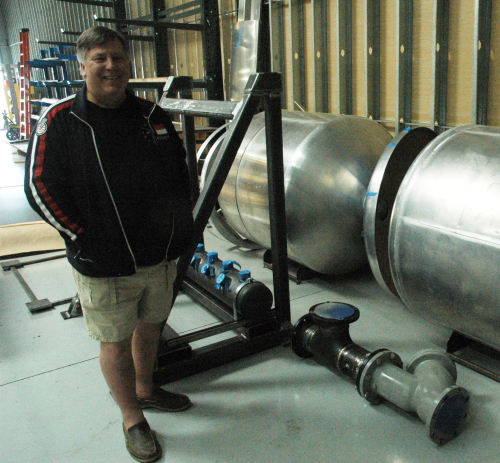
Jim Cantrell at Phantom

Creating a new rocket company is not something anyone can do. Nor is it something that even smart people can do, nonchalantly. The history of rocketry is littered with hundreds of attempts, almost all of which failed.

Jim Cantrell, pictured on the right standing next to one of the first test prototypes for a new rocket being made by his new company, Phantom Space, is one such person. In the mid-2010s Cantrell partnered with a number of others to found the company Vector, hoping to be one of the first smallsat rocket companies to launch a cheap and efficient rocket placing tiny satellites into orbit. At the time, Cantrell and Vector were racing neck and neck with Rocket Lab for the honor of being the first to do so.

While Rocket Lab succeeded in 2018, and has since completed more than twenty launches, Vector ended up on the ash heap of history, going bankrupt in 2019. The company’s failure was mostly due to problems with its rocket engine, which in turn caused one of its major investors to back out.

Cantrell however is apparently someone who does not take defeat quietly. Using what he had learned at Vector, in 2021 he started a new rocket company, Phantom Space, with a target date for its first test launch the summer of 2023.

Today Cantrell gave me a quick tour of Phantom’s operations here in Tucson.
» Read more

9 comments

Webb’s coldest instrument reaches operating temperature

The engineering team announced today that the mid-infrared instrument on the James Webb Space Telescope has now cooled to its operating temperature of -447 degrees Fahrenheit, less than 7 kelvin degrees above absolute zero.

On April 7, Webb’s Mid-Infrared Instrument (MIRI) – a joint development by NASA and ESA (European Space Agency) – reached its final operating temperature below 7 kelvins (minus 447 degrees Fahrenheit, or minus 266 degrees Celsius).

Along with Webb’s three other instruments, MIRI initially cooled off in the shade of Webb’s tennis-court-size sunshield, dropping to about 90 kelvins (minus 298 F, or minus 183 C). But dropping to less than 7 kelvins required an electrically powered cryocooler. Last week, the team passed a particularly challenging milestone called the “pinch point,” when the instrument goes from 15 kelvins (minus 433 F, or minus 258 C) to 6.4 kelvins (minus 448 F, or minus 267 C).

Before science operations can begin the instruments still need further calibration and testing. Expect the first infrared images sometime in the next month or so.

4 comments

On the road

Posting will resume this afternoon and evening, as I am leaving now for a tour today of a new rocket company based here in Tucson. Should be most interesting. Details to follow.

2 comments

Space Perspectives unveils luxurious interior of Neptune high altitude balloon

Capitalism in space: Space Perspectives has now unveiled the high class stateroom interior that it plans to put inside its Neptune high altitude balloon that will take tourists to 30+ miles altitude.

Space Perspective just released artist’s illustrations of the interior of Spaceship Neptune, which will include 360-degree panoramic windows and even a restroom with a view. The announcement Tuesday (April 12) coincided with the anniversary of the first human spaceflight by cosmonaut Yuri Gagarin in 1961.

Based on the imagery, Spaceship Neptune’s cabin appears to come in at least a couple of configurations. One has reclining seats, for example, while another with couches can accommodate a “more intimate dinner for two or special event,” Space Perspective representatives said in a statement on Tuesday.

Space Perspective will provide food and beverage services, and the capsule features mood lighting that can be dimmed to see stars or the curvature of Earth outside. Also included in the capsule’s “Space Lounge” will be a telescope, interactive screens and decorations such as floor lamps and plants to “remind us of the interconnected nature of our planet,” the company added.

The company hopes to begin commercial flights by ’24, each of which will last about six hours. Tickets are priced at $125K each, with the company saying it already has 600 people on its waiting list.

5 comments

Astronomers confirm comet with largest nucleus ever found

Using the Hubble Space Telescope astronomers determined that the nucleus of Comet Bernardinelli-Bernstein (C/2014 UN271) is about 80 miles wide, making it the largest comet on record.

The estimated diameter is approximately 80 miles across, making it larger than the state of Rhode Island. The nucleus is about 50 times larger than found at the heart of most known comets. Its mass is estimated to be a staggering 500 trillion tons, a hundred thousand times greater than the mass of a typical comet found much closer to the Sun.

The behemoth comet, C/2014 UN271 (Bernardinelli-Bernstein) is barreling this way at 22,000 miles per hour from the edge of the solar system. But not to worry. It will never get closer than 1 billion miles away from the Sun, which is slightly farther than the distance of the planet Saturn. And that won’t be until the year 2031.

The previous record holder is comet C/2002 VQ94, with a nucleus estimated to be 60 miles across. It was discovered in 2002 by the Lincoln Near-Earth Asteroid Research (LINEAR) project.

This measurement does have a great deal of uncertainty, as Hubble cannot yet resolve the nucleus, and thus its diameter was determined by computer models based on the size of the comet’s coma, or surrounding atmosphere.

The comet itself has an orbit 3 million years long, which means it has zipped into the inner solar system many many times. The reason its nucleus remains so large is because its orbit never gets that close to the Sun, so its material does not get burned off so much with each perihelion. That it exists suggests there could be many such large comets which never dip close to the Sun.

4 comments
1 141 142 143 144 145 192