MAVEN and Al-Amal scientists sign agreement to collaborate

Scientists running the Mars orbiters MAVEN (from NASA) and Al-Amal (from the United Arab Emirates [UAE]) have signed an agreement to share data and — more importantly — coordinate their observations of the Martian atmosphere.

A new partnership that encourages the sharing of data between NASA’s MAVEN (Mars Atmosphere and Volatile Evolution) project and the Emirates Mars Mission’s (EMM) Hope Probe (Al-Amal in Arabic) will enhance scientific returns from both spacecraft, which are currently orbiting Mars and collecting data on the Red Planet’s atmosphere. The arrangement is expected to add value to both MAVEN and EMM, as well as the scientific communities involved in analyzing the data the missions collect.

MAVEN went into orbit around Mars in 2014. Its mission is to investigate the upper atmosphere and ionosphere of Mars, offering an insight into how the planet’s climate has changed over time. “MAVEN and EMM are each exploring different aspects of the Martian atmosphere and upper-atmosphere system,” said Shannon Curry, MAVEN principal investigator from the University of California, Berkeley. “Combined, we will have a much better understanding of the coupling between the two, and the influence of the lower atmosphere on the escape to space of gas from the upper atmosphere.”

The EMM Hope Probe, which went into Mars orbit in 2021, is studying the relationship between the upper layer and lower regions of the Martian atmosphere, giving insight into the planet’s atmosphere at different times of the day and seasons.

What this agreement means is that the two science teams can more quickly match up the data from both orbiters, and figure out the relationships between both.

4 comments

Pushback: Black waitress sues NYC mayor over COVID shot mandate

Virginia Alleyne, blacklisted by the Democratic Party
Virginia Alleyne, blacklisted by
the Democratic Party

Don’t comply! A waitress who formerly worked at Yankee Stadium but lost her job because of the COVID shot mandate imposed by New York City mayor Eric Adams is now suing him and the city. Her suit is also fueled because of Adams’ arbitrary decision to cancel the mandate for wealthy athletes.

Virginia Alleyne’s Manhattan Supreme Court lawsuit claims Hizzoner’s exemption for athletes and performers is “arbitrary and capricious” and an “abuse of discretion.”

“For him to allow millionaires to work and to punish the workers who are the lifeblood of this city is just horrendous,” Alleyne told The Post. “So many workers have lost their jobs, yet he’s rewarding the millionaires because he doesn’t want them coming after him,” she continued. “We are being punished by a blatant and egregious double standard.”

The 57-year-old Upper East Side single mom said she was placed on unpaid leave from her job as a waitress at the stadium’s high-end restaurant Legends Suite Club in September because she is unvaccinated.

This quote from her lawyer illustrates quite starkly how incredibly arbitrary and capricious Adams’ edict is:
» Read more

9 comments

ULA orders 116 rocket engines from Aerojet Rocketdyne for its Vulcan upper stage

Capitalism in space: In order to meet its contract with Amazon to launch a lot of Kuiper satellites, ULA has now ordered 116 rocket engines from Aerojet Rocketdyne for the Centaur upper stage of its new and as-yet unlaunched Vulcan-Centaur rocket.

Aerojet said this was the company’s largest ever contract for the RL10 engine. The large purchase of rocket engines comes on the heels of Amazon’s announcement April 5 that it selected Arianespace, Blue Origin and ULA to launch up to 3,236 satellites for its Project Kuiper broadband constellation.

CEO Tory Bruno said ULA plans to fly Vulcan’s first mission late in 2022. Winning the Amazon deal would more than double the annual rate of Vulcan launches to as many as 25 per year, and ULA will ramp up production to meet the demand, Bruno said last week at the Space Symposium.

ULA’s engine choice for Vulcan’s upper stage dates back to 2018 when it selected a variant of the RL10, the same engine used to power the upper stages of ULA’s legacy rockets Atlas 5 and Delta 4 Heavy. Over the past 60 years, more than 450 RL10 engines have flown on various ULA heritage vehicles.

Meanwhile, ULA hopes to get its first BE-4 engines from Blue Origin, needed for the Vulcan first stage, this summer. Vulcan-Centaur cannot make its first launch until it gets some flightworthy BE-4 engines, and these are now three years behind schedule.

9 comments

Interstellar meteor impacted Earth in 2014

According to classified military data just released, it appears that an asteroid from interstellar space impacted the Earth in 2014, with some of its pieces possibly hitting the ocean in the south Pacific.

The meteor ignited in a fireball in the skies near Papua New Guinea, the memo states, and scientists believe it possibly sprinkled interstellar debris into the South Pacific Ocean. The confirmation backs up the breakthrough discovery of the first interstellar meteor—and, retroactively, the first known interstellar object of any kind to reach our solar system—which was initially flagged by a pair of Harvard University researchers in a study posted on the preprint server arXiv in 2019.

Amir Siraj, a student pursuing astrophysics at Harvard who led the research, said the study has been awaiting peer review and publication for years, but has been hamstrung by the odd circumstances that arose from the sheer novelty of the find and roadblocks put up by the involvement of information classified by the U.S. government.

The speed and angle in which the object hit the atmosphere are why the scientists believe it comes from outside the solar system.

Siraj is actually hoping to mount a mission to recover parts of this asteroid, something that is extremely unlikely. First, the meteor itself was small, so it likely all burned up in re-entry. Second, even if pieces survived, finding them on the bottom of the Pacific is likely impossible.

5 comments

Russia backs off its threats to leave ISS partnership

In several short news posts on Russia’s state-run press today, the Putin government indicated that it has backed off from its threats to end the partnership at ISS quickly.

First, Roscosmos’s head, Dmitry Rogozin, announced that it will proceed with its barter deal with NASA and allow astronauts from NASA and others to fly on Soyuz while Russian astronauts fly on Dragon and eventually Starliner.

“Why give up something that is useful? Anna Kikina [Russian woman cosmonaut] flew to Houston (USA) to familiarize herself with the design of the modules of the ISS American segment and the Crew Dragon spacecraft whose crew she may join. On our part, we are not ruining anything and keep to preliminary accords, although we continue waiting for the government’s decision on the program of cross flights,” Rogozin explained.

Second, Rogozin made statements that suggested Russia will maintain its full partnership on ISS through ’24, and maybe beyond.

Now Russia has to set up its mind about the year until which it cooperates on the ISS project, Rogozin said. “Yes, the Americans want it [cooperation] to last until 2030. The previous talks said that it would be until 2028. But let me repeat again that we have to decide on the main thing: to continue cooperation on the ISS or switch to the ROSS [Russian Orbital Service Station]. Subsequently, we will decide on what to do with our two new modules on the ISS that we docked last year,” Rogozin said.

In other words, Russia ain’t going no where. It might decide eventually to launch a new core module for their own station, and then transfer the newer modules on ISS to it, but none of this will happen until a final date for ISS’s deorbit is established.

Based on Rogozin’s earlier bombastic threats, I had expected Russia to take a harder position. It appears cooler heads in Roscosmos convinced Rogozin and Putin that in terms of cost and safety, a quick exit made no sense.

This decision to back off was also probably influenced by Russia’s losses in the Ukraine. It is no longer in a strong negotiating position in anything, has lost almost all its economic partnerships with the west, and thus does not wish to lose the one partnership that remains, on ISS.

16 comments

Curiosity retreating from Greenheugh Pediment

Overview map
Click for interactive map.

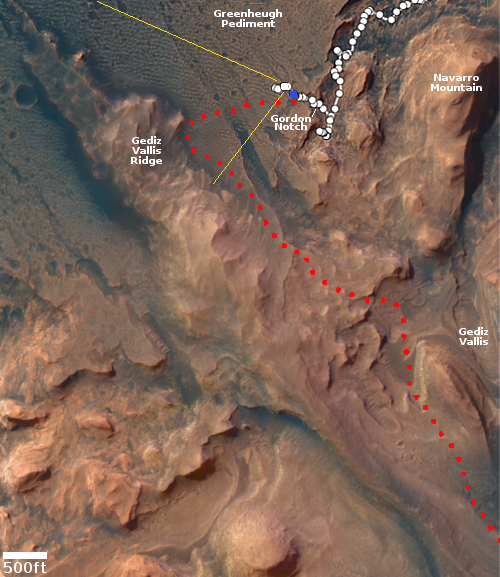
Because of the incredible roughness of the ground on the Greenheugh Pediment, the science team for the rover Curiosity has decided to make a major change in their route. Rather than continue their traverse across this terrain, as planned for years, they have decided to back off in order to protect Curiosity’s dinged wheels, and find a more friendly route up Mount Sharp.

“It was obvious from Curiosity’s photos that this would not be good for our wheels,” said Curiosity Project Manager Megan Lin of NASA’s Jet Propulsion Laboratory in Southern California, which leads the mission. “It would be slow going, and we wouldn’t have been able to implement rover-driving best practices.”

The gator-back rocks aren’t impassable – they just wouldn’t have been worth crossing, considering how difficult the path would be and how much they would age the rover’s wheels.

So the mission is mapping out a new course for the rover as it continues to explore Mount Sharp, a 3.4-mile-tall (5.5-kilometer-tall) mountain that Curiosity has been ascending since 2014. As it climbs, Curiosity is able to study different sedimentary layers that were shaped by water billions of years ago. These layers help scientists understand whether microscopic life could have survived in the ancient Martian environment.

The plan is to retrace the rover’s path back through Gordon Notch and then head uphill though another gap that will take it directly onto the next sedimentary layer, dubbed the sulfate unit. On the overview map above, the red dotted line shows the long-planned route. The yellow lines indicate the area seen in the panorama I posted on April 6th, when Curiosity was at its farthest into the pediment. The blue dot marks Curiosity’s position two days ago. You can see that it has retreated backwards.

This change means the scientists will likely not get a close look at Gediz Vallis Ridge. However, it also means the rover will likely reach Gediz Vallis much sooner that previously planned.

0 comments

Neptune’s cooling when it should be warming

Neptune since 2006

The uncertainty of science: Observations of Neptune during the past seventeen years using the Very Large Telescope have shown the planet mostly cooling during this time period, even though Neptune was moving into its summer season.

Astronomers looked at nearly 100 thermal-infrared images of Neptune, captured over a 17-year period, to piece together overall trends in the planet’s temperature in greater detail than ever before. These data showed that, despite the onset of southern summer, most of the planet had gradually cooled over the last two decades. The globally averaged temperature of Neptune dropped by 8 °C between 2003 and 2018.

The astronomers were then surprised to discover a dramatic warming of Neptune’s south pole during the last two years of their observations, when temperatures rapidly rose 11 °C between 2018 and 2020. Although Neptune’s warm polar vortex has been known for many years, such rapid polar warming has never been previously observed on the planet. “Our data cover less than half of a Neptune season, so no one was expecting to see large and rapid changes,” says co-author Glenn Orton, senior research scientist at Caltech’s Jet Propulsion Laboratory (JPL) in the US.

The sequence of photos above show that change over time. Lower latitudes generally get darker, or cooler, while the south pole suddenly brightens, getting hotter, in 2020.

The scientists have no idea why this has happened, though they have theories, ranging from simple random weather patterns to the influence of the Sun’s sunspot cycle.

8 comments

Rocket Lab breaks ground on Neutron rocket factory

Capitalism in space: Rocket Lab yesterday broke ground on the construction of its larger proposed Neutron rocket factory at Wallops Island, Virginia, right next door to where the company plans to launch it.

The 250,000 square foot Neutron Production Complex is being constructed on a 28-acre site adjacent to the NASA Wallops Flight Facility and Mid-Atlantic Regional Spaceport on Virginia’s Eastern Shore. The complex will support Neutron production, assembly, and integration, and is expected to bring up to 250 highly-skilled roles to the region. Construction will also soon begin on a launch pad for Neutron at the southern end of Wallops Island, near Rocket Lab’s existing launch pad for the Electron rocket.

Neutron will largely reusable, its first stage returning to Earth for reuse, and carrying with it the skin of the second stage. The design combines this skin with the fairings that protect the payload and second stage engine, so that only the second stage engine is lost in orbit.

4 comments

ISRO hires company to build future PSLV rockets

Capitalism in space: For the first time, India’s space agency ISRO is about to hire a private company to build five PSLV rockets, rather than supervise the construction in-house.

Hindustan Aeronautics Limited (HAL) and L&T consortium has emerged as the lowest bidder to make 5 Polar Space Launch Vehicles (PSLVs) for ISRO. “The company is the lead partner with L&T sharing the work. Other vendors too will be involved with the consortium in the manufacturing of the launch vehicles (LVs). However, the contract is yet to be formalised/ awarded,” HAL said in a statement.

If all goes as planned, the first rockets will be delivered late in ’24.

This contract changes less than it seems, though it is a step in the right direction. ISRO has for years hired private subcontractors to build its rockets and components. What is different now is that it appears that HAL is now the lead contractor, not ISRO. HAL however does not appear to own the rockets it builds, and thus will not be able to build more to sell launches to others. Until this happens, India’s space industry will remain wholly government run.

1 comment

Today’s blacklisted American: News staffers at CBS demand network blacklist Republican

CBS NEWS: Home of blacklisting

The new dark age of silencing: When the news division at CBS recently decided to hire Mick Mulvaney, a former Republican congressman and a former chief of staff for President Trump, there was a outraged revolt among the network’s news staff, demanding that the hiring be cancelled and that CBS blacklist all such partisan Republicans.

[Jeremy Barr, liberal Washington Post media reporter,] “obtained” a recording of a staff meeting led by CBS News co-president Neeraj Khemlani. Surely, the staffer recording this meeting was outraged that Khemlani said “getting access to both sides of the aisle is a priority because we know the Republicans are going to take over, most likely, in the midterms.”

Anonymous CBS News Democrats were alarmed “the network was jeopardizing its long history of journalistic excellence.” And you thought Dan Rather already did that.

“I know everyone I talked to today was embarrassed about the hiring,” said a CBS News employee who “spoke on the condition of anonymity because they were not authorized to comment.” This is the most ridiculous use of anonymous sourcing – to protect liberals while they publicly campaign against their bosses.

» Read more

47 comments

Perseverance arrives at Three Forks at the base of Jezero Crater’s delta

Panorama of delta in Jezero Crater
Original images found here, here, here, and here. Click for full resolution.

Overview map
Click for interactive map.

Cool image time! The panorama above was created from four navigation camera images taken by the Mars rover Perseverance on April 10th. Because the lens on Perseverance’s navigation cameras produce slightly curved images which are taken in pairs, the panorama is made of two parts, each a pair perfectly matched images looking from a different angle. I have overlapped the pairs but as you can see, the match at the center is imperfect. While this does not produce a single smooth image, the two paired panoramas show the foot of the entire delta that had flowed into Jezero crater in the past and is the prime geological target of the rover. What is it made of? What caused it to flow into the crater? When did it do it? How was Mars different when it did so? Was the crater wet? Was the delta mud when it flowed, or was it sediment under water, pushed out by that flowing water?

The location map to the right is taken from the “Where is Perseverance?” webpage but annotated to show the planned routes of both Perseverance and Ingenuity, as shown by the tan dashed lines. The red dot marks Perseverance present location, the green dot Ingenuty’s. The yellow lines the approximate area covered by the panorama.

What next? Expect Perseverance to move as close to the base of the delta’s cliff as possible and spend at least several months studying it. Ingenuity meanwhile will be flown to the west to scout the various hollows that are potential routes for Perseverance to climb up onto the delta.

0 comments
1 142 143 144 145 146 192