Rogozin: Lift sanctions by end of March or else!

Dmitry Rogozin, the head of Russia’s Roscosmos space corporation that runs all of that nations aerospace industry, yesterday demanded that Europe and the U.S. lift its sanctions against Russia by end of March or he would take further action against them.

“We will wait until the end of March. The lack of response or a negative response would be a basis for our decision,” he said, without specifying what kind of decision it would be.

According to the official, the space corporation was not going to yield to the sanctions.

One immediately asks, what happens at the end of March? Why time further space-related actions then?

Well, the only area in which Russia is still cooperating with the west in space is on ISS. At the end of March, Russia will bring home American astronaut Mark Vande Hei using its Soyuz capsule. This suggests that once Vande Hei comes home, Rogozin will announce that Russia will no longer fly any western astronauts to ISS on its rockets or capsules. He might also further announce actions that will accelerate the end of the ISS partnership, including laying out Russia’s schedule for adding modules to its half of ISS and then detaching it from the station.

If so, good. Such an action will bring clarity to the station’s remaining days, forcing NASA to make sure the station can function after the Russian half is gone. It will probably quicken the development of Axiom’s modules to the station, and might encourage the private construction of other modules to pick up the slack left by the Russian exit.

16 comments

SpaceX launches another 53 Starlink satellites

Capitalism in space: SpaceX tonight successfully used its Falcon 9 rocket to launch another 53 Starlink satellites into orbit.

The first stage completed its 12th flight, a new record. The fairings were also reused, one half for the fourth time and the other for the second time. SpaceX continues to maintain a one launch per week schedule in 2022.

At posting the upper stage still had one more engine burn to insert itself into the final orbit, followed by satellite deployment.

The leaders in the 2022 launch race:

11 SpaceX
6 China
3 Russia
2 ULA

The U.S. now leads China 17 to 6 in the national rankings.

11 comments

Today’s blacklisted American: Man who found Hunter Biden’s laptop harassed, threatened, and driven to bankruptcy

Today's modern witch hunt
A witch hunt: The mainstream media’s modern approach to discourse.

Persecution is now cool! The computer repair shop owner who found and made public Hunter Biden’s laptop prior to the election has found himself harassed, threatened, and even driven to bankruptcy because of that entirely legal act.

The Delaware computer repair shop owner who alerted the FBI to Hunter Biden’s infamous laptop before ultimately taking it to Rudy Giuliani says he’s faced harassment from Big Tech, the IRS and other government agencies ever since, and now faces bankruptcy.

“I was getting a lot of death threats,” John Paul Mac Isaac said. “I had to have a Wilmington trooper parked in front of my shop all the time.

“There were multiple situations where people came in and you could tell they were not there to have a computer fixed. And if there were not other people in the shop, I don’t know what would have happened,” he told The Post. “I was having vegetables, eggs, dog s–t thrown at the shop every morning.”

The threats and violence got so severe in November 2020 that Isaac had to shutter his shop and flee Delaware and live in hiding for more than a year. When he later tried to file for unemployment Delaware bureaucrats kept closing his case without resolution so that he received no checks and had use some of the money in his 401K to pay his bills. The Delaware unemployment department only finally acted after he sent a letter to the state’s governor.
» Read more

16 comments

The journey so far of China’s Zhurong Mars rover

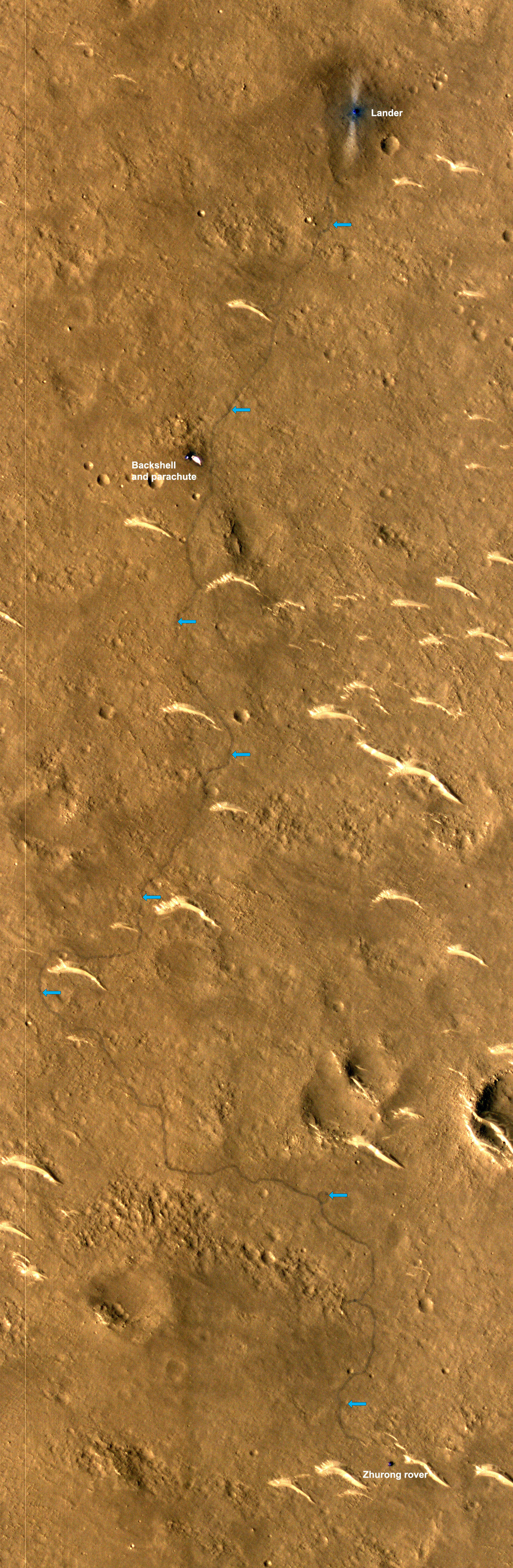
Zhurong's journey on Mars, as seen by MRO
Click for full image.

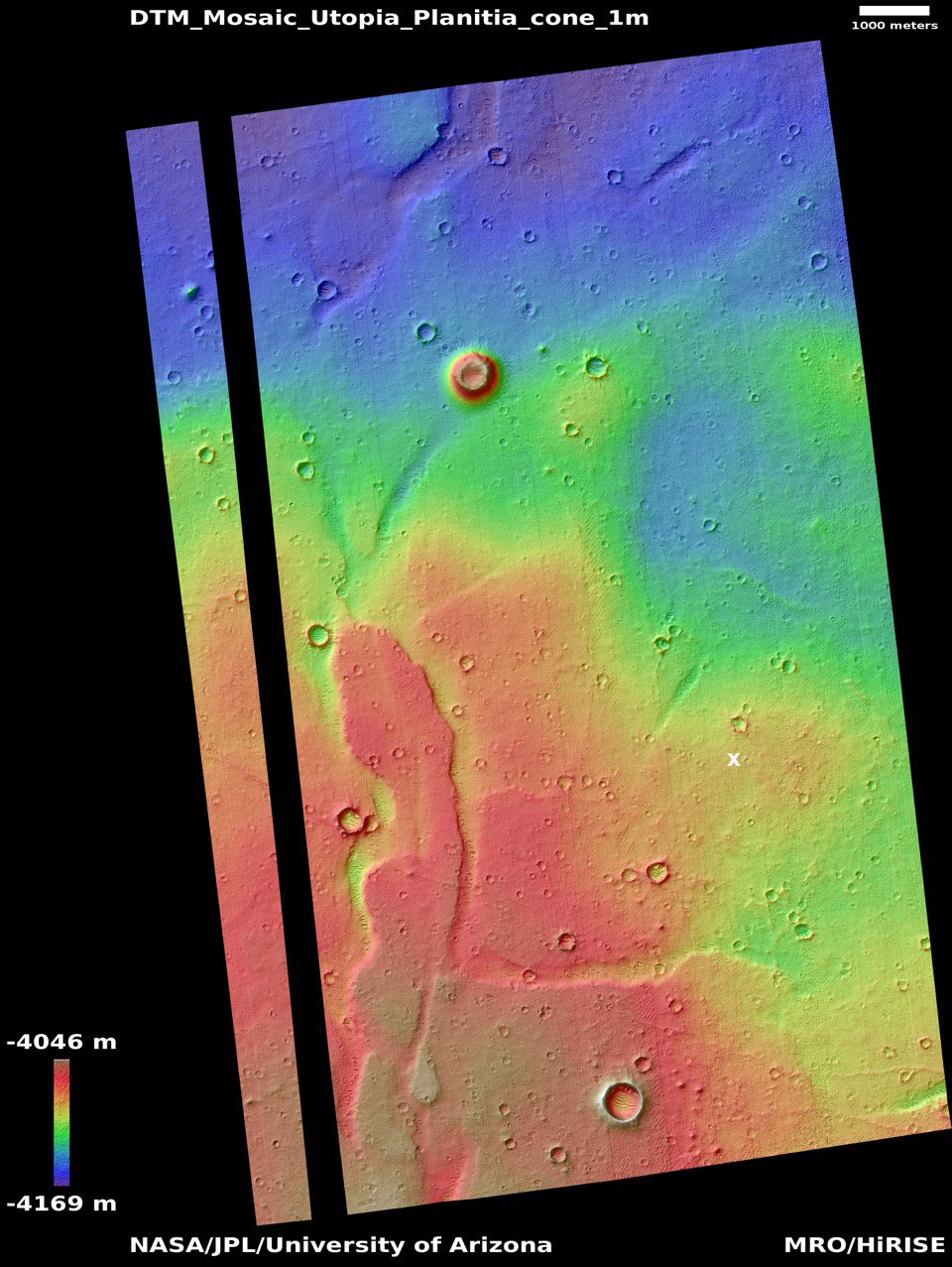
Elevation map and wider overview
Click for full image.

Cool image time! The science team for the high resolution camera on Mars Reconnaissance Orbiter (MRO) today released a new orbital photo that shows the entire journey on Mars of China’s Zhurong rover, since it landed in May 2021. That image, reduced to post here, is to the right. From the caption, written by Alfred McEwen of the Lunar & Planetary Laboratory in Arizona:

This HiRISE image, acquired on 11 March 2022, shows how far the rover has traveled in the 10 months since it landed.

In fact, its exact path can be traced from the wheel tracks left on the surface. It has traveled south for roughly 1.5 kilometers (about 1 mile). This cutout highlights the rover and the rover’s path (with contrast enhanced to better reveal the tracks).

The white curves that the rover has apparently been inspecting as it moved south are called megaripples, mid-size sand dunes from three to six feet in height that are generally found to be inactive, though not always. From a recent report about Zhurong’s findings:

“The examples Zhurong has visited appear very bright-toned in satellite images taken from orbit, and the team thinks that this is because the megaripples are covered with a layer of very fine dust,” says Matt Balme at the Open University, UK, who wasn’t involved in the analysis. “This means these features are probably currently inactive, as any present-day windblown sand would tend to remove the dust.”

That report used data from the rover’s first sixty days on Mars, after it had passed its first megaripple and had just reached the parachute and backshell. It does not include any later data in the past eight months, as Zhurong rolled past another nine megaripples and several small craters.

It also doesn’t include any data obtained as the rover skirted the wide apron that surrounds the large depression in the lower left. That depression looks like a crater at first glance, but because it appears to be on top of a mound it could instead by an old pitted cone. There are a lot of these cones in this region of the northern lowland plains of Mars, and planetary scientists really want to know whether they were formed from erupting ice, lava, or mud.

The Chinese have so far not released any data on what they have found in these later travels. We shall have to wait for further published papers.

The wider elevation overview map to the right, first published on August 24, 2021 and cropped and annotated to post here, shows Zhurong’s future potential geological targets to the south. The cone to the southwest as well as the nearest scarp to the south are probably the rover’s primary goals.

Though the released results have hinted that the geology here was shaped by both wind and water, direct evidence for water has not been found, or revealed by the Chinese. Zhurong has a radar sensor that could detect evidence of near surface underground ice, if it was there. As far as I know at this point, no results from that instrument have as yet been published.

2 comments

ESA makes official the split with Russia

At a press conference yesterday officials from the European Space Agency (ESA) officially announced that the partnership with Russia to launch its Franklin rover to Mars has ended, and the launch will not happen in ’22.

The program is not cancelled, but “suspended.” ESA is looking for alternatives to get its Rosalind Franklin rover to the Red Planet. Earth and Mars are correctly aligned for launches only every 26 months, so the next opportunities are in 2024, 2026, and 2028. Aschbacher said it is not feasible to be ready by 2024, so it will be one of the later dates.

Since Russia had been providing both the launch rocket and Mars lander, ESA cannot simply find a different rocket. It needs to come up with its own lander, or find someone else to build it. For example, one of many new private American companies building lunar landers for NASA might be able do it, though ESA would likely prefer a European company. If it did decide to go with an American company, it would certainly not hire one until it succeeds in completing successfully at least one planetary landing.

The officials also outlined ESA’s need to find new launch rockets for many other missions it had planned to launch on Russia’s Soyuz-2 rocket. That need will also be an opportunity for American rocket companies, but more significantly it could be a blessing for Arianespace’s Ariane 6 rocket. The Ariane 6 has struggled to find customers because of its high cost. The loss of Russia as a launch option will likely drive some ESA business to it.

Roscosmos’ head Dmitry Rogozin in turn announced that it will go ahead with its own Mars mission, using the lander on an Angara rocket

“True, we will lose several years, but we will replicate our landing module, make an Angara rocket for it and carry out this research mission from the newly-built Vostochny spaceport on our own. Without inviting any ‘European friends’, who prefer to keep their tails between their legs the moment they hear their American master’s angry voice,” Rogozin said on his Telegram channel.

Whether Russia will actually do this is questionable. For the last two decades Roscosmos has promised all kinds of numerous planetary missions and new rockets and new manned capsules, none of which has ever seen the light of day. To make such a thing happen now seems even more doubtful.

4 comments

Elon Musk targets 2029 for first Starship manned mission to Mars

Capitalism in space: In a tweet today Elon Musk announced 2029 as his present target date for the first Starship manned mission to Mars.

This target date should not be considered firm, though it must be taken seriously. Musk’s past predictions tended to be optimistic, but also not unrealistic. If Starship development proceeds at the pace SpaceX is presently maintaining, this date is wholly doable.

The article at the link also said that the first Starship orbital test flight “is expected to take place within the next month.” That certainly matches with Musk’s previous statements, but ignores the bureaucratic delays from the FAA that at the moment prevent it from happening.

5 comments

Russia launches three Russians to ISS on Soyuz-2 rocket

Russia today successfully launched three astronauts to ISS on its Soyuz-2 rocket, the first time the crew on a Russian launch to ISS was entirely Russian.

The docking at the station is expected three hours after launch.

The reason for the all-Russian crew has nothing to do with the Ukraine War. Initially NASA and Roscosmos were negotiating to have an American on this flight as part of a barter deal, whereby astronauts from the two space agencies fly on each other’s capsules in an even trade to gain experience with each. In October both agencies agreed to hold off the first barter flight until ’22. With the on-going sanctions however it is now unknown whether that barter deal will go forward.

The leaders in the 2022 launch race:

10 SpaceX
6 China
3 Russia
2 ULA

The U.S. still leads China 16 to 6 in the national rankings, with SpaceX having a scheduled Starlink launch this evening.

4 comments

Sierra Space signs Mitsubishi as partner in private Orbital Reef space station project

Capitalism in space: Sierra Space has now partnered with Japan’s Mitsubishi for developing technology to be used on the private commercial Orbital Reef space station project.

The companies did not elaborate on the technologies they will consider for Orbital Reef under the agreement. MHI does have extensive experience in International Space Station operations as the manufacturer of the Kibo laboratory module, which was installed on the station in 2008. The company also built the HTV cargo spacecraft and H-2 launch vehicle that launched those spacecraft to the station.

…Sierra Space’s role in Orbital Reef includes providing inflatable modules called the Large Integrated Flexible Environment (LIFE) Habitat. The company’s Dream Chaser vehicle under development will transport cargo and crew to and from the station.

A consortium led by Blue Origin announced Orbital Reef last October. In addition to Blue Origin and Sierra Space, Boeing will provide a science module, CST-100 Starliner commercial crew vehicle and support for station operations, while Redwire Space will handle microgravity research and manufacturing, payload operations and deployable structures.

This deal suggests that the project wants more experience in its stable. Also, by partnering with Mitsubishi, it likely garners political support in Japan.

0 comments

Orbit Fab wins contract to outfit U.S. military satellites for refueling

Capitalism in space: Orbit Fab has won a $12 million contract to outfit U.S. military satellites with its refueling port.

The funding includes $6 million from the U.S. Air Force and U.S. Space Force, and $6 million from Orbit Fab’s private investors. The contract is for the integration of Orbit Fab’s fueling port, called RAFTI — short for rapidly attachable fluid transfer interface — with military satellites. The port allows satellites to receive propellant from Orbit Fab’s tankers in space.

At present there are no refueling missions scheduled, simply because the satellites that could be refueled are not yet in orbit. Orbit Fab and the military however are discussing an in-orbit demo mission.

0 comments

SLS arrives at launch site

NASA’s SLS rocket finally arrived at its launch site early this morning after an 11 hour journey on its mobile launcher from the Vehicle Assembly Building (VAB), in preparation for a dress rehearsal countdown on April 3, 2022.

The approximately two-day test will demonstrate the team’s ability to load cryogenic, or super-cold, propellants into the rocket, conduct a launch countdown, and practice safely removing propellants at the launch pad. After wet dress rehearsal, engineers will roll the rocket and spacecraft back to the Vehicle Assembly Building for final checkouts before launch.

The launch is presently scheduled for late May, but we must not be surprised if it is delayed to June, or July.

1 comment
1 154 155 156 157 158 192