MonaLisa Twins & Mike Massé – Africa
An evening pause: Hat tip Chris Boswell.
An evening pause: Hat tip Chris Boswell.
Much of the reporting about the war in the Ukraine has been either based on individual anecdotal events, or propaganda being churned out by both sides in an effort to influence events and public opinion to their cause.
All of this information is generally useless in determining what is really happening.
A better way to understand the actual state of the war, who is winning and who is not, is to find sources that don’t look at individual events, but try to compile all the reliable and confirmed stories into an overall whole.
One source that does this routinely and with great success is the Institute for the Study of War. I have relied on their maps and reports for a clear understanding of the various Middle Eastern conflicts now for years. One week ago I posted a link to the Institute’s March 9, 2022 update on the Ukraine War, because I believed it provided the best review, well documented and sourced, covering Russia’s entire military operation in the Ukraine, as well as the effort of the Ukraine to fight back. At that time, the known data strongly suggested that though Russia appeared to be very slowly capturing territory, it was also meeting heavy resistance everywhere. Furthermore, Russia’s effort was hampered by a lagging logistics and supply operation. All told, this data suggested that Russia’s take-over of the Ukraine was going to take a lot longer than expected by Putin and his generals, and might even get bogged down into a long quagmire similar to what the Soviet Union experienced in Afghanistan in the late 1970s.
A week has passed, and the Institute has issued several updates since. By comparing today’s March 17th update with last week’s we can quickly get a sense of what has happened in that week.
» Read more

How the CDC determines its mask policies
Don’t comply: Ten pilots from three different American airlines — American, Southwest, and JetBlue — have now sued the CDC over the Biden administrations mask mandate requiring everyone to wear masks on airplanes.
A group of commercial airline pilots filed a lawsuit against the Centers for Disease Control and Prevention (CDC) in an attempt to lift the federal transportation mask mandate.
In court paperwork, the 10 commercial airline pilots – who work for American JetBlue and Southwest – argued that the CDC issued an order “Requirement for Persons to Wear Masks While on Conveyances & at Transportation Hubs” on Feb. 1, 2020 “without providing public notice or soliciting comment.”
The pilots are asking the court to “vacate worldwide the FTMM (federal transportation mask mandate)” calling the move an “illegal and unconstitutional exercise of executive authority.”
Biden’s edict was first imposed on February 1, 2021, shortly after he took power. It has been extended several times since, the most recent extension keeping it in force through April 18, 2022. At no time, however, has any data been put forth by the CDC demonstrating that the required masks accomplish anything, while we already have decades of data showing that the masks are useless against viruses like the Wuhan flu.
This new lawsuit is the eighteenth filed against the mandate, though it is the first filed by those who work on the planes.
The pilots claim above that the CDC did not follow federal law when it imposed the mandate is almost certainly correct. » Read more
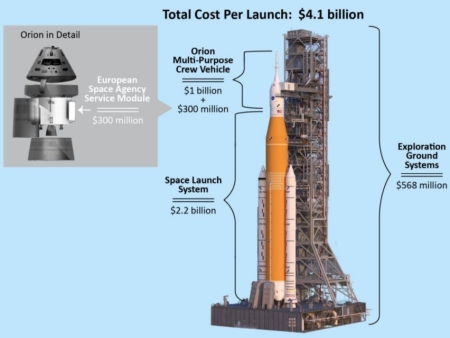
The expected real per launch cost of SLS and Orion
The big news in the mainstream press today is the planned rollout from the Vehicle Assembly Building (VAB) of NASA’s SLS rocket this evening in preparation for its dress rehearsal fueling and countdown planned for April 3rd.
This article by Newsweek is very typical. It glows with facts lauding SLS’s gigantic size and the monumental systems designed to slowly transport it the four miles from the VAB to the launchsite.
At a height of 322 feet (ft), making it taller than the 305ft Statue of Liberty, the SLS will be the largest rocket to move to a launchpad since the Saturn V launched on its last mission in 1973, when it carried the Skylab space station into orbit around Earth. Its size has seen NASA dub it a Mega-Moon rocket.
NASA says that the four-mile journey from the Vehicle Assembly Building to the launch pad at NASA’s Kennedy Space Center in Florida, where the SLS was recently adorned with the NASA logo, will take between 6 and 12 hours. It will be carried on the back of NASA’s 6.6-million-pound crawler vehicle. [emphasis mine]
If that April 3rd countdown dress rehearsal goes well, SLS will be rolled back to the VAB and then prepped for its first launch, presently scheduled tentatively for May ’22, though more likely in June or July.
For NASA the rollout today is somewhat of a relief. SLS was originally supposed to launch in 2015, making it seven years behind schedule. It has also been enormously expensive, costing close to $30 billion to build, if one does not count the $20 billion cost of the Orion capsule it carries. That the agency finally has this rocket assembled and almost ready to launch, after so many delays and cost overruns, means that NASA might finally be able to prove it is a reality, not simply a boondoggle designed by Congress to funnel cash through NASA to their constituents.
The Newsweek article however strangely ignores the launchpad stacking of another equally gigantic rocket that occurred yesterday. » Read more
In its on-going project to upgrade and refurbish the antenna dishes of its Deep Space Network communications, used to communicate with planetary probes beyond Earth orbit, NASA yesterday announced that the fourth of six planned new antennas is now online in Madrid.
DSS-53 is the fourth of six antennas being added to expand the DSN’s capacity and meet the needs of a growing number of spacecraft. When the project is complete, each of the network’s three ground stations around the globe will have four beam waveguide antennas. The Madrid Deep Space Communications Complex is the first to have completed its build-out as part of project. Construction on DSS-53 began in 2016.
The Deep Space Network has needed an upgrade for about a decade, and has been especially under strain as the number of missions to Mars increased during that time. After many years of delay, almost all due to budget decisions by both NASA and Congress, the upgrade began in earnest in 2016.
China today successfully launched its second Yaogon military reconnaissance satellite, using its Long March 4C rocket.
The leaders in the 2022 launch race:
10 SpaceX
6 China
2 ULA
2 Russia
The U.S. lead over China in the national rankings is now 16 to 6. Note too that tomorrow Russia is scheduled to launch another crew to ISS, using its Soyuz-2 rocket, while SpaceX plans another Starlink launch.
Embedded below the fold in two parts.
To listen to all of John Batchelor’s podcasts, well worth your time, go here.
» Read more
An evening pause: Pachelbel’s Canon in D is one of the most beautiful short pieces of music ever written, which of course is why it has been an evening pause a half dozen times before. I’ve posted a version of musicians jamming it at 3 am when they have nothing better to do, singing it a capella in a stairway, spectacularly on a guitar, as heavy metal, by a chicken (you have to watch it to understand), and played as a tango, bluegrass, gypsy, and practically any musical style you can imagine.
The rant below gives us the perspective of someone who has played the piece, and it is a perspective that might surprise you. After watching it enjoy all the other versions above, but above all make sure you watch the last one. You will then understand best what the cello player is thinking.

Click for full image.
Astronomers and engineers have now successfully completed the alignment of the eighteen segments in the primary mirror of the James Webb Space Telescope.
On March 11, the Webb team completed the stage of alignment known as “fine phasing.” At this key stage in the commissioning of Webb’s Optical Telescope Element, every optical parameter that has been checked and tested is performing at, or above, expectations. The team also found no critical issues and no measurable contamination or blockages to Webb’s optical path. The observatory is able to successfully gather light from distant objects and deliver it to its instruments without issue.
The picture to the right shows that alignment, focused on a single star. As noted in the caption:
While the purpose of this image was to focus on the bright star at the center for alignment evaluation, Webb’s optics and NIRCam are so sensitive that the galaxies and stars seen in the background show up.
After many years delay and an ungodly budget overrun, thank goodness Webb appears to be working better than expected.
It will still be several months before actual science observations begin. Further more precise alignment adjustments need to be done for all its instruments and mirrors.
R.I.P. Solar scientist Eugene Parker, whose research revolutionized solar science in the 20th century and for which the Parker Solar Probe was named, has passed away at the age 94.
As a young professor at the University of Chicago in the mid-1950s, Parker developed a mathematical theory that predicted the solar wind, the constant outflow of solar material from the Sun. Throughout his career, Parker revolutionized the field time and again, advancing ideas that addressed the fundamental questions about the workings of our Sun and stars throughout the universe.
Parker belonged to the past generations of scientists who followed the principles of the Enlightenment and believed that science was fundamentally the search for truth. He understood he could always be wrong, which brought a certain muscular strength to any ideas he proposed. He could not be lazy in any way, or his work would fail. Instead, it shone, and made what little we know of the Sun today possible.
Sadly, such men are one-by-one going from us. I wonder if the new generations will understand his mindset.

University of Illinois: run by clowns
Jason Kilborn, a tenured law professor at the University of Illinois who had been suspended and forced to undergo sensitivity training because several unnamed students objected to an exam question that referenced racial slurs and that Kilborn had been using in his tests for a decade, has now sued a number of officials at the university.
University of Illinois Chicago law Professor Jason Kilborn’s recently filed lawsuit accuses administrators of violating his Constitutional rights, as well as defamation, false light and intentional infliction of emotional distress. It seeks damages in excess of $100,000.
Kilborn has been described by students as “top notch.” As his lawsuit against the University of Illinois Chicago moves forward, Kilborn maintains campus leaders engaged in performative retribution against him.
The lawsuit can be read here.
The named officials in the lawsuit are Michael Amiridis, the university’s chancellor, Caryn A. Bills, its associate chancellor, Julie M. Spanbauer, the law schools dean, Donald Kamm, the director of the school’s Office for Access and Equity, and Ashley Davidson, the school’s Title Ix & Equity Compliance Specialist.
I had described Kilborn’s blacklisting back in November 2021, describing in detail how Kilborn’s exam question had been in use for ten years with no objection, and was designed to help his law students uncover facts that would help lawyers defend minorities against racial abuse. I also noted that:
» Read more

Click for full image.

For full images go here and here.
Cool image time! Today the science team for the high resolution camera on Mars Reconnaissance Orbiter (MRO) released images showing a very recent avalanche, or slumping, on the interior slopes of what looks like a small three-mile-wide crater inside the easternmost reaches of the giant canyon Valles Marineris.
The comparison above, reduced and rotated to post here, is their close-up showing the change, which occurred sometime between March 2021 and February 2022. The wider comparison on the right, cropped, reduced, and annotated by me, shows a wider view to help place this slumping in the context of the crater.
Calling this an avalanche is not really accurate, as it isn’t really the fall of boulders and rocks, but the quick slumping downward of an entire section of what looks like dust or sand. As Alfred McEwen of the Lunar & Planetary Laboratory in Arizona writes in the caption:
» Read more