
Overview of the impact Russia’s invasion is having on the Ukraine’s space industry

Link here. The summary focuses on the major aerospace regions in the Ukraine, Dnipro and Kharkiv, outlining how they have so far been untargeted by the Russian invasion.

“In Dnipro, Yuzhmash and Yuzhnoye have not been bombed or targeted by missile attacks so far. One of the possible reasons is that Russia’s plan is to take them over as part of their invasion, so they intend to keep these facilities intact,” Usov said. “Because of the Russian attacks in the Dnipro region, these facilities are not operating at full capacities, and they were forced to halt work on their projects. But a share of their employees ensures their operations continue.”

The situation is the same in Kharkiv. No aerospace facilities have been directly targeted, but the war has shut down some operations, while others — especially those partnering with western nations or companies — have gone almost entirely virtual.

The article also describes a Ukrainian startup, Orbit Boy, that is trying to develop an air-launched smallsat rocket in partnership with companies in Poland and Italy. The war is making this development difficult, if not impossible.

1 comment

China tests rocket engine for the next Long March 5B launches

China’s state-run press today revealed that a full duration test has been successfully completed of the rocket engine that will be used by the core first stage of the Long March 5B rocket that will launch the next two modules for China’s Tiangong space station.

Developed by the China Aerospace Science and Technology Corporation, the engine is designed for the core stage of the Long March-5 carrier rocket series, which will be used to launch two lab modules of China’s orbiting Tiangong space station this year.

The long-range test, lasting 520 seconds, has verified the reliability of the engine, and there will be more than 20 experimental tasks that the rocket engine will undergo to further test its performance, the company disclosed.

Though this short press release does not say, it implies that this new engine is restartable, something that on previous launches of the Long March 5B was not possible for the core stage. This lack meant that once the core stage lifted and deployed its payload into orbit, it no longer had an engine that could control it. It would within weeks crash to Earth, threatening many habitable areas around the globe. This lack also resulted in a lot of very bad press for China.

If this new engine is restartable, it means that China will be able to de-orbit it in a controlled manner, over the ocean. If so, hallelujah! It means China will finally be honoring its obligations under the Outer Space Treaty.

If not, than China will continue to prove that it is an unreliable and dangerous player on the world stage.

0 comments

NASA extends Ingenuity’s mission through September ’22

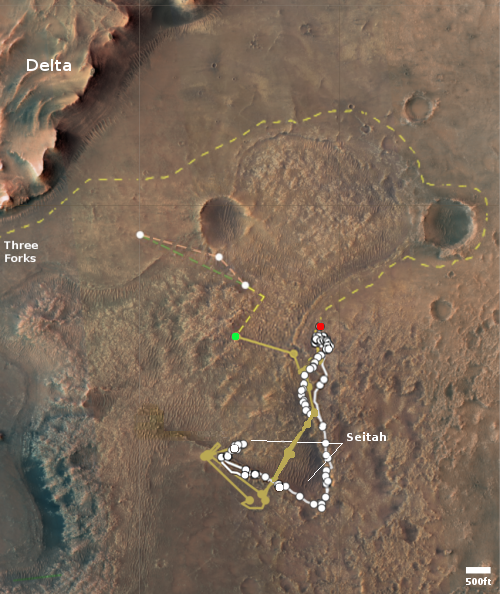
Overview map
Click for interactive map.

NASA yesterday officially extended Ingenuity’s flight operations on Mars at least through September 2022, outlining in detail the helicopter’s hoped-for flight targets.

The map to the right shows the helicopter’s present location with the green dot, with its two possible future routes proceeding from this location indicated by dashed lines. The red dot indicates Perseverance’s present location, with its planned route from this spot indicated by the dashed lines.

Scheduled for no earlier than March 19, Ingenuity’s next flight will be a complex journey, about 1,150 feet (350 meters) in length, that includes a sharp bend in its course to avoid a large hill. After that, the team will determine whether two or three more flights will be required to complete the crossing of northwest Séítah.

Once Ingenuity crosses the rough terrain and reaches the delta, it will then be used to do more route scouting for the rover.

Upon reaching the delta, Ingenuity’s first orders will be to help determine which of two dry river channels Perseverance should take when it’s time to climb to the top of the delta. Along with routing assistance, data provided by the helicopter will help the Perseverance team assess potential science targets. Ingenuity may even be called upon to image geologic features too far afield (or outside of the rover’s traversable zone), or perhaps scout landing zones and caching sites for the Mars Sample Return program.

This ambitious plan exists because both the helicopter and its engineering team have far exceeded expectations. At the moment, there is no obvious reason why Ingenuity cannot continue to operate for years, an expectation that no one predicted.

0 comments

Launching a rocket using atomic explosions?

Glenn Reynolds and Leigh Outten have just co-written a short paper advocating the use of “pulsed nuclear space propulsion” to launch rockets. You can download it here.

The concept, as first described in the 1950s, is described in the paper as follows:

It is not a tremendous surprise that when you set off an atomic bomb next to something, that something will move. That it could also remain essentially intact, however, was considerably more surprising. The challenge for the Orion team was to produce a spacecraft that could function after being subjected to not one, but many, nearby nuclear detonations, and that could be steered and navigated by an onboard crew.

This turned out to be easier than it sounds. The Orion spacecraft design that resulted involved a large steel “pusher” plate, behind a rather large spacecraft with a total weight of over 4,000 tons. That sort of design is very different from the spaceships we’re used to today.

The bulk of their paper reviews the legal obstacles to launching such rockets, as both the Outer Space Treaty and the Limited Test Ban Treaty put limits on the use of nuclear weapons in space. The paper argues that these limits would not apply to rockets propelled by atomic explosions, since the explosions would not be used as weapons.

The paper also argues that the technical obstacles for building such rockets are also solvable, and might even be easy to solve. This particular quote stood out starkly to me:
» Read more

36 comments

Today’s blacklisted American: Second-grade child punished for talking about Christianity

Persecuting Christians is once again cool!
Persecuting Christians, even little children, is once again cool!

They’re coming for you next: A second-grader at North Hill Elementary School in Des Moines, Washington, has been regularly harassed and punished by the teachers and administrators because she likes to talk about her Christian religion to her playmates.

The harassment has included searching her backpack each morning to confiscate any Christian materials before she entered school. The punishment included sending her to the principal’s office ten different times since January 1st for daring to mention the Bible and her Christian beliefs to others. From the press release of the American Center for Law and Justice (ACLJ), which is threatening to sue the school and its district if this Soviet-type censorious behavior does not stop:
» Read more

16 comments

OneWeb and Arianespace scramble to find a rocket to launch satellites

Capitalism in space: With the cancellation of the last six Soyuz-2 launches for OneWeb and Arianespace due to Russia’s invasion of the Ukraine, the two companies are struggling to find an alternative rocket to launch the remaining 216 satellites that would complete OneWeb’s satellite constellation.

OneWeb has already paid Arianespace for the launches, so the responsibility to get the satellites in orbit is at present Arianespace’s. The problem is that its flight manifest for both the Ariane-5 (being retired) and the new Ariane-6 rocket are presently full.

Going to another rocket provider is problematic, even if a deal could be negotiated. The flight manifest for ULA’s Atlas-5 and Vulcan rockets is also filled. Though SpaceX’s Falcon 9 could probably launch the satellites, that company’s Starlink satellite constellation is in direct competition with OneWeb, which makes it unlikely the two companies could make a deal.

There have been negotiations with India to use its rockets, but it is unclear at present whether this will work.

One other option is to buy a lot of launches from the smallsat rockets of Rocket Lab, Virgin Orbiter, and Astra. This will likely cost more because more launches will be required, and that would required a complex negotiation between all parties.

2 comments

India successfully tests solid rocket booster for its Small Satellite Launch Vehicle

The new colonial movement: India yesterday successfully completed a ground test of the solid rocket booster to be used in its Small Satellite Launch Vehicle (SSLV).

SSLV was originally scheduled for launch in 2020 but was put on hold for two years when India panicked over the Wuhan flu. ISRO, India’s space agency, hopes now to complete the first launch in the next two months.

The two-year delay cost ISRO significantly in the international smallsat market. While American private companies like SpaceX, Rocket Lab, Virgin Orbit, and Astra continued to launch throughout the epidemic and thus garner business from the smallsat market, India’s market share shrunk. Whether it can recover that share once SSLV begins flying remains to be seen. India’s willingness to shut down so easily will I think make satellite companies hesitate before buying its services.

1 comment

Mark Vande Hei sets new record for longest American space flight

Mark Vande Hei today set a new record for the longest American space flight, exceeding the 340 days flown by Scott Kelly on ISS in 2012-2013.

Since Vande Hei is scheduled to return to Earth on March 30th, his total record flight time should end up being 355 days, just short of a full year.

Vande Hei arrived at the space station aboard a Russian Soyuz spacecraft on April 9, 2021, knowing at the time that he would be there for at least for the five to six months that is typical today for expedition crew members. His mission was extended by NASA in September to allow for a Russian movie crew to visit the orbiting complex and, more importantly, protect against a crew rotation schedule that could leave the station without any Americans on board.

Vande Hei’s record will be the fifth longest, behind four other Russians on Mir. Musa Manarov and Vladimir Titov were the first to complete a year long flight in 1987-1988. Valery Polyakov holds the record for the longest flight, 437 days in 1994-1995. Sergei Avdeyev’s flight of 381 days on Mir in 1998-1999 is the second longest.

0 comments

Astra successfully completes its second orbital launch

Capitalism in space: After a February 10, 2022 launch failure, the rocket startup Astra today successfully completed its second orbital launch and first in 2022, putting its first commercial payloads into orbit.

Unfortunately the separation and deployment of a payload platform from the upper stage had not been confirmed as of this posting. While the payloads can still function attached to the upper stage (they are not fully functional satellites), if this deployment turns out to be a failure it will put a stain on the launch. Astra confirmed the successful deployment of the payloads about an hour after launch.

That the company could investigate a launch failure, fix the problem, and resume launches in just over a month however speaks well for its future. If the deployment failed fixing it should proceed as quickly. Meanwhile, the company announced yesterday a new multi-launch contract through 2025 with Spaceflight, which finds launches for smallsats and also provides a small tug to move them into their preferred orbit.launches.

The leaders in the 2022 launch race remain unchanged:

10 SpaceX
5 China
2 ULA
2 Russia

The U.S. now leads China 16 to 5 in the national rankings.

2 comments

Entire Russian communications satellite industry threatened by Russia’s Ukraine invasion

Because almost all Russian communications satellites rely on western components, the sanctions imposed on Russia due to its invasion of the Ukraine will likely prevent the future launch of any such satellites.

The overwhelmingly wide sanctions against the Kremlin left practically no chance for Russia to complete any of its communications satellites in the development pipeline at the time due to their dependency on Western payloads.

Conceivably, Russia could turn to China for necessary components or/and Moscow could try again developing necessary competencies inside the country, but given little signs of progress on both of those fronts in the past, it could probably take years if not decades before all the technological gaps could be closed and it would be even more difficult to do under much harsher economic conditions and export controls. It is also a question whether China would be interested in boosting strategically important industries in Russia with potential military implications or whether it would want to challenge the Western sanctions regime by putting at risk its far more important trade relations with the United States.

The article at the link also notes the generally low quality of Russian communications satellites, which for example generally last only five to six years, compared to the 10 to 15 year lifespan of western satellites. This low quality has meant that Russia has been unable to sell this technology to anyone outside Russia.

3 comments

Dumping Windows and Apple and switching to Linux

My regular readers know about my utter contempt for Microsoft and its terrible Windows operating system. Any company that treats its customers like dirt, as Microsoft routinely does, does not deserve the business of anyone. I realized this reality two decades ago, and successfully switched to Linux back in 2006. I have never regretted it.

Moreover, the increasingly intolerant behavior of big tech companies like Microsoft to free speech increases the need for people to free themselves from them. The willingness of these companies to also treat your privacy and personal data as a plaything for their use, without your permission, is another rational reason to stop depending on them.

Linux accomplishes this, in that its open source software structure is really controlled by no one. There is also no software company using the operating system to gather your data for its own purposes.

In 2016, after seeing a number of my posts noting the advantages of Linux (or anything) over Windows, one of my readers, James Stephens, offered to write a series for Behind the Black describing step-by-step the process by which one gets and installs Linux on either a desktop or laptop computer. Below are the links to this series. I have since used it myself as a guide to convert two used Windows 7 notebooks (purchased for $35 and $80) to my favorite flavor of Linux, both of which I use regularly as my travel computers.

I wish more people would do the same, which is why I am reposting the links to this series again. Though six years have passed, James instructions still apply perfectly, as I can attest as I used this series to convert the second laptop only a year ago. Nonetheless, James has added an addendum to Part 2, which brings the entire series up to date.

I am sure almost everyone has an old computer they don’t use anymore. It will work like new with Linux. Dig it out, follow James’ instructions below and free yourself from Windows. I guarantee you will not be disappointed.

19 comments
1 156 157 158 159 160 192